

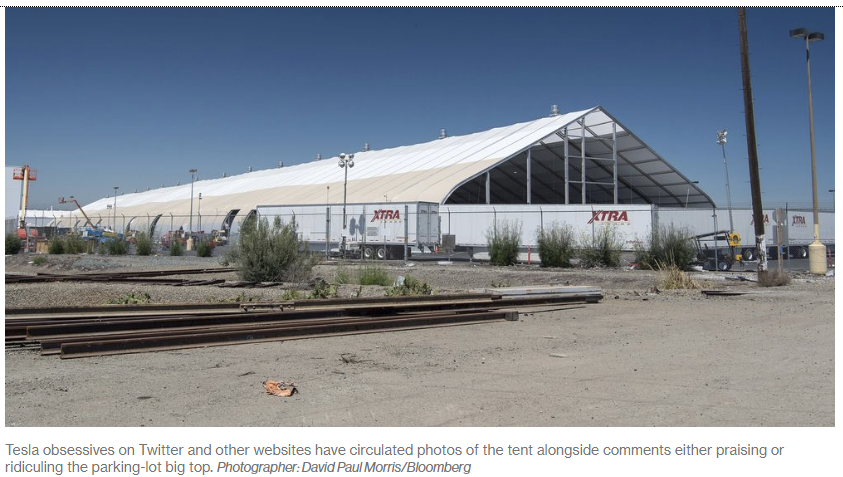
Bloomberg reports The Future of Tesla Hinges on This Gigantic Tent.
Production Goals vs Reality
Musk said about two years ago was that 100,000 to 200,000 Model 3s would be produced in the second half of 2017, and optimism about the car contributed to the company passing General Motors Co. and Ford Motor Co. by market capitalization. Instead, only 9,766 rolled out in the first quarter—a weekly output rate of roughly 750.
Building Cars Manually in the Parking Lot
>What gives manufacturing experts pause about Tesla’s tent is that it was pitched to shelter an assembly line cobbled together with scraps lying around the brick-and-mortar plant. It smacks of a Hail Mary move after months of stopping and starting production to make on-the-fly fixes to automated equipment, which Musk himself has said was a mistake.
“The existing line isn’t functional, it can’t build cars as planned and there isn’t room to get people into workstations to replace the non-functioning robots,” Warburton said in an email. “So here we have it—build cars manually in the parking lot.”
Crazy Complex of Automation
During a February earnings call, Musk told analysts that Tesla had an automated-parts conveyance system that was “probably the most sophisticated in the world.” But by the spring, it had been ripped out of the factory.
“We had this crazy, complex network of conveyor belts,” Musk told CBS This Morning in April. “And it was not working, so we got rid of that whole thing.”
Buildings? Who Needs Em?
The word “temporary” may be in Tesla’s tent permits with Fremont, but Musk has suggested it could stick around a while. He told one Twitter follower last week that he’s not sure the company actually needs a building anyway. He described the new assembly line as “way better” than the one in the plant that cost the company hundreds of millions.
That tweet spoke volumes to Dave Sullivan, an analyst at research firm AutoPacific who used to supervise Ford factories. “To say that it’s more efficient to build this with scrap pieces laying around means that either somebody made really bad decisions with the parts in the plant inside, or there are a lot of other problems yet to be discovered with Tesla’s efficiency.”
Preposterous
“It’s preposterous,” Bernstein’s Warburton said. “I don’t think anyone’s seen anything like this outside of the military trying to service vehicles in a war zone. I pity any customer taking delivery of one of these cars. The quality will be shocking.”
Congrats to Bloomberg for one of the most humorous articles I have read in a long time.
Mike “Mish” Shedlock

The day Musk is handed his just dessert could not come fast enough for the growing number of investors and Musk watchers that have become disenchanted by his erratic and sometimes capricious ways. Not only is the company burning through cash but it is having difficulty producing cars in the numbers and quality they promised.
This has resulted in Tesla becoming one of the world’s most-shorted stocks. Unfortunately, for the shorts, shares are up almost 30% in the past month mainly as a result of Musk’s antics and toying with those of little faith. More about this in the article below.
Is the Tesla explosion-immolation rate going up or down because of this? Might affect my buying decisions.
I’m not into much depth here but I remember reading ages ago that Tesla did not have much testing or development put into these cars meaning that they sort of bought readymade parts and fitted them together. At least this is how I understood it.
The aim was perhaps to cut “unnecessary” expenses and rush for production. One might think that an electric car is easier to build than combustion engine one that needs quite a lot of more parts than the EV does.
That said, any company spending hundreds of millions of any currency and ending up in a tent, is sure loser in the longer run. One just wonders why they didn’t use any companies that are on the assembly automation already. It can’t be that much harder to put together a Tesla than it to put together a Toyota. I bought a Toyota put together locally while living in SE Asia (Thailand at the time) and it was a very nice car. The benefit was also that it didn’t depreciate much in the local market so I got 2/3 of the money back after driving 5 years. But that’s another story.
You’d think the army of ex software guys at Tesla would have made sure they had the “source code” and required expertise to fix/hack something as complex and mission critical as this “never done before” automated supply line. Instead of buying a black box from halfway around the world, on nothing more than the assumption it would all work in their own specific setting.
This is a good example of why industries tend to concentrate. Autos in Detroit. Software in Teslaland. Oil Service in Houston. Maritime around the Chesapeake. You want the guys who delivered the supply line to be next door and on site, working hand in hand with you, until things run at least tolerably well. As well as have ex Tesla engineers, workers and managers on their payroll. Just as Tesla has ex theirs. A million informal communication pathways, down to the finest granularity. Nothing of distinction ever got done by writing “requirements documents” and pretending they mean something.
The car itself will be badly dated within a couple of years, and that is even granting that Tesla can produce 200,000 of them a year, which I doubt.