

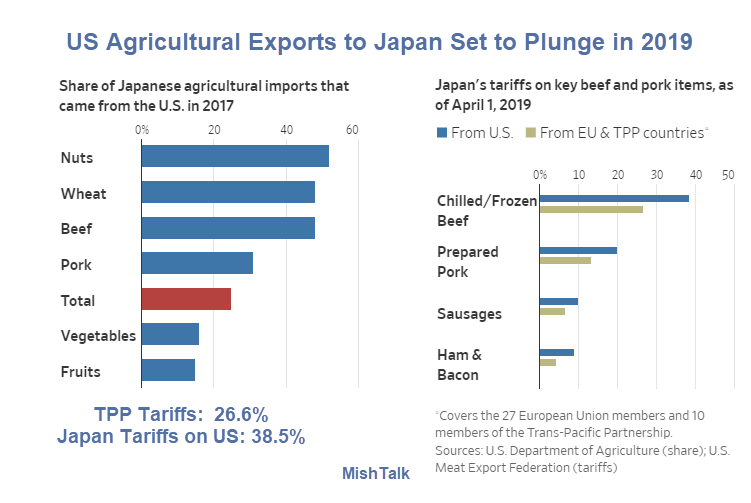
US farmers are about to take a big export hit as the Trans-Pacific Pact, TPP moves on without the US. It’s a new world order, and the US isn’t involved.
Please consider Pacific states launch bold trade pact, shaping world order as America retreats.
Eleven countries are pressing ahead with the Comprehensive Agreement for Trans-Pacific Partnership (CPTPP), defying barely-disguised efforts by the Trump Administration to kill the treaty.
A vanguard of Japan, Singapore, Mexico, Australia, Canada, and New Zealand activated the treaty over the weekend, ripping down barriers to trade in almost all goods. It eliminates 18,000 tariffs, and slashes others in stages over coming years.
The great irony is that the US itself drafted much of the original text under the Obama Administration, aiming to ensure that Washington writes the rules of global trade and commerce in the 21st Century, not Beijing.
The pact opens up trade in services on the basis of equal treatment. It cuts the costs of customs clearance, rules of origin, and compliance to a minor friction.
The White House assumed that the TPP would wither on the vine without US impetus. Instead, long-standing US allies across the Pacific have brushed off pressure from Washington and forged ahead regardless with what is now known as the “anti-Trump pact”.
“America is the biggest loser,” says the Peterson Institute in Washington. The fall in food tariffs under the CPTPP means that US farmers will be undercut by exporters from Australia, Canada, and New Zealand in the lucrative Japanese market. Wheat from Canada will be $70 cheaper per metric tonne by 2020.
The latest twist is that Chinese officials have begun to explore the possibility of joining the pact that was supposed to exclude them, prompting a polite though wary riposte from the founding members.
Beijing is alarmed by clauses in the revamped Nafta deal for North America that gives the US an effective veto if either Canada or Mexico wish to sign a future trade deal with a “non-market economy”, clearly meaning China. Membership of the CPTPP would help to circumvent this legal clause. Precisely for this reason the Trump Administration would fight Chinese accession tooth and nail.
U.S. Farmers Fear Lucrative Japanese Exports Will Wither
The Wall Street Journal reports U.S. Farmers Fear Lucrative Japanese Exports Will Wither.
After seeing exports to China tumble, U.S. farmers and ranchers are now bracing for more losses in their next-biggest Asian market: Japan.
On Dec. 30, Tokyo will begin cutting tariffs and easing quotas on products sold by some of American agriculture’s biggest competitors—including Canada, Australia, New Zealand and Chile—as part of the new 11-member Comprehensive and Progressive Agreement for Trans-Pacific Partnership.
The U.S. was originally part of that bloc, but President Trump pulled out last year, saying the agreement would have harmed American manufacturers and workers by loosening restrictions on U.S. imports of autos and auto parts, and intensifying competition with low-wage Asian nations.
Tokyo will follow up on Feb. 1 by implementing the European Union-Japan Economic Partnership Agreement offering similar breaks for the 28-country bloc’s agricultural products, aiding American rivals in France, Spain, Italy and the Netherlands.
Japan, unlike China, isn’t moving to block U.S. goods by retaliating for Trump administration tariffs. Instead, it’s doing the opposite, accelerating an ambitious market-opening agenda with more than three dozen countries spanning the globe—excluding the U.S.—that have unified to demonstrate to a skeptical Washington the advantages of free trade, and the costs of shunning it.
But the effect will be similar. Japan’s new free-trade push “threatens to cut into U.S. market share and depress profits for U.S. agricultural exporters by granting preferential access to … international competitors,” the Trump administration’s Agriculture Department warned in a May report.
By April 1, exporters from the EU and TPP will face a 26.6% Japanese tariff for chilled and frozen beef, compared with a 38.5% tariff for Americans, while paying a 13.3% duty on prepared pork, versus 20% for Americans.
Some producers say they’re already losing business as a result. Kevin Smith, a vice president at Seaboard Foods LP, a Kansas-based pork producer, said his company is “already seeing a decline” as longtime customers “develop new supply chains so they can be fully prepared to take advantage of the tariff reduction opportunities.”
Not a Free Trade Agreement
For starters, neither CPTPP nor TPP was a free trade agreement. It’s ludicrous to call it such. 26.6% tariffs are proof enough.
Yet, US agricultural exports will undoubtedly dive because the US will face 38.5% tariffs by Japan.
Trump will now have to execute bi-lateral trade agreements.
What might Japan want? How about lower tariffs on cars for starters.
Mike “Mish” Shedlock






























Don’t worry. I’m sure Comrade Trump can centrally plan an optimum outcome with his new Five Year Plan for the economy! MAGA!
“The U.S. was originally part of that bloc, but President Trump pulled out last year, saying the agreement would have harmed American manufacturers and workers by loosening restrictions on U.S. imports of autos and auto parts, and intensifying competition with low-wage Asian nations.”
So we are shifting historically protected profits away from farming to our long neglected, beaten down manufacturing sector. So what?! Hooray for Trump!
And while we are at (hopefully) converting the farming sector to the unprotected private sector, let’s also cut all subsidizes to it and shrink back the number of food stamp recipients from 43 million to 23 million, like it was before Obama came to office.
By the way, how many farm products come from California where water is vanishing resource? We should not be exporting our water to foreign countries.
nailed it. on ALL counts
“Beijing is alarmed by clauses in the revamped Nafta deal for North America that gives the US an effective veto if either Canada or Mexico wish to sign a future trade deal with a “non-market economy”, clearly meaning China.”
Yesterday i asked what is the goal line? Are people missing a forest, looking at the trees?
Why would Japam discriminate against the US?
First, that is what the treaty says since the US is not part of it.
Second, Abe wants his own military
Third Japan wants tariff reduction on cars. It can offer a reduction on ag tariffs if it gets something back
Yes Harmy – The TPP carved out an exception of the US sugar lobby among other things.
Japan was essentially forbidden to have a large army after WWII by the Allies. I’m not so sure they would be all that sad if there would be a cause to lift that part of their after WWII consitution.
Maybe the US can “negotiate” a trade deal like israel is trying to push through the US Congress right now… a “trade” deal where it becomes illegal to boycott them.
“For starters, neither CPTPP nor TPP was a free trade agreement. It’s ludicrous to call it such. 26.6% tariffs are proof enough.”
It’s a phased reduction Mish meaning that as the markets adjust tariffs will be cut further.
As for US Free Trade. Australia signed a FTA with the US which has cost us dearly. How about 25 years phased in tariff cuts for Australian sugar and dairy produce. Some FTA huh?
Trump to Japan. Nice hard ball you are playing.
We are pulling out our military from Korea and your country.
Feel free to deal with North Korea and China as you see fit.
Like tripling your defense budget. And reintroducing the draft.
Enjoy your New Zealand nutz!
When you talk about US-Japan trade relation, you should always mention the outsized US role in Japanese defense. Why would Japan discriminate against the US? I’m all ears.
That outsized role, just like in Germany, was, and is, there to disincetivize Japanese manufacturers from doing to Lockheed and Northrop Grumman (and Boeing) what Honda, Toyota, and BMW, have done to Ford and GM: Reduce them to second tier hangers-on. Has nothing at all to do with “helping” neither Japan nor Germany, at least not economically.