

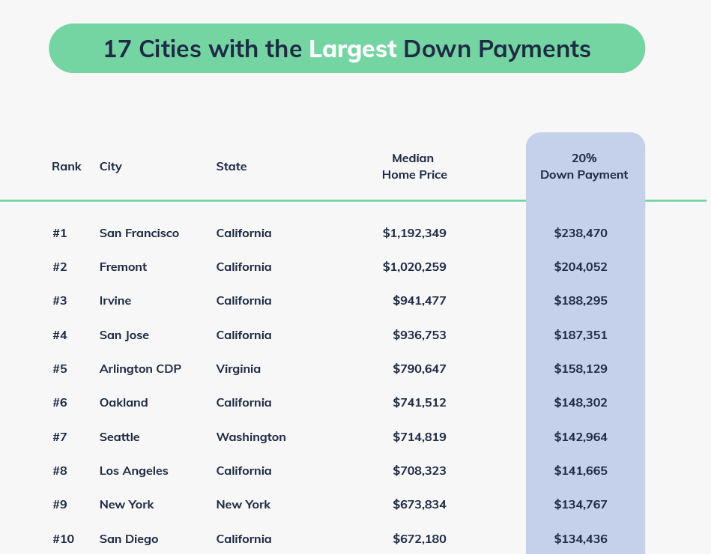
Down Payment on the Median Home
Buyers tend to want houses, not condos. but Saving for the Down Payment Takes Up to 94 Years
The national median home sales price reached $346,800 in the last quarter, bringing the down payment to almost $70,000. However, in a nationwide survey of nearly 7,000 prospective homebuyers carried out on its listings platform last autumn, Point2 found that around 75% of home seekers had much less than the average down payment amount set aside, and 14% had no savings yet.
The 20% down payment is perilously close to a staggering $70,000. However, 30% of all survey-takers believe they would need less than $10,000, making it abundantly clear that their expectations might be sabotaging the homebuying efforts.
How Would it Take to Save a Down Payment?
- There are big differences in median income between generation groups. Gen Z and millennials make the least so it would take them longer to save.
- At the current savings rate, Gen Z buyers would need more than ten years to save enough for a down payment in 36 cities.
- It would take over 20 years in expensive cities like Los Angeles and San Jose, CA
- Irvine, CA tops the list at 94 years.
Easiest Places For Millennials to Buy a Home

Hardest Places For Millennials to Buy a Home

There are more details and interactive charts in the above link.
Note that the number of years assumes saving 17% of income, an unlikely proposition over time.
The median income for Generation Z in Irvine CA was only$11,796 vs LA at $35,400 which accounts for the unrealistic 94 years. Most likely the Gen Z crowd in Irvine are all in school.
For millennials, the median household income in Irvine skyrockets to $115,318.
The study was for the largest 100 cities.
Danville, Illinois
Out of curiosity I decided to check up on Median Home Prices in Danville Illinois, my home town.


If you have a $400,000 home in Danville, IL you have one one the most expensive homes in the entire county.
Spotlight Danville, Illinois, My Home Town: Bankrupt
For more on Danville, please see Spotlight Danville, Illinois, My Home Town: Bankrupt
I grew up in Danville, Illinois, the home of Chuckles (the candy), Hyster (lift forks), Lauhoff (the world’s largest grain elevator), Petersen Puritan (one of the world’s largest aerosol bottling plants, think deodorant sprays), a GM foundry in adjacent Tilton, and many other industries.
All of those industries but Hyster are gone or sold to other companies. Hyster remains but production of forklifts doesn’t. Lauhoff is now the Bunge corporation. Inquiring minds may be interested in the History of Chuckles, no longer made in Danville.
There are many more interesting details in the above link including why Danville is bankrupt.
Shortly before that post I was accused on Twitter by someone named “Armed Snowflake” of being “Spoon Fed With Free Stuff Like You Got From Your Wealthy Parents“
He deleted his Tweet after my response but that response is still there.
Tuition when I went to school was $500 per year,
Tuition is now about $17,000-$21,000 depending on the program.
Mish






























No first time buyer puts down 20% unless it’s a gift from parents. Fha is 3% down.
“Irvine, CA tops the list at 94 years.”
Irvine is also the mortgage capital of the country. Coincidence?
With Klaus Schwab’s Build Back Better, Great Reset, no one will need to save for a down payment, as his intention is for no one to own anything and be happy.
Exactly. The goal is to get everyone except the elites into perpetual debt. The serfs are so much easier to control then!
I wonder whether the premise of this whole posting is off base. And off base because of available statistics.
Like, haven’t there always been “good areas” where homes were really, really expensive? But nowadays, such areas are so large they constitute statistical units. Whole cities. So we notice them and promote their importance beyond what it might be.
And by the time you’ve saved up the 20% downpayment, housing prices have already risen another 40-50% requiring you to save even more. At least if it’s Los Angeles in a decent area.
Well that’s why its very important to BUY NOW!!! And when you do and the price goes up, you are a financial genius! Lots of them running around now…
Economics
Texas and Georgia Are Paying the Price for Sprawl
The old growth recipe of boundless land and cheap housing isn’t working anymore as cities in the Sunbelt South mature.
Cities in the Sun Belt South have been needing a more modern development model for a while. That’s created tensions, both economically and politically, that have only accelerated during the past year’s pandemic. My colleague Noah Smith wrote a column about this specific to Texas, but it’s broader than any one state and it’s useful to think about how we got to this point and why these issues are relevant in 2021 in a way they weren’t a generation ago.
There’s an institutional reluctance to pivot away from the Sun Belt model defined by low taxes and cheap land because of how successful it was for key constituencies for decades. Coming out of World War II, there was a scramble nationwide to build more housing in response to soldiers coming home from war and pent-up demand for family formation.
The combination of the automobile as the nation’s now-dominant form of transportation and the passage of the Federal Highway Act of 1956 made building out the suburbs of less-populated southern states an irresistible growth model for politicians and economic development interests alike. If it required tax breaks and fewer regulations to lure jobs and people from northern states to accelerate the process, so be it.
A useful analogy for this dynamic might be the growth of manufacturing in China. When China began to trade with the West, it couldn’t offer much in the way of skilled labor or technological know-how. What it could offer was cheap labor and low costs to lure foreign companies to build their factories in China, and that became its starting point.
Over time, growth has reduced those advantages. Jobs and people moving to states like Texas and Georgia slowly bid up the price of land and labor. Ample spare capacity for land and transportation infrastructure — think six-lane highways — let sprawl be a growth outlet for decades, but over time congestion and distance from airports and job centers raised the cost of sprawl as well. The 2008 financial crisis arguably busted the sprawl model in the largest Sun Belt metros of Houston, Dallas and Atlanta, where until the onset of the pandemic single-family building permits had lapsed to 35% below the 2006 highs, despite those metros still having reputations for sprawl and fast growth.
Not So Fast
Despite the Sunbelt South’s reputation for fast growth, building permits still haven’t recovered to pre-2008 peak levels
Instead, what’s defined the growth of these metros over the past decade has been a land-use equivalent of moving up the value chain in manufacturing — urban and suburban gentrification and the development of pockets of affluence. Following the housing bust, the depression in land prices combined with a rise in the cost of living for white-collar professionals in coastal metros. That created an opportunity to develop Sun Belt neighborhoods attractive to the upper-middle class looking for a lower cost of living — people like me, who moved to Atlanta a decade ago.
In cities, that’s meant building luxury apartments catering to young, well-paid college-educated workers. For close-in suburbs with short commutes and good school districts, that’s often meant tearing down or significantly rehabbing older homes to make them more desirable to families with six-figure incomes. And in both cities and suburbs it’s meant bringing in many of the consumer and lifestyle amenities people in high-cost coastal cities are accustomed to — fancy coffee shops and restaurants, yoga studios, craft breweries and the like.
But readers in the Northeast and on the West Coast might not appreciate the extent to which these gentrifying suburban neighborhoods are no longer so affordable.
relates to Texas and Georgia Are Paying the Price for Sprawl
Photographer: Conor Sen/Bloomberg
Here’s a picture of a home in my neighborhood (see left) that’s set to be torn down to make way for new construction. It’s 1,000 square feet, built in 1945, and sits on a plot of land that’s 0.3 acres. It sold in January for $400,000, and if recent neighborhood development patterns are any indication, it will likely make way for a new home that’s at least 3,500 square feet and will price at over $1.1 million. Compared to Palo Alto, California, that might be affordable, but it’s probably not the sort of thing people think about when they’re talking about cheap Sun Belt housing.
Therein lies the tension. Well-educated people and their employers being drawn in by luxury apartments, fancy coffee shops and increasingly expensive suburban homes have expectations about infrastructure and public services that are incompatible with a late-20th century low-tax, low-service governance model. These are the types of people swinging the political makeup of these communities and states from Republicans to Democrats.
What’s needed to maintain past growth momentum and meet the expectations of these new populations is a continued push up the value chain towards local economies based on knowledge work, with higher-paying jobs and college-educated workers. The specific services or investments needed to lure these types of jobs and workers will shift with the political winds — it might be a greater investment in schools and universal pre-K programs today, and transportation infrastructure tomorrow. It’s the same kind of policy arms race these communities have been accustomed to for decades, only with more services replacing low taxes as the policy lever.
For now, the most likely tweaks to the governance model will probably be incremental — stormwater improvements, sidewalk construction and other “complete streets” projects, modest increases to educational funding — simply because the votes aren’t there to raise taxes enough for the kind of revenue needed for bigger changes.
But these tensions aren’t going away. It’s eventually going to require larger investments than current leaders and older voters are willing to make. Ultimately, the choice for these communities is to spend the money needed to stay competitive in the new arms race, or lose out to places that will.
This column does not necessarily reflect the opinion of the editorial board or Bloomberg LP and its owners.
To contact the author of this story:
Conor Sen at csen9@bloomberg.net
I posted this here because as we now know, cheap housing is never what it is cracked up to be. The banks, homebuilders and mortgage servicers and everyone else related to “homeownership” has cornered the market on how to make the MOST money off this as possible. Housing has gotten expensive everywhere around larger metro areas of a certain population and size. People with money are driving up the prices in suburbs and they aren’t from places like Dallas, Houston, Austin or Atlanta.
“Housing has gotten expensive everywhere around larger metro areas…”
Around the globe, really. I recall an Economist magazine cover, spring 2002, I believe, with large balloons on the front cover and the caption was the “global housing bubble”. Here we are 20 years later and the same game is played throughout the world. Except now the bubble is bigger and the victims are madder (just look at Antifa/BLM youth).
I think that article is spot on. Although most Texas cities have BOTH gentrification and urbanization AND still do have some level of new home suburban development going on on cheaper land repurposed from agriculture.
That article alludes to competition between cities/counties/states for people earning the big bucks. In the near future countries will be competing for such people.
More exactly, countries will be competing for people whose work doesn’t tie them down to a geographic area.
Huge deal, that. For instance, for the last many thousand years, people have organized around ownership of geography – who “owns” the farm. 50 years from now? Not so much so. This fundamentally changes the nature of many things like, say, war, culture and, as bio-tech advances, human bodies.
“In the near future countries will be competing for such people.”
China could easily overtake the US by promising American students that they will pay off their students if they move to their country and stay there for 15 years, promise low taxes, and give them a little religious freedom. “Just come here, but don’t give us any political trouble and we will allow you to get rich!”
That’s all they gotta do, but I doubt they have the courage to give up just a little power. A move like that would be something to behold though!
In California you have proposition 13. This is where your taxes at set at 1.2%~ and can only go up at 2%~ per year, if your property goes up. It will go down if your price goes down but it will go up when the property goes up to the rate it was prior (fast). This bases will last for as long as you own the house.
Are housing prices higher in Calif. Yes and they should be. You can blame other people but you got to give some to the government. Get rid of your house tax and see were prices will go! Sorry about the down payment but you can have 5% or 10% down. There is more to the high prices in Calif. but I don’t have the time to type all of it. Sure is nice outside!
I’m a State U. guy. Stephen F. Austin State, Class of ’81. I was on the 7 year plan, including two when I dropped out and worked for GE for the union wage of 7 bucks.
The University would loan me the money for tuition….around 300 bucks…and I had to get it paid off before the next semester’s registration to keep going. Books ran around a hundred bucks until the last couple of years when all those chemistry tomes had to be bought, like Morrison and Boyd…..
Only one of my millennial kids is in a house, my eldest. She saved her down payment by living in my cabana room and and saving her paycheck for a year. I didn’t give her any money. I seem to remember she had to put down 5%.
She bought here in 2016…a decent house for $196K and the house has appreciated to 329K according to Zillow (Redfin has it at 325K). I’m glad she go in when she did.
It’s one of those days. My comments keep disappearing before I get them finished.
But number one……FHA will secure funding for anybody with a pulse and a 580 credit score, with only 3.5% down. So very few millennials ever have to come up with 20% of anything.
Seems like there is an opening to create a university system with lower costs but most states wont allow this. State university systems have become cartels. Most states have two systems of public universities but the same cost and structure. It is a glorified monopoly. So I say go online or to a smaller state school via the community college system.
The Captured Economy, by Brink Lindsey and Steven Teles.
Ditto , city college. Worked my way through college.
Mish, I am like you. I went to a state university and could pay for it by working while studying and summer jobs. I got a better education than than most in college now because we weren’t loaded up with bullshit classes and the professors spent more time teaching.
You can only blame banks and real estate investors and speculators for this. If there were no derivatives market and no second homes allowed prices would become affordable overnight.
The first (and some would say only) rule of Real Estate is: Location, Location, Location
In other words the best areas (weather, scenic, job prospects, crime rates, things to do etc) command the highest prices because they are the most desirable especially when they are physically limited in size. You can do anything you want regarding banning 2nd homes, derivatives etc and it won’t change the first rule. The most desirable places will command big money due to demand (which only goes up due to ever increasing population).
I don’t agree at all. At least not now. You might have been able to argue this back in 2005-2008. You’d make a better case pointing to the mortgage interest deduction and ultra-low interest rates. Why should 2d homes not be allowed? You want to pass a law banning vacation and investment properties?
Don’t forget the Fed! Moral hazard be damned, they’ll own all mortgage securities eventually
Couple of points. The idea that condos are less desirable than homes is generally true but not so in a few isolated locals such a New York, San Francisco etc.
Large downpayments are importnt if we want to avoid default risk on the part of lenders. This isnt necessarily banks, it could be who ever ultimately owns the loan, an insurnce company, hedge fund, retirement account, etc
If we’re looking for some villains here, i like to point to the mortgage interest deduction which pushes home prices up with many buyers looking at their payment and not the cost of the home. in essence people rent money and not homes. Used to be people paid cash, or took 10 and 15 year term loans. Now the market is bifurcated with the rich paying cash while others struggle with downpayments and high ltv loans over 30 years. Till recently we saw the use of IO loans and even option arms as borowers struggled with financing.
California had the highest poverty rate using the Supplemental Poverty Measure in the country before Covid and will have the highest poverty rate coming out. Paradoxically it also has the most unaffordable housing. A middleclass home in LA is hardly better than one you find in a nice trailer park in Tennessee gut the weather is better.
I am a Realtor. There are few Buyers who put 20% down. 3-5% down is more common. The 20% threshold allows you to have no mortgage insurance, but we live in a payments world where people shop their monthly payments, not value. If the mortgage insurance allows the mortgage to still be a reasonable amount the Buyers don’t care that they are paying for nothing. Back to down payments: shortly after 2008 it was almost impossible to get a mortgage. Two years later craziness like 100% financing came back. It is not uncommon to see deals with 103% or 106% financing. Two years after the excesses we were right back to excessive mortgage lending. It’s incredible.
I am a Realtor. There are few Buyers who put 20% down. 3-5% down is more common. The 20% threshold allows you to have no mortgage insurance, but we live in a payments world where people shop their monthly payments, not value. If the mortgage insurance allows the mortgage to still be a reasonable amount the Buyers don’t care that they are paying for nothing. Back to down payments: shortly after 2008 it was almost impossible to get a mortgage. Two years later craziness like 100% financing came back. It is not uncommon to see deals with 103% or 106% financing. Two years after the excesses we were right back to excessive mortgage lending. It’s incredible.