

I am a firm believer the ideal corporate tax rate is zero. Yet I was against Trump’s tax cut.
Why? I also believe in balanced budgets and I was certain the Tax cut would take us the opposite direction.
As a pass-through corporation, I believe I benefited from the cut. Most didn’t or at least won’t in the long haul.
Bloomberg writer Stephen Gandel explains Tax Cut Is Better (for Companies) and Worse (for Everyone Else).
President Donald Trump and the Republicans’ tax cut is proving to be vastly more generous for corporate America, and vastly more expensive for taxpayers, than expected. Worse, the Trump Slump is erasing the bump the stock market received from the tax cuts. And evidence is mounting that the promised economic boost isn’t materializing. The administration’s signature political achievement is being eclipsed by disarray over trade, immigration and a government shutdown.
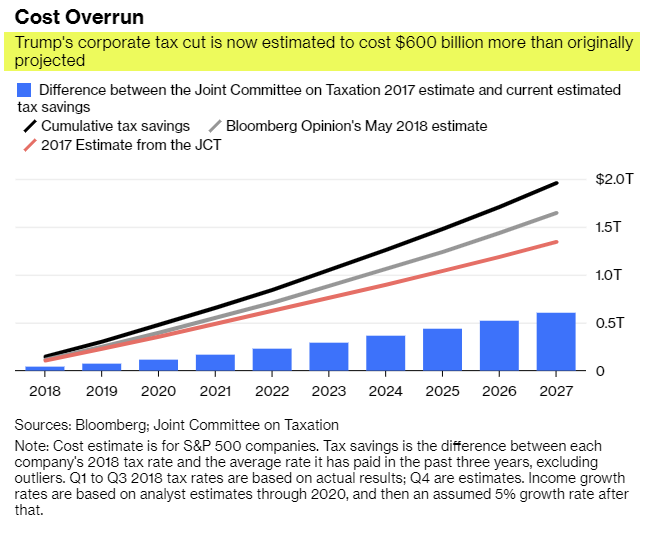
First, the headline number: $600 billion, at least. That’s how much more than expected I estimate the companies in the S&P 500 are on pace to save. It is also how much more the tax cut is likely to add to the national debt if it runs as planned for 10 years. The total savings for all of corporate America will be well into the 13 figures.
In late 2017, soon before Congress passed the tax cut — which reduced the U.S. corporate rate to a flat 21 percent from a previous marginal rate that topped out at 35 percent — the Joint Committee on Taxation estimated it would cost $1.4 trillion over 10 years. White House officials criticized that estimate as being too high. In fact, it wasn’t nearly high enough. My current estimate, now that companies have completed 2018, is nearly $2 trillion, and that’s just for the S&P 500. That’s nearly $400 billion more than I calculated in May. And the actual bill could rise even more while the lasting benefits are still pretty questionable.
Questionable Numbers
The number 1 rule is don’t believe any government estimate on what something will cost. Had there been an accurate assessment at the time, the cut would have exceeded budget rules.
Effectively, the administration had to lie to get this passed.
Again, I am in favor of tax cuts. But I am not in favor of tax cuts based on lies even if I personally benefit.
Biggest Winners

Where’s the Benefit?
It is quite interesting that some of the most reviled companies like Facebook were the biggest winners. So where’s the benefit?
The more difficult question is whether the tax cut has provided an economic boost. In October 2016, analysts estimated that the companies in the S&P 500 would earn a collective $146.80 a share in 2018. Those earnings are now looking as if they will come in a good deal higher at $159.20 a share. That includes the tax cut, which lifted earnings by nearly $15.70 a share. Exclude the tax impact, and S&P 500 companies actually earned less last year, $143.50 a share, than they were expected to before Trump was elected president. That suggests that the tax cut hasn’t provided much income growth outside the actual tax savings. It is possible earnings missed expectations because companies paid raises or spent some of their tax savings in other ways. But even in the unlikely event that full $3.30 a share ended up in employees’ paychecks — an average raise of $10,000 per worker — that would still be a 20-80 split of the tax gains between workers and corporate America.
We can entertain the notion that a 20-80 split is better than nothing. But I studied the plan and found most of the 20% went to the very bottom end. In other words, this was a middle class tax hike, especially in later years.
Rise of the Socialists
It is studies like these that explain the rise of socialists like Democrat Alexandria Ocasio-Cortez who at age 29 became the youngest woman elected to Congress.
She has economically unsound ideas like “Free College” and “Medicare For All” and a “New Green Deal” that hide the cost of debt.
Estimate vs Reality
Her cost estimate to “save the planet” is $1 trillion. The reality is something like $40 trillion. Yet the Green New Deal has garnered significant attention and support from some members of the media, Congress, and even prominent senators considering 2020 presidential runs: Cory Booker, D-N.J.; Bernie Sanders, I-Vt.; and Elizabeth Warren, D-Mass.
This is precisely the kind of too good to be true nonsense that people want to believe. The message is powerful. We need to “save the planet”.
The idea is so absurd that even Pelosi can’t stand it. She put it on the back burner. But there is really only one reason Pelosi did so.
The plan is so idiotic that any Democrat running for president on that platform would lose.
Yellow Vest Movement
The same thing is happening in France right now with the Yellow Vest Movement now in its 10th Week of Violence.
The Complaint?
“How can we continue to live with so little?” said Bernard Grignan, a 65-year old retired manager who took part in the Paris demonstrations.
Meanwhile, back in the US, please note that Democrat Presidential Hopeful Wants to Give Everyone $1,000 a Month Free Money.
Democrat Presidential Hopeful Wants to Give Everyone $1,000 a Month Free Money
Wrong Hands
Also note that New York Mayor Says “Wealth in Wrong Hands”, So, We’ll Take It
Starve the Beast
Proponents of the “Starve the Beat” theory believe we can cut social benefits, keep spending away, and keep deflating the dollar while spending trillions we no not have on illegal and insane military excursions that last forever.
It won’t last because it can’t. The system is broken.
If and When
If and when the middle class unites with the lower class against wealth and corporatism, we are going to see asset confiscation. It will not be pretty and it will not work.
Venezuela, Zimbabwe, and other examples explain why. But a global revolution is simmering.
Trump a Symptom of the Problem
Trump is not the problem. Nor is Marine Le Pen in France, nor Brexit in the UK, nor Lega in Italy.
All are symptoms of the problems: Global debasement of currency, central bank inflation tactics, bank bailouts, and government policies in general that favor the wealthy are the problems.
A revolt is coming. Don’t blame capitalism or Libertarianism. We have neither.
Instead, blame Fed and Government-sponsored monetary madness.
Mike “Mish” Shedlock






























“President Donald Trump and the Republicans’ tax cut is proving to be vastly more generous for corporate America, and vastly more expensive for taxpayers, than expected.”
It is higher and higher government spending that is vastly more expensive for tax payers. Neither political party is really interested in balancing the budget, as they are both spending tax payer dollars to buy votes to get re-elected. This vote buying comes out of the pockets of the tax payers.
“It won’t last because it can’t. The system is broken.”
A stopped clock isn’t broken, twice a day. Every long term debt cycle reaches the point in time where it is broken, as the cycle resets. Every business cycle is broken and resets to a new cycle.
What is the reset going to look like this time?
Speaking of lies, this is one gigantic lie, “I believe I benefited from the cut. Most didn’t or at least won’t in the long haul.” Most taxpayers DID see a tax cut. Whatever one believes about the tax changes, it cannot be disputed that the vast majority of taxpayers will see their taxes decline. I have no idea what Mish’s problem is with this. Also way underreported is the major simplification of the tax code by doubling the standard deduction. This was a brilliant, simple move that took away so many tax games by millions of people. No more writing off mortgage interest, charity, etc. It was probably the single best thing about the tax code changes.
I’m not opposed to deficits on an economic basis, but I am on a moral basis. By running massive deficits and exploding corporate income and military spending, conservatives have shown the left that there is no cost for income and job guarantee schemes or Medicare for all. You can’t scream deficits anymore. The genie is out of the bottle.
There is always a cost. The cost is just deferred. Interest on the national debt will supposedly soon exceed military spending. That will be a lot of taxes to be paying which won’t be providing any government service. In 1931 there was a sovereign debt default. The dollar is moving toward the end of its days as the worlds reserve currency. The world is in a lot of turmoil now, moving into the end of the current long term debt cycle.
“That will be a lot of taxes to be paying”
I disagree profoundly. The deficit has been going up for 40 years and my tax rates have been declining, not growing. There is no magical moment when the government has to say “well we have to pay this debt by raising taxes right….now!”
The government will just keep borrowing more and more to pay the old debt. And Republicans will just keep cutting taxes.
If you want to know a conspiratorial factoid, the US government can always get away with this. They actually print the money to pay the debt first, before collecting any taxes. That money then goes into the banking system. The Treasury then issues the debt, and the debt gets bought by the banks with the newly issued money. And the primary dealer banks are required to buy any outstanding bonds by law at the interest rate the Federal Reserve sets.
We’re not on the gold standard any more.
“Therefore, if follows that one result of tax cut should have been a significant increase in taxes paid by employees and stock owners. Has this happened? If not, why not? If it has, how much additional tax revenue is it producing?”
Interesting question. Stock owners only pay taxes when they sell. Dividends largely go to pension plans, institutions, and the wealthy.
So, it is hard to ascertain what you ask, directly other than to say wages did not go up much.
As a recipient of a one-time $1000 bonus I don’t think it was enough to push me into a higher tax bracket. So it was just another $1K of taxable income. I guess that’s a significant amount of extra tax I’ll be paying ($250 or so before deductions), but compared to my normal income it really won’t matter much. In fact I would have rather seen all of that money go into my after-tax ESPP account instead becoming a de facto stock bonus. But not everyone participates in ESPP and I’m sure plenty of my coworkers would rather have the cash.
But it’s all relative anyway. If I were still living in Pennsylvania I’d be earning far less base pay than I do in Colorado. And that $1000 would be a very nice bonus indeed.
When a corporation does a buyback, we know that on the other side of the transaction, someone was a seller. We also know that since most of the times, buybacks are done when prices are high, the seller will most of the time have a taxable event. I think that the buybacks and extra dividends will have a more significant effect on individual tax liability than wage increases or bonuses.
What could a corporation do with the money they saved from the tax cut (most did a combination of all of these):
Taken together, it is hard to know what the combination of these will be. I’m not claiming that I know what the effect will be.
I have a question on the data. According to the data, Corporations are saving Billions, or perhaps Trillions. Now, as we saw, not all of them have good investment uses for all these billions/trillions. Therefore, in some cases they gave employees raises or bonuses, but in many cases they initiated stock buybacks or issued one-time dividends. All three of these (raises, stock buybacks, dividends) create income for employees and/or owners, and all three are taxable events.
Therefore, if follows that one result of tax cut should have been a significant increase in taxes paid by employees and stock owners. Has this happened? If not, why not? If it has, how much additional tax revenue is it producing?
I concur 100% that Trump is a symptom. I also believe identity politics is often employed cynically to keep people from similar economic classes divided to the benefit of those at the top. How long will the manipulation work? Is it possible to effectively address the needs of the lower and middle classes without descending into Venezuelan chaos? I hope so, but suspect that addressing extreme income inequality will be part of any solution that does not devolve into chaos.