

There are more water rights than there is water. Higher prices will result.
Efforts to Save Lakes Powell and Mead Are Underway
This water problem has been understood for over a decade, but water levels are now so low there may be no water or electricity unless drastic measures are taken.
States refused to address the problem so the Federal Government took over. For once, that’s a good thing.
The Wall Street Journal reports The Colorado River Is Shrinking. See How Authorities Are Trying to Save It.
That’s a free link for those who want more than the excerpts below.
After years of impasse between states, the federal government has stepped in to try to save the beleaguered Colorado River.
The plans include a short-term fix for an ailing reservoir and longer-term efforts to keep the river flowing. It is unclear how effective these measures will be.
The Colorado River provides water for 40 million people and more than 5 million acres of farmland. But drought and overuse have drained its reservoirs.
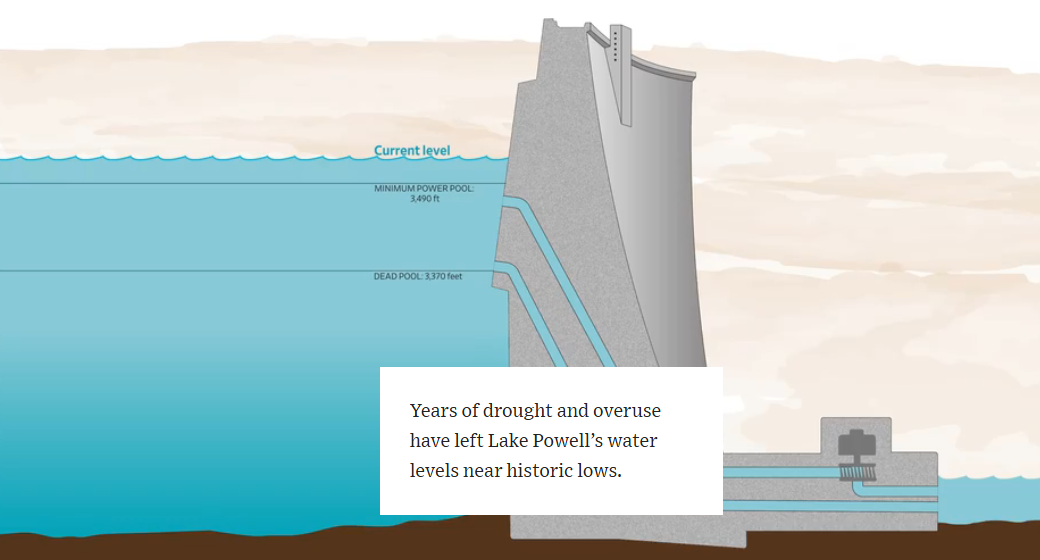
The Bureau of Reclamation announced in April moves to boost water levels of Lake Powell, which straddles the border of Arizona and Utah. The massive reservoir was at risk of falling below levels needed to generate hydropower. Its dam helps provide electricity for hundreds of thousands of homes across seven Western states.
Officials channeled water into Powell from an upstream reservoir and cut planned releases from the lake by 20%. So far, the efforts seem to be working. Projections now show levels staying just above “minimum power pool” through next March, when the reservoir is expected to be its lowest.
Minimum Pool
Minimum pool is the level at which no power is produced. Dead pool is the level at which no water flows to downstream homes, businesses, and farms.
Perpetual can kicking by states, all insisting on their rights to water finally brought this crisis to a head.
A legitimate role for the federal government is to handle disputes between states. The federal government should have acted sooner.
Powell’s problems have been exacerbated by exceptionally dry conditions this year. Record-low snowpack in many parts of the Rockies last winter deprived the river of needed replenishment. Runoff into Powell is now far below historic averages.
The dry conditions follow a “megadrought” that has gripped the region since 2000. Reduced river flows have made it harder to meet the needs of states downstream of Powell, leading to more frequent deficits over the last 25 years.
Last month marked a grim milestone: the combined volume of both reservoirs hit their lowest level since 1957, when Glen Canyon Dam was still under construction.
While the recent federal actions offered a lifeline for Powell, they shifted water around rather than addressing systemwide deficits. Jack Schmidt, director of the Center for Colorado River Studies at Utah State University, likened the measures to rearranging deck chairs on a sinking ship. “The ship continues to sink,” he said.
New proposals by the Bureau of Reclamation may do more.
The bureau is weighing in now because the seven Western states that rely on the river couldn’t agree on a plan of their own. Upper basin states of Colorado, Utah, Wyoming and New Mexico have been aligned against lower basin states of Arizona, California and Nevada. As water supplies have shrunk, each side has insisted that the other cut consumption.
On average, lower basin states have consumed about twice as much as the upper basin over the last 25 years. And while they have used less in recent years, it hasn’t been enough to steady the system.
Under the new federal plan, the lower basin could have to cut consumption by up to 40% from allotted levels.
Lower basin states have objected, including Arizona, which would be hardest hit because of its lower rights to the river. “Such reductions would devastate Arizona’s water users and its economy,” state officials warned.
More Rights than Water
Arizona complains about its rights. Idiocy abounds because there is not enought water to meet its alleged rights.
If the federal government did not act, power to Arizona users from Lake Powell would be shut off.
Arizona bureaucrats would still be moaning about their rights.
The federal plan also calls for potential reductions in releases from Powell and voluntary conservation measures by upper basin states.
Agriculture accounts for more than two-thirds of Colorado River consumption and potentially offers significant savings.
Options include “more efficient irrigation, less water-intensive crops and short-term fallowing of fields,” according to Michael Cohen, a senior fellow at the Pacific Institute.
Lower basin states now await details on how much they may have to cut.
Watering the Desert to Grow Alfalfa
According to comprehensive water accounting studies by Sustainable Waters and Northern Arizona University, roughly two-thirds of the Colorado River water allocated to Arizona agriculture goes toward growing food for animals, not humans. In fact, nearly 80 percent of the state’s agricultural water is swallowed up by livestock feed crops.
1. Livestock Feed Crops (The Largest Share)
- Alfalfa: This is by far the single largest water-consuming crop in the region. Arizona’s hot climate allows farmers to harvest alfalfa up to 8 to 10 times a year. This highly lucrative but incredibly water-intensive crop is grown to support the domestic dairy and beef industries, and a portion is compressed and exported globally.
- Other Hay & Forage: Sudan grass, grain hay, and corn silage are also heavily cultivated to feed cattle.
2. Winter Vegetables & Fruits
- Specific Produce: Crops include massive yields of lettuce, broccoli, cauliflower, tomatoes, onions, and carrots.
- Winter Greens: The lower Colorado River basin (specifically around Yuma, Arizona) uses this water to produce roughly 90% of the United States’ winter vegetables.
3. Industrial and Grain Crops
- Cotton: Arizona has a long history of growing upland and Pima cotton. Cotton is exceptionally thirsty, consuming significantly more water per acre than winter vegetables. [1, 2, 3, 4, 5]
- Grains: Cultivation includes durum wheat and barley, often rotated with winter vegetables or alfalfa to keep fields productive year-round. [1, 2]
With Lake Powell hitting severe historic lows, the federal government and basin states have forced steep reductions in water deliveries to these farms. This pressure has forced many Arizona farmers—especially in central counties like Pinal—to fallow their fields or switch back to pumping finite groundwater.
How Farmers Responded
Instead of adapting, many farmers—particularly in central counties like Pinal—have simply pivoted. Forced off the Colorado River supply, they have switched right back to pumping finite, unpriced groundwater. Because of archaic state water laws, rural groundwater pumping remains largely unregulated, creating a classic “tragedy of the commons” scenario where aquifers are drained to protect short-term agricultural profits.
Allegedly it’s their right to destroy the state. Water rights are truly messed up.
Crop Prices (Alfalfa & Hay)
Water restrictions, multi-decade-low alfalfa acreage, and poor winter snowpack have severely tightened forage supplies across the West.
- Western Price Gains: New-crop hay prices have strengthened across the West, climbing by roughly $20 per ton in multiple markets as ranchers scramble to secure winter feed.
- Current Trading Ranges: In drought-affected Western states, hay is currently trading between $220 and $300 per ton. Large squares of premium alfalfa are pulling in $230 to $250 per ton.
- The Looming Spike: Agricultural economists warn that if water allocations continue to shrink and dry conditions persist, hay prices could spike to as high as $400 per ton.
Cattle Inventory (The Structural Supply Shock)
Years of accumulated drought (2021–2025) across major grazing states triggered an aggressive, multi-year liquidation of the domestic cattle herd.
- 75-Year Lows: By the start of 2026, the total U.S. cattle inventory contracted to its lowest level since 1951.
- The Hard Metrics: According to the USDA’s inventory data, the U.S. beef cow herd dropped to 27.6 million head, down 1% from 27.9 million head the previous year. This marks the seventh consecutive year of cyclical liquidation. The national beef cow herd has shrunk by roughly 4 million head (a 12.8% decline) since its peak of 31.64 million head in 2019.
- Drought Headwinds: Rebuilding the herd has stalled out. Roughly 46% of the current U.S. cattle inventory is located in drought-affected areas, a steep increase from the 16% reported at the same time last year.
Cattle and Beef Prices (Record Highs vs. Margin Arbitrage)
Because cattle supplies are historically tight, prices for live animals have blown past all-time historical highs.
- All-Time Highs: In May 2026, the weighted-average price for feeder steers (750–800 lbs) hit an all-time record high of $388.06 per hundredweight (cwt).
- USDA Forecasts: The USDA’s livestock outlook updated its 2026 annual projections higher: annual feeder steers are forecast at $377.22 per cwt (up 17% from 2025), and slaughter steers are tracking at $249.66 per cwt (an 11% increase over 2025).
This environment creates a fascinating economic paradox. While retail beef prices and live cattle prices are setting records, ranchers aren’t aggressively restocking. The soaring cost of subsidized water and desert feed (like $300+/ton hay) makes it entirely unprofitable to expand herds.
Economic Distortion at Its Finest
This is what happens when you subsidize a scarce resource. When water is handed out based on 100-year-old political compacts rather than real-time market pricing, you get the economic absurdity of exporting water-intensive hay from a parched desert to the other side of the world.
If water were priced at its true market value, alfalfa farming in the Arizona desert would vanish overnight, the aquifers would stabilize, and the structural deficit of the Colorado River would fix itself.
Instead, central planners continue to manage the decline, ensuring that the mismatch between supply and demand only worsens.






























People of influence and authority see the dystopian possibilities that AI offers and they are not going to let anything get in their way.
Any consequences are for the poors. La di da! Can’t be helped!
My son’s a geologist and lives in SLC. You are correct. Just visited. Looked out the plane windowand saw a dried up lake with puddles here and there. He has no plans to buy a home there. His company lets their employees live elsewhere, if desired. My son will be leaving that pollution soon.
Record El Nino will solve this. Probably cause flooding,
You are delusional
I was baiting you to see if you read the comments.. For the short-term it will rain a lot in the Fall. I agree with you completely with the issues you mention. My apologies.
The deeper issue, seems to be little deep thinking and long-term planning. Issues are not thought through. I started noticing it when reading “Managing” by Harold Geneen, where he said, “there will be no more long-range planning”. Other (than USA) countries have 1, 2, 5, 10, 20 year plans, and non zero-sum thinking. If you have a 5 year plan, it is likely not zero-sum.
If you want to go to even deeper (possible further article topics for you), we have two big issues:
I prefer the “lead by example” view where the planet is looked upon as a giant basketball game, or soccer game. There are agreed upon rules, and may the best team win. This causes everyone to bring their A game and we all prosper. Bad actors need to get the South Africa under Arpartheid treatment (global isolation).
2.The debt is growing faster in than the GDP, and the traditional solution was always war, reset, rebuild. This does not work in todays world, with the weapons we have. It would require a radical down-sizing (like doge tried).
The issue with the above is the “bad team” has a plan, and it’s called “destruction”. War, famine, maximum control. This only works in the short-term. It is well known that “management by fear” only works in the short-term. I have known managers who have tried it. All did not last long in their positions.
The “good team” (the majority of us), have no plan, are not organized, and government is never proactive-unless pushed by the citizens.
The good team, right now, doesn’t seem to have a coherent plan for the future.
Are there not a few billionaires (with grandchildren) who can help fund the “good teams” efforts?
The billionaires got to be billionaires by not listening to people like you. 🙂
“States refused to address the problem so the Federal Government took over. For once, that’s a good thing.” This was written at the beginning and:
“Instead, central planners continue to manage the decline, ensuring that the mismatch between supply and demand only worsens.” at the end seem like conflicting statements.
To better understand the dilemma, it would be helpful to understand how water is priced from the river system, how ground water can be free when it presumably is a public owned commodity, and how electricity is priced to assure free market influence to assure proper compensation.
I have no idea how proper pricing would be achieved, particularly with federal government oversight. Maybe a form of competitive bidding by distribution organizations for bulk quantities would be possible, something like federal leasing of federal lands for potential petroleum or mineral extraction.
Never let a crisis go to waste, in order to do something that has never been done before. So someone said.
AZ has 1 swimming pool per 13 residents. Time to close the tap on this Frivolousness!
And shut down all the golf courses, no data centers either.
No more Alfa alfa grown in the desert for export.
watch ken burns “dust bowl” documentary. i worked in geography masters degree in the 1980s at nasa and other places i cannot discuss. our water professors always said to invest and settle in areas that survived the 1930s dust bowl. i’ve taken that to heart in the past decade as i sold off my western properties in AZ and CA………and settled in the hudson river valley. farms here have been growing fruits and other crops for 400 years. native iroqouis and others much longer. i love the southwest. but it is doomed. cannot support that many mammals and the plants they eat. i always enjoyed the anecdotes from ancient romans over grazing north africa to the point of sahara desert spread north…………..human primates, aka talking apes will keep doing this. other animals also over graze and consume.
i sold all my properties in AZ over the past few years. glad i did. this issue was our number one reason for selling. we now live in part of the world where all the local farmers rely on mother nature’s rains. many farms around here in same families since before the amerikan revolution. an old dutch town on hudson river.
I asked AI if the Colorado river and the low dam reiservoirs will be a problem for the Southwest population and will it still grow. AI said It will not be a problem as technology will allow more people to use less water over time. Growth may slow but there will still be growth.
Just passing along the message. 😄
“Cadillac Desert” predicted this many years ago. Still a best book on the topic of water and human stupidity/shortsighted actions
They want every state to make cuts in water consumption but the Lower Colorado River Compact states have been using more than their annual allocation for decades. They want the Upper Colorado River Compact states to reduce their consumption even though they have never used their total water allocation. The farmers must make reductions in water consumption in the Lower Colorado River Compact states which consumes 75-80%. It’s up to the Lower Colorado River Compact states to reduce their water consumption and stop overdevelopment which just makes the water shortage problems much worse!!
It is anthropogenic climate change, but no one (and unfortunately, it is not limited to just the right-wing fools in the US) is willing to do anything about it.
Forget about doing anything, it is too much to expect someone who does technical analysis on temperature patterns (as if it is a stock price chart!) to even understand it!
The US military is by far the largest polluter on the planet.
However, the US military is the biggest sacred cow there is.
This is just a smaller theater compared to a global issue. I note that the author is immediately and directly impacted by this particular little ecological disaster. On a grand scale and timeline (planetary) are we still trusting laissez-faire capitalism, or is it time to admit that the tragedy of the commons scales up just fine?
That’s commie talk! Report yourself to Homeland Security, citizen!
Just as the country has a strategic petroleum reserve, it needs a strategic water system. Places experiencing spring flooding / frequent flooding need to be “harvested” and redirected by pumping to areas of the country where water levels are relatively low. The technology for pumping already exists for oil, so pumping water should be simple; however, prevention / management of invasive species needs to be designed in.
The Great Lakes hold all of the water we need.
Too bad half that water belongs to Canada.
The phrase “Whiskey is for drinking; water is for fighting” (often misattributed to Mark Twain) applys here. Let the games begin.
I told my wife the federal government was going to step in and she laughed so hard I think she peed a little
At least the states are in the same country, so federal arbitration may kick in at some point.
Compare it so Turkey vs Syria/Irak: the Euphrates and Tigris water is held in Turkey by dams and there is nothing Syria/Irak can do about it.
There sure is something they can do. Hopefully, they do not become desperate enough to do that.
I’ve said this before many times and I’ll say it again, in time, everything west of the Rockies will be desert. This is the starting point but it will continue to grow. Instead of investing money for desalination plants that can ameliorate the issue we spend billions on wars in the middle east.
Salt Lake is also a disaster.
Total insanity.
I don’t feel sorry for California. They have done this to themselves by deconstructing dams, failing to build more, and prioritizing fish over people. And people obsessed with almonds.
Ban golf and golf courses.
I live in the Upper Basin. This has been a known potential problem for at least 20 years and little has been done about it. Arizona in particular had a substantial growth in population while knowing that water was an issue all along. There is a least one new neighborhood there that has no water tap; water has to be trucked in. Officials have totally mismanaged this on various levels.
Is to many People the main Problem— from 1973?
https://www.youtube.com/watch?v=PPIOp31up_U
What about golf course irrigation?
Mish mentions the lack of groundwater regulation toward the end of the article, that is the real deadpool
Remember reading growing cotton in water scare areas with limited rainfall treating it like it is an unlimited resource. 8,000 liters to a ton of cotton so usually less than two acres.
Billionaires Stewart Resnick and Lynda Resnick, owners of The Wonderful Company, do not own a majority of California’s overall water supply, but they do hold a 57% majority stake in the Kern Water Bank, a massive underground storage reservoir in the San Joaquin Valley.
The Facts on the Resnick Family and WaterThe Kern Water Bank: The Resnick family controls a 57% stake in this 32-square-mile underground water storage and recharge facility, which can hold up to 1.5 million acre-feet (nearly 500 billion gallons) of water.
20 Farming Families Who Use More Water From the Colorado River Than Some Western States.
I just wonder if the Government stopped subsidizing Midwest farmers to grow corn for fuel and instead subsidized them to grow alfalfa for feed would make a difference…just wondering…
Interesting take on the Arizona farm situation. The Mormons settled the Valley over 100 years ago. Built dams and reservoirs to make the barren lands productive. Starting in the 1970s vast numbers of sun seekers entered the watershed and began building golf courses and swimming pools. Now those who created the oasis are being displaced by those who are there for the pleasant life style. The grasshopper and the ant story in real time. Disgusting, for humanity.
CA & FL (& other states but these states have the highest useage in general) uses of water for aesthetics, comfort, pleasure (private swim pools, patio mist systems, water features, fountains, golf course mtnce, exotic non-native landscaping w/plants that require more water than natives, water theme parks, etc., should be the first looked at. The huge agribusiness companies that acquire massive stakes in huge underground water storage basins & control water allocation worth billions should also be looked at – as well as proposals to mine ancient desert acquifers in the southwest. Like the Colorado river it’s hard to see how states can effectively & fairly manage these valuable resources if they are inter-state or close to state boundaries.
This system’s core operating system is a kind of unregulated, absolutist growth, a.k.a. cancer. Where I live, every public place, every beach, is overcrowded and degraded. The concept of ecosystems doesn’t exist to the fanatics in charge, and that trickles down to the hordes of “livin’ large” idiots throttling our life support system. The only important thing is to meter everything and extract rents, for ever more insane self-indulgent fantasy escapes. Solutions always involve more entropy, not less. So it will ultimately solve itself, on our backs. It could have been so different, but not with the hordes of assh*les humans preferentially breed.
Humans are the supreme creators of entropy on earth… it could never have been anything but this.
anthropology 101. we are talking apes. still walking upright and breeding………
They aren’t fanatics, they are sociopaths. “Can I make a buck off of it? If I make enough bucks, how can I buy some for myself and keep the rabble off of my private beach?”
20% of alfalfa by weight is converted by cows into methane, 20x more powerful as a warming gas than CO2. This is hardly helping Arizona increase the snowpack it depends on for its summer water.
Oh, but wait, the farmers think climate change is a hoax. Never mind.
I haven’t had a bite of beef, pork or large land animal in more than 20 years. But try to tell an American not to have something, even if it is obscene and stupid.
Just rub some invermectin on it.
Demand for water keeps increasing.
The US is expected to build enough new data centers by 2030 that require a total of 90 gw of power.
A 1 gw gas generator consumes 10-20 million gallons of water per day. The data center consumes 1-5 million gallons of water per day.
If we had real, decent and patriotic leaders we would make it so that any and all data centers would be required to be both energy and water self-sufficient – if they want to exist, anywhere. That would really slow down the nonsense.
But they are whores, worshipers of a golden calf.
On a good day, and in between baby meals.
… in diapers.
How is China handling this demand?
Good question. China had 20 GW of data centers by the end of 2025. They expect this to grow to 110 GW by 2030. The data center numbers are very similar to the US.
There is no specific info on how these are powered but China’s overall electricity supply in 2025 was 55% coal and natgas, 13% hydro, 11% wind, 11% solar, 5% nuclear and 5% other.
Notably, China is adding a LOT of new electricity generation each year compared to the US. Because they are building so much generation, they will have no problem supplying power to their data centers. Which gives them a big advantage over the US in the development of AI.
In 2025, China added 533 GW of new generation: 311 GW of solar, 119 GW of wind, 93 GW of coal and natgas, 5 GW of Hydro, and 5 GW of nuclear. In addition to the 430 GW of wind and solar combined, they added 66GW of battery storage to make them work more reliably.
In 2025 the US added 46 GW of new generation: 33 GW of solar, 8 GW of wind, 5 GW of natgas, 0 hydro, and 0 nuclear. The US also added 19GW of battery storage to assist the solar and wind.
Note that most of the new generation in each country is from solar and wind, because they are cheapest and fastest to build. Though Trump is trying to stop solar and wind in the US because he doesn’t like them. Imagine what would happen if he successfully stopped solar and wind? 5-10 GW of natural gas additions each year won’t cut it in the race with China.
The assumption of the goodness of a “race with China” calls for some reflection.
Reflect all you want.
The US has been the most innovative country for the last hundred years. This led us to be one of the wealthiest and powerful countries. We now seem to be rejecting the very education, science and technology that got us there.
Countries with the best educated workforce, the best science and technology, the best innovation, and the best productivity will succeed above those that do not.
That is currently China. We can choose to compete with them, or we can sit back and watch them accelerate away from us.
Anyone who knows of the elaborate packets they send to admitted students from the elite Chinese university understands how China is truly investing in itself through educating its people en masse.
Well, that’s a problem now, isn’t it?
The rulers want herd animals just smart enough to be useful and to be good consumers, but not so smart that they start to get ideas or ask questions.
Seen their new dam? It will make you say damn. It’s 3x the volume of the Three Gorges Dam, which holds back enough water to shift the earth’s rotation.
This is a very, very serious problem of which there may be no return. Not enough water to continue business as it is. It boils down to a basic math problem….not enough water due to too many people, too many farms, and too many golf courses. Something will have to give and it will most likely be decided in the courts ad-finitum. This will take years while water levels continue to sink.
The Colorado River Compact of 1922, which divvied up water allocations between southwestern states, was based upon water figures that have since been determined to be at their high in the past 1000 years. The southwest has gotten drier. On another note, much of that alfalfa is being grown on land owned by the Saudi Arabian company, Fondomonte-Arizona, as a feed stock for their dairy cows back in the Middle East.
This was all foreseeable. Settling millions of people in the desert? Putting in endless golf courses?
This desert population’s existence is dependent on water from other states and on electric power for air conditioning necessary to keep people alive.
And we are all waiting on the federal government to solve the problem!? What could go wrong?!
The technology exists for mass production of food with a lot less water, what is missing of course is the financial/political willpower
Find a profit center that meaningfully addresses the issue, and the problem will be solved rapidly.
I live in NM. Elephant Butte Reservoir has reached its lowest level since 1971. We also have a lot of controversy over water from the Rio Grande river. We have farmers here growing Alfalfa and fighting for water. A huge farm ( miles long) next to me has pumped ground water to grow pecan tree’s and alfalfa when needed. It does seem like they are not watering the Alfalfa with well water this year. But I’m sure they are still watering the pecan trees with drip irrigation from their wells. As there has been very little water in the ditches this year for irrigation. We all keep hoping the climate will shift back as this is the longest drought period we have experienced in generations. One study using tree rings claims the drought is the worst in 1200 years. Having lasted 20 years. My 50 year old well has begun to suck air. I wanted to drop the pump a little. But the pump has not needed changed in 29 years. The well guys say that it’s likely to hang up in A 50 year old metal casing. So I’m going to have to put down a new house water well costing $40k. Fun times
Excellent article Mish! Fresh water is indeed a very precious resource and we continue to mismanage it. And yes, it requires governments to be involved. And not just governments within the US. Mexico is impacted by US water decisions. As are the great lakes that border both Canada and the US.
Water is indeed a global problem. River levels are so low in Europe that currently, 6 nuclear reactors are shut down for lack of water for cooling. Another 17 reactors are under output restrictions for the same
reason.
Similarly, several Italian natural gas generators are operating at reduced levels because of a lack of water for cooling.
And, of course, hydro power generation is severely reduced throughout Europe.
And coal barges cannot deliver coal by barge to coal generation facilities because of low river levels. Five European coal plants are shut or severely restricted for lack of coal as a result.
Good thing solar and wind are working well to help offset some of the other shortfalls.
Clearly we need to embrace “all” of the available generation platforms rather than trying to rely on any single one of them.
Back to water. Two billion people worldwide rely on glaciers to provide their primary fresh water source. As glaciers continue to shrink in size, this fresh water source is imperilled.
Glaciers used to provide significant amounts of water to the Colorado river but those glaciers have shrunk to the point of irrelevance today. The. Colorado now is 80% dependent on winter snowpack and 20% dependent on rainfall.
Our growing populations keep demanding more water. As our climate continues to change we are going to face these types of water challenges more frequently. More extreme drought in some areas. More extreme floods in other areas. The implications are far reaching.
And, Al Gore was essentially 100% correct.
Yup, I remember that as a prediction of Global Warming 20 years ago. The snow pack would be smaller because the snowy season would be shorter, and what snow fell would run off earlier, leaving little water in late summer through Autumn. Give it 30 years and Arizona will become the new dust bowl.
What is the message? That eating half a pig a day is going to save the planet?
Except about Manbearpig, I don’t believe it exists
In terms of ribeyes, nothing here that Bill Gates cannot solve with lab-grown, 3-D printed beef.
Mish, was this inspired by someone’s video in your last post? The one about the decline in the US cattle herd.
Probably because Mish is seeing this firsthand as he lives in St. George, Utah….the desert.
It’s 40 years old already, but Marc Reiner’s Cadillac Desert still is one of the best summaries of how we got to where we are today with water in the West. Even worse that the issues were laid out decades ago and still we are kicking the can down the road…
Water is free until it isn’t
Metaphor for the federal debt….eventually it hits the brick wall…until it does everyone leverages it for their private gain waiting until the loss is socialized after hitting said wall.
Correct (and great article!). In the series “Yes, Prime Minister”, when the PM made an unusual (but correct) decision, the bureaucrat congratulated him for having made a “courageous” decision. That word alone had the PM change his mind immediately.
If any local politician proposes your reasoning, the opposing side will pay a journalist to raise a false alarm. It is akin to “I can’t quit smoking, because I’ll lose all the money I’ve invested in smoking so far”.
I suspect early on land owners owned the water rights. Ranchers and farmers came first. But how do you decide to parcel out a natural resource that stretches 1500 miles? I guess that’s what the Compact was about. Whatever the reason for the drought, some sort of market pricing would have sorted out winners and losers. What was important and what wasn’t. If you can’t afford the water you can’t live, work, or farm there. But only government can resolve the wide variety of uses for the water like cities vs farms and ranches. Several cultures in that area have come and gone over the centuries. I suspect the lack of water influenced many of them. Mother Nature does not care. FAFO. They call it a mega drought but it could just be reverting to the norm. We could have been living in the fertile times.
Turns out raping the land and sucking it dry is bad, who knew! Every year it gets hotter, every year we continue to destroy the heritage of our children and grandchildren. This will be remembered as the most selfish, dimwitted, and cynical period in human history. If not, there won’t be any humanity left to remember it.
This should not still be ongoing. We’re paving a path to a world where several US states are uninhabitable thanks to the greed of the few.
The Great Basin was never our heritage.
The pioneers traveled through it as quickly as they could, to get to the green lands of northern Cal. and Oregon.
Well thankfully we murdered those pesky “native” Americans who actually dared think they had any right to data center land promised to us by white Jesus™. By the way they totally don’t exist anymore, don’t listen to those people begging us to leave them alone.
The west has been doomed for decades due to water usage as it’s not a new problem. It’s just taken a long term drought to speed things up.
A whole lot of crops being grown are way too water intensive to be grown in the desert. Don’t forget to add Almonds in California (300-400 gallons of water to grow 1 lb of almonds) to that list.
Imagine if beef herds weren’t at historic lows how high the price of feed would be and how much more water would have been used to grow more of it.
Because you get very little rain in the desert, it retains a lot of minerals built up over centuries. Adding water gives you incredibly productive farm lands. At least for a while.
This concept is ideological prattle.
Whole civilizations have depended for centuries or more on maintaining collective goods such as pastures, irrigation, canals, etc. In fact, over millennia, the rise of various civilizations had more to do with the administrative and governance required to maintain such goods than with weapons technology and conquest.
Over 20 years ago they (SNWA) were talking about a water pipeline from Utah – SNWA has told us many stories over the years – So far, by my count, most of what they said has not happened
I thought the majority of the nation’s winter vegetables came from the California great valley?
I am sure I have often read this too, and have seen lists with statistics about the percentage of national produce sourced in California, where they also use water to irrigate former desert.
You forgot to blame Trump.
This is a serious blog and I lay credit and blame where they should be.
I think I’ve seen you through your share of humor into the mix. But, it is your site.
Trump’s earth killing policies might have helped this issue along, but the blame is squarely on greedy farmers for despoiling their land.
There have been “developers” before the farmers who constructed irrigation districts and so forth, and then sold land and water to farmers. The farmers at least have sense enough to plant only enough almonds based on assured supply of water, and use the rest of their land and water for crops that can be sacrificed when a drought occurs.
As an example, consider where El Paso TX and Cd. Juarez Chih. obtain the water for their own municipal water supplies.
The new greedy developers build new suburban subdivisions in Arizona. They have to guarantee something like a 40 year supply of water, but what good is that 40 years from now?
As Mish said, the farmers are tapping into irreplaceable groundwater just as much as the insane golf courses ect. The result will be all of them eventually having to swarm somewhere else like locust when they eventually run out of aqua.
“Nobody’s perfec”…..MoM. (but I always thought she was talking about me)
It was obviously interference from a computer virus created by Hugo Chavez that reprogrammed the Compact to alter the distribution of water. Obviously…