

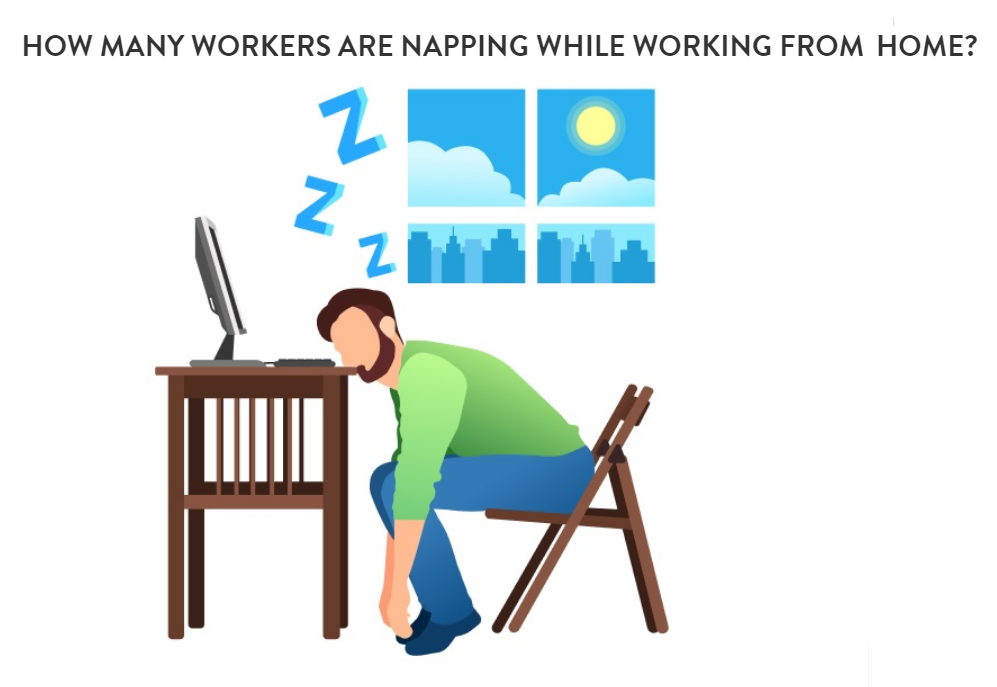
How Many Workers are Napping at Home?
A Zippia career survey shows a Surprising Number of People Napping While Working at Home.
Key Findings
- 33% of Workers Admit Napping on the Clock
- 15% of Nappers Sleep at Their Desk
- 37% of Nappers Opt for Their Bed
- 33% of Nappers Don’t Set an Alarm
- Over 50% Admit Spending Time on Social Media, Surfing the Net, and Texting.
Popular Diversions

Zippia surveyed 2,000 workers. Over 1200 of them admitted personal texting and social media activities. That’s 60% minimum for each.
Over half surf the internet. Under half (about 40%) take smoke or snack breaks. I would have preferred that group split into two pieces, smoking and snacking.
Zippia labeled the results “surprising”. The only aspect I find particularly surprising is how few do “Other” non-work activities.
That group encompasses cleaning the house, walking or feeding pets, exercise, non-sleep bedroom activities, etc.
“Other” appears to be about 150 out of 2,000 or 7.5%. I suspect way higher. If “Other” was a fill in the blank thing as opposed to a checkmark for a list of activities such as I mentioned above, that explains the low results.
The survey results are a bit stale. They are from May of 2020. I suspect but cannot prove that non-work activities increased as time went on.
Back to the Office, What Now?
Working remotely has made taking an afternoon snooze a lot easier, and it won’t be easy to give up. ‘I will totally miss the naps.’
OK, You’re Going Back to the Office. What Happens to Your Nap Habit?
When high-school teacher Ryan Tibbens learned he would be resuming in-person school in March, he embarked on a mission. He wanted to continue the naps he’d been taking while working from home over the past year.
“I didn’t want to pull the classic ‘Seinfeld’ episode where George Costanza sleeps under his desk,” said Mr. Tibbens, who is 37 and lives in Berryville, Va. So he bought a cot online and installed it in a backroom at school. He naps there for about 12 minutes during his 30-minute lunch break at least three days a week.
Mr. Tibbens is one of the lucky ones. Many people returning to offices in the coming months face an end to one of the secret perks of working from home: the daily nap.
While employers have increasingly discussed the need to ensure workers get breaks, he said, “I can tell you I have not heard one employer—and we survey a lot—talk about naps.”
Hey, Let’s Try Sleeping Under the Desk
Seinfeld S08E18 The Nap 2 – George gets his desk remodeled.
Overall Key for Employers
The key for employers is not non-work activity but rather how much work did get done vs. the cost of office space, furniture, travel time, and overall productivity.
Most companies are not fully returning to the office so companies in general must be pleased with overall results.
The “daily” nap may go away, but except for some jobs like teaching (discounting the above example), many weekday naps will remain.
Mish





























Ever watch the movie office space.
You know what, let folks take a siesta nap. Not having to be at the office from 8 to 5 means they can be flexible and work on projects throughout the day. The work gets done and the employee is happier, while the employer doesn’t have to lease an expensive office. Sounds like a good deal for everyone.
Before throwing them all under the bus would want to know how many hours of ‘real’ work they put in offline vs online. Who cares if they take a 3 hour nap or whatever if at the end of it they put in as much, or more, productive time (which might even be fewer total hours)?
The problem is that workplace management today is mainly about having people show up and be present for 8-10 hours. The degree of productivity is incidental, at best.
The vast majority of office work is maintenance stuff – working with spreadsheets, formatting documents, designing new marketing materials and os forth. Precious little work is actually developing anything new that hasn’t existed in that workplace before.
Same thing with blue collar manufacturing workplaces. Much of what is done could be automated but there would be a sizable investment in new technologies required and a learning curve to get everything working. If you ever look at the Science channel TV show titled “How Things Are Made”, you’d see that the vast majority of products they show have many repetitive steps, where people stand at stations doing the same thing over and over and over again, day after day after day. I get bored just watching these people “work” and feel sorry for them imagining them doing the same thing every day for years.
While working from home I would start at 6:00 AM. At 11:00 AM I took a 3 hour break to exercise, and then return for another couple of hours. I would even extend the “work week” into Saturday and Sunday to reduce the maximum hours worked in any given day. Of course meetings had priority over exercise, but I still took advantage of making my schedule as easy as possible.
Now that the project is in the integration phase, I have to be on site for the group effort, but it’s not for a full 8 hours. I still avoid rush hour traffic and finish my hours on the weekend.
I know someone working 8 full time jobs and none of his employers think he is working elsewhere. This is probably more rampant in the coding world after covid.
Productivity improvements are leveling off and declining at most organizations. Most companies will find this out the hard way. Humans need in person connections for trust to continue. If a job can be done from home it is more likely that job can be offshored to somewhere cheaper.
Besides the napping I would expect there is more online activity at home but less chatting. Naps seem to be a natural thing and help a lot of people, but a 2 hour siesta doesn’t really work for the commuter society.
But my IT team did 4 months WFH during early Covid. I found that people were as productive at home as in the office. Good or bad. I encouraged them to take breaks during the day, take advantage of the sun, or engage with family. As long as they let me know what periods they would be out. This actually helped as I had better coverage over a longer period of the day and we were very busy with Covoid related work.
On being directed back to the office people returned to doing there 8 hours and then they were gone. Can’t follow a management view that people commuting 40-90 mins a day to look at a computer screen all day were going to be happier and more productive than people working from home looking at a computer screen all day.
Obviously doesn’t work for all occupations, but if those that can WFH, do, it takes traffic off the road, which improves the general environment and for everyone else and reduces the need for government spend on maintenance.
I will never understand long commutes. Many companies should locate themselves closer to where people live if possible.
It’s a new day in the IT world. A lot of companies are embracing WFH for their tech workers. Those companies who won’t will be relegated to the second-rate, hand me down IT talent that couldn’t get jobs at companies which do offer WFH.
One of the great things about being retired is the ability to take a nap whenever I please.
I don’t do caffeine, so a nap is essential during my day. When I was working, I would often use the lunch break to go out to my car and grab 45 minutes snooze time. Then eat at my desk later. Of course, you lose the lunch bonding opportunities then.
As for web surfing, social media and other distractions during the work day, this is very common. However, the average person’s cell phone is data limited, so they use the company wi-fi, which then allows the company to see what phones are connecting to what sites, assuming those sites are HTTPS. If just plain HTTP, then the company could read all the data being transmitted. If you are going to web surf, etc on company time, then you need to use your cell provider, not the company wi-fi network.
Everyone knows naps are good but employers still laugh at them and so do your kiss ass coworkers.
A lot of start-up’s in the SF Bay Area have nap rooms.
I used to go for a walk, outside of inside, if I was stuck and wasn’t getting anywhere with a problem. Often you think differently during a walk or even on your way home. I always used to say, multitasking is fine, but when you are taking a morning shower, there is usually only a single challenge on your mind. What difference does it make if somebody makes a phone call to his kid, gets a cup of coffee, or has an informal sparring session during a lunch time break?
Even studying for an exam of writing a paper does not benefit from 12 hours slogging without interruption. Thoughts and solutions typically spring up when your attention drifts away. Concentration needs a rhythm of micro breaks, and longer breaks, clearing you head, gazing away, change of pace and posture.
Only the worst kind of management thinks they are squeezing more out of their coolies by having them sprint all the time or thinking that an extra $100/week will turbo charge something as complex as human motivation.
When I make a paper, I always feel that I am doing almost nothing in the first half (or more) of the time used for it. In this time, work is often split, some part of it often at night. But in the second half, especially in the end when I actually write, I feel overloaded, I think I work a lot. But the main work of course was done in the first half.
We have not noticed any reduction in productivity in our office. To the contrary, people working from home have been more productive, as they no longer can chat in the hallways, socialize at the water cooler etc. Plus, there is the added benefit that the morning and evening “commute” is now only 10-15 seconds, compared to about 90 minutes (one way) that it used to be.
At our firm the R&D side has shown remarkable productivity at home. We have the software tools and professionalism to make it work. Harder for sales and product people to be as effective. I imagine this experience is not unique and companies may bring some departments back sooner than others. Regardless I think companies will become more liberal with having workers conduct business remotely but not every company will be OK with workers not coming in at all
Many employers in NY are adamant they want workers back. Earlier dates as long as January 2022 were discussed. Now its Memorial day thru Labor day. JP Morgan has been the most adamant but there is also Mike Bloomberg who said he expects workers back after their 2nd dose. All this while NYC infection rates are rising and new strains are emerging. No one talks about what will happen if you crowd 10 people into an elevator
We all have to go back but as long as NYC has elevated cases it’s a concern. Companies can legally ask employees to vaccinate subject to health and religious exemptions but so far nobody is going that route.
Question is what percentage of Americans get vaccinated. Fauci says we need north of 70% for herd immunity. We are nowhere near that. Even in Israel where they lead in vaccination rates they are struggling to crack 60%
It’s only been a few months. Herd immunity typically takes 1-2 years after a vaccine arrives.
I much prefer working in an office but have some friends who never want to go back. I also think it’s easier to waste time in an office shooting the breeze with other people, which is much more enjoyable than scrolling through social media.
Companies can fire you if you refuse to return