

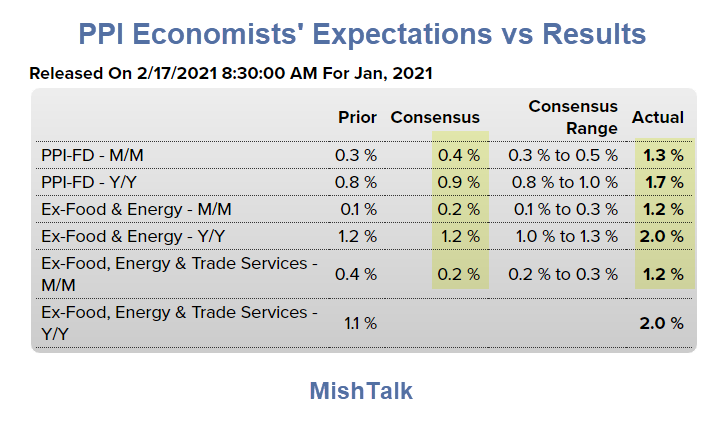
PPI Final Demand vs Expectations
- Month-Over-Month: Expected 0.4% Actual 1.3%
- MOM Excluding Food and Energy: Expected 0.2% Actual 1.2%
- MOM Excluding Food, Energy, Trade Services: Expected 0.2% Actual 1.2%
- Year-Over-Year: Expected 0.9% Actual 1.7%
- YOY Excluding Food and Energy: Expected 1.2% Actual 2.0%
That’s a pretty bad set of misses courtesy of Econoday with PPI Report Numbers from the BLS.

PPI Details
- The Producer Price Index for final demand increased 1.3 percent in January. This advance is the largest since the index began in December 2009.
- Final demand prices rose 0.3 percent in December and 0.1 percent in November.
- On an unadjusted basis, the index for final demand moved up 1.7 percent for the 12 months ended January 2021, the largest increase since climbing 2.0 percent for the 12 months ended January 2020.
- Two-thirds of the January advance in prices for final demand can be traced to a 1.3-percent rise in the index for final demand services.
- Prices for final demand goods increased 1.4 percent.
- Prices for final demand less foods, energy, and trade services moved up 1.2 percent in January, the largest advance since the index began in September 2013.
- For the 12 months ended in January, prices for final demand less foods, energy, and trade services rose 2.0 percent, the largest increase since a 2.1 percent advance for the 12 months ended June 2019.
Final Demands Services
- Prices for final demand services rose 1.3 percent in January, the largest advance since the index began in December 2009.
- Over 70 percent of the broad-based January increase is attributable to a 1.4-percent jump in prices for final demand services less trade, transportation, and warehousing.
- The indexes for final demand trade services and for final demand transportation and warehousing services also moved higher, 1.0 percent and 1.3 percent, respectively. (Trade indexes measure changes in margins received by wholesalers and retailers.)
- One-fourth of the January advance in the index for final demand services can be traced to a 9.4-percent rise in prices for portfolio management.
- The indexes for outpatient care (partial); guestroom rental; machinery and vehicle wholesaling; apparel, jewelry, footwear, and accessories retailing; and truck transportation of freight also moved higher.
- Margins for automobile retailing (partial) fell 7.7 percent. The indexes for food retailing and for property and casualty insurance also declined.
Final Demand Goods
- Prices for final demand goods moved up 1.4 percent in January, the largest increase since the index jumped 1.4 percent in May 2020.
- Nearly 60 percent of the broad-based January advance is attributable to a 5.1 percent rise in prices for final demand energy.
- The indexes for final demand goods less foods and energy and for final demand foods also climbed, 0.8 percent and 0.2 percent, respectively.
- Forty percent of the January increase in prices for final demand goods can be traced to a 13.6-percent jump in the index for gasoline.
- Prices for iron and steel scrap, oilseeds, industrial chemicals, diesel fuel, and light motor trucks also rose.
- The index for beef and veal declined 8.4 percent.
- Prices for fresh and dry vegetables and for search, detection, navigation, and guidance systems and equipment also fell.
Mish






























This price inflation is mainly due to additional economic friction caused by the pandemic. It’s just harder to organize raw material supply, production and delivery of finished goods and services. When the economy gets back to normal inflation could subside as bottlenecks get straightened out and restrictions on movement lifted. Some of the surges in demand are not sustainable as demand gets satisfied. There is a lot of speculation that we are at the start of a commodity super-cycle upswing but I have some doubts as to whether is would due to actual demand coming from booming economies. Realistically the demand would be more liquidity-related and that could mean volatility in specific commodities rather than a broad-based bull trend.
“When the economy gets back to normal inflation could subside as bottlenecks get straightened out and restrictions on movement lifted.”
You’d think so but restrictions on international trade and tensions between countries might counter that, at least for a while. Additionally Central Banks want inflation so they won’t be doing anything about it too soon. They’ll probably use your argument to justify letting inflation get a grip. It’s a difficult call.
that might be true in certain specific industries but not overall in my opinion.
Relevant information.
On a related note, lumber & copper prices have me baffled.
Other resources are surging but not like this, housing starts are up, but not enough to justify these prices.
This reminds me of the “mysterious” surge in oil prices back in ’08 that preempted the financial crash.
Lumber prices up due to unprecedented demand for homes (both existing & new).. I mean on Long Island and Northern NJ a small starter ranch home gets multiple bids when priced below $600,000 (with $15,000 a year in property taxes)
Lumber is +200% since the covid crash, I think this is an all time high, housing starts plummeted but have since rebound, but lumber prices are completely disproportionate to demand.
Either someone’s monkeying with prices, there’s a supply problem, or Mish can do a victory dance about rates v speculation.
But, for the latter, it wouldn’t just be lumber, lumber’s up completely disproportionate to other softs/commodities.
Trump started it by putting a 20% tariff on Canadian lumber. We just dropped it back to 9% in late 2020…but it should be zero….and prices are funny…They can go up fast…but they seldom drop fast unless we hit a bust cycle.
Beans, rice, yum.
Wow, that’s like 20% annualized inflation. $2.6t more in free money coming. Here it comes.