

SPD Leadership Contest Surprise
Two little-known left-wingers emerged as surprise winners in an SPD leadership vote on Saturday.
SPD is the junior partner in what’s left of Chancellor Angela Merkel’s no longer “grand coalition”.
Renegotiate the Deal
The Guardian reports New Co-Leaders of Junior Coalition Partner Want Major Concessions From Merkel’s CDU.
Germany is facing the prospect of months of political uncertainty with the collapse of the coalition, which has been fragile since its inception after the 2017 election, a growing likelihood. It also raises the prospect that Merkel, who has said she will not run for another term in office, will face an earlier exit from the political stage than she intended.
Walter-Borjans and Esken narrowly secured first place in the SPD leadership vote on Saturday on 53%, beating the expected winners Olaf Scholz, the finance minister and vice-chancellor, and Klara Geywitz by eight points in a second-round runoff.
The result, delivered on a 54% turnout of the 425,000 SPD members, was a blow to Scholz, one of the architects of the grand coalition, and is widely seen as a vote of no confidence in him. The immediate focus is now on Scholz. If he decides he has to resign from his ministerial roles as a result of the defeat, the coalition would in effect be over, even if an election would not happen until well into next year.
Demands
Among their main demands are an increase in the minimum wage from €9 an hour to €12 and a backtrack on the government’s central fiscal policy of balancing the federal budget, known as the “schwarze Null” or the “black zero”, to allow for more spending on infrastructure and welfare programmes. They are also calling for a more radical approach on the climate emergency.
The CDU has made it clear it is unlikely to accept such demands. Speaking after the result, Paul Ziemiak, the party’s general secretary, said: “Our aim is to govern Germany well, and the foundations for this are in our coalition agreement. This internal decision by the SPD changes nothing in this regard.”
If the coalition dissolves, Merkel, who has been in power since 2005, would have to choose whether to resign, call a confidence vote, or attempt to lead a minority government under her leadership or that of someone else within the CDU, or to start negotiations over the formation of a new government.
The Financial Times says SPD Result Heralds the End of Germany’s ‘Grand Coalition’
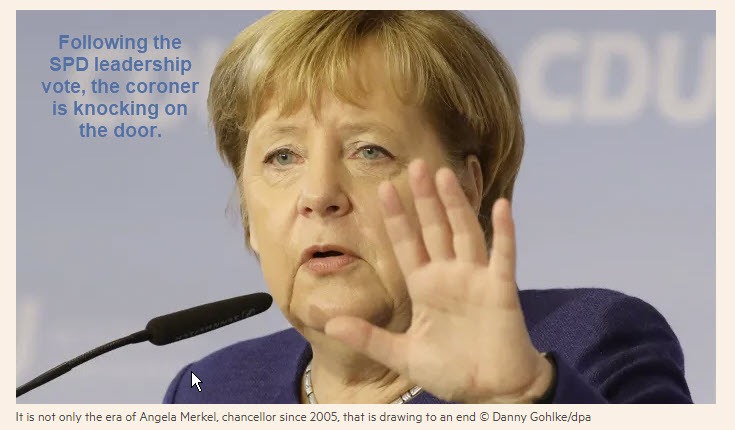
It is not only the era of Ms Merkel, chancellor since 2005, that is drawing to an end. So, too, is the era of “grand coalitions” uniting her Christian Democratic party with the SPD.
Actually, the grand coalition effectively ended years ago.
But SPD and CDU still remain at the deathbed refusing to admit the patient has already died.
Why?
Perks. It’s tough to give up limousines, big salaries, and other perks.
Even following this electoral surprise, it’s still unclear if the new leaders or Scholz will officially call in the coroner to state the obvious.
Meanwhile, let’s look at the polls for coalition replacement possibilities.
Germany Election Polls

The Union is CDU/CSU. Thus, the alleged grand coalition would get about 41% of the vote.
Coalition Possibilities
- CDU/CSU has ruled out a coalition with AfD. Besides, CDU/CSU + AfD + FDP only totals 48%.
- CDU/CSU + the Greens total 49. That total could get over the line. But the Greens would have to agree to be the junior player and they would place huge left-wing demands on CDU/CSU.
- CDU/CSU + SPD + FDP totals 49. But even if such an arrangement could top 50%, SPD has demands that neither CDU/CSU or FDP would accept. Besides, SPD is sick of these coalition governments with CDU/CSU as the senior partner.
- CDU/CSU + the Greens + SPD would total 63 but both the Greens and SPD would have even more demands CDU/CSU could not accept.
- The Greens + Die Linke + SPD would total 44. That’s not enough. Besides, neither party wants to deal with the radical left Die Linke.
The coalition that makes the most sense position-wise is number 1. However, CDU/CSU has ruled that out. Then again, Merkel will be gone so there’s a chance such a coalition will be in play.
Q: Why?
A: It’s the perks, stupid. Free limos and all sorts of goodies for the government in power.
CDU/CSU Unpleasant Choice
CDU/CSU will have a choice to make: Agree to give the Greens huge concessions or enter a government with AfD.
It’s not entirely CDU’s choice. The Greens might not want to go along.
Who Holds the Winning Cards?
If CDU/CSU or FDP refuses to enter a government with AfD, then the Greens will hold the cards one way or another.
Possibly the Greens and SPD would be willing to hold their noses and enter a left-wing government with Die Linke, if necessary.
I believe you know the reason. Perks.
In any left-wing government, the Greens would be the senior partner. Thus, the Greens have every reason to not enter an arrangement with CDU/CSU unless they get major concessions.
Meanwhile, the coroner is knocking on the door. Will SPD or CDU let him in, or will they continue this tortured death at the risk of Greens and AfD strengthening further?
Mike “Mish” Shedlock






























Hey, Avid Remainer: Corbyn’s economics have failed in Eastern Europe, former USSR, former Yugoslavia, Cambodia, Viet Nam, China, N Korea. There are still a few Marxist hell holes in the world. Why don’t you move to Zimbabwe or Venezuela, or Cuba instead of wishing that horror on the US, UK and rest of Europe without personally trying it out? Experience it for yourself before making your decision. There you will find crushing poverty and oppression for all. True equality achieved.
Have you read my posts? Do you think I am looking forward to it?
I hope not. This crap scares me to death. Socialism is always supposed to be different this time. We’ve got a slew of crazy candidates over here. Our problem appears to me to be creeping fascism. More and more collusion between big government and banks and multinational corporations ( those in control of them, actually ). The people see the problem but don’t understand it and swing far left or far right because the leadership at the center is so corrupt. The center leadership buys votes with giveaways while it fattens the big boys with favorable regulations and funding to the detriment of the people. Neither far left nor right offer a solution either. If the problem is too much government, then less government, less regulation and less spending should improve things. Fat f’ing chance that will ever happen. I fear for my children and grandchildren
If the government continues to print money and give it to the very few for nothing and lets the rest go hang, ie socialism for the few, capitalism for the many then you will get what you fear in spades. Your cure is the disease that brought us here.
The cure is don’t give money to the rich, don’t give money to the poor, don’t provide regulation that enables corporations to establish monopoly by creating barriers to market entry. Stop fascism and try capitalism. Not much of the economy is capitalist at this point an that is the problem. More government will only exacerbate the problem. Too much government is the problem. Does “Government sucks, give me more government.” make any sense? Why do you have faith in the people that are in charge of this mess, or the next batch of cronies, or the ones that follow them?
Sorry I misread your first comment. I don’t have much faith in anything at the moment. I agree that the corporatism we have at the moment has to end but history suggests it won’t be pleasant. I would suggest that it is not how big the government is or how much there is but how good it is. FDR was good, Atlee was good, the 1979 revolution might have been good if it had ushered in a new spurt of free enterprise but instead gave us Rentiers and gaugers instead.
In the US, even though Reaganomics was decried by the left, there was some true economic growth and the bottom moved up faster than the top.
Not enough growth though to have made it worthwhile.
It is beyond absurd to label Corbyn, a clear Marxist, as conservative in any way.
He wants to return to how things were, what could be more conservative than that?
Returning them to how things were before that again….
To a time when government budgets were a tenth or less of what they are today. When productive people weren’t being debased out of their homes, in order to facilitate illiterate, negative value add regime sycophants living in splendor off of the stolen-by-debasement loot, while sitting idly on the couch believing the roaches and mold in their walls make their “home” “go up.”
In America, Conservatives seek return to the America which was (at least somewhat) free and civilized and non totaliltarian. Pre progressive movement nonsense. Seeking to return to a 60s era LSD trip on the government’s tab, is hardly telltale of a “conservative.”
I very rarely agree with avidremainer, but I understand his moniker of small-c “conservative” for Corbyn. In the Burkean sense, a “conservative” wants to uphold tradition & custom. In both the UK and US, the welfare state has (sadly, IMHO) become at least a “custom” for the people. Thus, the “small c” conservative would seek to preserve the status quo or expand the welfare state, while the “radical” would seek to eviscerate it.
In the UK, things like the NHS & social insurance have now been around for the better part of a century. People have become used to them, some even reliant on them. To yank those away from Brits would be like pulling a rug out from under society because people have relied on them (rightly or wrongly) in arranging their affairs.
Here in the US, Medicare & Social Security have also been around for almost 100 years. People have factored both into retirement planning. Again, major changes to either program would unsettle the planning & expectations that many have made relying on these programs.
If you were of age during & right after the 1994 elections, you’ll recall that Speaker Gingrich & Co. were derided as the “Radical Republicans.” From a Burkean conservative view, reforming welfare WAS radical: a generation had grown up under Pres. Johnson’s War on Poverty. The small-c “conservatives” wanted to protect the existing welfare structure, while the “radicals” wanted to alter it.
If the greens strengthen, then so does the chances of Lagarde’s green (euro) bond.
Shenanigans play ordinary people as fools.
Slowly “populations” are waking up and seeing the show for what it is – not run for them, a sort of game show.
Are most people political? I suspect not.
The more alliances behind closed doors the wider the gap between voters and rulers.
Politics goes in cycles that is why the UK election is important. It is obvious that the Reagan-Thatcher revolution has run its course. We are on the cusp of a new orthodoxy. If Corbyn , big if, becomes Prime Minister then Europe will break left. This is because it will show that a left wing party can win if it goes left enough. That will be a huge thing for all of Europe. There is a paradox at work here. Corbyn is profoundly conservative with a little “c”. Don’t laugh, he wants a return to what he considers a better time, when boomers, and I am a boomer, were told that the world was our oyster, all you needed was a good education and the future was golden. I benefited from this. I was paid £16 per week, when colliers were on £35, to study. The radicals have been on the right. Forever changing everything, crushing Trade Unions, removing restrictions on finance forever reforming reforming never standing still. Trickle down will provide us all with everything. Except that trickle down never happened. Billionaires only need one washing machine per house that they own, there is only so much money that they can spend, the theory of surplus value kicks in with a vengeance. If Corbyn wins it means hello to a left wing Europe, hello President Sanders and goodbye to the current orthodoxy.
“If Corbyn wins it means hello to a left wing Europe, hello President Sanders and goodbye to the current orthodoxy.”
Or, to put in another way: Goodbye Peron, Welcome Chavez.
Or, yet another way: Same shit, another day. Just the color of the propaganda pamphlets, and the specific excuses employed for robbing and harassing people switched up a little bit. Perhaps theft slightly shifting from being executed by debasement, towards more direct taxation. Or, given how the idiots are told to fall and cheer for MMT these days, perhaps not even that.
In either case, thank goodness the Muzzies still grant women the freedom to be women, rather than just more indoctrinated stooges in some totalitarian progressive machine headed for hell and ruin. Someone’s got to inherit the earth, and it may as well be the least of evils.
Or to put it another way goodbye to prats who think that the way to deal with mass murder in American schools is to arm teachers. Only in America.
Leave it to a Brit to advocate for the Chamberlain approach to dealing with mass murderers…
Typical American, late to the party.
Milton Friedman made the obvious point, that you cannot have open borders and universal benefits. Corbyn is proposing exactly this. Logically this cannot stand and the consequences of even attempting this are pretty horrible to think through.
Given that, I wonder why you think that Europe will follow in Corbyn’s footsteps?
Because politics goes in cycles, I believe that if he wins then a dam breaks. I am in no way a Corbyn fan, you should know that by now.
There have been TWO radical shifts in the British political economy over the last century : a Socialist revolution in 1945 that launched the welfare state but ended in bankruptcy and industrial chaos ; and the conservative Monetarist revolution of 1979, which restored sanity to the nation’s industrial relations, and competitivity to its economy – though at considerable human cost.
For the last 25-odd years we have had, in effect, the same centrist social democratic capitalist government, albeit under changing party-political labels.
“and the conservative Monetarist revolution of 1979, which restored sanity to the nation’s industrial relations, and competitivity to its economy”
Exactly what “industry” is Britain competitive in again????? Chav production?
While Thatcher may have meant well, the only change the “monetarist” movement brought about, or more accurately passively rode, was the effect of the Bretton Woods breakup; which allowed them to continue stewing in the same increasing dysfunction as before; while thinly covering it up, for awhile and for an ever dwindling connected few, with out of control borrowing and printing.
That’s it. Nothing good. Nothing beneficial. Nothing competitiveness improving. Plain nothing. Just printing of money and handing it to useless leeches too darned incompetent to be able to manufacture a sandwich.
You can’t compete when your business has been besieged and closed by the actions of a Communist-led trade union ; workers can’t effectively oppose strike action without the right to vote on it – in a PRIVATE ballot.
So management constantly caved in, knowing that government financing would ensure some kind of survival. Consequence : inflation and lack of investment.
Margaret Thatcher broke this cosy death-spiral. She turned off the money taps and let the zombie companies collapse ; the sensational rise in unemployment that followed weakened the unions and ultimately tamed inflation.
But let the left-wing Guardian have the last word :
“As far as her supporters are concerned, this radical transformation worked. Britain ceased to be the sick man of Europe and entered the 1990s with its reputation enhanced. The economy had become more productive, more competitive and more profitable. Deep-seated and long overdue reforms of the 1980s paved the way for the long 16-year boom between 1992 and 2008.
To her detractors, Thatcher is the prime minister who wiped out more than 15% of Britain’s industrial base with her dogmatic monetarism, squandered the once-in-a-lifetime windfall of North Sea oil on unemployment pay and tax cuts, and made the UK the unbalanced, unequal country it is today.
The truth lies somewhere between these extremes.”
Larry Elliott
Thanks for this.
In my view, the next stage of the cycle is chaos. Violent chaos from 1914 to 1945 (war, civil war and genocide) was the cause and origin of the welfare state in Europe. I think we cannot avoid this kind of thing again… Brexit and the yellow vests are just the intro.
As for Corbyn, I have sympathy for him but he would be a lame duck as PM. The neoliberal establishment would resist him as much as the right. By the way, I think the situation is similar for Johnson. He would be a lame duck, too, just like he was before the election. This is the bitter irony of the whole election charade.
For sure, things go in swings and roundabouts but the UK is not ready for a Corbyn just yet. They’ll get an extreme Left-winger in power eventually but today is not that day and Corbyn won’t survive long enough as Labour leader for it to be him. If Labour did win the arse would drop out of the equity markets – everywhere.
One of the problems with all these dream team theories is that they assume that any given party’s vote would remain solid if it entered into a coalition. Protest votes, which probably underlie much of the Green’s popularity (or SPD’s), can pop like soap suds when brought into contact with increasingly unpopular parties like the CDU/CSU. I’d bet on the AfD and die Linke attracting more true believers, which might be a good reason for no-one to want to work with them.
It’s looking as though Germany, like many other Western states, is becoming increasingly difficult to govern, because more people want to join the opposition to anything the government does (whatever that is) than cooperate, or at least tolerate. It’s like a bunch of sour children: whatever it is, they’re against it.
You can rule out any agreement with AfD. Across Europe the game is the same, keep the nationalists out at all costs. Everything is subsidiary to that goal.
The same is applied to the ex-Communists. This leads to an interesting challenge in Thuringia, where AfD and Linke have more than half the seats in the state parliament Has anyone herd how that is doing?