

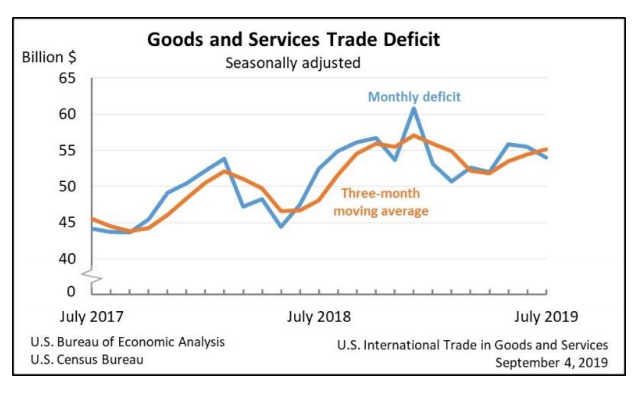
The U.S. Census Bureau and the U.S. Bureau of Economic Analysis announced today that the Goods and Services Trade Deficit was $54.0 billion in July, down $1.5 billion from $55.5 billion in June, revised.
Exports, Imports, and Balance
- July exports were $207.4 billion, $1.2 billion more than June exports. July imports were $261.4 billion, $0.4 billion less than June imports.
- The July decrease in the goods and services deficit reflected a decrease in the goods deficit of $1.6 billion to $73.7 billion and a decrease in the services surplus of $0.1 billion to $19.7 billion.
- Year-to-date, the goods and services deficit increased $28.2 billion, or 8.2 percent, from the same period in 2018. Exports decreased $3.4 billion or 0.2 percent. Imports increased $24.9 billion or 1.4 percent.
Three-Month Moving Averages
- The average goods and services deficit increased $0.7 billion to $55.1 billion for the three months ending in July.
- Average exports increased $0.5 billion to $208.0 billion in July.
- Average imports increased $1.2 billion to $263.1 billion in July.
Quarterly Goods and Services by Selected Countries and Areas
- EU: The US deficit with the European Union increased from -27,455 to -35,073.
- Japan: The US deficit with Japan increased from -15,575 to -16,251.
- Mexico: The US deficit with Mexico increased from -22,979 to -26,088.
- Canada: The US went from a surplus of $3.9 billion with Canada to a deficit of $3.3 billion in the second quarter.
China
- Quarter-Over Quarter the goods and services deficit with China fell a trivial 0.22 billion from the first quarter (-80,823) to the second quarter (-80,601)
- However, from June to July, the trade deficit with China increased from -29,643 to -30,154.
Big Wins Not
This is not winning big.
Heck, it’s not winning at all.
Skewed Reporting
For starters, trade deficit reporting is Deeply Skewed.
Take a look at the iPhone X. IHS Markit estimates its components cost a total of $370.25. Of that, $110 goes to Samsung Electronics in South Korea for supplying displays. Another $44.45 goes to Japan’s Toshiba Corp and South Korea’s SK Hynix for memory chips.
Other suppliers from Taiwan, the United States and Europe also take their portion, while assembly, done by contract manufacturers in China like Foxconn, represents only an estimated 3 to 6 percent of the manufacturing cost.
Current trade statistics, however, count most of the manufacturing cost in China’s export numbers, which has prompted global bodies like the World Trade Organization to consider alternative calculations that include where value is added.
Global Supply Chain Disruption
Global supply chains are long and complicated. Overall, China is barely running a trade surplus with the world.
All Trump has managed to do is shift supply chains from one country to another. The US has not benefited.
Even if one believed trade deficits represent a huge problem, it should be clear by now that trade wars cannot possibly be the answer.
Yet, Trump’s only solution to date has been to double with failed tactics.
Mike “Mish” Shedlock






























Germany and Switzerland have high costs …. but they also export a lot of high tech / high value items. There is no reason the USA can’t do the same.
We have had really bad leadership for the better part of a generation. I have no issue with stock buybacks (union pension funds own stocks folks! So do S&P index funds!).
I do have an issue with companies neglecting R&D. I do have an issue with tax subsidies for NFL / MLB stadiums while taxing factories out of existence.
We have a serious trade problem with China, but the long term solution lies with changes here in the USA
US has a high cost structure: Rackets for health care, education, and military spending (especially in view of the quality produced) function as a huge tax burden. Then there’s the lack of an industrial policy, poor infrastructure planning, and too much political corruption. The US undervalues tradesmen and has always relied on immigration to fill the gaps. Other than that, there’s no reason why the US should not be able to do the same as the Nordic and Rhineland countries, with the exception perhaps of the urban racial divides.
The USA can no longer be the global consumer of last resort. Too much debt and not enough GOOD job creation. Coffee barista doesn’t pay the day to day bills, much less college debts. Washington DC can’t even balance its own spending, it is absurd to suggest DC can help consumers balance ours. This was the case before Trump, it is the case now with Trump in office, and it will be the case no matter who the next US president turns out to be. It will take time for the education system to produce properly trained workers, and it will take time for debts to be worked down.
China doesn’t have an alternative consumer to export to, at least not in the short term. Their miracle economy depends on exports. This was the case before Xi assended to power, and will be the case throughout his reign. It will take time for China to develop other export markets, and it will take time to encourage more Chinese domestic consumption.
I don’t see the point in Mish micro analysing the quarterly trade numbers. Neither Trump nor Xi can do anything about long term trends in the short term.
Trump likes to stir the pot and get people thinking, so I submit all his tweeting IS working. It got the folks in Washington DC to pull their heads out of the sand and realize the status quo (losing good jobs, and getting coffee barista jobs) is not working.
Admitting there is a problem is step one. I think most people outside of the political class already know there is a problem. Its terrible that we required a guy like Trump to get the political class to pay attention. The sooner we stop hearing selfish and self proclaimed experts with tenure telling us that lopsided trade is good for us, the better.
College professors and market pundits still don’t understand that coffee barista doesn’t pay as well as manufacturing did…. and until the smart guys figure that out, Trump should keep tweeting.
[Biggest trade surpluses]
Meaningless without parameters
In absolute terms, or relative to GDP ?
Goods, goods & services, or current account ?
Then there are cases like the Netherlands, Switzerland, and Germany that have disproportionate export surpluses, but the proportion of their GDP from import/export is much greater (Netherlands >80%), and most of their trade is within the EU, which is like measuring the surplus of California or New York.
Yes, it’s complicated.
“Dumb question but is it even possible to have the reserve currency and be a net exporter?”
I believe that is an excellent question. I address that tomorrow in a post I already wrote but I will add that as a Q&A.
This is what Triffin’s dilemma is all about. In terms of accounting, it is obvious that if Mr Trump really wants less trade deficit, he should cut US government spending by about a $Trillion (or more).
China does not have a huge trade surplus, except with the US. China is distorted.
MM’s observation about Germany is correct and I noticed that too.
If Trump really wanted a trade war, he may have had better success with Germany than China. Politically, China can wait things out. Germany cannot.
That said, tariffs cannot solve this problem. It’s impossible. Have a post pending on this.
Dumb question but is it even possible to have the reserve currency and be a net exporter?
For a while after WW2, the US dollar was the reserve currency (more than now), and had a long string of trade surpluses as well as current account surpluses. Hope it answers the question.
Why would it not be? “Reserve currency” just means: Far and away most important trading partner for most of the others. Which does not, in and of itself, preclude the kind of high savings rate which show up as trade surpluses.
At some point, all those accumulated savings will end up lowering the savings rate, though; and people will start to spend their wealth. But the same holds true even for smaller, non-reserve-currency countries. So it’s probably not entirely incidental that the highest savings rates, hence highest trade surpluses, tend to be observed in rapidly growing middle income economies; where people are wealthy enough to afford saving instead of living hand to mouth; but not yet wealthy enough to feel they don’t have to save every penny they can, in order to avoid falling back into poverty again.
The biggest trade surpluses are run by:
No.1 and No.3 are among the highest cost countries in the world (and higher than US), but make high value added products.
Germany has the Euro and Swiss try to trackit.
Southern Europe has its uses to help weaken the currency as under the DM Germany would have a struggle on its hands.
So ok, yes high value products but a tail wind of an artificially low currency and mercantilist policies.
If a weak currency helped exporters over anything more than the shortest of runs, Zimbabwe would be an exporting powerhouse. Germany become an exporting powerhouse with the DMark. Switzerland did so back before debasing the Franc to please halfwits in London and ambulance chasers in the US became a national pastime. Japan with a Yen appreciating though the darned roof.
The people and organizations able to build internationally competitive product for export, are exactly the ones who are being robbed of resources by debasement. While the ones benefiting from the debasement (in the short term and/or relatively vs their countrymen) are nothing but useless dregs incapable of creating competitive anything at all, hence dependent on being kept afloat by welfare handed out either directly by governments, or even more commonly and destructively in financialized dystopias, via artificial “asset appreciation” and the distortions it underpins.
THANK YOU!!!
Germany and Switzerland have high costs …. but they also export a lot of high tech / high value items. There is no reason the USA can’t do the same.
We have had really bad leadership for the better part of a generation. I have no issue with stock buybacks (union pension funds own stocks folks! So do S&P index funds!).
I do have an issue with companies neglecting R&D. I do have an issue with tax subsidies for NFL / MLB stadiums while taxing factories out of existence.
We have a serious trade problem with China, but the long term solution lies with changes here in the USA
You’ve got a BIG education system problem, among all other problems, which can only be resolved when you’re literally down in the mud.
I want to argue with you, but I fear you are right