

Nobody Worried Yet
Retail Sales
Weak Home Sales Everywhere But Florida
Bank of Japan’s Hoard of Assets Is Now Bigger Than the Economy
https://twitter.com/GoldTelegraph_/status/1062416088971935744
Starbucks Slashes 5% of Workforce
Those are excellent Tweets that caught my eye from @dlacalle_IA@GoldTelegraph_@EconguyRosie and @LizAnnSonders.
Mike “Mish” Shedlock






























Also, interesting: The BoJ has apparently been buying the Japanese stock market. At some point they’ll be the dominant “owner” of listed Japanese stocks. Is this some kind of Communism?
The Swiss bank is doing the same thing, isn’t it?
ANY room for government to involve itself with “managing” “the economy,” is ultimately indistinguishable from full blown socialism. At best, the descent take long enough to prevent the less than erudite from catching on:
There’s no economically meaningful difference between the BOJ buying assets directly, and the Fed providing credible guidance that they will “do whatever it takes” to save the system of US commercial banks buying them, on what is effectively the Fed’s behalf.
Just as there’s no economically meaningful difference between the Swedish government sticking a gun in Sven’s face, forcing him to hand them money that they then use to pay for someone else’s healthcare; vs the US government sticking a gun in Joe’s face, forcing him to pay a nominal “insurance company”, so that said “insurance company” can then pay for someone else’s healthcare.
One is not any more socialist than the other, although the latter one may have more of the tenets of the “fascist” branch of socialism.
Economics deals with actors making decisions. If the relevant decisions of what is ultimately done, is largely planned and influenced by the state, you have socialism. Covering that up with outward trappings of nominal “private ownership,” facades of “markets,” mandates, and activist judiciaries acting in synchrony with the government, is nothing more than obfuscation. If people’s important economic decisions are not made by themselves, freely and with at most minimal interference; but rather by someone else planning, managing and deciding what they are allowed to “choose”to do, what you have is just another branch of socialism.
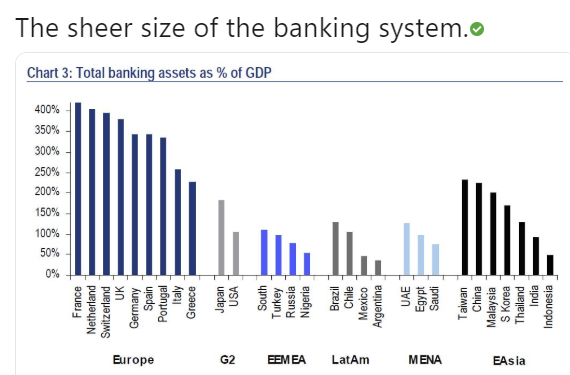
That first chart showing banking assets: How is that a parallel with your owning a house that’s worth more than your income? Far more, if you’re in France. 🙂
Or having more in the bank (so to speak) than you make?
That is, to what extent does this show that the world’s assets have become represented (quite unevenly, by country) by numbers at banks more than in the past? Given that the world’s assets are arguably more the world’s peoples than minerals, land, buildings, etc, is this a good thing, or what?
Because the Federal Reserve is buying assets using money which does not exist. So its assets increase and money is injected into the economy which did not previously exist and which the government did not print.
Actually that 1st chart is commercial banking assets, not central banking assets. Think of it this way: if just 10% of loans on the balance sheets of French banks were to go bad that would represent fully 40% of the entire country’s GDP. In the not-too-distant past the value of assets on Deutsche Bank’s balance sheet alone were much larger than the entire German economy (I don’t know what the current state of play is).
Put another way: what is the capacity of the state to bail out its banks in the event of another, larger crisis (than the GFC)?
Banking “assets” are claims on the future output of (overwhelmingly) other people. In fiat systems, their size are largely a measure of the extent to which people, their children and grandchildren have been packaged up and handed off freely as livestock to those with privileged access to freshly printed money.
In an economy consisting of a factory valued at GDP, if loans taken out by said factory were to “go bad,” that would represent 100% of GDP…. And yet the factory would keep on trucking, producing just as much wealth as it did before….. Extended to more factories, as well as farms and other productive enterprises, none of that changes.
Assuming, and this is the important part: Efficient and friction free bankruptcy processes are in place. So that the factory owners who took on more debt than what was prudent, lose ownership and control over the factory, along with the debt being eviscerated. Making room for less provenly incompetent people to take the reigns. And for less naive lenders to provide future financing. Both safe in the knowledge that ghosts from the past can’t arbitrarily be brought back to haunt and rob them down the line.
The fairytale than bankruptcy is some sort of economic calamity, is just another imaginary hobgoblin, used to scare the uncritical masses into bending over to “save the system,” despite “the system” existing for no other purpose than to rob and rape them.