

Productivity Measurement
Brookings questions the Productivity Slump. It cites measurement issues.
Much of the recent debate, and related research, on productivity measurement issues has focused on this decline in productivity in the U.S. Predating the financial crisis and the ensuing Great Recession, and now continuing for more than a decade, the productivity slowdown in the U.S. does not appear to be just cyclical in nature, but rather seems to reflect also deeper, structural phenomena. There are different views on what factors explain the slowdown. But one view challenges the very reality of the slowdown, arguing that the slowdown wholly or largely reflects the failure of the productivity statistics to capture recent productivity gains, particularly those from new and higher-quality ICT goods and services
There are two potentially important sources of underestimation of productivity related to ICT goods and services. First, if prices do not fully capture quality improvements in the new ICT products, price deflators are overestimated and real output (adjusted for improvements in quality, including product variety) is underestimated. Second, many ICT services, in particular internet-based services such as Google searches and Facebook, are largely not reflected in GDP measurement even though they generate substantial utility for consumers, the reason being that their use does not involve monetary cost as they are available free of charge to the users.
Facebook a Productivity Killer
Google searches are indeed a time-saver. But what the hell is “produced” by them. And where do the searches and Facebook playing take place?
At work perhaps. After discussing the above Brookings did come to this conclusion: “In large part, the productivity slowdown—and the associated productivity paradox—are real.”
It never explained why. Rather Brookings remains puzzled: “While recent research suggests that mismeasurement, although sizable, does not explain most of the observed decline in productivity, it must be noted that there remain unknowns and gaps in data.”
Real or Imagined
The National Bureau of Economic Research (NBER) asks Is the U.S. Productivity Slowdown a Mirage?
Labor productivity in the United States—defined as total output divided by total hours of labor—has been increasing for over a century and continues to increase today. However, its growth rate has fallen. One explanation for this phenomenon focuses on measurement difficulties, in particular the possibility that current tools for measuring economic growth do not fully capture recent advances in the goods and services associated with digital communications technology.
One reason some analysts believe that labor productivity is understated is that price inflation may be overstated for digital goods and services.
As with Brookings, the NBER concludes there is some mismeasurement but fails to figure out why.
As an aside, the NBER group is the official arbiter of recession dates in the US.
Federal Reserve Bank of San Francisco Study
The FRBSF asked the same question: Does Growing Mismeasurement Explain Disappointing Growth?
The FRBSF came to the same conclusion that mismeasurement is a problem but like the others fails to offer credible rationale.
No Hidden Productivity
The problem with the above analysis is the Fed, Brookings, and the NBER all focused on the measurement issue in apparent belief there is some sort of hidden productivity waiting to be discovered.
Mismeasurement Irony
I propose productivity is likely to be overstated, not understated because of mismeasurement.
How so?
- How many overtime hours do supervisory workers at Walmart, Target, etc., actually work while getting paid for 40?
- How many hours do employees work at home and on vacation while not getting paid for them?
Before diving into a 6-point practical explanation as to why productivity losses are real, please ponder a few charts that I put together.
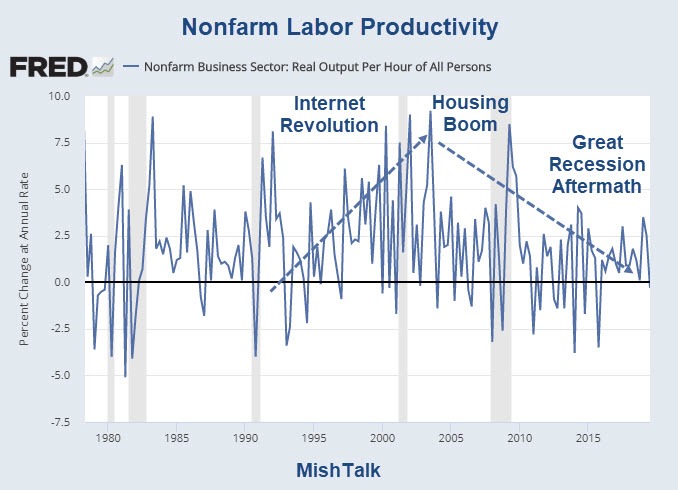
Nonfarm Productivity 1990-Present

In the above and all the following charts, I let Excel plot the trendline. The chart shows declining productivity, but it’s horribly misleading. Let’s investigate other timeframes to understand why.
Nonfarm Productivity 1990-2000
Those are the heydays of the internet revolution. Computers replaced people. Spreadsheets replaced accountants. Robots replaced manufacturing workers at an increased pace.
Nonfarm Productivity 2001-2007
Productivity soared coming out of the dotcom and 911-related recession.
By 2004, economic activity was all about housing and finance.
Nonfarm Productivity 2009-2019
Productivity soared coming out the the Great Recession as is the case coming out of any recession. Since then corporate productivity has been anemic.
Manufacturing Real Output vs Employees
From 1990 until 2008 manufacturing output per employee skyrocketed. Both plunged in the Great Recession and the trends are now positive but output per employee has slowed to a crawl as the number of manufacturing employees has been on the rise.
This indicates decreasing marginal utility of robots, lower worker skill sets, or both.
Obesity Trends
Chart from the National Institute of Health.
Obese workers have more health-related issues and thus need more time off. They also move slower and do not function as well as healthy workers.
Rise of the Zombies
Zombie firms are companies that are unable to cover debt servicing costs from current profits over an extended period. Cheap financing is the primary cause. The result is low productivity.
Please review Rise of the Zombie Corporations: Percentage Keeps Increasing
Collective Bargaining with Militant Unions
On October 31, I asked Chicago ISM Crashes: How Much is GM to Blame?
I do not pretend to have the answer, but GM agreed to a lot of worker protections, guaranteed hours, plant improvements, etc, that will not make any sense if there is an economic slowdown.
Chicago also just settled its teacher strike to which I commented Chicago Headed for Insolvency, Get the Hell Out Now
Chicago Teacher Contract Details
- 16% raise over five years (not including raises based on longevity)
- Three-year freeze on health insurance premiums
- Lower insurance copays
- Caps on class sizes
- More than 450 new social workers and nurses.
- New job protections for substitute teachers who going forward may only be removed after conferring with the union about “performance deficiencies.”
- Chicago Public Schools will become a “sanctuary district,” meaning school officials won’t be allowed to cooperate with the Immigration and Customs Enforcement without a court order.
- Employees will be allowed 10 unpaid days for personal immigration matters.
- Under the new contract, a joint union-school board committee will be convened to “mitigate or eliminate any disproportionate impacts of observations or student growth measures” on teacher evaluations.
- Instead of student performance, teachers will probably be rated on more subjective measures, perhaps congeniality in the lunchroom.
- The new union contract caps the number of charter-school seats, so no new schools will be able to open without others closing.
Points four through 11 are all productivity killers.
Soaring Fiscal Deficits

Government does not spend money wisely to say the least. It collects money via taxes then wastes in on counterproductive military operations and other nonsense.
When it spends on infrastructure, it overpays because of prevailing wage laws and collective bargaining.
For further discussion of the debt vs deficits, please see Budget Deficit Lies: What’s the Real Deficit?
It’s the Debt Stupid
It takes $103 in public debt for a $100 increase in GDP.
Build up public debt, expect lower productivity.
Interest on the National Debt
According to Treasury Direct, Interest on the National Debt is $574 billion.
There is nothing remotely productive about paying interest to banks.
Corporate Buybacks
Trump’s tax cuts did not spur investment as claimed. Corporations took the cuts and another repatriation holiday for dividend and buybacks.
In addition to using profits to buy back shares, some companies went further into debt to buy back shares.
If you skimp on investment, don’t expect productivity miracles.
Real Productivity Decline, 10 Simple Explanations
- The internet boom and the rising productivity associated with it were very real. The rate of change in internet-related improvements has fallen since 2000.
- Decreasing marginal utility of robots.
- The Fed’s easy money policies sponsored numerous corporate zombies. Those zombies survive only because of ultra-easy financing. Zombie companies are unproductive, by definition. Things are even worse in the EU because of negative rates.
- The Fed’s easy money policies also sponsored a “store on every corner”. There are far more retail stores, restaurants, fast food establishments, and outlet malls than needed.
- Marginal stores have to be manned by somebody and they are, by increasingly marginal employees as the unemployment rate declines.
- Demographics. As skilled workers retire, those workers are replaced by workers with lower skills.
- Health issues in general. Obesity and drug-related issues are on the rise as are time off for those reasons.
- Militant unions demand and receiving unwarranted pay, time off, and control over workplace conditions.
- Corporate buybacks mainly benefit CEOs and executives who cash out their shares and options. It takes careful investment, not reckless expansion, not buybacks to have productivity gains.
- It’s the debt, stupid. Fiscal deficits are totally out of control. Interest on the national debt by itself is $574 billion. What are we getting for it?
Looking in the Wrong Place
The San Francisco Fed, Brookings, and the National Bureau of Economic Research all struggle to explain falling productivity.
They can’t come up with the answer because they all have a spotlight on mismeasurement (and in the wrong direction at that, failing to count supervisory overtime and hours worked at home).
But there’s the answer, in ten easy to understand points, supported by data, logical analysis, and graphs.
By the way, this enormous buildup of debt at every level is hugely deflationary. Bubbles do burst eventually.
Mike “Mish” Shedlock






























I’m not a scientist, but I think one of the reasons of declining productivity might be the lack of the right productivity tools. And I say that because my team had been doing a lot worse before we started to use kanbantool.com
Interesting post, yet supervisors and also team leaders additionally need to comprehend what encourages people separately in order to react to their requirements when handling performance. I had one team member who was adamant that their only incentive was ‘even more cash’ and also in a disciplined wage framework this can not be suited, bring about contravene previous supervisors. Also there is help with students https://subjecto.com/ here. Conversation revealed that more obligation, which might result in promotion, in fact fulfilled the person’s need as well as boosted their performance.
But not only performance is falling. Now, fewer and fewer people get a good education, less and less read. Its importance has disappeared with the development of technology. Everyone thinks: why should I strain and go to uni, if I can go to courses at any time, and will be taught everything from scratch? Why should I write, for example, a dissertation or an essay, if I can buy it, check for plagiarism on https://noplag.com/ or somewhere else, and enjoy life? It’s scaring …
People must have reached their limits. After all, the same employers are trying to automate processes everywhere, and then complain about lower productivity. It’s ridiculous. People are used to stability. People know that they will not die of hunger if they do not work out the maximum possible hours. If a person has lost his job, then he can always find another job, because the job market is full. This is what we’ve come to. I understand that employers do not like it, they want to squeeze more work for less money. But nobody wants to strain and that’s alright
With regards to demographics, millennials for the most part have delayed family formation. Once you are the head of a household, you suddenly care a great deal more whether you get fired or not, and whether you get raises or not. Suddenly productivity goes up a great deal. If you look back, productivity growth was horrible in the 1970s, as baby boomers entered the work force, but once we formed families, a productivity boom started that lasted a long time.
Facebook and the like are a huge waste of time, completely pointless nonsense. But humans invented procrastination long before Zuckerberg, and after Faceplant goes the way of AOL and Cabbage Patch dolls — there will be other wastes of time. This isn’t the problem (or its not a new problem anyway, procrastination has been with us for centuries).
Cost justifying a bloated government bureaucracy (this includes the bloated faculty on college campuses, and the bloated administrative staff infesting big hospitals) is choking the real economy.
And the cost of servicing all forms of debt (including empty pension “promises”) diverts resources away from building for the future.
The decline in productivity is due to the slowing of the effect of technology as a large net gain in productivity. It is also because as humans get automated out of jobs human productivity can only fall. Looking at traditional metrics in the era of automation wont work.
I disagree partially with this. The industrial revolution of the 19th and through the mid-20th centuries was the period of the highest growth in productivity in human history. And it was all about the application of technology in the form of machines to human production.
The difference though was that the early industrial revolution caused such a vast collapse in prices that that whole new industries popped up and demand for goods and workers surged. In the second half, labor unions captured the increased productivity in the form of wages and, again, demand grew along with the need for workers. Government at all levels promoted employment in the USA by developing the suburban lifestyle which promoted demand for houses, cars, washing machines, etc…
The problem with current technology is that it doesn’t really cause that great a surge in demand or lower prices, and to meet what demand is created, production is moved offshore so American workers aren’t employed. Monopolies (Apple, MS GOOG) control markets and pricing so prices can’t collapse, workers are left without labor representation so they can’t capture productivity gains, so the whole system suppresses the natural demand historically created by technology improvements.
Basically the productivity gains have gone overseas because of the effects of globalization. I would agree with your take overall. Another reason traditional domestic metrics don’t work is because of the impact of the American economy on the world. A generation ago most of the good would have been to America but now the benefits get globalized. There was a Harvard paper about who benefits the most and is hurt the most by globalization. It concluded emerging economies benefited the most and the middle class in America, Europe and other developed countries were hurt the most.
Are there more government workers as a percentage of the economy?
Also, what are wages working for the state like, better than the private sector?
If you have higher public sector wages than in the private sector, overall productivity will fall as the most productive workers will gravitate towards the non-productive state sector. Likewise if you have more state workers as a percentage in total, then again productivity will fall as a greater percentage of workers move into less productive work.
That is my theory at least, do the statistics give it any credence?
Maybe a lot of people in our divided and dysfunctional society simply don’t give a rats ass. Work all the time to be broke all the time. How motivating is that? Plus plenty of evidence by looking at your elders that’s all that you’re ever going to be. Getting skills etc is a different topic than what I mentioned. Also, a large % of the population are working jobs that fit into the ‘why do I even bother getting out of bed’ category. And if they think robots are the solution ill be interested in hearing how these robots are going to buy the crap they make. Then maybe I dont as future headlines could read ‘worlds richest robot’.
I personally know a few govt workers id say there about as productive as a snowthrower in july. Except on their days off. Beyond me how most of them I know are in labor positions and if I ever help any of them they are near complete worthless and get winded easy.
I might add its ironic to listen to them cry about socialism and how their taxes are paying welfare. Overall pretty disgusting.
How about the ongoing consolidation of companies? We went from 7000 or so companies on the NYSE to under 3000 today. At some point businesses no longer scale, because internal communication becomes increasingly difficult. So management engages in endless reorganization schemes that never seem to pan out.
Companies who are duopolies or regional monopolies tend to sandbag when it comes to earnings and margins. As long as they can blame “weather” for sales misses and watch the stock go up with buybacks, everyone’s happy to slap themselves on the back with praise for their business acumen.
They might not be zombies by definition because they have profits, but they’re not growing, they’re just acquiring. Startups aren’t built to disrupt a market, only to augment existing businesses and become acquisition targets. With no one to rock the boat, everyone just heads to the buffet (or Buffett, see #2).
Everyone wants to be a cable company. Instead of trying to sell a new product, they want everyone on a monthly subscription. Once you get everyone on a subscription (and your competitor does the same), it all becomes a zero sum game. All you can do is try to get customers from your competitor. Worse still, any interaction with your customers become a threat to the monthly bottom line. Innovation is all about controlling costs, not increasing the size of the pie.
There simply isn’t a lot of room for productivity growth in a service economy. Cutting hair takes as long as it takes. Manufacturing is where you get productivity growth through the design and creation of new tools and materials.
So productivity growth can only really grow along with the portion of the population employed in manufacturing.
And investment in manufacturing only happens when there is either an increase in demand or an increase in costs, primarily wages. And since wages have been stagnant over the last 40 years, there is little increase in demand or labor costs. Ergo, no need to invest in increased productivity.
Central banks are subsidizing global entropy and it’s working for them. It’s nature’s preferred steady state after all.
Productivity of workers is not measured by how many hours it takes to make a buggy whip, it is a measure of the labor costs to produce profit for a corporation.
If the cost to rent labor goes up but output is the same then productivity goes down.
If it used to take $1 to produce 100 widgets but now it takes $1.02 to make 100 widgets productivity has gone down by 2%.
But, you cannot realistically measure this any more than you can unemployment or inflation. The data is entirely fictional. The stock markets move trillion every day on mere rumors That Xi and Trump might be close to a deal, in a trade war that never needed to happen, and you are worried about turbulence in short term productivity data that is so bent it is actually worse than useless?
Look at what driven economic activity for the last decade……GOVERNMENT ,more specifically the military,welfare,prison industrial complexes,which means if your only driver of growth is ever increasing govt to drive growth…..then kiss anything near productive goodbye!
No 6. is very true. I see this everyday at the office. An older guy, real SME on this or that, retires. Nobody to replace him. Skill lost. Corporate does not give a crap. Management does not even try to replace those skills.
There is one factor that drove the 1990s productivity surge you forgot to mention – namely the collapse of the communist bloc and the transformation of the Eastern Bloc countries into market economies and the associated boom in global trade. This is not only not repeatable, but Western countries are now moving in the opposite direction, toward ever more central planning and socialism (and if the climate hysterians get their way, the complete abandonment of modern civilization).
Then under that theory productivity should be surging now as regulations have been dropped under the current administration.
????????????
exactly in which alternaverse did that happen? Twitterverse?
Here in reality: Government spending is up; Fed interventions greater than ever; and massively distorting, direct interventions like arbitrary tariffs and threats thereof at an all time high…..Some “dropped”…..
Agree, but a lot of that increase is for the military and some of that money is used for basic research – that hopefully will improve productivity. But sorry OSHA, EPA, banking, agriculture, interior, energy regs all being pulled back at the direct request of the impacted industry. So where is the payback?
Where the regulations have decreased, first order productivity has increased. This encourages businesses to
a) invest in plant/equipment, which raises productivity
b) invest in training employees, which raises productivity
c) hire new employees, which at first lowers productivity
d) raise salaries of existing employees, which decreases productivity
e) share buybacks/raise dividends, no direct effect on productivity
f) increase startups, which probably at first decreases productivity
From 2009-2019, we got very little of a) and b), and lots of c), d) e) and f).
In addition, e) tends to decrease executive productivity, as they will focus on financial engineering more than plant engineering
So, deregulation can lead to a decrease in measured productivity, while at the same time increase national wealth, as it does not consider newly employed people going from zero productivity to some productivity.
Another factor in productivity gains: offshoring. Especially in NA, the creed of the day was; everything requiring extensive productivity killing manual input should be off-shored. That has run its course.
You’re right, there was a creeping development on the social engineering side. Generally worthy subjects are being hijacked by semi intellectuals in institutions of learning. Let’s skip the LGBTQ part of the “neo-enlightment”. The focus is on the West and its consumption model alone. Never with a long pole would any of these touch the major disaster of population explosion because it’s happening in the third world.
Growing CA pension costs hitting cities and fire districts – hard https://calmatters.org/commentary/pension-costs-taxes-firefighters/
The headline for the article is actually wrong. The headline says “Declining Productivity”, but should say “Declining Productivity Growth”. Productivity is actually still going up, just is going up more slowly.
It’s the Slacker Revolution, or whatever.
I would say that the list of 10 is excellent analysis and why I come and read this.
I’m in manufacturing and we see productivity flat and all of the “new robotics and digital revelation” improvements as way over hyped. Most fail to achieve the improvements expected. Because of the poor return on investment of the new technologies, businesses are reluctant to invest. For us, the return just isn’t there.
I would submit that it is kind of hard to do an apple to oranges comparison. Sure a google search saves you a lot of time compared to looking things up the old-fashioned way, but without printers and copy machines and computers, you would never even think of doing many of the things you do. The same applies to spreadSheets and databases and many other parts of the economy — a lot of action that was not permissable without technology.
Of course you can measure productivity in terms of added value in inflation adjusted numbers, but how are you measuring inflation, is pricing in a world with a globalized economy (including people in the third world working for next to nothing) comparable, are assets comparable?
What I see are a lot of people working harder than ever, a lot of people doing completely useless things (whether working hard or not), and a lot of people that have it pretty slack, or are being pretty ineffective. All in all, it seems too hard to compare in a meaningful way. Remains true that some things that used to cost a week’s wages can be had (functional equivalent) for pennies.
what is capitalism? https://www.currentaffairs.org/2019/11/the-dictionary-of-capitalism
Surprised you mention obesity, but not the continual increase in the number of old people in the work force. A lot of them are probably less productive at 75 than the same individual was at 25 or 35.
point 6: Demographics. As skilled workers retire, those workers are replaced by workers with lower skills.
One important point you miss is that the Federal Minimum wage has not gone up since 2009. When minimum wage goes up, it always spurs a big investment in automation, while the least efficient employees are terminated. Increased automation does eliminate low wage jobs, but in the process, increases productivity. If the minimum wage does get bumped to $15, as some want, expect a lot higher unemployment, but much higher productivity.
I buy 3, 4, 7, 9, and 10. Plus lots of underemployment of very capable people and cronyism permeating all levels of our society especially the public sector.