

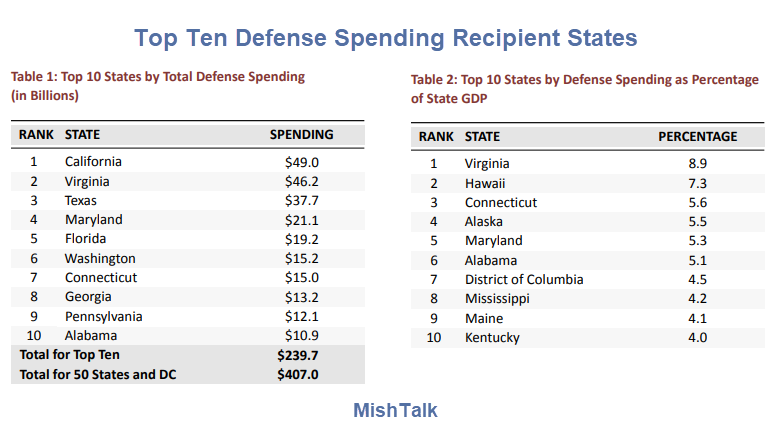
Please the US department of Defense report on Defense Spending by State for fiscal year 2017 as revised in March of 2019.
Conducted between June 2018 and November 2018, the analysis primarily entailed an examination of DoD prime and sub-contract award data and of defense personnel and payroll figures, which become reliable for analysis in March of each year. This report’s findings are drawn from numerous sources, including the DoD’s Defense Manpower Data Center; the U.S. Department of Commerce’s Bureau of Economic Analysis and Census Bureau; and USASpending.gov, which is managed by the U.S. Department of the Treasury.
Overview
In FY 2017, DoD spent $407 billion on contracts and payroll in all 50 states and the District of Columbia, approximately $1,466 per U.S. resident. This spending accounted for 2.3 percent of the country’s gross domestic product (GDP) in 2017, and was higher as a share of GDP than the $378.5 billion spent in FY 2016. Of these funds, $271.7 billion (67 percent) was spent on contracts for various products and services, while the remaining $135.3 billion (33 percent) paid the salaries of DoD personnel. Most contract spending went to supplies and equipment (51 percent) or services (38 percent). The remainder supported research and development (8 percent) or construction (3 percent). Personnel pay was allocated fairly equally amongst active duty military (41 percent), the National Guard and the Reserves (31 percent), and civilians (28 percent). With regard to total defense spending by state, funding varied from $393.6 million in Wyoming to $49 billion in California, averaging $7.98 billion per state. Almost 59 percent of that funding ($239.7 billion) went to 10 states.
If this funding is examined as a component of the states’ economies, a slightly different picture emerges. On average, defense spending accounted for 2.3 percent of all states’ GDP in FY 2017, ranging from 0.5 percent in Oregon to 8.9 percent in Virginia. The defense spending of $1.3 billion in Oregon, for example, was a small portion of its $240.7 billion GDP, while Virginia’s $46.2 billion in defense spending accounted for a relatively larger segment of its $517.6 billion GDP.
Top Defense Contractors

Top Spending Locations

There are 128 pages by state, down to the county level.
Vote Buying
This is how and why people support perpetual war.
Anyone who does not support perpetual war is labeled “weak on defense”. And of course, no Congressmen ever turn down projects in their own district.
Finally, much defense spending is hidden. Homeland security costs are not considered “defense”.
Perpetual War
In reality, hardly any of this spending is “defense”. It’s primarily “offense”.
We need to make enemies to support perpetual war.
Mike “Mish” Shedlock






























Thanks for helping publicize this interesting report. Journalism in the spirit of I.F. Stone, who used the government’s own reports to help keep it accountable. I wish I had the time to use this report to detail what I believe to be true: that the Pentagon’s procurement office has a significant presence in every congressional district in the nation. If I am right, this has almost unfathomable political consequences for perpetuating permanent war.
Hey Mish,
I would like to know how they break down the statistics. My former employer was a high volume machine shop that did about 30% of business with defense contractors. As an example, we had a big program with Raytheon years ago. Raytheon is based in MA. We did our sub-contract machining in Florida. Product was shipped to a Raytheon facility in Tennessee for final assembly. Assuming the contract was issued for a total of $10 million to Raytheon in MA, and our sub-contract work in FL amounted to $1 million, and the assembly work in TN amounted $7 million, where are the dollars accounted for??
Defense spending is our version of MMT.
California is at the top of this list?!
Calif is the biggest state by far in terms of population and GDP (state). On a per capita basis, the spending is in the lower 50%. California has 11 times the population of Connecticut (7th on the list), but just above 3x the defense spending.
There are also geopolitical reasons to have more defense on the west coast. If a Russian or Chinese ship were to encroach on the US coastline, it would likely happen on the Pacific coast.
In the Golden Years of budgets under the Eisenhower Administration, spending on defense was about 50% of the federal budget.
Today, spending on defense is about 16% of the federal budget. Entitlement spending is about 65% of the federal budget.
You’re speaking as if that’s not a good thing.
If we made defense spending 90% of the Federal budget, solely by getting rid of almost all the rest of the nonsense the government is involved in, that would be a good thing compared to where we are today….
Entitlement is the wrong word. Most of entitlements is money that was paid in by the taxpayer for future return. If defense companies want more defense spending they are welcome to lobby and pay higher taxes.
No it wasn’t. If it was, there would be a pile of money sitting around, which was “paid in.” Which could then be returned.
There isn’t. Hence there wasn’t.
A huge percentage of our national creative capacity, and the world’s, is locked into “defense.” Much of the rest is invested in lawyers and CPAs.
A very interesting and potentially instructive experiment was inadvertently conducted in the early 1990s at the end of the Cold War: 440,000 weapon systems development people were dumped on the street with no jobs. They promptly invented the web; No, it wasn’t Al.
I wish I had a better answer as to how we prevent the Tojo, Stalin, Hitler types plunging us into war than the fear of defeat.,
Maybe we have it already, in the form of Nukes.
How much defense spending is too much? I don’t think it’s possible to know the answer until that line of tanks coming over the hill has the wrong markings on them; Then you know you’ve been spending too little.
The “web” was invented by the DoD. It was a DARPA project.
Same goes with GPS, cell phones, radar, jets, space travel, TV, etc.
The “Internet” was arguably a DARPA project. The “Web”, as in hyperlinked www, was invented at Cern.
Regardless, I’m fairly confident we would have the wheel today, even if that one guy who happened to first invent it, had been stomped by a mammoth before getting around to it.
In spite of what patent trolls, and starry eyed progressive drones “edumecated” by watching cheesy Hollywood movies, might claim and/or believe: Inventions are 98% standing on shoulders, 15% random noise, and 1% individual inspiration.
We already spend more than Russia and China combined. The last I read the DOD budget was about the next 15 top spending countries combined. I suspect we are spending to much on this as well as entitilements. I am sure they could figure out the optimum amount of defense spending if they wanted to. They don’t . Unfortunately the need for defense spending is a necessary evil. If you want peace prepare for war.
There is no state of war. Defense spending merely keeps the economy going. As time goes by the US has become a more closed economy with government spending driving most of GDP. Without it there would be meager growth to speak of as defense spending is one of the few productive spending measures the government does.
There nothing whatsoever “productive” about building craters all over the world. If you instead phrased it as “one of the least counterproductive things government does…), you may well be right. But then we’re back to picking favorites among turds in a sewer again…
Right. The US has industrial policy shielded from competition; it’s called the Pentagon procurement budget.
Mish: Anyone who does not support perpetual war is labeled “weak on defense”.
I didn’t know late nite talk show host Stephen Colbert was a war hawk. He had no love for Tulsi Gabbard, when she appeared on his show.
Many countries used to have a “Ministry of War” instead of a Department of Defence. Labels and narratives change, but their activities are pretty similar. There would be something satisfying about having a Pompeo labelled as Secretary of War and Bolton as War Strategy counsellor . And when was there ever a war that was not launched pre-emptively against the aggression of the other party. Whenever was offense not the best defence?
“Whenever was offense not the best defence?”
Always.
It’s almost impossible to construe a situation where defending a geography, is not more resource intensive than taking it. Literal superpowers serially striking out, fighting cave dwellers on the cave dwellers turf in Afghanistan, may be an extreme example; but wrt offense vs defense, that theme is universal. It takes much more might, to be the attacker, than the defender. For Russia, it took virtually no military might at all, to defend against the most powerful armies on earth. First Napoleon’s, then Hitler’s…… Yet, despite a military vastly more powerful, things didn’t work out so well when they attacked the Afghans…
The only reason “offense is the best defense” is even a saying wrt military action, is because every military officer already knows the above, and only attacks those who they are confident are much weaker than themselves. And then try to excuse their aggression by pretending it was defensive in nature. Well defended locales, those sporting a rifle (or more) behind every lade of grass, simply don’t get attacked at all.
In non military arenas, like games, sports and suckerpunching/jumping/surprise-attacking individuals and small groups; the saying may well make sense. But at the scale of modern nation state militaries, it’s nothing but mindlessly regurgitated nonsense. The discrepancy in resources required between the attacker and defender, is just too great.
“It’s almost impossible to construe a situation where defending a geography, is not more resource intensive than taking it.”
Not sure why editing comments no longer work, but that was intended to read the opposite way….
Methinks some have not detected the tongue by jowl nature of the last two (ironic) sentences. The aggressive party always claims it was forced to act pre-emptively by the other one. 1000 years of Roman conquest and aggression, but all their wars were puportedly to defend the empire against agressors ! In modern times, aggression is considered (under international law) to be the most serious and emblematic of war crimes, the seed of all others. That’s why Libya Iraq Serbia Somalia Niger Yemen Venezuela Syria Nicaragua Panama and Grenada are such rogues — they all attacked and endangered the continental United States.
🙂
I guess I need to lighten up sometimes…..
“Whenever was offense not the best defense?”
A: When your military vastly exceeds the opponent. When you have unlimited military budget, you have to look for enemies.
One example out of many:
Napoleon’s invasion of Russia when the latter was practically suing for peace, despite the fact that Napoleon reneged on their peace treaty (treaty of Tilsit).