

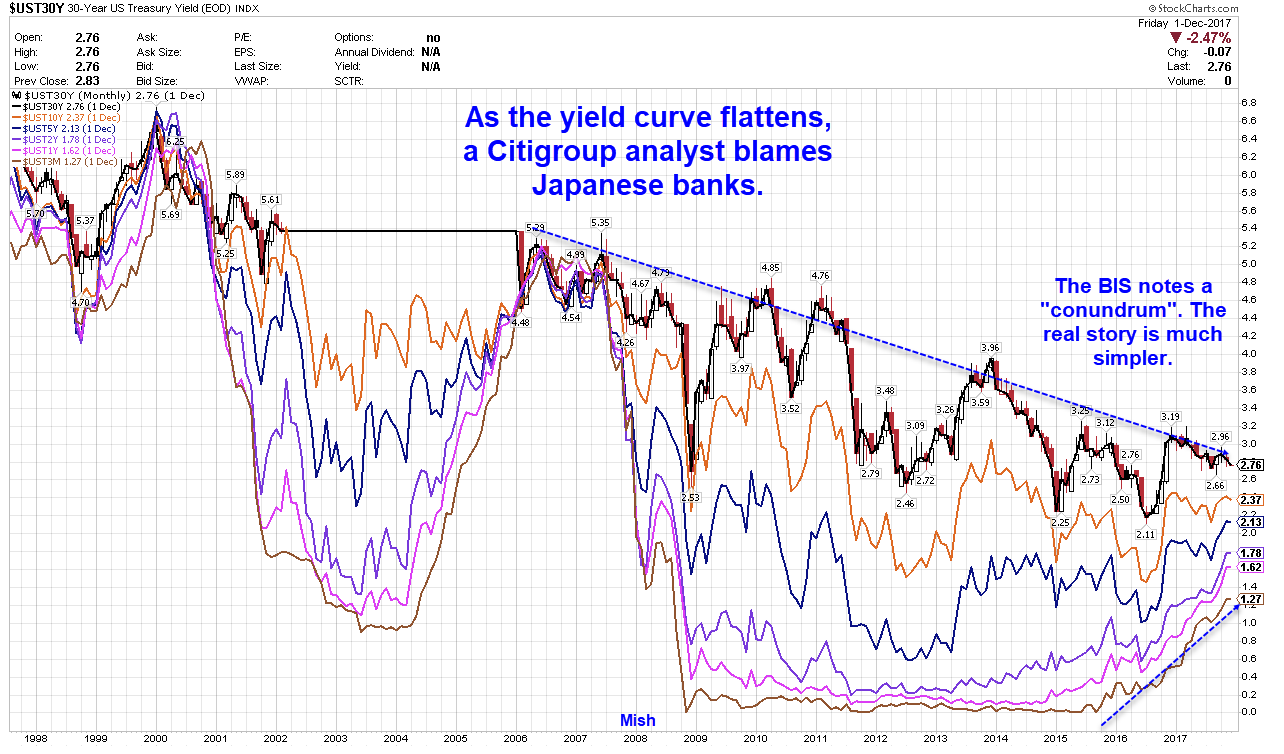
A Citigroup analyst says don’t worry about the flat yield curve. Instead, Blame Japanese Banks.
“We believe that the latest leg of curve flattening has been, to a large extent, driven by front-end selling from Japanese banks and back-end buying from domestic pension funds, and we expect these flows to continue into next year,” said Citigroup strategists led by Jabaz Mathai in a note on December 1.
Under this theory, Japanese banks plowed into 5-year and under duration treasuries and are losing money because of rate hikes. Japan has now given up. Meanwhile, US pension funds, flush with profits, are plowing into long duration treasuries.
The fact of the matter is that pension plans have not recovered to healthy levels despite this rally.
BIS Conundrum
A BIS Quarterly Report makes this claim: Paradoxical Tightening Echoes Bond Market “Conundrum”.
An elusive tightening
Financial conditions have conspicuously eased in US markets over the last 12 months, despite the Federal Reserve’s gradual removal of monetary accommodation. After raising the federal funds rate target range for the first time in almost 10 years in December 2015, the FOMC has taken several further steps in that direction.
Since last December, it has raised the target range another three times, amounting to 75 basis points. Finally in October, it started the process of trimming its $4.5 trillion balance sheet, in a move for which it had been preparing financial markets at least since its March meeting.
Yet investors essentially shrugged off these moves. Two-year US Treasury yields have indeed risen by more than 60 basis points since December 2016, but the yield on the 10-year Treasury note has traded sideways. Moreover, the S&P 500 has surged over 18% since last December, and corporate credit spreads have actually narrowed, in some cases significantly.
Overall, the Chicago Fed’s National Financial Conditions Index (NFCI) trended down to a 24-year trough, in line with several other gauges of financial conditions.In many respects, the current tightening cycle has so far been reminiscent of its mid-2000s counterpart. At the time, Federal Reserve Chair Alan Greenspan had characterized the fall in long-term yields as a “conundrum”.
Greenspan’s Conundrum
What do 1999, mid-2000, and now have in common?
Amazing exuberance that nothing can go wrong at precisely a time when everything is likely to go wrong.
I recall full well Greenspan’s Conundrum in 2005. Some snips from that 2005 article are pretty amusing.
Greenspan said he was not certain what an upside-down rate structure would mean this time around. Lapsing into characteristic Fedspeak, he responded to a question from the audience in Beijing by leaving himself plenty of room for error, saying, “I’m reasonably certain we would not automatically assume that it would mean what it meant in the past.”
In prepared remarks, Greenspan said it was “credible” to think that low long-term rates are signaling economic weakness but said that seems unlikely because “periodic signs of buoyancy in some areas of the global economy have not arrested the fall in rates.”
Dot Plot Conundrum

In addition to Greenspan’s historic conundrum, we have a current BIS conundrum, and a DOT plot conundrum.
The market does not believe the Fed will hike as much as the Fed believes it will hike.
It’s difficult to pin that on Japan.
No Conundrum Then or Now
Economists are in a deep search for evidence that bond market yields are “unlikely” to be signaling weakness.
Since that is what analysts want to assume, it’s hardly surprising they found some data that fits the curve.
In 2005 I said there was no conundrum. Rather the bond market was starting to price in a housing-related calamity.
This time, rational individuals note a “Carrot Top” and a Generational Chance to Sell Equities.
When these bubbles burst, treasury yields are going to crash, and from already amazing levels.
Mike “Mish” Shedlock






























or TS they can exchange dollar debt for sovereign debt, or debt in some other currency. its hard to imagine a currency contraction because all currencies are priced relative to one another, so if they all shrink, it looks as though nothing has happened, but of course it has
in the one off between fiscal and monetary policy, the fiscal side has weighed in with tax cuts, (revenue holiday? and still holding out on the fiscal stimulus package) which leaves it to monetary policy to make things work, and that likely means a BAIL-IN of investors/ depositors/ and asset owners.
the Fed could effectively REFI its outstanding debt at a much lower rate. when rates go negative you you are taking the buyers money and he is paying you to do it. since we can’t raise taxes it might get some revenue coming in.
TS you don’t suppose the flight to safety in a market crash would bring down the 30yr as well? The long bond market is like a big ship, it doesn’t turn easily, and with government monetizing in 30yrs, settling the trade deficit with China using 30yrs, not to mention all the investors (pension funds) who actually buy them to use as bonds, as well those who buy them to collateralize and speculate on stocks. The dollar will only crash in so far as other currencies are rising, or in this instance crashing. The dollar could well not move one bit and be worth a lot less.
“Treasury yields are going to crash”, you’re right. I see in a variety of charts, HYG. Gold which could break the $1000 mark. Crude could lose 50% AGAIN. At least as far as RE goes, asset prices should hold or actually rise as the cost of servicing that debt is once again dropping. The moment when the Feds cold dead fingers are pulled from the levers of the rate hike normalization machine will happen when Congress storms ME (just ahead of the mob that wants their heads). First you screw us by taking away what HC options we had, then you give the rich our tax cut, and then you raise rates to put the crimp on consumer credit spending so we can’t put that cancer operation on our credit card. Shame on you.
The flip side of this is that we are in a bond market bubble and that those in charge are not fully in control of the situation. Never before do I remember seeing so many predictions of interest rates remaining low forever and a day. Many of us have a problem lending hard earned money out for a long period of time and we should be wary. Rates are based on predictions of future government deficits and events around the world that may or may not unfold as expected. The article below delves into whether the bond market is a bubble phase and the ramifications facing us if it pops.
http://Bond Market Bubble Ending has Massive.Ramifications html
” In 2005, congress changed the bankruptcy laws. They knew what was coming. In 2014, the G20 changed the rules for depositors. They know what is coming.” I’m guessing its not a stretch to see negative interest rates during the next recession (depression). The banks wont let you take your money out and to top it off, charge you interest for your money which they don’t have.
Excellent points Ron, but “They” does not include Congress or then-president Bush. The bank lobbyists had an inkling for sure.
“In 2005 I said there was no conundrum. Rather the bond market was starting to price in a housing-related calamity.” In 2005, congress changed the bankruptcy laws. They knew what was coming. In 2014, the G20 changed the rules for depositors. They know what is coming.