

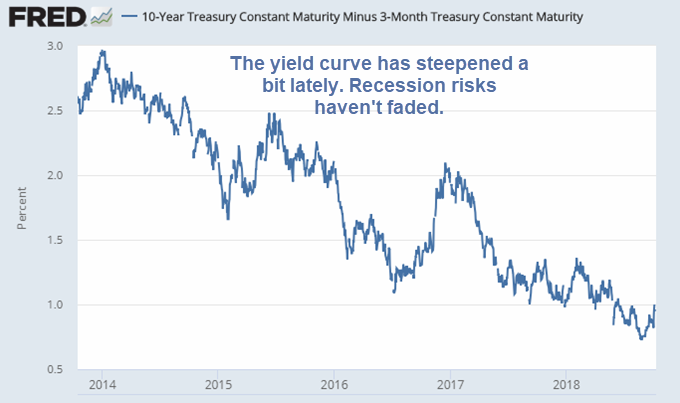
Yield Curve Debate
A longer-term picture will put the steepening in perspective.
10-Year Minus 2-Year Treasury Yield

The yield curve has not inverted this time. But what if it doesn’t. There is no universal law that says the yield curve will invert before a recession. Look at Japan for proof.
With so many eyes on the yield curve flattening, perhaps it doesn’t.
Mike “Mish” Shedlock






























The 10-yr UST interest rate is no longer a market rate, due to the selling (manipulating) of long term Treasury prices by the Fed. Quantitative Tightening is surely pushing the interest rate higher than it would be otherwise. The inherent intelligence that is transmitted by rates and curves is now muted. Treasuries sold off during sharp stock market downturns in March and now in October. That is exceedingly rare, and demonstrates that the Fed is triggering selloffs via QT and hiding the danger signals that would be there. The Fed is engineering the end of this cycle and wants a recession. Beware.
McDVoice, also known as McDonald’s Customer Satisfaction Survey is conducted on https://mcdvoicecom.club/. In this survey, you are allowed to share your views and opinions openly.
From Hoisington.com
As this chart reveals, if this yield spread is still positive but falls below +40 bps, there is a more than reasonable possibility of a decline in economic activity. The spread is quite variable, but at +73 bps, which it was in August, is close to the +40 bps level which would signal an outright recession. Two more 25 bps hikes in the Federal Reserve target rate may be sufficient to move it to a full recession signal.
From Hoisington.com
A great deal of analysis has been done on this subject. Recently, San Francisco Fed economists conducted a study on various spreads in the treasury market. Using monthly data from January 1972 through July 2018, they looked at each spread and predicted whether the economy would be in recession 12 months in the future. The study found that the ten year-three month (10y- 3m) spread was the “most reliable predictor” in signaling a recession. One of their conclusions, however, was that while the risk of recession might be rising, the flattening of the 10y-3m yield spread does not currently signal an impending recession. They also correctly pointed out no causality. The spread at the time of the article was +100 basis points (bps), or 1%. As recently as late August, the spread was down to the low 70s, but, quite volatile, it has recently reversed higher.
As Dr. Hunt explained, debt is deflationary…and we’re drowning in it!
I suspect that quantitative easing will go down in history as one of the greatest frauds of all times, but it did make bankers and Wall Street executives fabulously wealthy.
“The current 30-year treasury rate at 3% seems ridiculously low. In the near future, at 1.5%, the 3% yield will seem generous.”
Note than in all the cases above, the recession started after the rate curve began to steepen again.
Correct. One could easily conclude it is the steepening that actually causes the recession, but that the inversion or (in 2018, the near inversion) simply provides the opportunity for rapid steeping which brings on the recession. Kind of like a tsunami. The tide goes way out, and then . . . .
In fact, the recent steepening may be the very signal indicating that recession risk is now rising.
How can anyone come to that conclusion?? Consumer spending remains white hot, job growth remains white hot, jobless claims look like they may come in at under 200,000
Ummm auto sales crashed in September. Jobs are far weaker than implied as new grads haven’t been hired in significant numbers for much of the past decade and thus aren’t even counted as unemployed. Jobless claims require that people have previously had employment in order to make a claim. Inflation is crashing.