

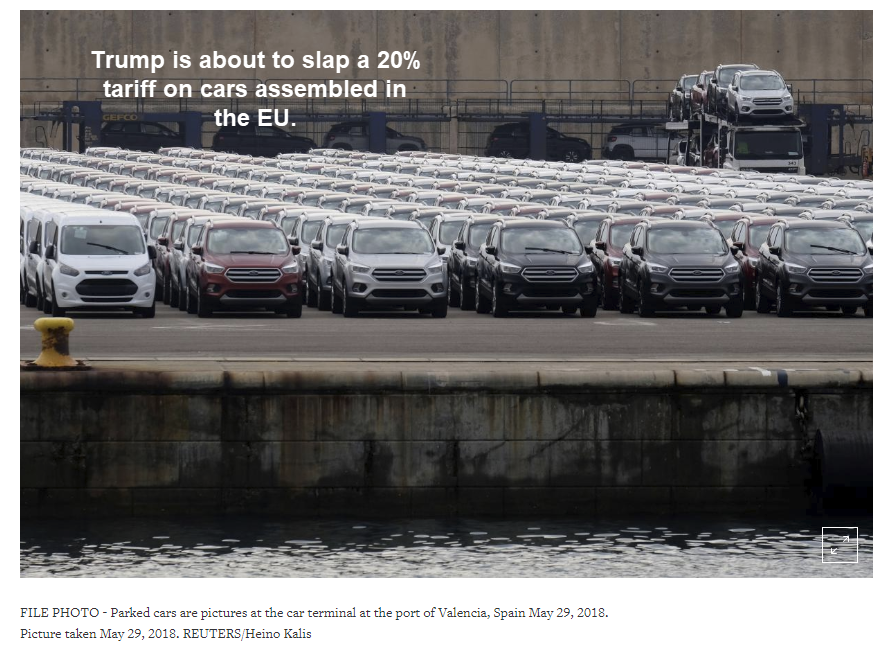
It’s an amazing spectacle to watch. Every day there is another tariff, tariff threat, or tariff retaliation, all in the name of “free trade”.
Trump Goes After EU
https://twitter.com/realDonaldTrump/status/1010166772912320513
Trump Goes After Mexico Exports and Immigration Laws
For Good Measure Trump Goes After Opec
Lovely. Since Trump is adamant about free trade and lower oil prices I have two suggestions.
- Unilaterally suspend all tariffs.
- Halt the Iran sanctions
As I said yesterday, No Matter What Any Other Country Does, the Correct Action is to Eliminate Tariffs.
More accurately, I said “reduce” not eliminate, but eliminate is how I feel. I ran into a character limit on the title. The article itself said eliminate.
Mad, Mad, World
Like Trump, the EU trade commissioner also “Stands Up for Open Global Trade” by Hiking Tariffs.
It’s madness.
Mike “Mish” Shedlock

Americans having to pay tariffs hurts Americans. Duh! They are the ones paying them, so obviously they are hurt/rendered poorer by them. That Americans are rendered poorer, will also indirectly hurt anyone producing something Americans would want to buy, but can no longer afford. So it also hurts Chinese producers. But the latter getting hurt, doesn’t somehow make the Americans rendered poorer any better off, no matter if idiots think some Chinese guys suffering is some sort of “victory.”
So where does the money go? To, tah-dah, governments. And to lobbyists and lawyers, and their clients; who suddenly become important players in who gets to buy what, hence can command fees they otherwise wouldn’t have. So, what tariffs does, is make both consumers and producers of actual value worse off. By transferring the value those two create and trade amongst them, by force, to an ever growing army of produce-nothing-of-any-value leeches. But then again, what else is new in progressivestan….
“.. Wonder why the unilateral free traders hardly ever mention this topic?..”
Perhaps because Chinese businesses shooting themselves in the foot by having their executives falling out of the sky in droves in Chinese made planes, rather than buying American made ones; is a bit of a self correcting problem?
If you are a US business, your competition choosing, or being forced to, buy and make use of subpar products at inflated prices; because those happen to be made in the same zip code or, on the same city block, as they themselves are located; just mean those guys won’t stay in business too long.
Tariffs are not the only imbalance that hurts the US and we know the US regulatory regime isn’t going anywhere, or the minimum wage. How do you propose to offset that?
The US has placed significant tariffs on imported pick-up trucks for a long time. Which is why the Tacoma and Honda Ridgeline are made in the US. The Ridgeline is actually considered the most “American made” of any truck including the F150.
Though Honda makes most of the cars for the US market in the US and has since the ’80’s. That’s when Reagan started putting tariffs on Japanese cars because of “unfairly low Japanese labor costs”. Yes, that used to be important. Soichiro Honda laughed at that and said the problem with American cars was not “over-priced American labor unionists” but utterly incompetent American management. So he moved his plants here and continued to kick GMs, Ford’s and Chrysler’s collective a$$es.
Mish — that is a nice thought, right up there with buying the world a Coke. Even if China followed suit and set its tariffs to zero, there would still be the non-tariff barriers — like the ‘Make it in China” policy. It does not matter how efficient the US producer is, the manufacturer would still have to move the factory to China if he wanted access to the Chinese market.
Unilateral disarmament has not stopped any wars; it is hard to see how unilateral trade disarmament would be any more successful. That is unfortunate, but that is the real world we live in.
How many times do I have to say “The correct procedure is to remove all tariffs regardless of what the other nations do.” ?
Yes, I would prefer if everyone did the same. Guess what? If one major country did, it would perform so well economically, that others would follow.
Lead by example.
Comment that disappeared earlier — The obvious solution to the problem of Germany’s unsustainable trade surplus is for German manufacturers to move more of their production of vehicles for the US market to the US. Energy costs are much lower in the US than Germany; labor costs are comparable; transportation costs to market are much lower than for vehicles assembled in Europe. This would help balance Germany’s trade account, and create economic growth in the US. Win-Win!
The challenge for the US Political Class is to remove the “hidden tariffs” that make the US an unattractive locus for manufacturing — i.e. excessive, counter-productive, economically-damaging, over-regulation.
And the consumer gets stuck with the bill or the layoff. Just like politics everywhere.
Mish – I get it that you favour free trade. But in an imperfect world, such that we live in, do you prefer ‘even’ tariffs (where both sides charge each other the same amount) or ‘uneven’ tariffs? It misses the bigger picture in my opinion if people are negative on Trump raising tariffs, when in many cases the other side charges more to begin with… tks
How about a 300% tariff on Trump property hotel rooms? Tariffs on Trump golf course green fees? Why hurt Harley-Davidson workers who produce a great product when you can go directly to the source if you want to make a point.
What is Trump going to do? Raise prices on Merkel’s hotels in the U.S.? Additional green fee taxes on Macron’s golf courses in Florida?
Tariffs are an early 20th century idea. That’s when America produced lots of cars and so did Germany. Then Germany would export cars to the US, drive down prices, and American car companies would howl in protest. Today, American car companies are producing cars in Mexico and Korea and importing it themselves. So I don’t understand who is howling about this.Surely not the car companies. We already have a 3.8% unemployment rate. Is the desire to make it go down further? Is the desire to have people stop working at Walmart and work on an assembly line instead? Is putting on a tire more valuable than re-stocking inventory?
It is also worth considering non-tariff barriers, which are probably even more important than monetary tariffs. Think of mercantilist China’s “Make it in China” approach, where manufacturers who want to sell in China have to set up production facilities there. Even if all tariffs around the world were reduced to zero tomorrow, those non-tariff barriers would still be distorting trade. Wonder why the unilateral free traders hardly ever mention this topic?
Obvious solution is for European (mainly German) companies to move production to the US closer to their market — where energy costs are much lower, labor costs are comparable, and transportation costs would be much less than from Europe. This would help to balance Germany’s unsustainable trade surplus and create jobs in the US.
The challenge for the US Political Class is to encourage this logical economic move by rolling back extreme counter-productive over-regulation which has made the US a less attractive locus for manufacturing.