

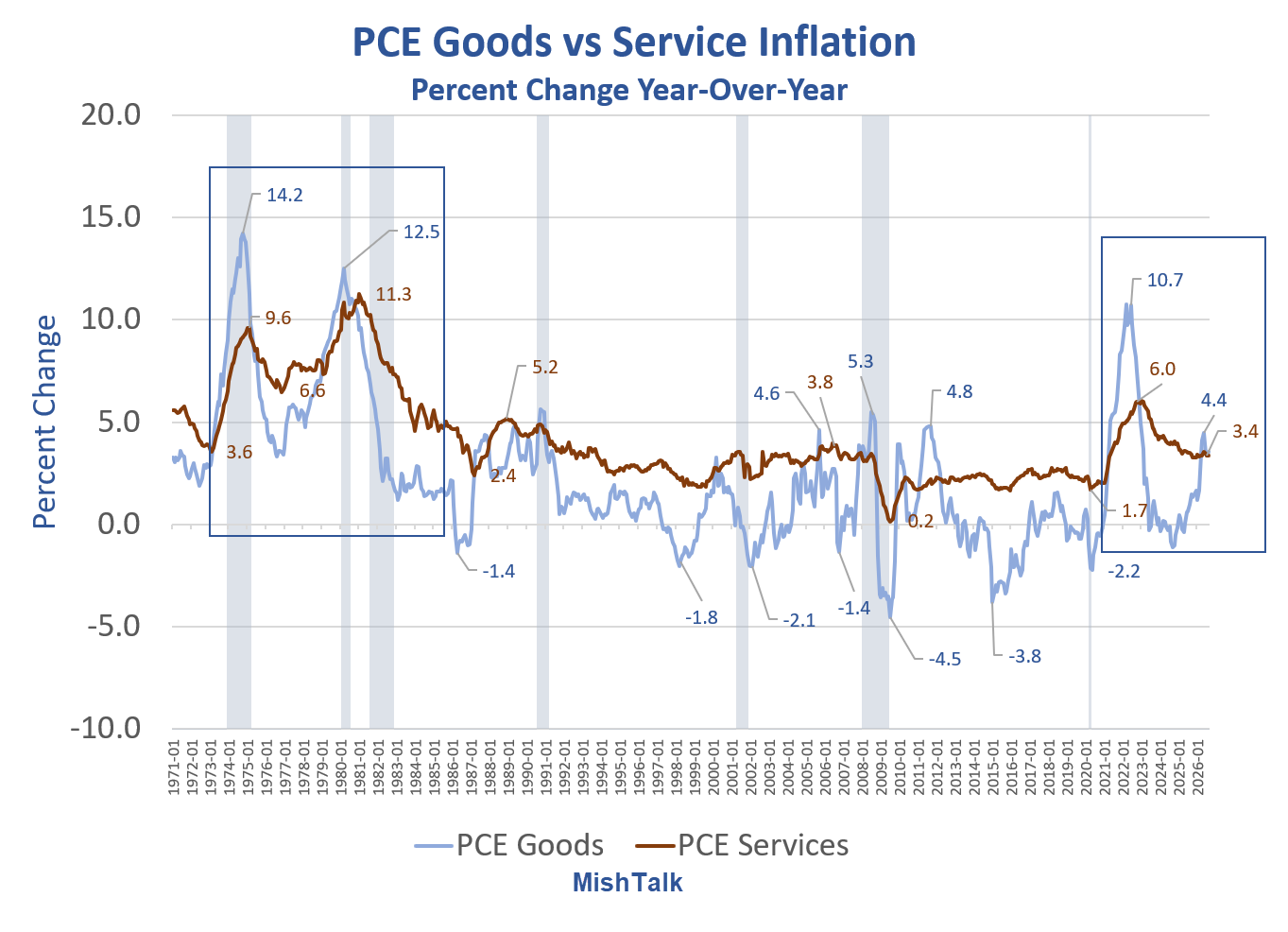
It’s not the primarily the deficit, nor is it just oil. 
We are witnessing something we haven’t seen since the stagflationary 1970s and 1980s.
Hat tip to Jim Bianco for inspiring this post.
Let’s hone in on the period between 1992 and 2026.
PCE Goods vs Services Inflation Detail

From 1992 through 2020 goods were a moderating factor on overall PCE as the next chart shows.
PCE Goods and Services 1992-Present

1992-2020 PCE Goods and Services Key Points
- From 1992 through 2020 the average year-over-year for PCE goods was 0.4 percent.
- The average PCE services 2.6 percent.
- The net PCE was 1.8 percent, slightly under the Fed target of 2.0 percent.
2021-2026 PCE Goods and Services Key Points
- The average year-over-year for PCE goods from January 2021 to present is 3.1 percent.
- The average PCE services is 4.2 percent.
- The average net PCE is 3.9 percent, well over the Fed target of 2.0 percent.
Annual PCE Goods vs Services Share of PCE
| Year | Goods share of PCE | Services share of PCE |
|---|---|---|
| 1992 | 37.2% | 62.8% |
| 2000 | 36.3% | 63.7% |
| 2010 | 32.3% | 67.7% |
| 2019 | 31.4% | 68.6% |
| 2025 | 31.1% | 68.9% |
Even if year-over-year PCE goods falls back to the 1992-2000 average (it won’t), PCE services rate to make the Fed miserable.
Six Structural Issues
- Just-in-time manufacturing has ended
- Outsourcing to China is no longer in vogue
- Trump’s tariffs raise the price of imports
- Manufacturing in the US is more expensive
- Deportations have led to a shortage of skilled trades, especially construction and housing, but also leisure and hospitality, and agriculture.
- Aging boomers need more services, especially healthcare
All of those are structural. Trump is responsible or partially responsible for the first five.
Add the deficit, military spending, and the war in Iran to that list.
Blame both parties for the deficit, but blame Trump for the war and the need for more defense spending.
So, even if oil comes down when the war ends, six structural issues will remain for at least two more years.
Related Posts
October 1, 2026: ISM Manufacturing Expanded in September for the Ninth Consecutive Month
Input prices up 24 months, increasing faster.
October 1, 2026: The War in Iran Is the Biggest Self-Inflicted Political Mistake in Decades
Iran is one of the least popular wars in history.
October 2, 2026: In Big Warning to the Fed, Bond Yields Rise Despite Weak Jobs
The bond market is telling the Fed it wants another interest rate hike.
October 2, 2026: Mortgage Rates Have Largest Weekly Gain in Four Years
Since February, mortgage rates have surged from 6.00 percent to 7.54 percent.






























The total net US interest payment as % of GDP curve mirror the previous oil shock and ensuing inflation, and the GDP drop after the great financial debacle of 2008. So we’re on a right path, globally.
Comparing today’s interest rates and events to those 60 years ago simply means the 60 year cycle is what’s driving interest rates. And there are clearly identifiable 60 year interest cycle peaks going all the way back to the late 1700’s in the US. Different people, different events, different technology did not disrupt this cycle. When Kondratiev discovered the 60 year cycle, it wasn’t what Stalin wanted to hear, so Kondratiev was executed in Stalin’s purge. Stalin, however, could not kill the economic cycles affecting the Soviet Union.
Trumpnomics is largely responsible.
Mish, You and many many others are leaving out the fact that Bernanke’s “savings glut” has become a “savings drought”. The US accounts for 26% of world GDP and borrows over 40% of world current account surpluses (roughly total global net savings), and, yes, in years past there was enough savings to meet the public and private borrowing needs of all major economies. That’s no longer true. The competition for savings is driving up real rates worldwide. Let me know if you’d like me to send you a short paper on this.
That and the relatively sudden massive demand in capital for corporate investments in AI and infrastructure, including the U.S. govt itself in becoming directly involved in spending works for tech & manufacturing start-ups especially in metals/heavy manufacturing?
I think blaming both sides for the budget overage is not quite balanced. Looking at the large tax cuts from Regan, and Trump X 2, (Bush as well? I forget.) and you have one side of the budget problem that that can clearly be placed at the Rs feet.