

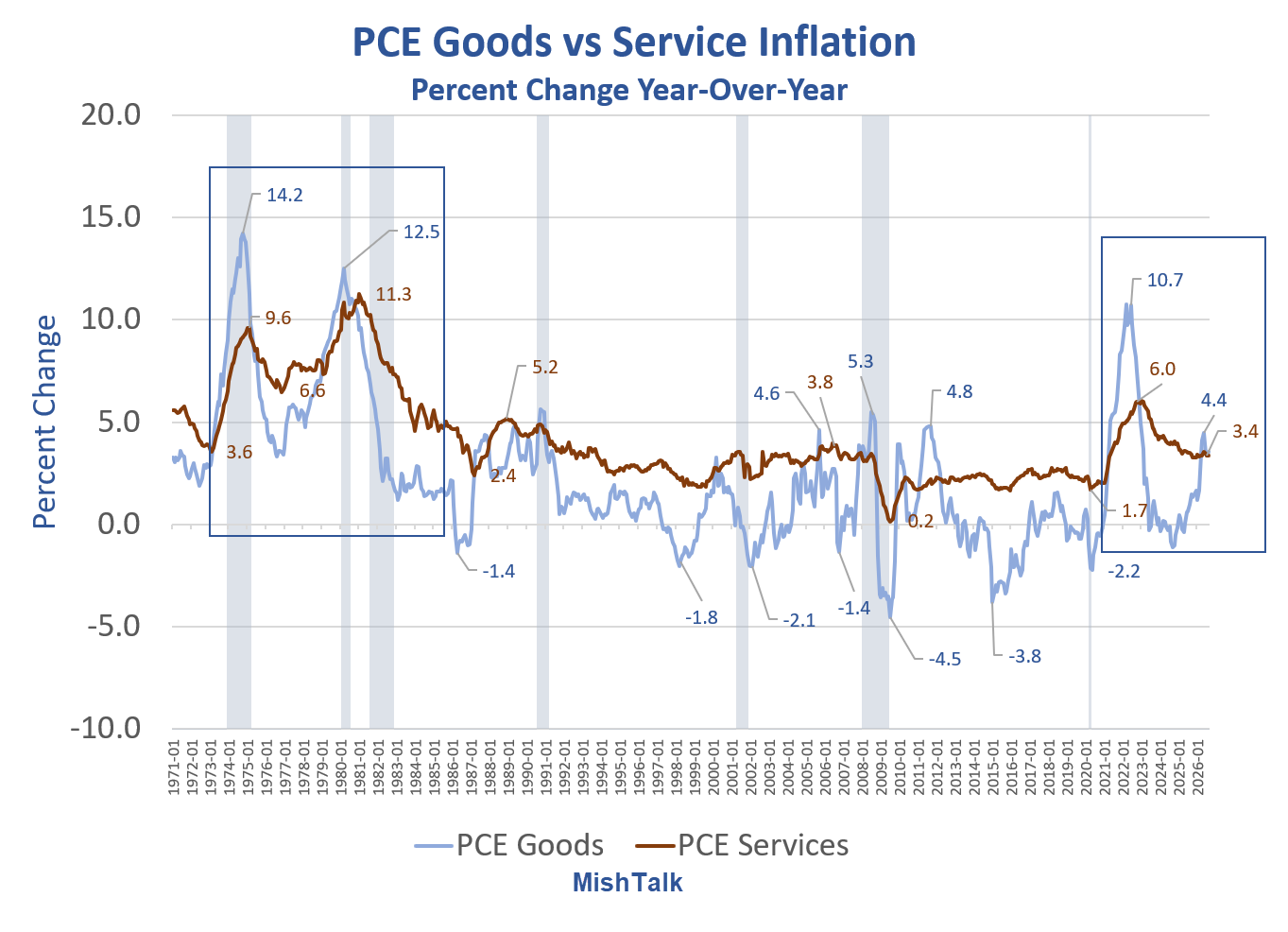
It’s not the primarily the deficit, nor is it just oil. 
We are witnessing something we haven’t seen since the stagflationary 1970s and 1980s.
Hat tip to Jim Bianco for inspiring this post.
Let’s hone in on the period between 1992 and 2026.
PCE Goods vs Services Inflation Detail

From 1992 through 2020 goods were a moderating factor on overall PCE as the next chart shows.
PCE Goods and Services 1992-Present

1992-2020 PCE Goods and Services Key Points
- From 1992 through 2020 the average year-over-year for PCE goods was 0.4 percent.
- The average PCE services 2.6 percent.
- The net PCE was 1.8 percent, slightly under the Fed target of 2.0 percent.
2021-2026 PCE Goods and Services Key Points
- The average year-over-year for PCE goods from January 2021 to present is 3.1 percent.
- The average PCE services is 4.2 percent.
- The average net PCE is 3.9 percent, well over the Fed target of 2.0 percent.
Annual PCE Goods vs Services Share of PCE
| Year | Goods share of PCE | Services share of PCE |
|---|---|---|
| 1992 | 37.2% | 62.8% |
| 2000 | 36.3% | 63.7% |
| 2010 | 32.3% | 67.7% |
| 2019 | 31.4% | 68.6% |
| 2025 | 31.1% | 68.9% |
Even if year-over-year PCE goods falls back to the 1992-2000 average (it won’t), PCE services rate to make the Fed miserable.
Six Structural Issues
- Just-in-time manufacturing has ended
- Outsourcing to China is no longer in vogue
- Trump’s tariffs raise the price of imports
- Manufacturing in the US is more expensive
- Deportations have led to a shortage of skilled trades, especially construction and housing, but also leisure and hospitality, and agriculture.
- Aging boomers need more services, especially healthcare
All of those are structural. Trump is responsible or partially responsible for the first five.
Add the deficit, military spending, and the war in Iran to that list.
Blame both parties for the deficit, but blame Trump for the war and the need for more defense spending.
So, even if oil comes down when the war ends, six structural issues will remain for at least two more years.
Related Posts
October 1, 2026: ISM Manufacturing Expanded in September for the Ninth Consecutive Month
Input prices up 24 months, increasing faster.
October 1, 2026: The War in Iran Is the Biggest Self-Inflicted Political Mistake in Decades
Iran is one of the least popular wars in history.
October 2, 2026: In Big Warning to the Fed, Bond Yields Rise Despite Weak Jobs
The bond market is telling the Fed it wants another interest rate hike.
October 2, 2026: Mortgage Rates Have Largest Weekly Gain in Four Years
Since February, mortgage rates have surged from 6.00 percent to 7.54 percent.






























While I get way more in retirement income than I expected, the biggest expense I have (and everyone else has) in retirement is property taxes. Not everyone lives in Chicago, but the higher property taxes are slowly drifting into all those places (Florida, Texas, Arizona) people move to that have low property taxes (for now) but wont for long. Thats the thing about old people — they didnt save and invest enough, but they still expect govt services 24/7, and cops, fire-dudes and teachers dont work for minimum anymore (nuns all dead). Inflation, because of property taxes, (which arent included in inflation calculations) is the stealth issue for the next 20 years of elections. And even dropping property values dont matter. Cook county has to collect $20 billion a year, either from million dollar or half million dollar homes. Taxes stay the same.
In Texas, seniors have the option to defer paying property taxes one year or multiple years with a 5% annual interest rate applied to the balance. I might consider doing that to delay and increase my Social Security check.
Texas does already have high property taxes for the most part (New Jersey is the highest), but Texas accepts something that a lot of older people dont … Texas knows yer gonna die a lot sooner than you thought. 🙂
My property Texas property taxes in 2025 came to just over $17,000.00
$20,000 in Chicago last year
I have one of the smallest houses in the neighborhood. 2100 sq ft. 1928 classic.
Meh. I’ve owned my homesteaded house in Florida for 25 years. In that time, my property taxes have gone from $1100/year to $1400/year. My homeowner’s insurance has gone from $900 to $1500. At least I get something for my property taxes. How about we make it so banks can’t make loans on residences so you have to pay cash? That will push down prices and taxes.
We all know where this is headed. The only people who get pensions in America (funded by property taxes) now are cops, fireguys and teachers (15% of working population). The attack on them is coming.
The Baumol effect: rapid growth in manufacturing productivity allows for growth in manufacturing wages. The growth in manufacturing wages drives growth in service sector wages as the service sector needs to be competitive for labor. But productivity increases in the service sector is far lower than in manufacturing which drives service sector inflation.
Manufacturing productivity increases are declining now too. But, Americans expect annual pay increases to afford a higher standard of living. That’s far more important than most people think. If you get decent annual increases, you don’t need labor unions. You don’t need to change jobs, forcing your employer to constantly spend on hiring and training. You can look forward to a decent house, car, maybe a boat. You become very conservative in your financial outlook for yourself and the country.
We are now moving in the opposite direction. AI must start making significant increases in service sector productivity and pay. Or the US politically becomes Europe and moves much farther to the left.
An economic illiterate in the White House?
CNBC had a good article on the aging demographics issue a few days ago.
https://www.cnbc.com/2026/10/05/aging-population-moodys-public-finances.html
Their views are a bit more optimistic than reality but it doesnt matter, the direction is all the same, more leeches, less productivity around the world.
Still waiting on alm those free robots, free AI and free automation to save the world.
Summoning Jojo are we? Say, I haven’t seen dear old Jojo lately. I think the Iranians got him.
He either got orders from AIPAC to stand down given the declining popularity or he got a Lindsey Graham special. Either wat, win-win.
If this were correct, wouldn’t inflation breakevens be rising as well? They are, but only modestly. Something else driving the long end moves?
All you have to do is look at retail MMMFs to tell when rates top.
“When MMF yields stop rising relative to bank deposits, retail flows flatten or reverse—often right around the point policy rates top out.”
Retail Money Market Funds (WRMFNS) | FRED | St. Louis Fed
Trade deficit came in at 105.6 deficit.
This analysis is very good, but at this point Treasury yields are driven up almost exclusively by real forces and not higher inflation expectations. And those real forces driving yields up seem to be global, rather than just US-centered; even German real yields are moving in lockstep with real Treasury yields. We may indeed have an utterly crazed president, but that well documented craziness seems not be the main driver. I don’t have any great insight, except it’s either: (i) an increase in the global natural real interest rate due to booming AI investments; (ii) people waking up to the unsustainable fiscal positions across the world; or (iii), people repricing the safe asset status of government bonds independently of out of control fiscal deficits.
I think Trump is a total imbecile, and that he is bad guy who is doing tremendous damage to the United States of America, but I actually agree that interest rates are too high. Each rate increase is a mistake.
Okay JCH1952, what exactly would you do about the out of control inflation then?
Get rid of most of the tariffs and increase income taxes.
Also: end the sanctions on Russia and Iran, i.e. end the futility and stupidity of trying to control distant geopolitical outcomes abroad with weak (but inflationary) economic means.
Okay so screw the commoner while companies continue to get to borrow free money to fund AI datacenters that have no ROI. Got it. That’s sure to be a winner.
The commoner is who is paying the tariffs, the biggest tax increase on the American people in the entire history of the United States of America. With scant protest from Republicans. So they never meant it. They were never against increasing taxes on commoners. You are welcome to imagine a quarter point is going to slow AI center borrowing.
yes we actually need to tax the bitllionaires and multi millionaires Warren should pay more taxes in % then his secretary. Stop corporate welfare oil companies do not need to be subsidized. Increasing taxes on the top 10% will have the same effect as raising interest rates and paying down the debt
All this is secondary to expansion of the money supply, as part of a conspiracy between the government and its creature, the central bank. People who want the fraud to continue, want you to focus on secondary causes and effects.
Chat gpt says I’m wrong:
“Of the $1.5 trillion increase in demand deposits (DDs) since July 3, 2025, only about $150–250 billion is true means‑of‑payment money (transactions deposits).
The remaining $1.25–1.35 trillion is saved DDs, reclassified savings, institutional liquidity buffers, and idle balances — not money used for spending.”
That in and of itself explains the rise in rates. Banks don’t lend deposits
Link: “Changes in Wealth and the Velocity of Money”
https://files.stlouisfed.org/files/htdocs/publications/review/87/03/Changes_Mar1987.pdf
The demand for money is rising (“It is the desired holding of liquid monetary balances (cash, demand deposits) rather than interest‑bearing assets”), so velocity is falling.
But I don’t think it works that way. Only a small percentage of demand deposits get “liquified” periodically. Banks have every incentive to turn those demand deposits into interest bearing investments such as short term treasuries.
Since bond yields are rising in Europe and everywhere else (maybe not China) it could mean oil plays the biggest role in all of the structural issues.
“Economic activity is energy transformed” I’ve read.
Indeed. Yen carry-trade unwind much affected by oil price and definitely has global reach.
The total net US interest payment as % of GDP curve mirror the previous oil shock and ensuing inflation, and the GDP drop after the great financial debacle of 2008. So we’re on a right path, globally.
Comparing today’s interest rates and events to those 60 years ago simply means the 60 year cycle is what’s driving interest rates. And there are clearly identifiable 60 year interest cycle peaks going all the way back to the late 1700’s in the US. Different people, different events, different technology did not disrupt this cycle. When Kondratiev discovered the 60 year cycle, it wasn’t what Stalin wanted to hear, so Kondratiev was executed in Stalin’s purge. Stalin, however, could not kill the economic cycles affecting the Soviet Union.
I really hope you’re right and this is the 60 year cycle at work…meaning it’s not just going to dip back down as soon as we get over this hump (whatever this hump actually ends up being).
What happened was the ratio of DDs to TDs reverted to the 1965’s. As soon as we got the flight to liquidity the bull market in bonds ended.
There will be at least one pullback between the 2020 lows and the projected peak in ~2040 due to the 54 month (4.5 year) and 9 year Hurst cycles.
Elliot wave theory (structurally focused) also guarantees at least one pullback.
Exactly. It’s a secular trend.
Only I would argue the oscillation has lengthened to 80 years (40 up, 40 down).
People live longer, demographic pyramid is destabilized, more activist central bank interventions and financial engineering.
Trumpnomics is largely responsible.
Mish, You and many many others are leaving out the fact that Bernanke’s “savings glut” has become a “savings drought”. The US accounts for 26% of world GDP and borrows over 40% of world current account surpluses (roughly total global net savings), and, yes, in years past there was enough savings to meet the public and private borrowing needs of all major economies. That’s no longer true. The competition for savings is driving up real rates worldwide. Let me know if you’d like me to send you a short paper on this.
That and the relatively sudden massive demand in capital for corporate investments in AI and infrastructure, including the U.S. govt itself in becoming directly involved in spending works for tech & manufacturing start-ups especially in metals/heavy manufacturing?
I prefer to look at a “savings glut” as diminished claims against ones future labor, and a “savings drought” as having limited labor capability to repay debt.
I think blaming both sides for the budget overage is not quite balanced. Looking at the large tax cuts from Regan, and Trump X 2, (Bush as well? I forget.) and you have one side of the budget problem that that can clearly be placed at the Rs feet.
W. Bush’s first big public acts included tax cuts. My understanding is, the Iraqi and Afghan wars were thus funded largely with debt, which fed this deficit further. Allegedly VP Cheney told Bush, ‘Reagan proved that deficits don’t matter.’
Ironically perhaps, I think this also preceded the Vietnam run-up: tax cuts were done at JFK’s behest, to juice business. Then he took a bullet and LBJ launched two ill-funded wars: on poverty and in Vietnam. (LBJ was no businessman: he was a New Dealer true believer, you know: government can solve all problems.) That kindled inflation and sped the dollar’s decline (leading to Nixon in ’71 abandoning the Bretton Woods exchange rates regime), all swooping right into the longer 1970s inflation. Going into ’72, Nixon also successfully arm-twisted Fed Chair Arthur Burns to loosen interest rates and credit, for Nixon’s second election, feeding the flames (and over-nervously, Nixon indirectly set in motion that Watergate type stuff). Then came a decade of all kinds of weirdness. Iran shows up in that next chapter too, as the mullahs finally grasped that oil leverage and shook it.
The Great Inflation was due to the monetization of time deposits. The end of gate keeping and move to electronic processing from clerical processing.
Rs can only vote fiscally conservative in the US House when a D is prez. For example, the 1997 Balanced Budget Act during Clinton and the 2011 Budget Control Act during Obama.
“Fiscal Conservatism” is not cutting taxes without cutting offsetting expenditures. It is simply theft from the next generation. Republicans have never been fiscal conservatives. They’re just thieves.
Totally agree
Regan was often accused of throwing a spitball.
Some truth in this, but take away government budget deficits (aka “free money for cronies!”) and watch the economy nosedive.
Bush 1.0 raised taxes in an effort to get deficits under control, and he was pilloried as a result.
Bush was rightfully pilloried because he had previously said, in no uncertain terms, that he would not raise taxes no matter what (“read my lips”)
Clinton also raised taxes after promising a middle-class tax cut, but nobody said boo.