

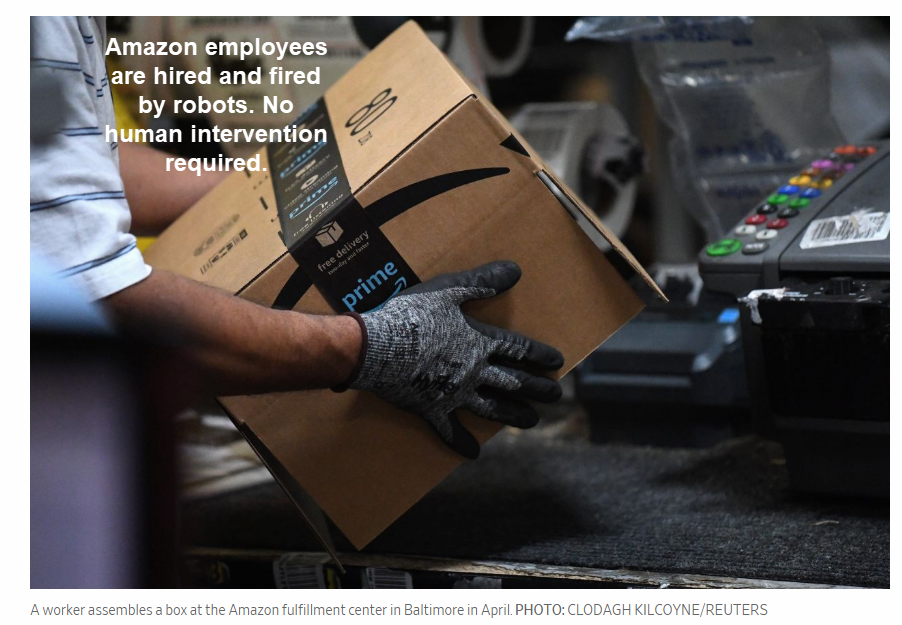
Software and algorithms are used to screen, hire, assign and now terminate workers at Amazon. For lower-paid employees, the Robot Overlords Have Arrived.
Millions of low-paid workers’ lives are increasingly governed by software and algorithms. This was starkly illustrated by a report last week that Amazon.com tracks the productivity of its employees and regularly fires those who underperform, with little human intervention.
“Amazon’s system tracks the rates of each individual associate’s productivity and automatically generates any warnings or terminations regarding quality or productivity without input from supervisors,” a law firm representing Amazon said in a letter to the National Labor Relations Board, as first reported by technology news site The Verge. Amazon was responding to a complaint that it had fired an employee from a Baltimore fulfillment center for federally protected activity, which could include union organizing. Amazon said the employee was fired for failing to meet productivity targets.
Perhaps it was only a matter of time before software was used to fire people. After all, it already screens resumes, recommends job applicants, schedules shifts and assigns projects. In the workplace, “sophisticated technology to track worker productivity on a minute-by-minute or even second-by-second basis is incredibly pervasive,” says Ian Larkin, a business professor at the University of California at Los Angeles specializing in human resources.
Industrial laundry services track how many seconds it takes to press a laundered shirt; on-board computers track truckers’ speed, gear changes and engine revolutions per minute; and checkout terminals at major discount retailers report if the cashier is scanning items quickly enough to meet a preset goal. In all these cases, results are shared in real time with the employee, and used to determine who is terminated, says Mr. Larkin.
Amazon employees have complained of being monitored continuously—even having bathroom breaks measured—and being held to ever-rising productivity benchmarks. There is no public data to determine if such complaints are more or less common at Amazon than its peers. The company says about 300 employees—roughly 10% of the Baltimore center’s employment level—were terminated for productivity reasons in the year before the law firm’s letter was sent to the NLRB.
Big Brother is Watching
In addition to the government wanting to know everything you do, so do employers and their robots.
Those robots do not care about someone’s race. They only care about performance.
If you are supposed to handle x packages per minute, and you underperform, goodbye.
One huge advantage for employers having robots fire people is the process will stop discrimination lawsuits. As a side benefit companies can get rid of higher paid employees who used to make these decisions.
Mike “Mish” Shedlock






























All that alleged productivity, yet they can barely earn a profit… Doesn’t seem like they’re productive at all…
Reminds me of a Jetsons episode where Mr. Spacely bought a robot to be Georges boss. I dont have a link at the moment but if anyone can find it I promise it’s hillarious.
Software is not perfect. AI has so many decisions statements that all of it can’t possibly be tested. And then there are situations that the systems engineer never envisioned happening.
Hidden behind this automation thing, is the fact that Amazon made it a business model to fire and hire some percentage of workers on a regular basis, just to keep everybody insecure enough. This doesn’t even makes sense from the point of view of buyers; garbage will get shipped if that ups the score.
Amazon is in a very competitive business. They have to constantly innovate and make employees as productive as possible.
There’s nothing less motivating than working hard and having another employee spend the day attending to personal matters.
USA: the new shithole country. Make sure you don’t have a bad day worrying about that cancer treatment your wife is having that day.
I take multiple antidepressants (SSRIs) and ADHD medication and Gabapentin for anxiety
The article doesn’t go into the procedures for warnings, nor the time span that the computer considers. No company fires someone for a first offense, so I presume that if someone starts having lower performance, they will get a couple warnings before they get discharged. I also would guess that a single day is going to affect the outcome much, because the algorithm is going to look at a time period more like a few months, or a year.
By the way once a lawyer and computer scientist prove that a robot does discriminate and win, Amazon will be SOL. if you dont think a program written by humans discriminates then you must think the robot programmed itself.
How on earth does a hammer “discriminate”? It was made by a human….
Of course, factual incorrectness, nor lack thereof, has never had any bearing on what can be “proven” by the standards of ambulance chasers. Such is newspeak and arbitrary rule by the privileged. So, as long as “proven,” is defined to mean “that which provides ambulance chasers the most loot and the most power and privilege,” hammers will no doubt be “proven” to discriminate as well.
AI is being widely used already to not hire people. Only a matter of time before it was used to fire people.
Then, there are wags like me who view this as a good thing because It turns on the lights and leaves the perennial deadbeat(s) in a department with no place to hide. A competent manager is being paid to deal with problem employees. Failure to do that will guarantee high turnover in the afflicted department as over-burdened fellow employees quietly make their own plans and find work elsewhere.
Wage inflation has nothing to do with the unemployment rate. Wage inflation is a function of collective bargaining. No one employee can set labor rates overall. That would be insane from an employers perspective.
Not much “collective bargaining” in the fracking business at it’s peak. Yet plenty of kids straight out of high school making “six figures.”
If collective bargaining was what drove wages, unionized service workers would get paid more than non unionized rockstars.
Prices, including the price for labor, is set by supply and demand. Not by strange women lying in ponds nor self aggrandizing clowns sitting in union offices.
The unemployment rate is not the same in all parts of the country. In some places it is difficult to hire people. Advertise for help, and you get no applicants, or perhaps a few, but no one qualified. I know a nurse that just got a new job, and they gave her a $1-2,000 signing bonus to induce her to leave her prior job. In reality, she wanted to leave her prior job for some very good reasons, but the new employer was desperate for qualified help.
$1-$2000 signing bonus is supposed to be a big deal for a professional? Really? Employers used to pay several times that for relocation without even batting an eye when the economy was ‘normal’.
I assume you are taking about the NYC and greater Boston metro areas where there are no takers for many job posts on Indeed. I don’t count low wage ($40 per hr or less Position) but white collar jobs with pay starting just under 100k
$1000 -$2000 is barely significant in 2019. I would say that is what an average 20 something spends just on eating out each month. And of course everyone has at least one Canada goose coat which start at $ 1000
Can you please tell me what jobs and where they are that are getting ‘mountains of Resumes’ and applications. I am taking about mid level white collar jobs in areas like greater Boston and NYC which are posted on Indeed but getting few if any takers even at $80,000 a year or more. Employers in the Boston area are so starved for talent that they are giving$10,000 signing Bonuses for programmers and positions in Data Analytics. NYC has 7,000 startups and they cannot find people for jobs paying at least$120,000 a year.
I have never seen the economy in the Northeast as strong as it is now especially NYC which is going thru the greatest economic boom in history
Interesting because I’m looking for jobs on Indeed in the LA area and there are over 600 people applying for each of the decent paying jobs…plus figure the job is listed on several more job boards. Yeah there is a shitload of $10-15 per hour jobs but once the job pays over $50k per year the competition is unbelievable. Plus I know a lot of folks of all ages that are underemployed. The job market is nowhere near what it was in the 1970’s here in LA.
So what, the unemployment rate is 3.8% ,jobs are a dime a dozen. First time claims at record lows as well meaning that fired workers find new jobs making filing for unemployment benefits unnecessary
You must get your news from MSNBC, CNN, and other MSM.
Glad I am self-employed. Only me can fire me. LoL.
I was self-employed for 10 years. My boss was a jerk.
I’m self employed and sometimes work slows down. I don’t get fired but my pay sure suffers.
What Amazon is doing, is very much in the direction of depersonalizing work. Treat everyone as if they are “self employed.”
If you contract with a bunch of different shippers, you’ll over time figure out who works the best for you. And stop sending work to the ones who don’t do so well.
All labor decisions are, economically speaking, bought on a task by task basis. You can bulk buy tasks, but the economic decisions involved, fundamentally boils down to cost vs benefit on a whole host of different tasks aggregated together. Only the simpleminded starts deifying the various aggregation rituals and institutions themselves, into something of fundamental economic significance.
Same as it ever was. If you do your job, you get raises and promotions. If you slack, you lose your job. In the old days, though, the process was less fair, as a human might show favoritism, seeing the bad in people he didn’t like, and the good in people he did like.
Mish raises a good point. This is yet another place where the really big guys can be more efficient that smaller competitors. Favoritism lowers efficiency dramatically, plus it introduces the potential for wrongful discharge lawsuits. That extra efficiency, in turn, translates into Amazon being able to pay higher wages.
If doing your job was enough then no one would ever be out of work. The truth is companies fail for multiple reasons. There is a reason for mass layoffs that have nothing to do with performance.
While it is true that companies fail all the time, or shrink, and have t lay off people, that has nothing to do with this. Amazon is neither shrinking, nor failing.
As for the first statement, “If doing your job was enough then no one would ever be out of work.”, that is so patently false that I can’t imagine that it was what you intended to say. There are plenty of people who don’t do their jobs, and who are discharged for good reason.
You can also bet that your family’s health care claims and other expenses your company incurs on your behalf are also in the algorithm. Making rate is nothing new, but the bar is raised along with your seniority to keep the average wage near the starting wage.
Luckily enough I do not (have to) work at Amazon. Everything I’ve read about it to date makes me think it’s about as close to hell that you can get — in some ways worse than slavery (slaves in most context could pick their nose without repurcussions). Of course they could — theoretically — leave, but in practice nobody would elect to stay there without some form of coercion. If this is supposed to be human progress ….
No one is forced to work at Amazon.
Yet.
If anyone is ever ‘forced’ to work for Amazon, then Mish’s article provides the obvious escape route. Use the AI bots to your advantage; just be unproductive as all hell. Continual screw-ups, dropped packages, four-hour bathroom breaks … basically emulate The Simpsons’ Patty and Selma at the Springfield DMV.