

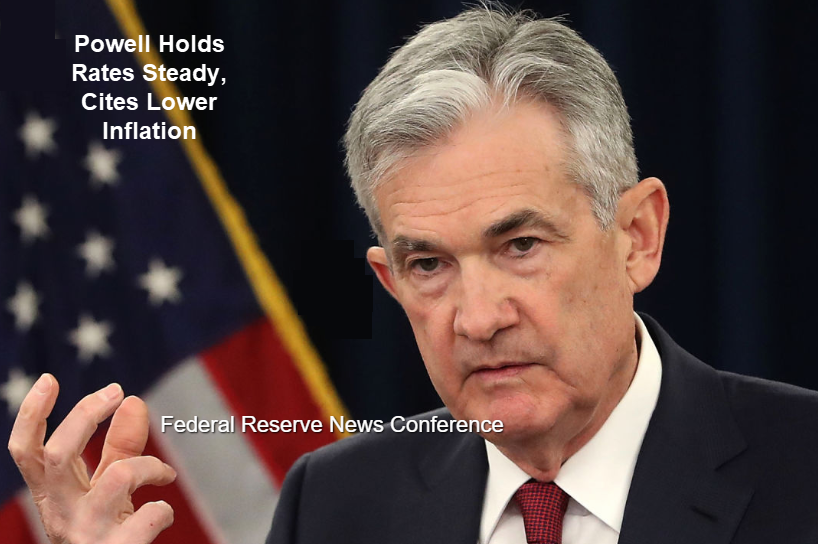
Please consider the FOMC Statement following today’s interest rate policy decision, emphasis mine.
Information received since the Federal Open Market Committee met in March indicates that the labor market remains strong and that economic activity rose at a solid rate. Job gains have been solid, on average, in recent months, and the unemployment rate has remained low. Growth of household spending and business fixed investment slowed in the first quarter. On a 12-month basis, overall inflation and inflation for items other than food and energy have declined and are running below 2 percent. On balance, market-based measures of inflation compensation have remained low in recent months, and survey-based measures of longer-term inflation expectations are little changed.
Consistent with its statutory mandate, the Committee seeks to foster maximum employment and price stability. In support of these goals, the Committee decided to maintain the target range for the federal funds rate at 2-1/4 to 2-1/2 percent. The Committee continues to view sustained expansion of economic activity, strong labor market conditions, and inflation near the Committee’s symmetric 2 percent objective as the most likely outcomes. In light of global economic and financial developments and muted inflation pressures, the Committee will be patient as it determines what future adjustments to the target range for the federal funds rate may be appropriate to support these outcomes.
In determining the timing and size of future adjustments to the target range for the federal funds rate, the Committee will assess realized and expected economic conditions relative to its maximum employment objective and its symmetric 2 percent inflation objective. This assessment will take into account a wide range of information, including measures of labor market conditions, indicators of inflation pressures and inflation expectations, and readings on financial and international developments.
No Dot Plot
The Fed did not release interest rate projection material (a dot plot of where each member thought interest rates were headed. following this meeting).
Projections tend to follow the March, June, September, and December meetings.
Bond Market Reaction

Bond yields are lower across the board with the yield on the 5-year bond dropping the most.
The 3-Month to 5-Year inversion widened to 18 basis points.
Asymmetric Inflation Targeting
Inflation and inflation projections are in the eyes of economic wizards who have no idea how to measure it.
Fed induced asset bubbles are clearly not part of their thinking but the resultant bust will be.
Mike “Mish” Shedlock






























The biggest risk is that they might believe their BS. If I was sure they are at least competent crooks, I would sleep better. With this historic low unemployment, interest rates would be hitting 10%, so why dither about inflation (interest rates being still below neutral).
Unemployment is “historically low” in numbers only. Actual unemployment/underemployment is dramatically higher. Very few can actually find quality jobs. Especially in the STEM sector which is an utter disaster.
Lots of low-paying, part-time jobs with no benefits available. Lots of openings in software too. What part of STEM do you mean — science and math? Tech and engineering are chugging along, no?
They definitely believe their theories and games. Economics is a biased profession, and that bias is rewarded by politicians, who are rewarded by voters, who don’t value their own freedom. It’s a web of people trying to live in an alternate universe, where money grows on government trees and wealth can be wished and demanded into reality.
That is my point. This is an absurdly minuscule “tweek” that will change nothing. Actually, the “thinking” behind this is that it will add to liquidity by causing some of those reserves to leak into the inter-bank market.
It is actually sorta a big deal (I mean it is not “nothing”). They cut the IOER because there is a shortage of bank reserves since Fed Funds is trading 5 bp over IOER (and IOER is meant to be the “floor”). The Fed is trying to flush some bank reserves out of the Fed and into the Fed Funds market. It is a signal possibly of the Fed losing control of the banking system. I mean how could there be a shortage of reserves with all the QE $ floating around the system? It implies a more speedy stoppage of QE runoff and further rate cuts.
When they crash the banks this time around with higher than justified rates, they better actually let them die off and be liquidated properly instead of the TARP, QE, etc., nonsense they did last time. And hang Hank Paulson for his treason while they’re at it.
And they reduced the interest rate paid on excess reserves by 5 basis points. That’s right, a FIVE basis point (0.0005) move. They must be kidding.
It’s all Kabuki theater. Recall that reps from both parties voted to confirm Hank Paulson as Treasury Secretary. But Hank headed up Goldman Sachs during the period of their maasive fraud settlement. Al Capone as head of the FBI? It’s all a joke, with folks filling their pockets, and directing according to the prevailing winds.