

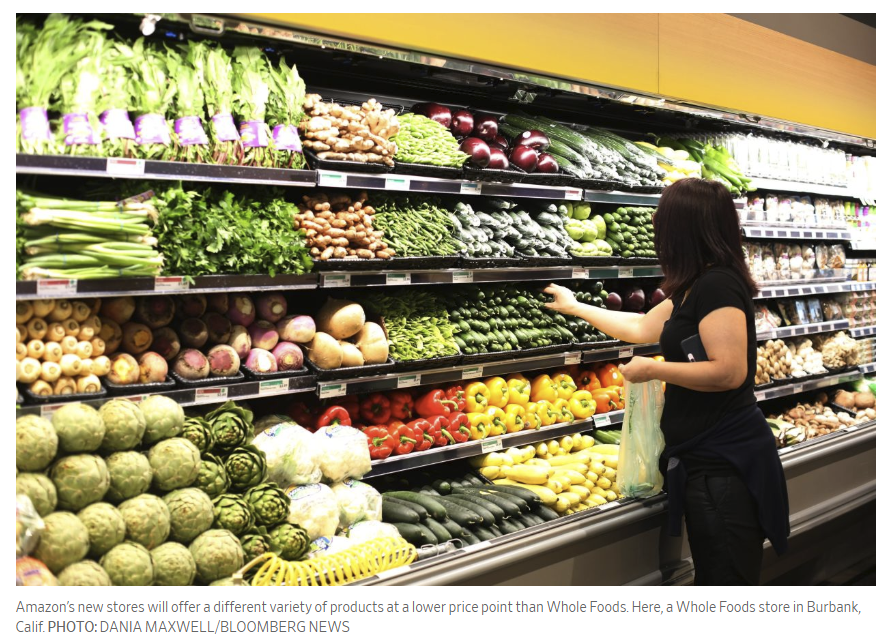
The Wall Street Journal reports Amazon to Launch New Grocery-Store Business.
Amazon.com Inc. is planning to open dozens of grocery stores in several major U.S. cities, according to people familiar with the matter, as the retail giant looks to broaden its reach in the food business and touch more aspects of consumers’ lives.
The company plans to open its first outlet, in Los Angeles, as early as the end of the year, one person said. Amazon has already signed leases for at least two other grocery locations with openings planned for early next year, this person said, without saying where those stores would be.
Additional talks are under way for Amazon grocery stores in San Francisco, Seattle, Chicago, Washington, D.C., and Philadelphia, the people familiar with the matter said.
After two decades of upending the retail industry by shifting shoppers to the internet, Amazon in recent years has become increasingly focused on physical retail, posing a threat to traditional grocers. The new chain would help Amazon in fulfilling a yearslong initiative to build out a physical grocery presence, which was at one point potentially envisioned to reach more than 2,000 brick-and mortar stores in a variety of sizes and formats.
Amazon is also exploring purchasing regional grocery chains with about a dozen stores under operation, one person said, that could bolster the new chain.
Good Thing?
Is this a good thing? Of course it is.
Any action that provides lower costs and more choices for consumers is a good thing by definition. Lower costs improve standards of living.
“Customers want to be able to shop when it is most convenient for them, which could be in-store, online or a combination of the two,” said a spokeswoman from the International Council of Shopping Centers.
In the absence of distorted Fed and Congressional policy, free market capitalism delivers what consumers want. And if businesses fail at their mission, they go bankrupt.
If is only when governments and the Fed interfere with capitalism does capitalism seem to fail. The answer isn’t more socialism or more government, it’s more capitalism.
Mike “Mish” Shedlock






























This initiative will open new prospects for their business, because now there are still people who do not trust online shopping (I am among them). Too scary to get something different from what you want to get. Therefore, I prefer shopping offline, on the Internet I use only free sites. After all, while you read blogs or useful sites, for example like https://free-doc-examples.com about “the solution to grow your business”, you will not lose anything
If it will be a traditional grocery store, where shoppers walk through, I would imagine it will be more of a real estate play, where shelf space is sold to the highest bidder. Large sections of grocery stores, especially in the “middle” are just micro real estate space. The soft drink isle, potato chip isle, and end caps are all for rent. Bezos might be thinking about just opening up the space to everyone else. Note that a large percentage of Amazon’s selection is from third party vendors using the infrastructure.
“If is only when governments and the Fed interfere with capitalism does capitalism seem to fail. The answer isn’t more socialism or more government, it’s more capitalism.”
Government is never the only answer, but the tragedy of the commons and other flaws in markets make it clear that pure capitalism isn’t the only answer either.
Where is the pizza drone?
Maybe everyone is wrong about the margins.
Finally…finally something breaking ground that’s not another gov’t office,pawn shop,liquor store,pot store,fast food joint,dollar store,convinience store, fast food joints or title loans .
This is a hyper competitive market with razor thin margins.
So Amazon is not entering this market to make money.
The next area for “disruption?” To what end? To drive existing chains to bankruptcy? Why?
In the same way the automobile manufacturers did to the buggy whip manufacturers.
It’s quite possible that this is related to distribution for Amazon. For Amazon, shipping is 500lb gorilla in the room. Many local grocers now offer home delivery. If Amazon can get the goods to the local grocer (who they own), and then use the local grocer to provide the last mile delivery, that could be a big benefit to them.
I agree this move is about distribution. A grocery store fits nicely since economies of scale in logistics lower costs. The final mile is debatable since people still go to the store once a week to get fresh food; however, they may want their non-food purchases overnight. Maybe customers will pay less for shipping to the store and more to the door.
Everyone always says that the grocery business is low margin with only 1-3% net profits, so what does Bezos see in this business?
In my area, there are at least 10 major grocery supermarkets within about 6 miles, plus a Costco and a Target. More grocery choice is only going to further dilute margins.
Bezos should spend his money on building Blue Origin. Outer space is the future, not groceries!
Grocery stores carefully calculate shelf space to the fastest selling idems. Yes, 1-3% margin, maybe more on some items, but then loss leaders (milk and sale products) bring in the customers. Then there is turnover. The shelves clear much faster in a grocery store than at Dick’s Sporting Goods, thus that margin also multiplies very quickly. Margin X turnover is the key.
Bezos should just go into the temporary mail order bride business. He’s certainly painted a pretty picture of himself in the news
Low margins or not, at least they tend to make some money……..