

Disturbing Details
A New Report on 138 Coronavirus Cases Reveals Disturbing Details including the emergence of a super-spreader.
One patient, admitted to a hospital in Wuhan, China, infected at least 10 health care workers and four other patients [actual suspect total is 57 see study below].
The patient who infected so many health workers had been placed in a surgical ward because of abdominal symptoms, and the coronavirus was not initially suspected. Four other patients in that ward also contracted the disease, presumably from the first patient.
The incident was a chilling reminder of the “super-spreaders” in outbreaks of other coronavirus diseases, SARS and MERS — patients who infected huge numbers of other people, sometimes dozens. The phenomenon is poorly understood and unpredictable, an epidemiologist’s nightmare. Super-spreaders led to considerable transmission of MERS and SARS inside hospitals.
Super-Spreader Infects 40 Health Care Workers
The JAMA Report, published on Friday, is among the most comprehensive articles to date about people infected with the newly identified virus.
Of the 138 patients, 57 (41.3%) were presumed to have been infected in hospital, including 17 patients (12.3%) who were already hospitalized for other reasons and 40 health care workers (29%). Of the hospitalized patients, 7 patients were from the surgical department, 5 were from internal medicine, and 5 were from the oncology department. Of the infected health care workers, 31 (77.5%) worked on general wards, 7 (17.5%) in the emergency department, and 2 (5%) in the ICU. One patient in the current study presented with abdominal symptoms and was admitted to the surgical department. More than 10 health care workers in this department were presumed to have been infected by this patient. Patient-to-patient transmission also was presumed to have occurred, and at least 4 hospitalized patients in the same ward were infected, and all presented with atypical abdominal symptoms. One of the 4 patients had fever and was diagnosed as having nCoV infection during hospitalization. Then, the patient was isolated. Subsequently, the other 3 patients in the same ward had fever, presented with abdominal symptoms, and were diagnosed as having nCoV infection.
The data in this study suggest rapid person-to-person transmission of 2019-nCoV may have occurred. The main reason is derived from the estimation of the basic reproductive number (R0) based on a previous study.
In this single-center case series of 138 hospitalized patients with confirmed NCIP in Wuhan, China, presumed hospital-related transmission of 2019-nCoV was suspected in 41% of patients, 26% of patients received ICU care, and mortality was 4.3%.
JAMA Video
“Fatality rate in a normal Flu is about 0.1%. When you get into the pandemics, of 1957 and 1968, it goes up to 0.8% to 1.2%. The 1918 pandemic, the famous Spanish Flu, you go up to as much as 2.0%. … I think I can say we don’t know everything about this virus, but it is evolving in a way that it looks like it is adapting itself to infecting much better but we are going to start seeing a diminution in the overall death rate. … The r0 of this one is supposedly somewhere around 2.0, 2.5, 3.0 depending upon how you model it. Which means that it is a virus that is quite good at transmitting from one person to another.”
First US and Japanese Deaths
Massaged Numbers?
https://twitter.com/Charlie_Box/status/1226203341086175233
Or Not Enough Test Kits?
Terminal 3 in Copenhagen Closed
Shanghai Empty
https://twitter.com/tallada12/status/1225739442062626816
Downtown of Shanghai, a city with 24 million people and it is totally empty!
Cruise Ship Update
China ignores offers of help from the C.D.C. and W.H.O.
China probably wants and needs US assistance, but it absolutely does not want US reporting or any investigation into the alleged number of deaths.
The streets in Shanghai, population 24 million, are empty.
60 million people are quarantined not even able to leave their houses. That is equivalent to no one in California, Illinois, and Wisconsin being locked in, unable to go to work. The economic hit will be enormous.
I just cannot believe this would happen over the reported 700 dead.
In case you missed it, please see 50,000 New Coronavirus Infections Per Day in China.
Mike “Mish” Shedlock






























You do realize the tweet you used in the “Massaged Numbers?” section isn’t accurate right? The guy even admitted it himself. And he wants to claim that China is faking the numbers lmao
Who really believes the numbers ? There is major underreporting going on.
It depends on which numbers you mean. I tend to believe the numbers from outside of China, for the most part, yet you see deaths reported in the news (e.g. Malaysia, Japan), and mysteriously they never show up in the official stats. As for the China situation, I’m more apt to believe the official numbers than numbers from conspiracy sites, to be honest. Are there really 50,000 new cases a day, and doubling every week? Well, if there are, and they are serious cases, things would look a lot different than they do. Two additional hospitals, both in one city, would not be nearly enough. They would need to add that many and more in every major city, and it still wouldn’t be enough.
Yes, there are numbers I doubt. I think that the death numbers from China outside of Wuhan are suspiciously low. For example, Guangdong and Zhejiang combine for 2200 cases, and have but one death between them, but 342 recovered? I don’t think that is believable. Or, alternatively, it tells us that they ARE reporting every case, even very mild ones, but that the vast majority of cases are very mild.
Let’s ask, are there really another 200,000 cases in Wuhan that haven’t been reported, perhaps because they are asymptomatic, or have only very mild symptoms? Perhaps, but, if true, is that good or bad? Really what I’m more interested in is the load that nCov19 is putting on the healthcare system, and the deaths. Are those rising or going down?
Let’s suppose that China is totally lying, and that there are thousands dying every day. If true, the people living there obviously know that, and it will most likely lead to the end of the CCP. In the end what I believe, or you, doesn’t matter, because in the end the truth will be what matters, and if the truth is as gruesome as some believe, it can’t be hidden, and there will be a heavy price for trying to hide it.
Therefore, I’ll just continue to watch the official stats, and watch to see if a second wave of nCov19 infections occurs outside of China. It seems inevitable that it will escape somewhere, and when it does, we’ll have another set of data to compare to the Chinese numbers.
I think we will see a hundred cases in Europe this week and then within 10 days we will know for sure.
With regard to missing deaths, the Japanese guy died in China, not Japan, and the Malaysian death was actually the Philippines.
What we can, I think, say for sure is that most authorities believe what they are hearing from China since if they did not, they would not have just released cruise passengers and the ski resort would be in complete lockdown.
And tomorrow, the Chinese return to work after the extended holiday. So regardless of the death rate, the Chinese presumably think they have this under control.
As you infer, there doesn’t seem much value in lying about this – the truth will out and soon. If they’ve lied about this, the West has the power to crush them economically.
So I remain hopeful that the apparently extreme reaction of the CCP is designed to demonstrate that this is not 2003.
But then you read this: https://www.ccn.com/billionaire-whistleblower-wuhan-coronavirus-death-toll-is-over-50000/
Ok, that explains the Malaysian and Japanese deaths, thanks. I guess the best way to sum up my attitude is that while I don’t necessarily believe the official numbers, I don’t have any other numbers I believe more. I’m sure the reported deaths in Wuhan are lower than actual deaths, but I’m equally sure that that doesn’t tell us anything other than the fact that the medical system in Wuhan was overwhelmed and not delivering good care. Nowhere else is having deaths even as high as Wuhan’s official numbers, much less the much higher speculated numbers.
I totally agree that in a week or two we will have much better information. For example, if the Chinese return to work tomorrow, we will most likely see a second wave of infections. How big? We shall see.
Here are more calculations from the official data. If you take the average growth rate in the number of cases over the last three days, cases are now growing at the following rate:
Hubei – 10.7%, down from 20.6% the three days before that
Rest of China – 5.6%, down from 9.9% the three prior days
Rest of World – 10.7%, down from 12.3% the three days prior
All numbers are even lower tonight:
Hubei up 9% avg last two days
Rest of China +4.6% avg last two days
Rest of World +8.7% avg last two days
Now that we have firm evidence of just how fast it can spread, let’s go back to January. Back in January, just when nCov19 was starting to spread, Wuhan hosted a massive buffet. I heard they were trying to break the Guinness World Record for the most people at a buffet, but I don’t know if that is true. I also heard there were between 50,000 and 100,000 people at the buffet. How many people could just a single infected person have infected? Suppose there were 20 infected people there?
I heard that it was actually directly related to the virus: they did it to demonstrate that there was no issue. I suspect some officials will come to regret this if true.
But very difficult to find anything online about this.
D/J, where D is number of deaths and J number of infected is a poor model.
D(t)/J(t) representing the ratio of deaths to infected given infection time t (let’s say in days granularity) seems rather good calculation, but dependent on good data and future results (when t is near past, so not all infections concluded). Then, we can average the D(t) sequence. A running average seems right to me (with a two week windows – let’s say).
I don’t get the fascination with the “2.1%” argument. That’s just a way for people to demonstrate their lack of understanding of mathematics. Given that each day a small number of new cases and new deaths are added into a large pool, of course the total percentage for the pool isn’t going to move very far. Duh. Look at the daily totals, though, and the days move around quite a bit. The last few days have been, using the data from the tweet above:
64 deaths, 3970 cases, 1.6%
71 deaths, 4164 cases, 1.7%
160 deaths, 6072 cases, 2.6%
None of these are 2.1%, yet none are large enough to shift the average for the much larger pool.
Edit – I am going to switch to my numbers, rather than the numbers in the twitter post above. Now that the number of new cases is declining each day, but deaths continue to rise from the older infections, we can expect to see a significant increase in the useless ratio of (deaths from old infections/newly reported infections). Starting about a week ago:
58 deaths/2779 new cases, ratio 2.1%
65 deaths/3269 new cases, ratio 2.0%
67 deaths/3968 new cases, ratio 1.7% <== peak # of new cases
71 deaths/3694 new cases, ratio 1.9%
73 deaths/3077 new cases, ratio 2.4%
86 deaths/3407 new cases, ratio 2.5%
89 deaths/2627 new cases, ratio 3.4%
97 deaths/2964 new cases, ratio 3.3%
With 4 days in a row over 2.1%, the cumulative ratio has now risen to 2.2%. If you look at just Hubei, the cumulative ratio is 2.9%, and the last few days have been:
70 deaths/2987 new cases, 2.3%
69 deaths/2447 new cases, 2.8%
81 deaths/2841 new cases, 2.9%
81 deaths/2147 new cases, 3.8%
91 deaths/2531 new cases, 3.6%
If new cases continue to decline in the typical bell curve shape, deaths will eventually plateau and fall as well, but the ratio should stay over 2.1% for the rest of Wave 1 of the infection.
The question remains open whether the Cornavirus will escape to the wild in other parts of the world, initiating a second wave of infection, and also whether, if China relaxes the nationwide shutdown, there will be a second wave in China. Both seem possible, even likely.
The guy who made the tweet about the 2.1% being consistent admitted he essentially mislead people
The guy who claimed that the numbers were consistently 2.1 admitted to basically misleading you guys. I would link it but my two comments that featured the tweet got removed.
No worries, UserName. I’d actually rather he was intentionally trying to mislead. It bothers me more when people don’t understand basic math.
Indonesia with 300+ million dirt poor people also has no REPORTED cases. Java island (Jakarta) is most crowded place in the world. Impossible all these places have no cvirus , it’s an issue of testing and reportsing
China has admitted a problem with false negatives in it’s testing, thats not good in a number of ways
Dirt poor means bad healthcare. Lots of people die everyday. Without an X-ray machine these people just die at home.
We are still very early in this. 14-28? days from infection to death. Many people are just sick and infecting others at this point. 28 days puts the infection at Jan 10. Very early in the process.
This isn’t going away.
The correct math is death divided by death + recovered…the outcome of those infected is still unknown. As the data from the epicenter is skewing any analysis and the most unreliable it should be excluded…the mortality rate approximates 2.22% (26 deaths/1173 recovered, excludes Hubei). That’s the best number we have today. The data to track is deaths and recoveries outside of China, however, the sample size is too small as of today.
Not conclusive because of timing. Those discharged might be within say days, those who do not survive weeks. Equally the other way round.
Explains some of this. Hubei has most complete figures, so they should be used. You take records of how many applied for testing, how many were turned away, sample those turned away and those who did not apply, calculate in unknowns in all senses from existing and sample data, factor in delays etc. – it isn’t my field but the methods of this kind of analysis are well known and don’t need a full data set , just accurate sample.
Or you have the WHO with their way of chasing the curve
“Michael Ryan, executive director of the WHO’s health emergencies program, said “it’s very early to make any conclusive statements about what the overall mortality rate will be,” adding that the focus should be on “how many have died from how many have been reported,” rather than fixating on a percentage. “
Agree, we just need an accurate and representative sample size to make a good prediction. However, factors will change over time…mutation of virus (good and bad)…weather warming in northern hemisphere…better treatment methods…etc.
Total deaths and total fully recovered will provide a current mortality rate. Right now data outside of the epicenter being reported by John Hopkins is running at 2.36%. A look outside of China (perhaps cleaner data) the numbers are still too small, 2 deaths and 14 fully recovered for a mortality rate of 14%.
Sorry, 2/(14+2)= 12.5% mortality rate outside of China
Yes, factors will change over time for a number of reasons, the point is that the public need and deserve some basic figures to work from, for their own planning and for pressuring policy response if need be. We are just left in the dark and those figures are known. Even CCP mentioned it would have probably been wiser to let people panic, now they are probably stuck trying to cover lies, losing trust, and basically getting in the way or badly managing a population that would have likely understood if full explanation was given.
Same goes for our own countries, they are not releasing the info they surely have obtained from China one way or another. This means their response lacks transparency. It is not likely they will be held accountable for if there are mistakes in judgement, and this opens up a rift in society.
I see no good reason not to present known details , and lots of bad ones. For example the time to try to lock out the virus internationally was now, was yesterday, not in two weeks time when it has established in various countries. People then will ask if this was purposeful, and so on.
I leave it there, because really we are where we are left, guessing.
I was just looking at the Johns Hopkins map of global cases and note that there have been no cases reported on the continents of Africa and South America. How can this possibly be correct? China has abundant economic interactions on both continents. More likely this is a failure in either diagnosis or reporting. If so, this has enormous implications for the rest of the world. Neither continent has the governmental structure or the medical infrastructure to deal effectively with an outbreak.
Testing is the first cause and the second is exponential growth.
It takes a few generations to really get going. It is there. It’s just not been realized yet.
I heard that only last week Africa got the CoronaVirus test kits , they did not have kits before so anyone sick can be recorded as other illness. Don’t know SA.
there is posibility too hot for the virus there or people have immunity
The Coronavirus is just another consequence of an overpopulated world. It is a natural consequence of poor controls, poor sanitation, and poor people. And even after it has finally been contained, something else will be right around the next corner.
The world is suffering from overpopulation. There are simply too many people for the planet to sustain. We are witnessing the consequences of this overpopulation:
Global Warming> Climate Change> Consequences
Deforestation>Desertification>Consequences
Pollution>Poor Sanitation>Unsafe water>Consequences
Overpopulated Cities>Consequences
The Consequences include health issues such as the Coronavirus. But there are hundreds more. Chief among them will be our food supply and our supply of usable water. We are already seeing the disappearance of pollinators, such as bees. Floods, droughts, extreme weather, insects, blights, wildfires, etc are all beginning to have an impact on food production. For the developed world, this will mostly be an inconvenience; higher food prices; perhaps shortages of certain food types. For the poor in the world it will mean malnutrition and starvation.
I imagine, that as these catastrophes continue, we will slowly get better at dealing with them, and perhaps even preventing some of them. But the costs are going to be high. Sadly, this is nature’s way of solving the overpopulation problem.
Somehow the world self regulates and will control whatever causes a rapid perturbation from the prevailing environmental norm at the time.
As for this virus – it does need investigation to confirm it’s not a release from a lab.
The reaction of the authorities is sending a message.
Perhaps it does need the investigation you mention. But surely it does not need it at this very minute. The last thing we need is to vilify a government that is only hanging on my its fingernails to control this thing.
It could spur an even more rapid response outside China and an open discussion on weaponisation of biological agents.
If this is engineered but manages to be contained it will be a case of “nothing to see here” and back to normal afterwards.
Typical human behavior suggests a positive finding will result in finger pointing, blame and recriminations. Negative findings will result in disbelief and allegations of cover-up. Neither of those will help in containment.
Over population – this doesn’t help.
Russia’s Putin seeks to stimulate birth rate https://www.bbc.co.uk/news/world-europe-51120165
“The world is suffering from overpopulation. There are simply too many people for the planet to sustain. We are witnessing the consequences of this overpopulation”
Nonsense. The planet doesn’t sustain people; people sustain themselves, mostly through productive work. And developed countries are now facing a population decline, especially in young people.
I don’t suppose you’d agree with David Attenborough then -:)
No, I don’t agree with Attenborough, whatever he says beyond “The planet can’t cope with overpopulation”.
“China probably wants and needs US assistance, but it absolutely does not want US reporting or any investigation into the alleged number of deaths”
The US is investigating whether or not this virus was weaponized from samples stolen in Canada.
In nature it’s called the population limit.
Any evolutionary entity will eventually reach its environmental population limit. That’s how evolution works.
Humans are no different from this virus. We want exponential growth forever and so does this virus. That’s where the population limit comes in and brings us back to reality.
DNA works the same regardless of its capsule.
Perhaps that is why viruses rarely kill a high percentage of their hosts. If they kill all the hosts, then the virus dies as well.
One can look at this situation analytically, and determine that it is natural, and even beneficial to the survival of the human species, to have some humans perish. Just as it is beneficial to the virus to killl some, but not all hosts.
However, there is a big difference between a human and a virus. Humans have empathy. They can “feel” the suffering of other humans. They shed a tear for a starving child.
As such, I take no pleasure in seeing humans suffer at the hand of this virus. Particularly since it’s development and spread can be prevented with more appropriate care.
By overpopulating the world in the first place, we are simply increasing the chances of more needless human suffering.
Humans use contraception. So, humans do not seek to reproduce without limit.
And we are doing a poor job of using it. There were 2 billion people on the planet in 1927. We are now closing in on 8 billion. A quadruple in less than 100 years.
Take away electricity and fossil fuels (including derivatives like crop fertilizer) and that number will drop back down pretty quickly.
New viruses have always appeared, and will always appear. The last really pandemic virus was in 1918, when the worlds’ population was a lot lower.
you say:The Coronavirus is just another consequence of an overpopulated world.
You and David Attenborough should stop drink the Kool-Aid
Plague of Athens, from 430 to 426 BC
Antonine Plague, from 165 to 180 AD.
The Plague of Justinian (541–542 AD)
Black Death, from 1331 to 1353
It was the first of a cycle of European plague epidemics that continued until the 18th century.[19] There were more than 100 plague epidemics in Europe in this period.[20] The disease recurred in England every two to five years from 1361 to 1480.[21] By the 1370s, England’s population was reduced by 50%.[22] The Great Plague of London of 1665–66 was the last major outbreak of the plague in England. The disease killed approximately 100,000 people, 20% of London’s population.
As humans, we affect the environment, and it affects us. However, we are the only species who has the ability to also control our environment. And we are doing a poor job of that.
When pandemics happen, as they often do, we are the only species that can respond to fight it. Other species simply die off. We also learn from these pandemics, what can be done in the future to prevent or minimize them. That is another thing that separates us from most other species.
But we sometimes ignore what we have learned.
As I stated earlier, poor sanitation, unsafe water, pollution, poor environmental controls are all part of the problem; I merely summarize the problem as overpopulation.
The more we overpopulate our planet, the more important it is to manage all these things, or suffer the consequences.
Pure conjecture IMO. Sounds plausible but that’s why its called sophistry.
I’m curious if they have video of the super-spreader. I think personal carelessness can have major impact on transmission rates. A few years back, just as my wife and I were seated at a restaurant table in Vegas, a woman at the next table coughed open-mouthed directly at my wife. When it happened a second time, less than a minute later, I started looking for our waiter, intending to ask for a different table. Before he arrived, they got their check and left. Two days later, my wife began having problems. Two days after that, I took her to emergency, over her objections, and she was diagnosed with pneumonia. I’m convinced that, given free rein, the woman could have infected the entire Strip overnight.
Any suggestions about the no-news (good news) from Africa, South America and the Middle East?
Is that merely a function of lesser flying traffic bw the PRC and those regions?
Bingo, you nailed it Floyd. This is an example of how to lie with statistics. Stats are extremely valuable but unfortunately most susceptible to use for disinformation given the grossly ubiquitous ignorance of them.
Lack of reporting due to grossly substandard health care systems and the ability to test for this specific pathogen?
First test kits just delivered to Africa, I am advised.
Looking at SARS figures and these regions were spared ( or not reported ?)
The epidemic lasted two months of strong infection increase with under 10 000 cases.
R0 < 5
Here we are about one month or less from cases taking off and over 30 000
R0 2 ? or < 4 is what we are given.
I think it will arrive in southern hemisphere eventually 🙁
It is inconceivable that chinese workers involved in China projects did not participate in the new year mass migration.
Adding on@eths point: Dividing total reported death over total reported cases is a poor approximation. The reported figures are suspect. The formula is wrong. And, none-flat rates of infection and death as pointed by @eths.
The correct computation is to extrapolate based on some sort of weighted summation of patient death by daily cohort.
One can attempt approximating this idea with daily stats and modeled distribution representing days to recovery/death.
Try dividing the infection rate of 6 days ago by today’s death rate to get a ball-park figure, assuming that the death rate is first-order to the infection rate.
Not a bad approach. If I recall from a paper I read the other day, for patients admitted to ICU, the mean time to develop acute respiratory problems was 8 days.
Of course, the rate you come up with is meaningless when we have no idea how much mild disease is out there (or indeed how many deaths are being recorded as something else because a test hasn’t been done before death).
Surveying and adjusting for sampling error based on available statistic is a fully mature science nowadays. Many could bring in a narrow range with existing data if it were provided. That is how the WHO and others know (but have not released). With SARS they started at 4% mortality and worked their way to 15 % ( if I remember ) towards the end – it seems they are being prudent, but it is the opposite, prudence would be to project adjusted existing figures and release, not wait to tally up at the end so as to be “right”.
******s
I wouldn’t say meaningless as I do point out that the method of calculating the overall mortality rate is grossly flawed.
Truth be told, the actual mortality rate will not be known until this is over, and a decent estimate available only as the pandemic is winding down and new cases being a small fraction of the aggregate.
Chinese data is essentially worthless for this task. Better to rely on data from outside China.
Better still to focus on western countries due to cultural differences in hygiene and common knowledge of pathogens which will affect exposure.
OR, go back 6-7 days to the number of infections at that time and then re-calculate the mortality rate using TODAY’s deaths. Still a crappy metric but at least it’s not so grossly low-balling the actual metric as to give a false sense of security.
Calculating the fatality rate by dividing the number of deaths by the number of current cases seems anyway to be a good way to minimize things, especially when the number of cases is exponential.
Replying to Mish: It surely shouldn’t be a surprise that a wrongly diagnosed patient, surrounded by unprotected sick people and medical staff, spread the virus to more than his allotted 2.5.
If JAMA can’t explain this, then I’m worried 🙂
The correct mortality rate CANNOT be calculated by dividing the number of deaths into the number of present infections because death LAGS infection by 7-10 days. You have to perform regression analysis and then backtrack the number infected 7-10 days ago, which is when the dead initially caught the bug. The media is being grossly irresponsible/ignorant with their reports of 2.2% death rates. I think it has to be FAR higher.
Actually, it is probably slightly lower than 2.2%. If you divide the data into three groups, Hubei (Wuhan), the rest of China, and non-China, you get very interesting data. Let’s take the deaths and divide them by the number of cases 6 days ago:
Hubei: 780/11177 = 7.0%
Rest of China: 31/6131= .5%
Rest of the World: 2/183= 1.1%
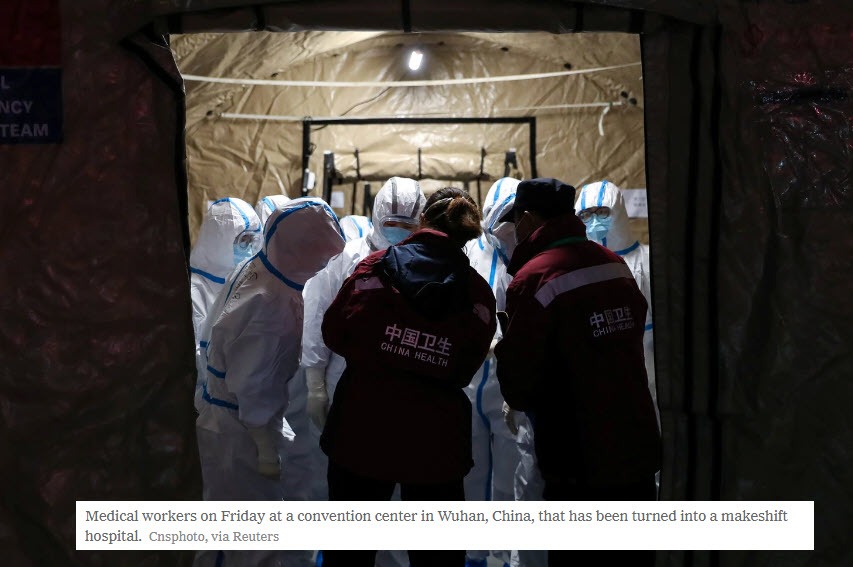
One glance that that and the problem is obvious. The data from Hubei is ridiculous, and reflects one of two problem, most likely both. First, it is clear that their medical system became quickly overwhelmed, and they quickly ceased to be able to provide adequate medical care. We saw videos of people dying in hallways. China responded as they could by building 2 huge hospitals, and also setting up additional facilities in a gym, a stadium and an exhibition hall. With those, together raise the quality of care in Hubei sufficiently? Deaths in Hubei, by day, the last four days have been 70, 69, 81, and 81. We aren’t seeing any improvement yet.
Second, it is almost certain that the other aspect of the system being overwhelmed is that only the most serious cases were tracked. Combine the two factors, and you end up with more deaths than their should have been, and not as many cases as their were, it makes their ratio look awful.
When all is said and done, I expect that the CFR will end up below 2.2% in areas where proper tracking and care is available.
Sorry but this is just flat-out WRONG. Dividing mortality into the PRESENT number of infections is incorrect. People generally do not die on the day of diagnosis and this is an exponentially increasing infection rate. So that 2.2% number is complete and utter garbage.
Please stop propagating this nonsense. It’s a highly dangerous thing to do as it conveys a false sense of security to others who buy into it.
Replying to Mish:
This report is a good example of how easily it spreads.