

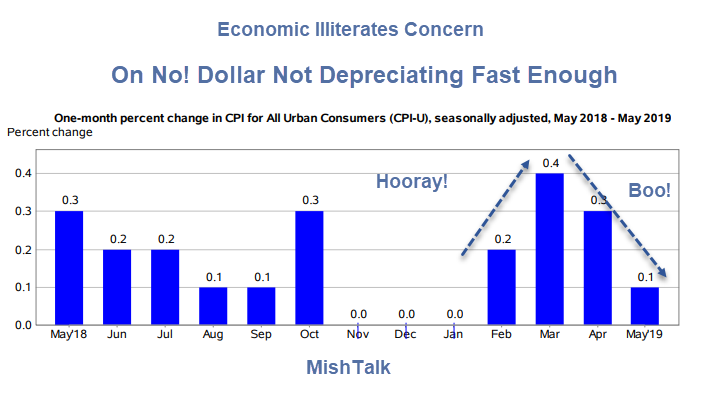
Economists and others are investigating the Consumer Price Index (CPI) for signs of wanted inflation.
The Consumer Price Index for All Urban Consumers (CPI-U) increased 0.1 percent in May on a seasonally adjusted basis after rising 0.3 percent in April, the U.S. Bureau of Labor Statistics reported today. Over the last 12 months, the all items index increased 1.8 percent before seasonal adjustment.
The food index rose 0.3 percent in May after declining in April, with the food index accounting for nearly half of the May seasonally adjusted all items monthly increase. The energy index fell 0.6 percent in May, with the gasoline index falling 0.5 percent and the indexes for electricity and natural gas also declining in May.
The index for all items less food and energy increased 0.1 percent for the fourth consecutive month. The indexes for shelter, medical care, airline fares, education, household furnishings and operations, and new vehicles all rose in May. The indexes for used cars and trucks, recreation, and motor vehicle insurance were among those that declined over the month.
Year-Over-Year CPI

The all items index increased 1.8 percent for the 12 months ending May. The index for all items less food and energy rose 2.0 percent over the last 12 months, and the food index also rose 2.0 percent. The energy index decreased 0.5 percent over the past year.
Econoday Lowlights
Price pressures at the consumer level are losing pace, as the ex-food ex-energy core rate missed expectations with only a 0.1 percent gain in May. The year-on-year rate edged 1 tenth lower to 2.0 percent which also misses expectations. Overall prices rose an as-expected 0.1 percent though the annual rate fell 2 tenths and at 1.8 percent is moving away from the Federal Reserve’s target.
Energy fell a monthly 0.6 percent in May with gasoline down 0.5 percent. But food is showing some pressure, up 0.3 percent for a 2.0 percent annual rate. Medical care is also showing a little lift, also up 0.3 percent in the month for a 2.1 percent pace and a 2 tenths gain. Housing, which makes up nearly 1/2 of the index, continues to be the central area of price support though strength is weakening, up only 0.1 percent on the month and 2.8 percent on the year vs 2.9 percent in April.
Other readings include no change for apparel, an area that Jerome Powell was expecting to see some traction appearing. Year-on-year, apparel prices are down 3.1 percent. But airfares, another area Powell expects to see strength, did jump 2.0 percent in the month though this yearly rate is still soft at 0.9 percent. New vehicle prices rose a monthly 0.1 percent with used vehicles down 1.4 percent.
At the last FOMC in late April and early May, policy makers were putting a positive spin on a slumping core inflation rate, in this case the Fed’s preferred gauge which is the PCE core which was at 1.6 percent in April. This rate runs several tenths below the CPI core and today’s report is not pointing to acceleration for the PCE core back to the 2.0 percent target. The spin Powell puts on the latest inflation data could well be the most important part of next week’s FOMC results.
Hooray! Food and Airfares Cost More
The economic stupidity of this line of thought is consistently stunning.
There is no economic benefit to pay more to get less. But that’s what economic illiterates say.
Yesterday, Trump complained the US is at a “big disadvantage” because of Euro devaluation.
I commented Clueless Trump Demands You Pay More For Less: He Says So Himself.
Europe vs the US
Europe is hardly a hotbed of economic activity.
France went through months of riots of “yellow vests” protesting the rising taxes and inability to make ends meet.
Because of asinine work rules and regulations, it is difficult to start a business in much of Europe.
Corporations like Google, Apple, Amazon, and Microsoft cannot exist in Europe because the EU would demand they be broken up to save the family farm and bookstore.
The US is clearly not at a big disadvantage to Europe.
And if the Eurozone splinters over Italy, it is difficult to say what the heck a euro would be worth. For discussion, please see Italy’s Mini-BOT Trojan Horse Could Blow Up the Eurozone.
No Economic Benefit to Inflation
There is no economic benefit to inflation.
The average second-grader understands it’s better to get 10 gumballs for a dollar than 1. The average economic doesn’t.
Economic foolishness doesn’t come easily. You have to be taught to be stupid. It takes years of brainwashing.
Mike “Mish” Shedlock






























In a recent interview with Bloomberg the former ECB President Jean-Claude Trichet, opined about his outlook for the global economy and monetary policy repeating the line declaring 2% inflation the desirable goal. In a speech not long ago FED chairman Powell also declared this as the goal and said the economy appeared solid going forward. The article below delves into why all central bankers seem to say the same thing and if it is really true.
Inflation would be less of a problem if employees actually had equity like the old days. That only happens in a small slice of the overall economy which is healthier than the rest of the economy.
There are at least two reasons the Fed and the government need a modest rate of inflation, as opposed to no inflation or – heaven forbid – deflation.
Without inflation the Fed has significantly reduced influence on the economy and loses it’s raison d’être. If it can’t stimulate the economy when it thinks it’s needed, what good is it? (For an extra 10 points, describe its value even if it can stimulate the economy.)
Inflation allows government debt (and others) to be repaid with cheaper dollars. Deflation requires repayment in dollars of higher value than those in which it was borrowed which would require higher taxes or decreased spending to make up the extra value.
These are serious issues for the Fed and the Federal Government, but they cannot talk about them for fear that the public will catch on to their game.
Of course inflation also allows companies some freedom on price increases which also somehow spill over into profit increases – i.e. the increase covers more than the inflationary effect – they can raise prices (profits) and blame it on inflation.
It’s a shadow game that those with the money dare not address directly.
The last person I’d believe on this topic is a professor of finance from North Carolina State University, who has no “skin in the game”. Professors were pushing the same silly argument when I took college economics about two lifetimes ago, and it didn’t make any sense even then. It is a quasi-religious mantra from economists that can’t be questioned.
“Financial illiteracy among the masses in America is shockingly underestimated!”
Bing – best comment of the day
Inflation is healthy for the economy – but too much can trigger a recession
June 12, 2019
Richard S. Warr – Professor of Finance, North Carolina State University
In a healthy economy, prices tend to go up – a process called inflation.
While you might not like that as a consumer, moderate price growth is a sign of a healthy, growing economy. And, historically at least, wages tend to go up at about the same pace during periods of inflation.
The U.S. Federal Reserve sees 2% inflation as the sweet spot for the economy, which is about its current level. But some economists, including those at the Fed, worry the economy is weakening, which would cause inflation to drop below its target – something it wants to avoid. The latest data, out June 12, suggested this may be happening.
….
That number (propaganda) was hand picked for consumption,basically setting the table and providing cover for, take a guess……….massive QE (money printing)NIRP!
Am I the only one here who thinks these numbers are absolute bullshit? They have changed how they measure true inflation to fit the govts needs and people just accept these figures w/o question?? Lets follow the dear leaders infallible propaganda numbers.
Of course those inflation numbers are 100% bullsh*t. They don’t want people to know just how ruthlessly effective they are at currency debasement. Hence, their ridiculous statements that “inflation is too low”.
The Federal Reserve is in the “Currency Debasement Business”, at which they have proven to be very effective. Believing that they have any goal other than that is a big mistake.
Inflation, in terms of pricing power, is very beneficial to corporations because it allows them to make debt payments while increasing net income. Corporations are taking on a lot of debt to repurchase their shares, but don’t have the pricing power to increase prices and income to make those debt payments. In an economic downturn, when corps may have to actually cut prices, this can lead to disaster.
I know you can just say to not repurchase shares with debt, but that’s not really a choice on the table. Private Equity is running the country now, and debt is how their profits and wealth are created. There is no alternative.
Looks like another good SS increase coming this year. Thanks Trump!
I wonder can this can kicking go on forever? I mean FED, ECB, BOT and Chinese are all devaluing their currencies to cause economical suffering by QE methods. I mean, they try to make sure that no main currency can ever be too expensive compared to others. Where in your estimate is the breaking point?
Lower inflation, in of itself, is a natural outcome of greater productivity. Deflation would be a more natural state if not for a rising money supply.
Greater productivity dominantly driven by disruptive technology and robotics!
Stagnant wage growth since late 80s, decline of unions, labor arbitrage working against American wage workers
Inflation in housing, mkts, education and health care – NOT in their equation!
Financial illiteracy among the masses in America is shockingly under estimated!