

Fed Panic
The Fed will cut a minimum of 25 basis points on July 31.
The CME Fed fund futures model jumped to 71% Chance of a 50 Basis Point Cut as New York Fed president John Williams said “When you have only so much stimulus at your disposal, it pays to act quickly to lower rates at the first sign of economic distress.”
Williams attempted to downplay that statement with a subsequent and obviously transparent excuse: “This was an academic speech on 20 years of research. It was not about potential policy actions at the upcoming FOMC meeting.”
Yeah. Right.
Let’s call this for what it really is: Fed panic with a hedge.
Earnings Recession Warning
James Bianco at Bianco research says Market needs a deep rate cut to prevent an earnings recession
I had to read that twice.
- Is the Fed supposed to be worried about S&P 500 earnings?
- Is that part of the Fed model?
Yet, here is the same call in a Bloomberg interview: Only a Half-Point Rate Cut From the Fed Will Do

“The sooner the Fed fixes it, the better. A 50 basis-point cut fixes it better than a 25 basis-point cut” says Bianco.
Triple Wow
I have met Bianco. He is a very bright guy.
But I have a deep philosophical difference of opinion with his statements on Wednesday.
I believe
- The Fed ought not be making assessments based on stock market performance.
- The Fed blew obvious bubbles and keeping them alive and zombie corporations alive is a serious kick-the-can mistake.
- More importantly, the overall notion the Fed can micromanage the economy via policy decisions is a proven falsehood.
Yield Curve

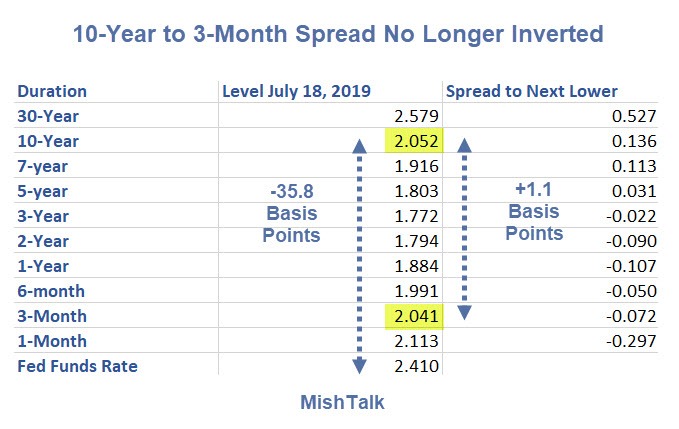
On June 25, when I last presented these charts, the yield on the 3-month T-Bill was 2.136% and the yield on the 10-Year note was 1.992%.
The spread then was -14.4 basis points. It’s now +1.1 basis points.
What If?
If the Fed cut 50 basis points the Fed Funds Rate would drop to 1.91 assuming perfect correlation.
If the 10-year yield dropped a mere 15 basis points in response, the Fed Funds Rate to the 10-Year note would still be inverted.
But let’s assume an un-inversion.
So What?
The idea that the yield curve is a problem is complete silliness.
The yield curve is a symptom of a problem, not a problem.
The problem is the economy is a bubble-laden environment that’s choking on debt, zombie corporations, and unwarranted credit expansion fueled by interest rates that were far too low, for far too long.
Rate Cuts Don’t Matter
Un-inverting the yield curve does not fix the problem, does it?
I stand by my assessment earlier today: Half-Point Rate Cut Odds Explode to 71% – So What? It Doesn’t Matter!
Looking ahead: Deflation Up Next.
Importantly, this obvious Fed panic by NY Fed President John Williams implies one of two things, and possibly both: A recession has already started and/or the consequences of a recession are far bigger than the Fed wants you to believe.
Mike “Mish” Shedlock






























Fiscal policy is indeed a problem.
We have far too much government and government spending
Mish, I luv you, I do, well then please tell me how do we update our infrastructure?
The answer to that is easy. The most valid functions of government are to maintain order, both internally, and externally, which justifies the police and the military. Next most valid are infrastructure, such as roads, water, sewer, airports, and fire departments. The government has ample tax revenue to pay for these.
The problem is that government has learned that if they pay for the less essential things first, people will allow them to to do the infrastructure, too, and will almost always approve bonds to pay for schools, police stations, sewers, roads, etc. Therefore, governments spend money on countless other things first, and once out of money, come to the public with bonds to pay for the essentials.
The yield curve spread is the answer to the problem of visibility into the future, in particular the clarity about the inflation is better into 6 months than 10 years. With the reining insanity this distinction does not hold anymore, hence the yield curve jigsaws. The only force that affects the yield curve is whatever the FED decides, sell short and buy long, or vice versa.
Looks like insiders are now cashing out even before IPO…
There’s been a new investing game in town, ever since Treasury Secretary Hank Paulson’s 2008 congressional sales pitch for a bank bailout.
Words matter. Had this former Goldman Sachs CEO slipped and replied as follows to the senator’s question, “Then god help all us BANKERS, instead of his actual, “Then god help us all,” there might have resulted an actual debate and outright rejection of Paulson’s demand for $700 Billion to bail out his banker associates.
There’d have been a serious recession and subsequent recovery and we’d all still be playing the same old familiar investing game we grew up with. Those days are gone. For how long? Nobody knows. I do know that the Fed have been made rock stars by the MSM. Bernanke gloried in this adoration and fame, casually commenting repeatedly on the beneficial wealth effects of high stock prices, a factor utterly unrelated to the Fed’s ostensible charter. A Dallas Federal Reserve bank President also pointed out stock gains as Fed largesse we should all be grateful for.
This is the same Fed whose actual, Congressionally-mandated charter, in my jaded view, is to provide a job for anyone who can fog a mirror, while cutting the purchasing power of the currency in half every 35 years with 2% inflation.
It’s taken me time, but I’m learning the Fed rules of investment and I don’t like them, but they are what they are: A finger in the political wind blown by Wall Street.
Mish, isn’t a big part of the problem the lack of fiscal policy ? Why do we NOT invest or reinvest in infrastructure in this country? And why does know one want to talk about this? I don’t get it? But I am getting pissed off at this whole mess
If we didn’t have messed up fiscal policy, monetary policy would be unnecessary. The goal of monetary policy is to keep the economy going, despite incessant, destructive deficit spending.
You have to think about the return on investment and the time it takes to return. The reason money doesn’t flow to infrastructure projects is because they take too long and cost too much relative to investing in hedge funds, stocks and other securities. In short, you can cash out your chips at the end of every day at the stock market casino. Can you do that with infrastructure spending ? This is not even getting into the fact that market return is better too.
This latest round of announcements by Williams and Clarida with the ensuing market reaction proves how totally messed up current US monetary policy is.
We are all speculators now.
Remember, it’s not the inversion itself that it the recession signal. It is when, after an inversion, it un-inverts:
https://moneymaven.io/mishtalk/economics/surefire-recession-signal-in-pictures-8xjAjnxcx0igtWCJABnNgA/
This un-inversion, combined with the LEI data yesterday is a pretty strong signal that a recession will start in a year or so. Will it start before, or after the election?
The FED has stepped in every time the market has faltered. The FED is a market manipulator.
Rate cuts help the stock market short term because idiots think it helps the economy long term. It doesn’t.
agree totally. Know one cares about main street USA for a long time now, Wall St is not USA , its global money, that the majority seems to give 2 shits about the USA. We need fiscal policy in this country and can someone explain why we don’t have any?
I think that US rates need to be looked at with respect to international rates. With EU rates negative or zero, US rates look high. There is no one that wants to stop deficit spending, so rates need to be 0 or below.
It’s a crazy upside down world and who knows how long it can stay this way. 2 years? 20 years? 50 years? I sure don’t know but it has been longer than I would have imagined possible!
Deficit spending is a major cause of low interest rates. Tax cuts are a killer for savers.
This seems backwards. Deficits should bring higher rates. Tax cuts (keeping more of the interest you earn) is good for savers.
It does seem backwards, but its not. The treasury creates new money and spends it into the economy and then takes it back in taxes and treasury sales. That ends up putting far too much money into the banking system. So you end up with too much money chasing too few investments. Hence lower interest rates.
And the tax cuts may be good or bad depending upon who you are. If you have enough wealth that you can afford to take higher risks and put your money in stocks and bonds, tax cuts are a great way to enhance your wealth. If your not in that position and have to more conservatively keep your wealth in cds, bank accounts, IRAs and the like, your probably losing more with the low return than the loss in taxes.
This is the old issue of viewing federal spending like household spending. It works just the opposite and it’s actually designed that way.
Crisis of liquidity will turn into ‘crisis of confidence’ in the $!
Gold will keep shooting up!
I’ve been waiting for this to happen since 2009.
I think the $ is the safest currency in a world of crappy currencies.
The dollar isn’t going to be the first currency to experience a crisis.
The currency traders believe Williams’s nonsense about academics because the USD is up strongly this morning. What idiots!
Deflation may happen when people realize the king has no clothes but I would bet in the end they “will do whatever it takes” to get out of it. Think of who massive money printing will save, its every prolfligate govt in the world. So my guess they will pull out all stops worldwide until the currency debasements inflates away all the govt debt to sustainable levels. Rinse wash and repeat ad infinitum.
Crisis of liquidity will turn into ‘crisis of confidence’ in the $! Gold will keep shooting up!
My thesis: banks borrow short and lend long. Therefore, an inverted yield curve is bad for bank profits and therefore bad for credit creation which effects the long-term health of the economy.
The Fed can control rates at the short-end, but has no ability to increase rates at the long end. Therefore, it has to cut short-term rates to fix the inversion. The question then becomes why has Mr. Market pushed the 10 year so low when Mr. Fed wants it higher? My guess is the ECB and BOJ are forcing their respective investors into the US 10 year seeking yield.
Or it could be that the money centers are betting on deflation in the long-term.