

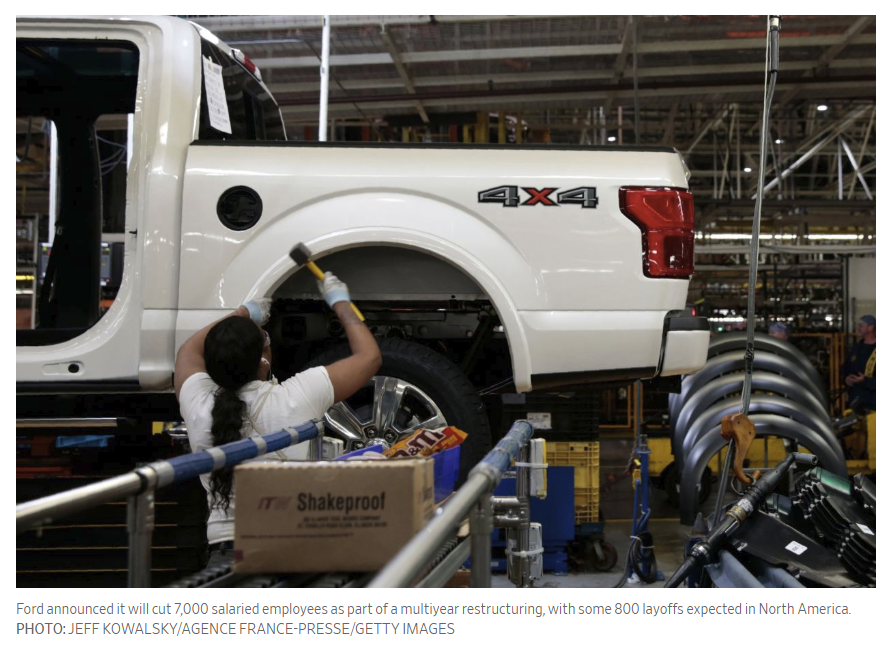
In another sign of troubling auto sector news, Ford Announces Restructuring Plan to Eliminate 7,000 Jobs.
Ford Motor Co. said it is cutting 7,000 salaried employees, or about 10% of its white-collar workforce, as part of Chief Executive Jim Hackett’s broader plan to revitalize the auto maker.
In an email sent to employees Monday, Mr. Hackett said the cuts include some buyouts and layoffs that already have occurred, and the process will be completed by August. The cuts will save about $600 million annually and are part of a broader, multiyear restructuring that will result in about $11 billion in charges.
The reductions will include 800 layoffs in North America, where Ford already has made about 1,500 voluntary buyouts, a company spokesman said.
US and European Changes
- Europe: Ford will shrink operations in Europe and South America by moving away from traditional retail car buyers to focus on sales of vans and trucks to commercial customers.
- US: Ford will phase out car lines like the once-popular Fusion family car. It will add more-lucrative pickup truck and sport-utility vehicles, like a new Bronco rugged SUV slated to go on sale next year.
Does Everybody Want Trucks and Vans?
Millennials are not buying much of anything, at least compared to their boomer parents. And I keep wondering when the boomer love affair with trucks and huge SUVs ends.
A major stock market decline perhaps? Or will it take a boomer die off?
The latter is not too far off, at an accelerating pace.
Also on deck are self-driving vehicles that will reduce the need for cars in large cities altogether.
The two huge drivers going forward are massive demographic changes coupled with huge shifts on the role of cars and how those cars function.
In 10 years, neither Ford nor GM will look like they do today.
Mike “Mish” Shedlock






























Ford is only going with three models next year. The auto business is in a war with climate science, regulators and road planners one they are going to lose.
Pick-up trucks and SUVs provide more belly room for boomers. I have fun watching those guys with extended everything F150s trying to park at Walmart.
Niche markets, and cut your losses while you still can. They know they can’t build a better car than others so why try.
Americans do not run Japanese engines at the Indianapolis 500. Good American engineers CAN build better cars.
Then why don’t they? If they did I wouldn’t drive a Subaru. “People respond to incentives. All the rest is commentary.” – Steven Landsberg in The Armchair Economist.
Toyota and Subaru both race plenty, and used it for development of their products, just not much here in the states.
How can kids buy cars with their debt load?
Guess they’re banking on the US not doing away with the 50-year old import tariffs on light trucks (25%).
Japanese trucks have V8 engines with double overhead cam, fuel injection, hemispheric combustion chamber. Ford made such engines for the Sherman tank, but have yet to produce a modern truck engine. Ford has no pride in their quality nor in their engineering. It’s all about how many ways can we cheat the customer.
I am afraid that they will be making a mistake as gas prices are volatile and a period of high gas prices will result in a shift in consumer preferences. Hopefully they will be able to shift production if needed. US car makers are not alone in a decline in demand for passenger cars, its also happening to Japanese and European car makes. I drive only GM vehicles and have no quarrels with their quality.
We stopped buying American cars in the 1980s. Of course the ones we buy are produced in America. The engines are just from Japan or Korea or Europe. Ford and GM and China trade issues will trigger a recession in the midwest. This wont be felt on the coasts but it will flip the White House in 2020 to Biden. You heard it here first.
Lol stop drinking
Henry ford had a mass production planned obsolescence philosophy. Planned obsolescence is fraud. His philosophy cannot compete with the high quality long service life philosophy of many competitors outside of Detroit. I guarantee I would not purchase a Ford truck. Ford can buck up their philosophy or go out of business. I see they made their choice. Sell the stock.
And I keep wondering when the boomer love affair with trucks and huge SUVs ends.
Once gas hits ‘unaffordable’ . . . we say that people could save if they just bought less lattes . . . they would save even more if they didn’t commute singly in vehicles that get 25 mi/gal or less. Expensive to buy, expensive to fill, expensive to maintain.
SUVs have improved their gas performance. Actually many are the same as a high performance car engine. There is a reason so many 7 and 8 passenger vehicles are new SUVs and not minivans or station wagons. As time goes by more will become hybrid and put more cars out of business. Just because GM and Ford cant build fuel efficient large SUVs dont assume others cant.
No matter how great the gas milage, you will even get better milage with the same design engine (or a smaller version) in a smaller lighter car . . . that’s just plain physics (weight, wind resistance, rolling resistance, losses in the engine, etc)
Not necessarily true anymore for equivalent cars of the same performance. Remember no car can hold 7 or 8 adults. Station wagons are dinosaurs. Large cars are next. Finally if anyone thinks small or medium sized cars are safe they are mistaken. I saw one car flip another. The newer car got flipped because they are much lighter. The older car literally kept going through the intersection as if it hit a bird.
“Commute singularly” saves time. It only saves money if you don’t put a value on your time.
I’ll be the first to admit that . . . I do so myself. The point was however that you don’t need an F150 to do so, there are more fuel efficient cars. The majority of trucks I see here do NOT look like work vehicles . . . and the majority of SUV’s have a driver and at most one passenger (there are exceptions to both of course). I drive a small vehicle that gets 38 mi/gal … lets see a F150, RAM or Highlander do that . . .
We have a truck but that was for dirt bike hauling. We no longer have our bikes (had to pay for kids school) but since the truck is paid off and still runs great, it would be more expensive to replace than pay for the extra gas. We also have a Civic so the truck is not driven all the time. There are quite a few reasons for having trucks (and probably SUV’s) but not everyone has a use for them.
Gas mileage has nothing to do with buying or driving. A 1962 Ford Anglia got 34 mpg and almost nobody bought one.
Yep . . . which is the point I was (unsuccessfully apparently) trying to make. Even IF people could save by bying a smaller vehicle very few people actually DO. Until it becomes unaffordable (or the demographic dies) the American love affair with large vehicles will continue unabated, reason has nothing to do with it . . .
It’s just a reversal of the Ford policy of a century ago. Back then, Ford paid those building the cars well enough to buy them. Hence contributing to massively growing the market for its own output. Now that those who produce things have been safely corralled back on the plantations again, there’s just not nearly the same market for passenger cars anymore. So, just as before Ford, a few coachbuilt one-offs a la Ford GT, for those on the Fed’s payroll; and commercial vans and buses to ferry the rest back and forth to the quarries, cotton fields, servant’s quarters and bordellos.