

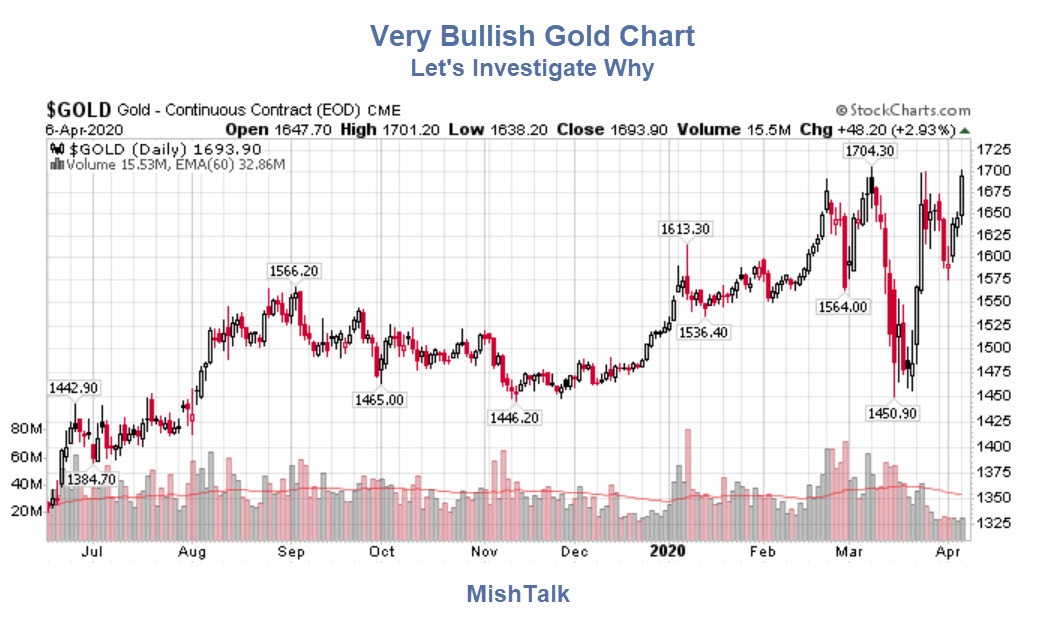
Next Major Resistance
Gold’s next major resistance points are $1798 then the all time high (in US dollar terms) of $1923.
It’s how we got here that’s hugely bullish.
Gold vs Commitment of Traders Report

The above chart is from Barchart. They have excellent interactive COT charts.
Understanding Futures
In the futures world there is a short for every long.
The first horizontal box has Large Specs, Small Specs, and Commercials. The second box distinguishes producers from the swap dealers (i.e. market makers). It’s Old vs New COT reporting.
We frequently hear things like the commercials are record short or record long.
Such comments put the cart in front of the horse. The commercials are not the driving force. Speculators are (Managed Money and Other) (Large Spec and Small Specs) depending on which set of numbers you wish to use.
The producers mine gold and sell it via futures.
The Swap Dealers are commercial market makers who take the other side of the trade. They do so because as Market Makers they have to. It’s their business to make a trade.
The swap dealers are hedged. They do not much care if prices rise of fall. If that was not the case, they would be blown out of the water on big, sustained rallies. That does not imply honesty as the dealers have been caught manipulating. Rather, they manipulate if their hedges get out of balance or they see a chance to profit. The latter could be in either direction, up or down in the price of gold.
Regardless, the dealers are not going to get blown out of the water if the price rises high enough as is often claimed.
Commercials Don’t Cover Shorts
Another thing we hear is “commercials covered” their shorts or the commercials are the “smart money”
That is nonsense as well.
The producers don’t buy gold and the swap dealers are hedged (long gold and short equivalent futures). There is nothing “smart” about being forced to take the other side of a trade.
This subject comes up all the time.
For example, on December 27, Tom McClellan said “Gold COT Data Call for More of a Drop”
Gold was at the $1500 level.
Investigating Alleged Smart Money Positions in Gold
I responded with Investigating Alleged Smart Money Positions in Gold which led to a nasty exchange over me using his chart so I produced my own and linked to him.
On March 12, McClellan said Gold Moving Lower Despite Covid-19.
McClellan said “Gold prices should start trending down now, and for the next 5 years, according to this week’s chart.“
I am reluctant to quote more over risk of being accused of copyright infringement once again. So, please read the article yourself if you think I may be out of context.
Long Accumulation and Liquidation
Instead of putting the cart before the horse regarding smart money, look at things this way.
Hedge funds and small traders accumulate gold. As they do, prices tend to rise. That’s best viewed as “long accumulation”.
When gold peaks (sentiment changes and hedge funds and mo-mo investors are not willing to add more contracts) the setup reverses.
Prices tend to decline in “long liquidation”.
Gold vs Commitment of Traders Report Detail

Managed Money
Note that the Managed Money crowd (hedge funds etc.) were long 232,732 contracts at the end of December with the price of gold at roughly $1500.
As of last Tuesday, Managed Money was long 152,598 contracts. That is a long liquidation of 80,139 gold contracts.
Somehow the alleged “smart money” was on the wrong side of the move as the commercials went from 366,491 short contracts to 283,959 short contracts.
To weed out the producers, focus on the Swap Dealers. They went from 220,340 short contracts to 171,750 short contracts.
Q: Smart Money?
A: No
Curiously, Managed Money is both smart and dumb depending on which way the price of gold is moving.
Gold vs Faith in Central Banks

Why Am I Especially Bullish?
The answer is the price of gold blasted to new highs while long liquidation was happening.
This is not a normal occurrence.
If you believe as I do that the price of gold is reflective of faith in central banks, there is every reason to be bullish rather than pay heed to alleged 5-year cycles.
COT action is icing on the bullish case.
Gold as an Enforcement Mechanism
Physical Gold vs Paper Gold
The other meme of the day is an alleged huge price difference between physical gold and paper gold, with futures representing one form of paper gold.
In reality, there is no shortage of gold, but there are shortages of some forms of gold, primarily due to delivery issues.
For discussion, please see No WSJ, Gold is Not the New Unobtanium: Where to Buy?
Mike “Mish” Shedlock






























What a great article, esp the really perceptive analysis of the COT data. Thanks.
Hmm, just too a look at weekly silver…. really went down there for a while….looks like a setup to me…
Mish, do you worry about “all assets correlate” if we get a big unwind deflationary crash?
COMEX just saved by JPMorgan.
Gold more expensive in New York than in London.
Say no more.
No, Mish I think you have it backwards. If you look at the COT chart at Sept-Oct, you’ll see that was time to go Long. But the Specs weren’t in the game. They are the dumb money, the Commercials are the smart money in Cot trading
Mish, can you tell what source you use to determine the current spot price? Or do you not follow that? Recently, past few weeks, Apmex and Kitco are wildly different. And the $GOLD is, as you show, still above $1700, but what really is a “true” spot price. $GOLD is the nearest futures contract?
Goldprice.org
Goldprice.org is different from both of them but appears to be much closer to Kitco than Apmex.
The spot is derived from whatever market(s) are open at the time it is quoted. I don’t consider it worth following much as I am not sure many buy at it. For example, the US Mint does not buy at spot. It buys based on the LBMA Gold PM Fix.
Don’t think Corto will buy in the same quantity as the mint does.
Why isn’t there a single spot gold price?
Starting in Sydney, Australia each morning – and then moving onto Tokyo, Hong Kong, Shanghai, Singapore, Mumbai, Zurich, London, New York and finally California’s business hours – the world’s spot gold market is what’s known as “Over The Counter” (OTC).
In this OTC market, each gold buyer and seller works directly with the other, and each individual deal – often still agreed over the telephone – sets a unique gold price and quantity. This is very different to buying and selling equities through a stock-market exchange such as the NYSE in New York.
Electronic trading exchanges show your order to everyone else using that platform, and your deal is cleared by the company running the exchange. This means that it accepts the shares from the seller, and it transfers them to the buyer. The exchange also guarantees to transfer shares to the buyer, and pay money to the seller, even if the other party fails to deliver.
Spot gold trading is different. It sees the buyer and seller first research each other’s credit and financial standing, signing an agreement to do business. Each deal is then a private trade between themselves. Nothing is standardized in this spot gold market besides the high quality of the Good Delivery gold bars that change hands. So as a result, the world’s gold dealers also lack a single, market-wide spot price.
If you think of gold as an inflation hedge, your thinking may be wrong. The Fed has been on a “printing spree” for 10 years. Think of gold as an alternative currency to the dollar. The dollar is strong and getting stronger because of a worldwide shortage of them. Gold should perform very well if/when the world seeks an alternative to the dollar. That is coming, but probably a few years in the future. Other than that, there is no really compelling reason to own paper gold other than as a trading vehicle. Physical, yes, as “sleep well” insurance.
I bought GLD in January and February of 2013. I bought as an inflation hedge and insurance if the Fed went on a printing spree. I’m still down 2% from those buys. Maybe the safety insurance will work out in the long run.
I bought some PMs around that time too, but the nosedive that followed didn’t bother me too much. I was in it for the long haul and it’s only a matter of time before a QE-based society loses control of price discovery.
Mish, do you think the USD stays strong medium term, and Au/USD goes up anyway?
I think gold goes up.
The US dollar is a mostly a bet on the Euro – Don’t know – but I don’t like the Euro, the dollar or the yen
” all time high (in US dollar terms) of $1694.”
That can’t be correct right?
Thank you
Should say 1923
I have a question Mish:
Annual 2019 Gold production was about 3,300 metric tons. Which if my maths is correct is the equivalent of 1060 futures contracts.
According to the bar chart producers were short in the 100’s of thousands of contracts. So why so many? Have I done something wrong?
1 metric tonne = 32150.7 troy ounces
3300 metric tonnes = 3300 x 32150.7 = 106,097,310 troy ounces
1 futures contract is for 100 troy ounces.
106,097,310 / 100 =~ 1,060,973 contracts
So it would seem that you lost 3 digits somehow.
Keep in mind that speculators are not really looking to take delivery for the most part and will close out their contracts before First Notice Day (FND), possibly rolling them over).
FND for the April GC was 3/31. If one did not want to be assigned they had to be out by EOD.
To give you an idea of how this situation plays out:
On 3/20, just 7 trading sessions before FND, open interest was over 205,000 (20.5 million+ ounces).
On 3/25, 3 trading sessions later, open interest was just under 108,000 (10.8 million ounces).
At the close of FND, open interest was 7,378 (737,780 ounces) with 17302 deliveries (1,730,200 ounces).
After yesterday’s (4/6/2020) close, open interest was 1752 contracts with total deliveries to date at 25,133 (2,513,300 ounces).
Looking at the above behavior should make it clear why the fail-to-deliver that is supposedly going to expose the CME (COMEX) just doesn’t happen. The screamers constantly harp about paper supply and ignore the offsetting paper demand, which vanishes without taking delivery. This is not surprising when each contract requires the buyer to come up with as much as $160,000+ (depending upon when the contract was bought). Most buyers don’t want the gold. They are just engaging in highly levered speculation on the price movement.
Ah that’s great, thanks very much. I don’t have a Gold futures account & after googling, for some reason I thought 1 contract was 100,000 ounces 🙄
Yes I agree about the “paper gold” etc. Most of those long futures contracts will rollover their long to the next contract rather than take delivery.
The futures market, although serves to aid liquidity also increases volatility in my view. I prefer to hold allocated bullion because I then have no counter party risk.
There are obviously sharply diverging opinions on the futures. But forward markets have been around for a long time in many markets, not just the PMs. For whatever reason, it’s the PMs where there is the most angst. It usually happens when the price doesn’t do what someone thinks it should do. As regards price behavior, in gold the complaints are nearly always about downside action. In the stock market it is typically about upside action. Heh.
For all the complaints about them, I would bet that today’s regulated, standardized, exchange-based contracts are much more transparent and safer than what went on before they appeared on the scene.
The sharpest moves (and manipulation) occur in less liquid markets. Some very big gold moves, in both directions, have occurred in the futures overnight session, where liquidity is much lower.
I don’t know if this is still true as I do not follow the oil market closely but I read years ago that the oil market moved away from the spot market to futures-based pricing because … drum roll … there was little liquidity and the spot market was subject to squeezes and other price distortions.
Futures aid liquidity because market makers are able to run longer physical positions within internal risk management limits by virtue of their future’s hedge. In other words from a supply viewpoint there’s more physical stock in market makers portfolios than otherwise, albeit most of it hedged. The leverage futures permit just makes it easier for speculators as you mentioned in your the original post. However I take your point that without futures, markets might also be more volatile on occasions because liquidity is thin.
Generally, I’m of the view that futures benefit markets overall.
I should add although I don’t have an account now, I did use them regularly in a previous life as a Eurobond market maker. 😀
“I should add although I don’t have an account now I did you use to use them regularly in a previous life as a Eurobond market maker.”
I’m not sure what you are asking but it looks like you are asking if I have a futures account. If so, then yes, but the only futures I have ever traded are the S&P 500 contracts (as a speculator). I currently trade the ES (but not in this environment – I use UPRO / SPXU instead to cut leverage) and traded the SP (large pit-traded contract) back in the 90s when the ES did not exist.
Sorry I wasn’t asking anything. I typed the word you in the sentence by mistake.
Ive corrected it now. My bad English!
Some people claim the gold etfs GLD and IAU don’t actually have enough physical gold. No idea if it is true, but I do have some in my 401K. However, it makes the premium of physical feel like worthwhile insurance.
If you are concerned – simple solution
Sell GLD – Buy Equal dollar amount of OUNZ
Good Article Mish.
I use GLD for options ONLY otherwise use SGOL, IAU, BAR, OUNZ and GLDM
CEF is about 50% gold, 50% silver and is supposed to be 100% physically backed.
I trade GLD from time to time. I see no reason to distrust it. They are audited twice a year by Inspectorate, a well-respected firm. James Turk’s GoldMoney used Inspectorate at one time and for all I know still uses them. It’s ironic as I believe Turk was one of the first to express concerns about GLD.
I can and (with others) have addressed the naysayer’s “issues.” But they can mostly be addressed by one simple key fact that the GLD-looks-fraudulent-to-me crowd just ignores : if the fund doesn’t really have the gold the creation / redemption mechanism falls apart and the ETF share price will not track the underlying NAV, neither of which the ETF has control over.
In order to keep the share price aligned when it diverges to the downside (share price < NAV) and profit from it through arbitrage an AP (Authorized Participant) must be able to short the underlying (gold) while simultaneously buying the ETF shares. The shares are later redeemed to the ETF in exchange for gold. If the ETF doesn’t have it the AP is holding worthless shares that it bought while still being on the hook for the short. That is no longer arbitrage. That is a sale of gold with a purchase of shares that now have a value of 0.
IAU is mostly likely the same thing, but GLD is better for trading as the bid / ask is tighter so I have never bothered with it. IAU has lower expenses but for trades the bid / ask matters more as the holding periods aren’t generally long enough for expenses to matter. Both usually have a spread of $0.01 during normal trading but multiple IAU shares must be bought to get the equivalent exposure to gold of 1 GLD share.
If the gold isn’t in your hands you have counter-party risk. Period. I think the risk with GLD is extremely low but it is not possible for it to be 0.