

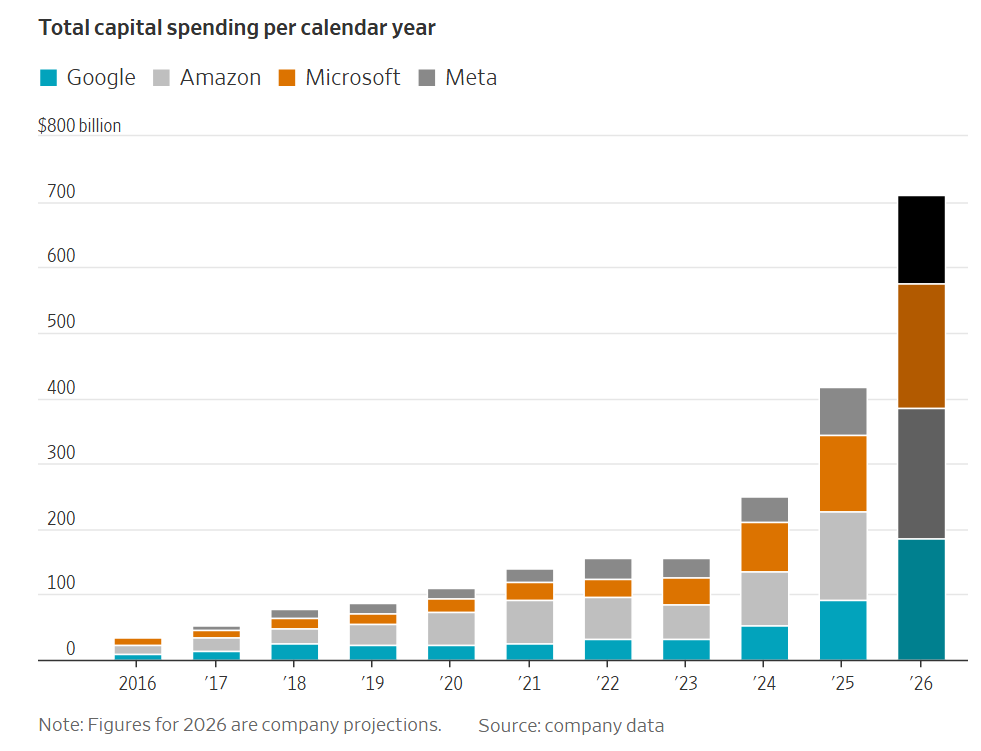
Some ask whether or not big tech overspent. I ask by how much.
The AI Spending War
The Wall Street Journal asks Will Someone Finally Blink in the AI Spending War?
Big tech reining in its AI spending may be a tantalizing prospect for some. It would also be a costly one.
That doesn’t seem in the cards yet. Second-quarter reports coming later this month will likely show another period of blowout AI investments. Wall Street analysts estimate that combined capital spending by Google, Microsoft , Amazon and Meta Platforms year over year to hit $168 billion in the June-ending quarter, according to consensus estimates from Visible Alpha.
This spending is crimping both the free cash flow and stock prices of those four companies; only Google-parent Alphabet has managed to outperform the S&P 500 this year.
But there are also some signs that AI’s big spenders are looking for more ways to at least rationalize their investments. Before SpaceX went public last month, its xAI business signed a major deal to effectively share its computing capacity with Anthropic—for $1.25 billion a month.
Now Meta may be getting in on that action. Bloomberg reported last week that the social-network giant is developing a cloud-computing business using the extensive AI network it has built out.
Meta would be very late to that industry; Amazon, Microsoft and Google have all been selling cloud services to businesses for well over a decade. But Bernstein Research analyst Madison Rezaei says the scale of Meta’s network already “easily rivals cloud provider footprints.” She estimates the company has about 20 gigawatts of computing capacity now with an additional 14GW coming online over the next few years.
Renting out some of that capacity would effectively confirm that Meta has overshot in its build-out. Founder and Chief Executive Mark Zuckerberg said as much at the company’s annual shareholder meeting in late May. “We haven’t done that yet because we think that we have a use for the compute,” Zuckerberg said, in response to an investor’s question about building a cloud service. “But obviously, if we get to a point where we feel that we have overbuilt, then that is an option that we have.”
The big question would be whether renting out excess capacity is a short-term offset to continued mega-spending, or a sign that such spending is about to recede. Meta is a smaller company than Amazon, Microsoft and Google, but it has been the most ambitious in its AI investments. Zuckerberg has built up a division called Meta Superintelligence Labs in a push for the social network to be the first to develop a supercharged form of AI. Meta expects to spend well over half its revenue this year on capital investments, which will likely take its free cash flow into negative territory for the first time in its life as a public company.
Most analysts doubt that Meta plans to actually scale back its spending. “Meta is not stepping away from the AI race; it is turning early, aggressive capacity commitments into a strategic value creation option,” wrote Brent Thill of Jefferies. Still, the idea that the company has excess capacity at this stage of its AI cycle raises eyebrows. Justin Patterson of KeyBanc Capital said “it is conceivable that the scope of MSL’s ambitions have narrowed vs. Meta’s original AI goals when it began the capex cycle.”
Big Tech’s Financials Obscure True Cost of AI Buildout
The above link is a free WSJ link. The article has a related video that worth watching on the true cost of the ai buildout.
Here’s a stat that caught my eye. 90 percent of stock buybacks have gone to stock options for employees.
The competition for top AI recruits has been so intense that the big tech companies have been using free cash flow to hire employees masking shareholders dilution.
Free cash flow estimates are essentially a huge lie.
It’s a fascinating video well worth a play. It explains how and why companies get away with this.
And none of it is illegal.
Circular Financing
Nvidia is facing scrutiny over allegations of employing “circular financing” (or “round-tripping”), where the company allegedly invests in or lends money to AI startups and cloud providers (e.g., OpenAI, CoreWeave), which then use those funds to purchase Nvidia’s GPUs. Analysts worry this creates artificial revenue growth and inflates AI demand.
So not only has AI overbuilt capacity, free cash flow is very overstated as well.
$1.8 Trillion in Off-Balance Sheet AI Risk
Also note $1.8 Trillion in Off-Balance Sheet AI Risk Reminiscent of Enron
There’s $1.8 trillion in AI-related debt off the balance sheets vs $1.4 trillion on.
The hardware makers and cloud providers post massive revenues.
However, the pure-play AI developers like OpenAI and Anthropic are operating at a significant loss as they burn billions on infrastructure to build and run their models.
That money is fueling profits at the chipmakers. But most of the risk is hidden off the balance sheet, inflating earnings.
How long this can go on is unknown but cracks are clearly visible now.






























The bankrupt Global Crossing in 2002 is an example of too much capacity and too few customers for it’s network of fiber optic cables paying the original fees for usage,
All these Data Centers and AI networks will face the same fate as free doesn’t pay the bills
A great analog is the us railroad boom in 1890s
Maybe the panic of 1893 is coming
It’s a great analog, except the tracks and other railway infrastructure weren’t in need of replacement within 5 years.
I want someone to tell me where the profits will come from to pay off this debt? And where will the money come for the next cycle of hardware in another 2-3 years?
The same way these ‘new’ technologies always work out – a couple of companies succeed and make crazy money and the rest fail, leaving stockholders and debtholders with little to nothing. That’s why they spend so much money trying to be the winner.
Think Google and Yahoo competing for web search engine success. Google stock price (Alphabet) has increased by 10x (!) in the last decade due to huge profits. You can’t buy Yahoo stock any more. One made it big; the other failed.
What happens if China allows use of their open AI for free or next to nothing? Poof 😱 I think that is a realistic possibility.
The AI boom isn’t a bubble — it’s a faceplant happening in slow motion. Meta overspent by gigawatts, Nvidia engineered a demand loop that would make a hedge fund blush, and the industry is quietly sitting on more hidden debt than the GDP of Canada. Buybacks aren’t returning value; they’re just a laundering mechanism for compensation bloat. Big Tech keeps insisting this is sustainable while torching cash like a dumpster fire behind a datacenter. If this is the future, it’s built on denial, debt, and the hope investors don’t sober up.
No not at all , what hajea you come to those conclusions. By the way all the illegal immigrants need to be here to do the work that the data center engineers feel is beneath them
And this is why America is on the fast track to being a has-been country, if it hasn’t already happened. We make mistakes, taste the pain of them, and then insist they never happened. We learn nothing every. single. time. Slavery? Just a little blemish, don’t mind those unpaid Mexicans and mostly black prisoners toiling in the cotton fields now! Corruption? It was just a few times that led to a soft-civil war in the 30s guys, that was forever ago! Lawlessnes? Well, we don’t talk about the years from 1870 to 1900!
Other countries learn from their mistakes, Americans find a way to shift the blame for mistakes to history books and then forget they existed because they can’t read. It’s not sustainable and we all know it.
S e c u r i t y
Breaching security is the heart of the AI enterprise
[1] It is being supported by the military/industrial complex as an existential issue, and when it fails financially, national security will be the predicate for bailing it out.
Don’t forget Google was originally a CIA sponsored project.
[2] The premise for this AI race is the Orwellian surveillance state our overlords have in mind, breaching everything we have learned about individual human rights, privacy, property, etc.at a global scale.
[3] The training model material collections have breached all laws (copyright; intellectual property; robot.txt permissions/prohibitions to website visitors) protecting content, with impunity — the end justifies the means.
[4] The agents will be used to breach not only digital security perimeters, but will enable robotic war, illegal data collection and retention, security credentials, software vulnerabilities, and irrevocably blur the difference between real information and the digital simulacrum.
Just like the financial corporations in 2008, they are counting not only on being too big to fail, but on political connections and the existential nature of the project.
Google A CIA sponsored project? I thought it was just 2 guys in a garage that created Google
You’re thinking of Bill Gates and Steve Jobs.
Both from a well-to-do family.
The garage, as with most anecdotal stuff, is probably more urban legend and folklore flourish than real, but, yeah, maybe they did spend time in the garage. Google’s search engine started as a research project at Stanford with early “interest” by our [secret] government.
Modern version of paper boy becomes president.
A good one. The story of two guys and the garage is an American folklore. It’s so corny, that they have to invent a new one for eBay, about a guy who couldn’t buy a flower for his girlfriend…
I thought Ebay was built by a guy for his wife so she could trade Pez dispensers.
So i just read this on the google.
“A popular early rumor claimed he built it so his fiancée could trade Pez candy dispensers, but Omidyar later admitted that origin story was completely made up to give the site a fun marketing background”
he got me, but like a lot of the internet ebay has gone to shit
Like, way more than the level-headed, Chinese communists.
Good thesis. The hyperscalers are building ‘intercontinental missiles,’ and must recoup investment, while ‘cheap drones’ will potentially scoop them. Or I think of a dinosaur apocalypse where the tiny mammals have the survival niche. Or moose growing ever bigger and bigger antlers to compete, to the point they tip over.
I think we’ve found our bubble….
…well, one of them.
Just eyeballing it, looks like cumulative total spend 2016-2023 (8 years) will be spent in a single year, 2026. Perfectly reasonable….oooofaaaa 💩💩💩
“Here’s a stat that caught my eye. 90 percent of stock buybacks have gone to stock options for employees.”
This is in leu of salaries and benefits which will vanish for most of their employees. The money spent will be recovered through massive employee downsizing. Look at the big spenders. They can eliminate many employees with AI and robotics.
No that the hasn’t happened and actually the opposite is happening but we need the migrants here to do the work that engineers feel is beneath them
Stock buy backs were correctly identified as market manipulation and outlawed until Ray-Gun changed the law.
Apparently, few seem to care. Just buy, buy, buy………….worst case is more taxpayer funded bailouts.
May the Farce Be With You!
I will worry what will be the next pump-and-dump after AI. Before AI, there was crypto mining, and before that cloud. We are desperately running out of options.
The true cause is too much liquidity sloshing in the system, and inflation ahead of interest rates, fake as it is.
There are Musk’s species salvation cartoons, and quantum computing. There will always be new gimmicks to keep the salivation going. All that loose liquidity means perpetual salad days for grifters.
The root cause of financial bubbles: credit bubbles. Credit created out of thin air not backed by real savings. The all-knowing Fed doubled the Monetary base during the Faucian dystopia, and the liquidity slosh is still going on.
Ai security is basically asking it to be nice, and hoping.
Mish, what are the odds that these companies end up needing bailouts should the market turn?
The main purpose of sound financial regulation is to require financial health and fitness of entities, in advance of breakdowns, distributed across the players, so that does not become necessary. Likewise insurance, private or governmental, is properly designed to pre-position a “bailout” with actual funds, for that rainy day. A glimpse at today’s casino tilt-a-whirl suggests this is not occurring. Instead, rampaging competitive forces are loudest, nudging hypercscalers toward a cliff edge. Casino minds do not grasp this point or implement it, though the tools are there. Instead we have this cheesy Fed rescue after-the-fact regime, or whatever Congress decides to do with our unbreakable good credit. (The latter statement is facetious.)
The main purpose of sound financial regulation is to let poorly run private and publicly traded institutions crash and burn, no matter how big they are. The way an actual free capitalist market system was meant to run. Not the moral hazard, socialist lite, fascist oligarchy, we have now.
Odd: China which does not have to pretend it’s a capitalist country uses it resources in SOEs (state owned enterprises) and start ups in manufacturing and medical and scientific discovery. To great effect and excellent benefits for the population.
The USA which continues to pretend to be a free enterprise, capitalist country waits for industries or economic sectors to fail then bails them out without punishment only to have them fail again. Seems very odd to me, kind of stupid or maybe just corrupt.
It seems like the last few decades China has had a common goal to build an economy that benefits the people. While the USA has built an economy with no common goals and only a get it while you can by whatever means possible and screw your neighbor as it’s goal.