

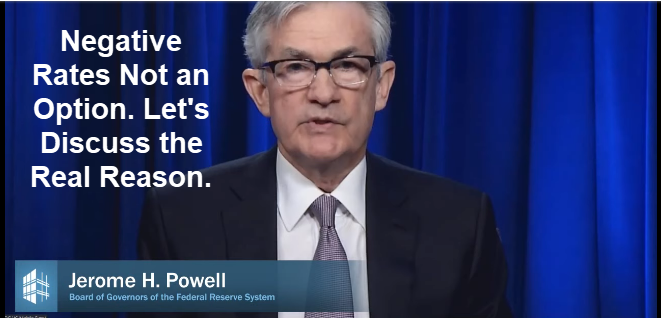
Economic Outlook “Highly Uncertain”
In a live economic interview with PIIE, Jerome Powell discussed the Fed’s outlook for the economy and the advisability of negative interest rates.
The video interview is above and here is Here is Powell’s Prepared Transcript.
Key Transcript Snips
The scope and speed of this downturn are without modern precedent, significantly worse than any recession since World War II. We are seeing a severe decline in economic activity and in employment, and already the job gains of the past decade have been erased. Since the pandemic arrived in force just two months ago, more than 20 million people have lost their jobs. A Fed survey being released tomorrow reflects findings similar to many others: Among people who were working in February, almost 40 percent of those in households making less than $40,000 a year had lost a job in March.
While the economic response has been both timely and appropriately large, it may not be the final chapter, given that the path ahead is both highly uncertain and subject to significant downside risks. Economic forecasts are uncertain in the best of times, and today the virus raises a new set of questions: How quickly and sustainably will it be brought under control? Can new outbreaks be avoided as social-distancing measures lapse? How long will it take for confidence to return and normal spending to resume? And what will be the scope and timing of new therapies, testing, or a vaccine? The answers to these questions will go a long way toward setting the timing and pace of the economic recovery. Since the answers are currently unknowable, policies will need to be ready to address a range of possible outcomes.
The loss of thousands of small- and medium-sized businesses across the country would destroy the life’s work and family legacy of many business and community leaders and limit the strength of the recovery when it comes. These businesses are a principal source of job creation—something we will sorely need as people seek to return to work. A prolonged recession and weak recovery could also discourage business investment and expansion, further limiting the resurgence of jobs as well as the growth of capital stock and the pace of technological advancement. The result could be an extended period of low productivity growth and stagnant incomes.
The current downturn is unique in that it is attributable to the virus and the steps taken to limit its fallout. This time, high inflation was not a problem. There was no economy-threatening bubble to pop and no unsustainable boom to bust. The virus is the cause, not the usual suspects—something worth keeping in mind as we respond.
At the Fed, we will continue to use our tools to their fullest until the crisis has passed and the economic recovery is well under way. Recall that the Fed has lending powers, not spending powers. A loan from a Fed facility can provide a bridge across temporary interruptions to liquidity, and those loans will help many borrowers get through the current crisis. But the recovery may take some time to gather momentum, and the passage of time can turn liquidity problems into solvency problems. Additional fiscal support could be costly, but worth it if it helps avoid long-term economic damage and leaves us with a stronger recovery. This tradeoff is one for our elected representatives, who wield powers of taxation and spending.
Negative Interest Rates
The above transcript takes up the first 9 minutes of the video. The rest is a Q&A discussion between PIIE president Adam S. Posen and Powell .
Posen asked Powell about negative interest rates.
“The committee’s view on negative rates has not changed. This is not something that we are looking at. … We revisited this question last October and the minutes said all FOMC presidents – and that’s not a sentence you get to say very often – that participants did not see negative rates as an attractive policy.”
This subject comes up time and time again. Even before the Fed openly discussed negative rates I was of the view the Fed would never do so.
That Tweet was in response to articles like these.
- It Begins: For The First Time Ever, Futures Price “Fatal” Negative US Rates Starting Dec 2020
- Why The Fed Will Go Negative
In Search of the Effective Lower Bound
Last September I penned Negative Interest Rates Are Social Political Poison.
Also last September I discussed the lower bound in In Search of the Effective Lower Bound
The Fed pays interest on excess reserves but the ECB charges them. Whereas the Fed gave free money to banks, the ECB charged the banks for excess reserves it forced into the system.
Whereas the Fed slowly recapitalized banks over time by paying interest on excess reserves, the ECB further punished the banks, perhaps purposely.
What better way to get Eurobonds or debt commingling that to purposely kill the banks?
No Economy-Threatening Bubble
I strongly disagree with the Fed’s self-serving statement “There was no economy-threatening bubble to pop and no unsustainable boom to bust. “
The Fed blew the third major economic bubble in 20 years.
- Dotcom Bubble
- Housing Bubble
- Everything Bubble
What many label as the “Everything Bubble” is really a junk bond and asset bubble.
What one label’s it isn’t important, how it came about is.
The Fed embarked on a nonsensical battle against routine CPI deflation spawning the third major asset bubble.
Plenty of Inflation
There was plenty of inflation, in housing, in junk bonds, in Airbnb leverage, in borrowing everywhere and in the search for yield.
None of that shows up in the CPI. Home prices are nor in the CPI, just rent.
Very Deflationary Outcome Has Begun: Blame the Fed
On March 5, well before the Covid-19 bust, I cautioned Very Deflationary Outcome Has Begun: Blame the Fed
To be fair, that was not timely because something like this would trigger a deflationary bust, all in the name of “preventing deflation”
Economic Challenge to Keynesians
Of all the widely believed but patently false economic beliefs is the absurd notion that falling consumer prices are bad for the economy and something must be done about them.
My Challenge to Keynesians “Prove Rising Prices Provide an Overall Economic Benefit” has gone unanswered.
BIS Deflation Study
The BIS did a historical study and found routine deflation was not any problem at all.
“Deflation may actually boost output. Lower prices increase real incomes and wealth. And they may also make export goods more competitive,” stated the BIS study.
The existing bubbles ensure another deflationary outcome.
So prepare for another round of debt deflation, possibly accompanied by a lower CPI especially if one accurately includes home prices instead of rents in the CPI calculation.
Historical Perspective on Deflation
For a discussion of the BIS study, please see Historical Perspective on CPI Deflations: How Damaging are They?
Fed Lie of the Day: “Low Inflation is One of the Major Challenges of Our Time”
Please recall my May 18, 2019 post Fed Lie of the Day: “Low Inflation is One of the Major Challenges of Our Time”.
In reality, Fed-sponsored bubbles were the major challenge. Then when bubbles pop, what the Fed claimed to be preventing happens.
Supply Shock and a Demand Shock Coming Up
A Supply Shock and a Demand Shock are Coming Up.
So prepare for another round of debt deflation, possibly accompanied by a lower CPI especially if one accurately includes home prices instead of rents in the CPI calculation.
Central banks’ seriously misguided attempts to defeat routine consumer price deflation is what fuels the destructive asset bubbles that eventually collapse.
And here we are, with the Fed’s Balance Sheet Ballooning Out of Control hoping to prevent the asset bubble deflation that the Fed itself caused.
Mish






























…but permanent ZIRP & printing fiat-to-infinity…? These ARE sane options, apparently.
…as if NIRP being off the table makes any difference… LOL.
“The scope and speed of this downturn are without modern precedent, significantly worse than any recession since World War II.”
The correct term is ever. A large section of the U.S. economy was shut down at the flip of nearly 50 switches.
“In reality, Fed-sponsored bubbles were the major challenge. “
Yup! Since it serves the cabal’s (President, Congress, Government, Corporate, Media and Central Bankers) purpose, they are willfully blind. This makes my blood boil.
“Then when bubbles pop, what the Fed claimed to be preventing happens.”
The arsonist becoming the fire-fighter and either patting themselves on the back or writing a book on “Courage to act” or put on a pedestal (Great Alan’s photo would adorn people’s wall) when they should be rotting in jail makes my blood boil some more.
Social Security is required by law to buy only US Bonds. Does anyone think it is a good idea for Social Security to invest in negative yielding bonds? Wrap you head around that.
This is a discussion about negative nominal rates. The real rates are already negative i.e. interest rates are below inflation. Can that situation continue? Evidently it does so far.
“The real rates are already negative i.e. interest rates are below inflation.”
People paying others to take money off their hands, is, in reality, not very likely.
Hence, if you observe interest rates below inflation, chances are the problem lies with how you calculate inflation.
I think there is more naunce to deflation. It can mean many things: some good, some bad. As an analogy consider weight loss. One way to lose weight is to diet and exercise. Another is to cut off an appendage. One is good, the other not so much.
The current form of deflation is bad. It is really just the public recognition that bad business decisions and bad debt have been compounding over the past couple decades. In short, liabilites far outweigh assets. Thus, assets need be repriced downward to reflect this reality.
Note that this mispricing can go unnoticed for many years and then some crisis occurs that bring it into focus.
Printing money (counterfeit) does nothing to correct the situation. It just shifts the cost onto the backs of the forgotten man. It may generate the perception that things have been solved, but in truth they’ve have just avoided the problem and allow it to fester for a few more years. This is the hallmark of the political hack and why politician should hold as little power as possible. They always do the expedient and wrong thing.
Consumer price vs Debt deflation. The former is a result of increased productivity, the latter is a result of fed bubbles
While the current deflation may be painful, it is the only game in town.
Asset valuations have been artificially inflated and are not sustainable. They have to be revalued to reset the system and allow for future growth.
The truth is assets are so far out of line with earnings the system can no longer support or justify their valuations.
What about capital flight risk if the USD goes negative? Thinking metals, crypto.
I know the government could make them illegal to own, but nobody is talking about it.
As long as the US is running a massive balance of payments deficit with the rest of the world, negative rates are not an option. Even Powell knows this.
You cannot stick your creditors with $trillions in IOU’s that bear negative interest rates – I don’t care how large and powerful your military is.
I firmly believe that this “virus” is (maybe intentionally) providing a kind of “shock therapy” to the deeply mal-adjusted and distorted US economy that existed beforehand. It has stopped globalization in its tracks. Our out-of-control trade deficit will come more into balance as off-shored jobs relocate back here. A lot of the “jobs” created in the past 25 years were “bullsh*t” jobs, that produced nothing of value, but somehow contributed to “GDP”. A re-structuring back towards actual production was long overdue.
I hope you are correct in your predictions. It’s fine to have plenty of services that people want to use, but someone; somewhere has to actually produce something tangible to get the ball rolling.
The fed doesn’t want negative rates. The market is saying negative rates are going to happen.
There is to much money and not enough assets. Stocks are toast.
Commodities, gold and bonds are the only option.
The market says negative rats are coming.
” …as off-shored jobs relocate back here”
That is a very, very big if.
All the air, and then some, of the “Bring Supply lines out of China” panic reaction to the Wuhan lockdown, has gone into reverse as the virus has spread world wide.
America is large enough, I suppose, that some domestically focused industries could relocate the whole shebang of suppliers back home.
But aside from those special cases, all supply chain managers are realizing that as bad as it is to have everything in China when China shuts down; that’s still a lot more predictable and manageable than having it all spread across 20 countries on multiple continents, when each one of those countries are shutting down at different times, and you need every single one operating in concert to get to the end-goal of a shipable product.
So now, whether they feel comfortable about it or not, the momentum is shifting to simply getting all their suppliers somewhere in the same corner, where they can at least work somewhat in sync. And that, as unpalatable as it may be for some, tends to favor the biggest, least easy to replace, manufacturing destination; China. The same forces which leads the financial world to flock to dollars in times of uncertainty, is similarly leading the manufacturing world to flock to China.
Again, America may, in at least some areas, be big enough to substitute for China as that biggest, least easy to replace, host. But in many industries, that is a long shot at best.
There was a post you had done around the housing bust which said something to the effect that the fed will blow bigger and bigger bubbles but won’t take responsibility, and each time there’s a bust they will grab more power. That does seem to be coming true now.
Excellent Memory!
It was written in April of 2008. I actually had it open before I saw your comment. It came up in a response I made moments ago on Twitter.
I am going to write this up again
Smells like capitulation while shifting the blame.
“Since the pandemic arrived in force just two months ago, more than 20 million people have lost their jobs.”
Many would argue that the real virus is the central banking itself, that creates and props up non-viable businesses, through pumping credit with abandon, I would just say, the past 30-years has been a central banking pandemic.
Mr Market does not care what Mr Powell “thinks”.
Federal Reserve follows Mr Market.
Only a matter of time before spineless Powell reconsiders.
Disagree Tony
Negative rates harm banks
The Fed is beholden to banks.
He will not go there
Sticking to my call that 10 yr yield will go negative.
Investors – especially foreign – will drive market.
If the Eurozone goes bonkers tomorrow, investors will flee to Treasuries, driving yields to negative territory.
Will the Fed raise rates then, causing the implosion of the corporate bond market and the stock market?
The banks can be bailed out.
Couldn’t they just issue another trillion dollars worth?
I have to agree with you. They will have no choice after the curve gets inverted to the 10 year.
The euro is toast.
Gold will go off like a firecracker. Even in the deflationary part of the cycle, asset and commodity inflation could rise significantly as the pulse of cash rushes in.
Can we imagine CPI inflation and negative rates? When people have to move money and realize there are not enough things to buy, strange things happen. I don’t really think this will happen but with enough money printing it can.
CO – you ask some good questions.
One, foreign demand will be strong — a) positive yield better than many developed markets b) strength of $US. US assets will be bullseye for carry trade –> borrow in cheap currency to buy strengthening one + positive yield. Two, US treasury HAS been stretching out debt along the curve. In 2015 avg maturity of Treasury debt 61 months. 2019 65 months. Three, reasonably good chance at least one of EU breaking up or China major devaluation. Either will greatly strengthen $US (fueling carry trade to US) and be deflationary for US. Don’t like to make stock market calls, BUT if equities to fall hard there would be a surge into Treasuries. Investors still worried about Return ON Capital. In the next 2 years I think their worries will turn to Return OF Capital. All bullish for Treasuries.
Oh, I should add – the big Wall Street banks are sitting on $ TRILLIONS in Treasuries. Negative yield would provide a very nice profit via capital gain. A potential backdoor bailout for them.
Thanks for your replies. I am still wondering, wouldn’t the Fed and Treasury be able to ensure rates do not go negative through their management of issuance and QE/reverse QE?
Sure, but issuance is planned months in advance. Primary Dealers need to prepare for auctions … when / how much / maturity … in order to line up their clients. Markets will (imo) react much quicker to events than Treasury.
TBAC in charge of funding.
The Fed and bubbles.
“It is difficult to get a man to understand something when his salary depends upon his not understanding it.”
That quote that from Upton Sinclair is a neat summary of the Fed and the people who rely on bubbles.
Very nice synopsis, thank you.