

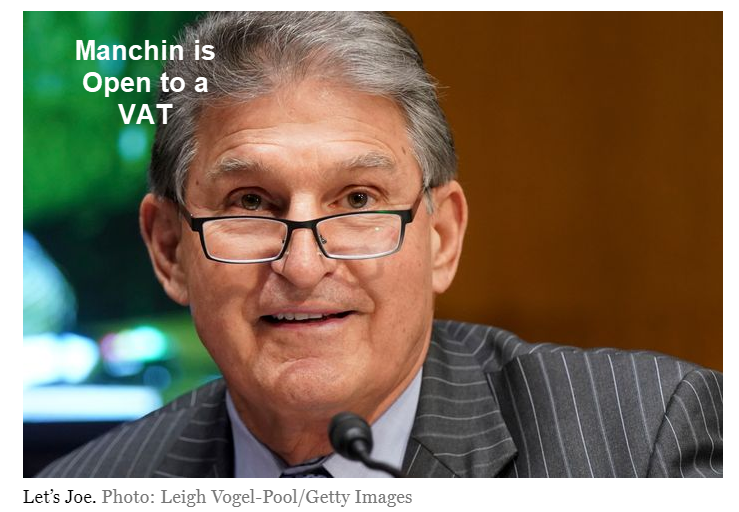
Manchin Open to VAT
Last month Manchin called for ‘Enormous’ Infrastructure Package Paid for With New Taxes.
“I’m sure of one thing: It’s going to be enormous,” the West Virginia Democrat, who is seen as a swing vote in a chamber divided 50-50, told reporters at the Capitol.
While he didn’t predict a price tag, Manchin said Congress should do “everything we possibly can” to pay for it. He said there should be “tax adjustments” to former President Donald Trump’s 2017 tax law to boost revenues, including by raising the corporate rate from the current 21 percent to at least 25 percent.
The tax benefits in the Republican law were “weighted in one direction to the upper end,” Manchin said. He also suggested an “infrastructure bank” paid for with revenues, potentially a value-added tax, that would be used for “rebuilding America.”
“I’m not afraid to look at other things,” he said.
Pulling Biden to the Left
Yesterday, NY Magazine reported Joe Manchin May Be Pulling Biden Left on Infrastructure.
Joe Manchin is an odd Democrat. This is true in a banal sense, in that the West Virginia senator is far more conservative than the median member of his party on a whole host of issues. At present, Manchin is directly blocking the passage of progressive gun safety, voting rights, and minimum wage bills, and indirectly obstructing just about every other item on President Biden’s agenda, by opposing substantial reforms to the legislative filibuster.
But on infrastructure, Manchin is a different kind of strange. Whenever the subject comes up, the man’s mood grows lighter, his eyes grow wider, and a wee bit of socialism creeps into his heart.
In an interview with the Bipartisan Policy Center in February, Manchin likened the scale of his desired infrastructure package to that of the New Deal or Dwight Eisenhower’s federal highway bill.
What Does Manchin Want?
If Manchin values “paying for” infrastructure more than he does bipartisanship, he could actually force the White House to roll its remaining spending priorities into one giant reconciliation bill, which Republicans would have no influence over. That could both expedite the passage of a bill permanently extending the American Rescue Plan’s child allowance, while also pushing the details of the physical infrastructure package in a more progressive direction.
Reconciliation Rules
It normally takes 60 votes to pass a bill in the Senate to kill a filibuster.
In special situations, however, Reconciliation Rules allow passage by a simple majority.
Reconciliation bills can be passed on spending, revenue, and the federal debt limit, and the Senate can pass one bill per year affecting each subject. Congress can thus pass a maximum of three reconciliation bills per year, though in practice it has often passed a single reconciliation bill affecting both spending and revenue.
Policy changes that are extraneous to the budget are limited by the “Byrd Rule”, which also prohibits reconciliation bills from increasing the federal deficit after a ten-year period or making changes to Social Security.
The reconciliation process was created by the Congressional Budget Act of 1974 and was first used in 1980.
The Lock and the Key
Manchin’s vote can prevent passage of a bill or ram it through.
Without Manchin, Democrats come up short in the Senate 51-49. With Manchin on board, the Senate ties 50-50 and Vice President Kamala Harris gets to cast the tie breaker.
Using the EU as an example model, a VAT would be very destructive to the economy.
Manchin is both the lock and the key. With Manchin on board, the smart money expects higher taxes of some kind.
Mish






























Every so often I breeze by MISHTALK to see if anything has changed–like a serious discussion of global economics. What I see makes me wish for the old days, when Mish and his readers were comparable with Roubini et al, insightful and thoughtful analysis.
Yes, a VAT would be regressive. But it would be ideal to fund something like a national health insurance system like Medicare For All, for example.
Mish says “Using the EU as an example model, a VAT would be very destructive to the economy.” Can you explain why a VAT would be very destructive?
How’s about another 10% income taxes raised to pay for millions of illegal children in US for the next 20 years! It might be another 1T when their parents join them !
Or, another 10T when China releases the next virus!
Good! party time for the top 01% is over. higher taxes will not hurt the economy per my previous posts…
All for it. The long delayed Gateway tunnel is a must. High speed rail such as a real line connecting ny to boston and maybe d.c would reduce air travel, increased productivity and cut pollution. We just wasted four years on a wall.
Please, no more high speed rail boondoggles (see California). Amtrak already connects all those cities now by rail and you can use it to travel any time you like.
If we are truly moving to Electric vehicles over the next few decades we don’t need high speed rail esp for pollution reasons.
what you call boondogle i say is more likely a function of the legal system. It’s very difficult for the city, state and federal government to exercise right of eminent domain and go through the environemental impact studies. it adds time and money but that’s our system. have you been to france , spain , belgium or germany? the trains work. its not necessary to fly a plane in many cases.
as bad as it is , i took the acela once from dc to new york. no airport delays, check-ins or sitting through traffic. the total time was the same given rush hour, not competitve if during non-rush hour. the train time is way longer than it should be given the technology available.
when we compare the cost of rail to cars, do we include the cost of maintaing bridges, tunnels, and road? now that’s a boondogle
Who cares about European trains. What matters is what works here. American’s don’t want to ride trains except for nostalgia reasons.
Not a single public transit system breaks even in any city (here/Canada). They are all money losers to some degree. Now you want to build a high speed train when:
We will be far better off spending all that money fixing roads and bridges for cars which is what people actually use.
Who cares about European trains. What matters is what works here. American’s don’t want to ride trains except for nostalgia reasons.
What???
You’ve never ridden the Acela. It’s riden by thousands of people for business.
Right and what did I just say about business travel. It’s not coming back thanks to Zoom. Airlines already know this and are wondering how they are going to fill their business class seats and more expensive tickets.
And since we already have such a train, why do we need another one (is it for example over crowded in which case add a few more cars or runs-per-day)? If we do need another one, let private enterprise build it. And for what it’s worth, thousands of train travelers/day is probably less than move along I95 in 1 hr by car.
First and foremost all the roads and bridges etc should be repaired and bought into peak condition since no matter how many trains we build, we will always have cars using those roads and bridges. After that is an aging electric grid (see California and Texas) that next need repairs/improvements.
no! This will ruin my idea of coming over to Dover, Delaware and using the money saved by buying a big bunch of clothes and electronics at 0% instead of 20% UK to pay for the whole holiday!
The worst thing about high VAT ,imo, is that it kills restaurant and bar culture which is just miserable. The French, not a country known for low tax fondness, put exemptions in when they realised how many cafes etc were closing after a greedy tax grab (forgot the year maybe Macron at the beginning).
That aside, you can guarantee additional job losses in the first year of VAT increases and as has been shown many times in Europe, the government invariably uses the revenue (that is purported to be raised) to increase the level of maintained debt. So its a one term spending gain accrued to the democrats but you have VAT to pay for the rest of your lives.
How do electric cars pay Highway Users Tax like gasoline and diesel vehicles do?
By the mile based on tachographs installed in all new cars?
At the moment, some are paying zero dollars.
But more and more states are implementing a flat fee for electric vehicles regardless of miles driven. This simplifies doing odometer readings (which requires owners to go some place to have it read which costs them time and tax payers have to pay someone to read that odometer).
Don’t know, but electric cars are a lot worse for the roads than ICE cars.
And why is that?
4 Trillion is an insane amount of money right after already spending 1.9 Trillion. Not sure but did Trump even spend 5.9 trillion in 4 years or Obama spend that in 8?
Actual spending for actual infrastructure (road / bridge repairs etc) is sorely needed I can get behind (assuming again we don’t have to use union wages everywhere). But spending for roads to nowhere or green energy I don’t support. The thing is, under Obama we were supposed to have spent 800 billion on shovel ready projects on infrastructure and yet I don’t recall any of it actually being spent on such things (anyone know of any actually done by that 800 billion).
If Manchin is a swing vote, then so is every other Democratic senator. A 50-50 Senate is quite problematic.
Go to West Virginia, they have a bunch of federally funded roads that go from really nowhere to much else. Byrd was very good at bring home the pork.
This was always coming, it just took some time to get here. I’m not surprised.
VAT will cut consumption, cause job losses, and (as usual) the burden will fall disproportionally on the middle class.
And the Republicans can run on lowering taxes…….and win…and then only lower the for the .01%, as usual.
I wonder what makes Joe Manchin tick. I’m a firm believer that most politicians back legislation that directly benefits them, their families, and their political backers. To be that conservative on so many other issues while being a populist on infrastructure makes me think there is more here than meets the eye.
VAT will cut consumption, cause job losses, and (as usual) the burden will fall disproportionally on the middle class.
The entire burden always falls on the productive (working) class. We’re the ones who have nothing left over after expenses and taxes.
Perhaps Senator Warren will insist on her 2% wealth tax on the 0.01%ers to fund the infrastructure bill.
It will also be a giant nightmare to businesses to reclaim the VAT Tax paid on all the goods they buy (some of which will be for personal use of course like say that work truck that you don’t pay VAT on but use for personal use). So another massive tax code nightmare.
It’s not too onerous for businesses to reclaim it. All businesses prepare and submit a return. Vat paid on costs are set off against Vat received on sales, and only the net amount owing is transmitted to the tax authorities. However all businesses have to prepare a return so that is an added administrative burden. Software companies will be pleased because they’ll all have an excuse to upgrade everyone’s accounting software.
One positive aspect is it helps business cash flow because they receive Vat on sales as their invoices are settled but the Vat due on purchases is only paid quarterly when the returns are due. That’s the case in the UK anyway.
“Vat due on purchases is only paid quarterly”
That should say “the net vat due is only paid quarterly”
Manchin wants a highway built that will make it easier to go from DC to Ohio through West Virginia. Right now, the highways go around the mountains of eastern WV. It’s not a bad idea,
I favor decreased consumption, so there you go. I think an economy built on savings and investment is a lot healthier in the long run than one built on consumption. The balance of trade will be better, too.
Decreasing consumption is a euphemism for lowering GDP. I don’t think you really want a whole lot of that, especially all at once. It’s a recipe for a recession, at best.
A VAT, like a sales tax, discourages consumption, rather than discouraging productive behavior, as an income tax does. Also, since the reporting mechanism is simpler, it has a higher yield. Those engaged in illegal activities, and those working for cash, rarely pay any income tax, but they would have to pay a VAT, since it would be priced into everything they buy. To me, a VAT is clearly superior to an income tax.
Unfortunately, there is a small (large) problem. The Constitution requires taxes to be apportioned among the several states, and specifically says “No Capitation, or other direct, Tax shall be laid, unless in proportion to the Census or Enumeration herein before directed to be taken.” How do you apportion a VAT according to the Census? Is a VAT a direct tax?
The 16th Amendment is: “The Congress shall have power to lay and collect taxes on incomes, from whatever source derived, without apportionment among the several States, and without regard to any census or enumeration.” That doesn’t help with a VAT.
If a VAT is passed, expect a Constitutional challenge.
I think a VAT has been long overdue for capital expense items. Every other country in the world has it and it’s way naïve to say they’re all stupider. No, WE are.
Example: Canada has a 7 digit Postal Code (Zip Code). B/e it also has alpha-numerics (letters) a SHORTER 7 digit Postal Code can dial in address roughly similar to out 9 digit full zip code. We should have used alpha-numeric and SAVE SOME WRITTING & INK!!
Huh? What?
My Parents postal code is 6 characters&letters in length.
The basic US Zip code you put on an envelope for a hand written letter is 5 numbers because it’s easy to remember. But the actual US postal code has many more digits that describe street address/house on street. These are sprayed on by machine as bar codes on envelopes (I designed the S/W for these machines in the 1990s).
Anyway, no idea how this relates to a VAT discussion.
Can you explain the difference? I assumed, based on what I know of Europe, that a VAT is a tax that is levied at the source, meaning that each stage of the product a VAT is levied, which is, in essence, similar to a national sales tax.
Or am I missing something?
There is a difference between a national sales tax and a VAT
Governments love VAT because it’s very difficult to avoid so has a high tax yield.
Nominally yes but in reality no, the consumers end up paying higher prices for products and services. It would be one thing to have a VAT coupled with a massive cut in personal income tax but that will not happen. I’m a dual citizen and follow news from my European country, we have a massive VAT, about 25% I believe yet giant national debt regardless. Government can never collect enough revenue.
I believe if you dig deeper into the infrastructure plans, somewhere in there is a private/public “Partnership” not just designed to bite us in the ass, but to chew off a huge chunk of it.
I would take a national VAT over the complicated mess that is the US tax code.
The problem with any VAT being proposed now is that it will be ON TOP of the existing complicated tax structure, making it even more complicated.
And there will thousands of pages of exceptions for food medicine, etc.
And of course it will be hugely regressive on the poor who literally spend everything they make and would suddenly be X% poorer (X=VAT) on day 1. Unless of course the poor are somehow able to write it off at tax time which is yet more tax code.
Yes, it would be regressive. But a VAT would be the ideal way to fund a national health insurance system like Medicare For All, for instance.
Unfortunately, you will wind up with BOTH.