

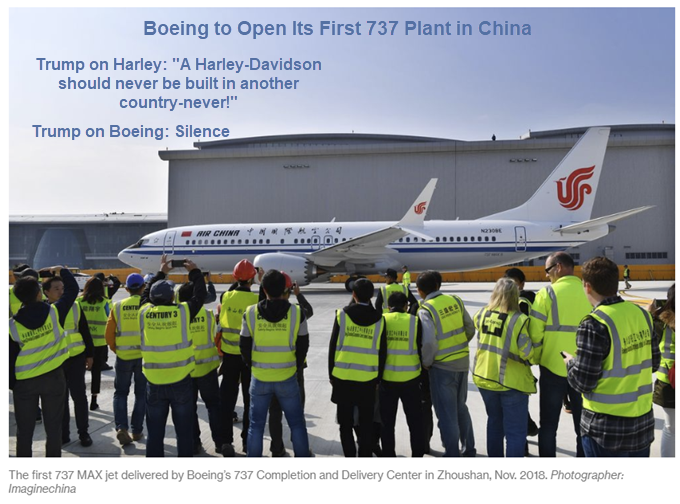
This headline seems suitable for “The Onion”, Boeing to Open Its First 737 Plant in China Under Shadow of a Trade War.
The Chicago-based planemaker will inaugurate its completion and delivery center in Zhoushan, 90 miles southeast of Shanghai, on Saturday, after more than a year of construction. The facility marks a rare industrial foray outside of the U.S. for Boeing and a joint venture with state-owned planemaker Commercial Aircraft Corp. of China Ltd.
While the plant was sent in motion before U.S. President Donald Trump was elected, the ribbon-cutting risks being overshadowed by his tit-for-tat on duties with China on products ranging from cars, machinery to pork and soybeans.
About one of every four jets that Boeing builds is bound for China, while the country’s airlines are the biggest buyers of the 737, the manufacturer’s largest source of profit. China is expected to need about 7,700 commercial planes over the next two decades to connect an increasingly mobile middle class. That represents a $1 trillion market opportunity for Boeing, Airbus SE and homegrown rivals like Comac.
Boeing, the largest U.S. exporter, has urged both governments to resolve their trade differences and protect aerospace, which generates about an $80 billion annual trade surplus for the U.S.
Love Affair Ending?
On October 19, Bloomberg asked Is This Chinese Love-In With Boeing About to End?
A Chinese airline that’s been an exclusive operator of Boeing Co. jets for more than 30 years is in talks with Airbus SE on a potential plane purchase, amid growing trade tensions between Beijing and the U.S., according to people familiar with the matter.
Should it come off, an Airbus purchase would be a blow to Boeing, which secured Xiamen last year as a launch customer for the latest variant of its best-selling 737 Max plane, a direct competitor to the longest range A320. It also highlights the risks of U.S. President Donald Trump’s high-stakes effort to curtail China’s rise as a global economic rival.
Clearly the love affair did not end, but Boeing held a threat card on the US that I have mentioned on numerous occasions. And that’s on top of soybeans. Playing that card would have hurt China too, but China would have done it.
Harley Davidson Should Never Be Built in Another Country
Trump Proposes Harley Davidson Boycott
So here we are. Trump cheers the demise of Harley Davidson for opening a plant in Europe but is strangely silent on a multi-billion dollar Boeing move to China.
Mike “Mish” Shedlock






























It doesn’t matter in which country a plane is made, I won’t fly.
737 Max is not affected by the tariff.
Gee, I thought the Chinese rail system was the envy of the world (well, except maybe Japan’s). Why bother with airplanes when they can build out a huge high-speed rail network?
Oh because it’s a big country with vast empty spaces between cities? Nevermind…
Leading edge rail tech has mostly moved to Europe. The Japanese, per their own estimation at least (and it’s hard to argue against them), “perfected” everything by the late 80s, and haven’t seen fit to improve much of anything since then. Focusing instead on dying off, before their 80s era infrastructure beats them to it.
There’s “Made in Germany” all over the most complicated parts of the Chinese rail buildout. Even more so the machinery building the machines that build the machines that build it. Not that the Chinese aren’t just as “smart” as the Germans and Japanese ( as well as US aerospace engineers). They just got started much later, and are currently better off sourcing certain key components abroad, rather than banging their heads against a wall for decades trying to make them themselves.
Possibly more important is that China’s fledgling aviation industry is ramping up and when it hits its stride we can expect cutthroat competition. A new Chinese built airplane the C919, a single-aisle jetliner designed to seat up to 190 passengers, is about to directly challenge U.S. plane-making giant Boeing and European rival Airbus.
The piece below gives the details on how this plane came about and why we should be concerned. It would be incredibly naive to underestimate China’s resolve in rapidly becoming a player in a field that will move it up the manufacturing food chain.
“How about a poll: How long before China is making knock-off copies of those 737s, now that Boeing is showing them how?”
That’s a damn good question by CJ
The irony is easy to spot though.
Companies complain about China stealing their technology then go do this!
Mish
Exactly, which was the point of my first comment.
People need to stop looking at “companies” as entire organizations. They’re represented by a small cadre (at most) of executives, who hope to take bonuses and cash out options before any problems arise. Nobody thinks long term because IBGYBG.
How many more tons of soybeans will China have to buy, per month, just to get back to where we were?
“Mish, you are behind on the news: China just bought 1-1/2 to 2 million tons of US soybeans (Chinese love soybeans).”
Really?
Up to Oct. 2018? That’s old news. Going forward? We’ll see. I would be surprised if they catch up to normal for a year, but nothing as bad as when Carter BANNED all sales to Russia, the US farmer’s main customer then.
Boeing has to remain friends with China. It’s where 98% of the rare earth minerals production is.
How about a poll: How long before China is making knock-off copies of those 737s, now that Boeing is showing them how?
They can get a Boeing plane and reverse engineer it and they’ve been making military planes for decades. I doubt this will help make much a difference in their airplane production know how.
Also, Boeing aren’t (complete at least) idiots. The hard cards will be kept close at hand. There’s nothing magical about Chinese partners and subcontractors. American ones have just as much of an incentive to take what they learn from partnerships and setting up competing ventures. In China, even. Heck, seemingly half the engineering grads employed by any US company, are Chinese, or at least of Chinese origin, already.
Only dumb halfwits enriched by welfare from the Feds (that’d be those who run end up running companies in all financialized dystopias), rather than competent people; fall for the sham that the hard engineering processes that underpins state of the art manufacturing is something that can be cheaply “stolen” by others. The processes are hard specifically because they can not.
The problem is instead, that what used to be hard (making big things fly), over time becomes less so. Hence become attainable by others than the companies operating at the very cutting edge. The Chinese can already build a 70s era Boeing plane without much trouble. And a 70s plane was arguably already good enough. Which limits how much Boeing can charge for the increasingly superfluous upgrades they are putting into the newer ones, before 70s era ones become viable alternatives for many buyers.
The car industry has been hit hard with this problem. And they, especially the leading Germans, have fought back not by hiring ambulance chasers to scare people about nonsensical “theft,” but rather by getting government to ban 90s era technologies, despite those being just as good for most purposes as the over engineered current stuff. Expect to see more of same wrt emissions requirements for planes operating in US airspace etc…..
Mish, you are behind on the news: China just bought 1-1/2 to 2 million tons of US soybeans (Chinese love soybeans).
This reminds me of the infamous Lenin quote: “When we are ready to hang the capitalists, they will sell us the rope”. True in 2 ways: the communist system probably could not manufacture the rope, and there are some very stupid, greedy capitalists.