

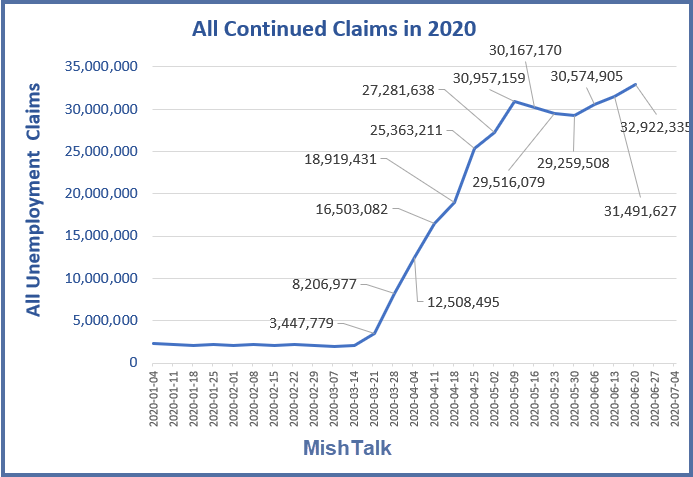
All Continued Claims Rise for Third Week
Based on Pandemic Unemployment Assistance, admittedly lagging, there is little or no improvement in the number of unemployed.
My “All Continued Claims” chart is the sum of state claims, federal claims, and various pandemic unemployment assistance (PUA) claims.
All claims lags continued claims by two weeks.
State Continued Claims

Based on trends in PUA claims any improvement may be a mirage.
Primary PUA Claims

Initial State Claims

Continued state claims lag initial claims by a week. There are new claims but also people find jobs.
The number of initial claims is down from the pandemic surge but is very elevated historically.
People must first file at the state level but some do not qualify. And some who did qualify exhausted state benefits and now need to apply for PUA.
Not a Pretty Picture
The trends suggest the unemployment picture is not improving much. Instead, people who qualified at the state level now need PUA assistance.
Add it up and there are 20 to 30 million people unemployed.
Fewer People Pay Their Rent on Time in July
That Fewer People Pay Their Rent on Time in July suggests more people are struggling.
United Warns It May Cut 36,000 Employees
Factor in United Warns It May Cut 36,000 Employees. All the airlines are in the same boat.
In general, state reopenings are in reverse and that will slow if not reverse some labor gains.
Trump Claims to Have Saved 51 Million Jobs
If you are looking for a nonsensical claim, here you go Trump Claims to Have Saved 51 Million Jobs
Mish






























I can possibly understand why small businesses are conforming to the idiotic mandates, guidelines, and recommendation, as they don’t want to incur the cost of frivolous lawsuits. However, since none of these business-killing actions are against the law, WHY ARE NO BIG BUSINESSES TELLING GOVT’S TO SHOVE IT? It couldn’t be that they want their small business competitors wiped out, now could it?
I got a haircut last week! Okay that’s not big news. But what’s interesting is my stylist said she has been spending about 4 hours each day dialing to reach the Oregon unemployment department. Still hasn’t received a penny.
I know someone from Oregon with a similar experience. Is the system just overwhelmed? Fortunately, the guy I know is single so he’s been able to make it (by moving home).
I’m not sure. It sounds like if there’s anything at all unique about one’s situation, you get buried at the bottom of the queue for Oregon unemployment.
We are really finding out in 2020 just how deeply dysfunctional so many government systems are.
I believe the system is running on a severely overclocked set of 4 Packard Bell 286 computers – without the Turbo button that was so popular in the subsequent years.
stop analyzing the data which everyone knows is negative; focus on the nasdaq which is guaranteed to be positive!
Here is state by state data:
Almost all states are 8.9% or above. The lowest are Nebraska at 5.2%, over 3 points better than anyone else, then Utah at 8.5%, then Wyoming at 8.8%.
One thing Nebraska did well is that our governor actively promoted the PPP. He worked with the state’s community bankers to be able to efficiently process loans, and made sure businesses were aware of the program. Appoximately 85% of the state’s payroll was covered by PPP. If there will be a jump in unemployment after the completion of PPP, you should see it in Nebraska.
At the other extreme, the worst are Hawaii at 22.6% and Nevada at 25.3%. When your economy revolves around tourism, Covid19 really hits the economy hard.
I have several friends here in LA trying to file for unemployment….unable to get it done cause systems are overloaded
Of course.
Like all “systems” paid for with taxpayer money, the purpose is to enrich ever less competent consultants (who is as likely as not to count former “public servants” now collecting 6 figure retirement while getting commission for hawking “services” to their former colleagues.) Fewer and fewer of whose employees get paid to actually build systems. Instead babbling abut “requirements documents”, “buy in”, “signoffs”, “lean” and other silly excuses for not being able to build anything more complimecated than a childish sales and/or brownnose pitch.
The way that whole business works, is that instead of hiring (and paying) competent people in house who actually have experience and a clue about what it is they are attempting to accomplish, the invariable illiterates “running” these “projects” are wined and dined by “partners” in “firms” peddling $1000 hourly rates for empty promises.
While behind the scenes, only 1/5th of billed hours, and of those only 1/8th of the billed rate, goes to those who actually do any work. With the rest, as is customary for America in the Fed age, goes to incompetent, illiterate wastes sitting around babbling and having opinions about all manners of things way, way, way above their meager brain grade.
And then, once taxpayers have paid their 40x for an inevitable junk pile, they get to pay another 3x of that again, to ambulance chasers running around “holding” some “them” “accountable.”
It’s America!
For all their almost on-purpose outdatedness, the Japanese are getting 10-100x value for money from their 70s era greenscreen mainframe applications, compared to what “public sector” customers in the West. And for a very simple reason: In the 70s, people in computing (used to be science back then, not “coding”), even those in management, and not just implementation, roles, where competent people. On bigger, more critical projects, the leads would work not far removed from physicists with Nobels over at IBM. With rarely an “investor”, nor “counsel,” in sight. Outside of a precious few startups and open source projects, that sure as heck ain’t the case no more.
So much winning.
Who got all those 51 million jobs? Why didn’t some of them go to the unemployed?
/-sarc
No, no. You are supposed to imagine how awful things would be if those 51 million jobs had not been saved, and then vote based on your imagined fear of that.
“The number of initial claims is down from the pandemic surge but is very elevated historically.”
…
Some context.
The peak week – ending March 28th, 2009 – for initial claims during GFC:
665,000