

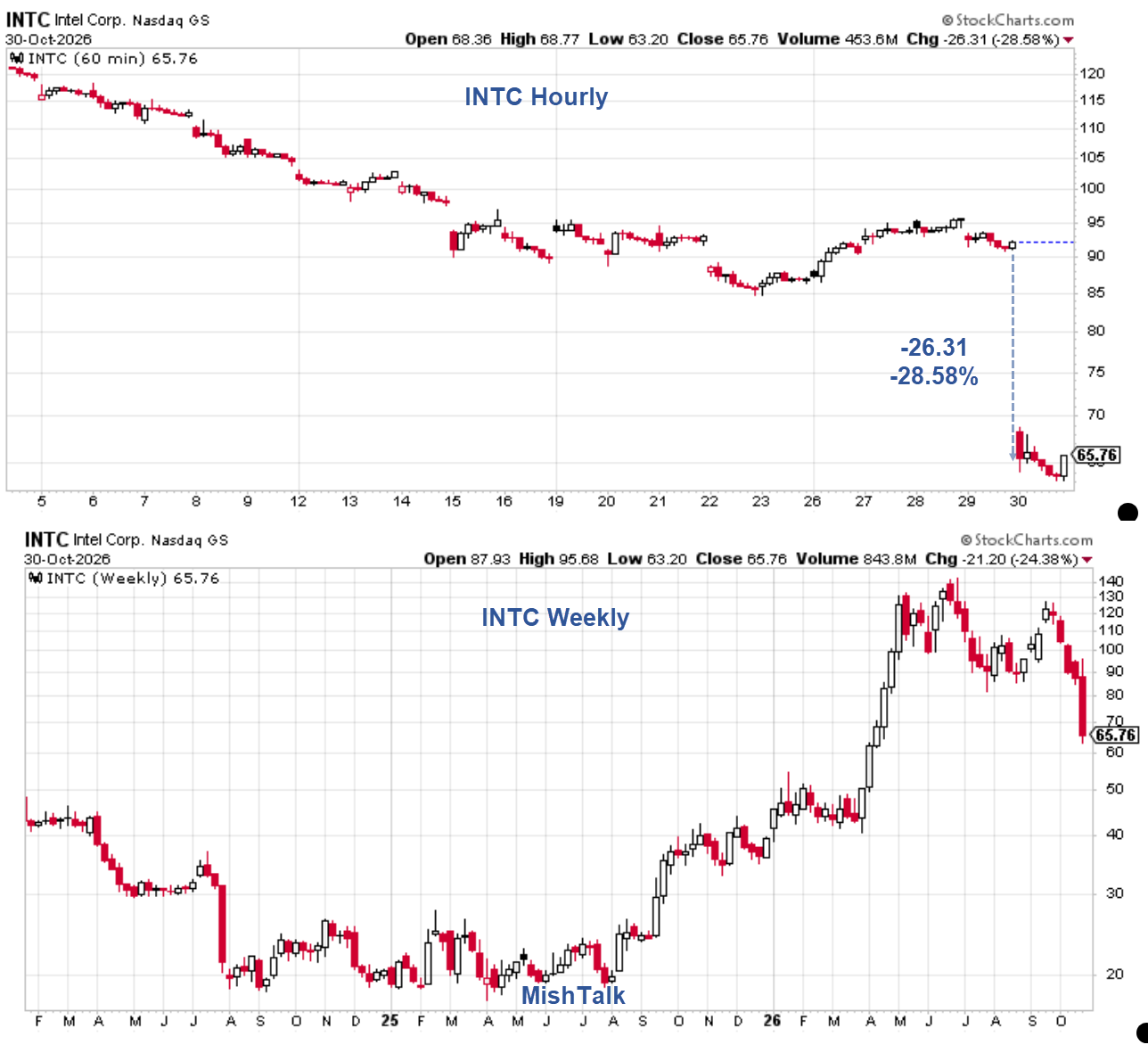
An earnings miss and weak forecast triggered an enormous slide in Intel. What’s that mean?
Weak Forecast
Bloomberg reports Intel Suffers Worst Stock Drop in Decades on Weak Forecast
Intel Corp. suffered its worst stock rout in more than four decades after the PC industry slump and supply-chain snags hurt its forecast, renewing fears about the chipmaker’s turnaround bid.
Sales in the fourth quarter will be $15 billion to $16 billion, the chipmaker said in a statement on Thursday. Analysts on average estimated $17 billion, and some projections topped $18 billion, according to data compiled by Bloomberg. Profit will be 25 cents a share in the quarter, excluding certain items. Wall Street was projecting adjusted earnings of 43 cents a share.
Intel is contending with a severe slump in the personal computer market. Makers of laptops and desktops — key customers — are struggling with shortages of memory semiconductors and surging component prices. That’s cut into PC shipments and hurt demand from users. In addition, Chief Executive Officer Lip-Bu Tan said his company’s data center unit would have done even better if it hadn’t suffered from shortages of some raw materials and a shutdown of a factory in Israel — supply snags that the company is working hard to fix.
As to the PC market, “one of the main challenges, basically, is memory,” he said. “Memory pricing went up a lot. I think my prediction is that in 2027 it is going to be a very severe issue to all of us. We are not alone — it’s just the whole market is impacted.”
Intel projects the PC downturn will persist through at least the first half of 2027 — with a decline of 10% next year following a 12% slide in 2026. Still, longer term, the company is optimistic about demand for its products and is increasing its spending on new equipment to boost production. It’s growing more confident it will attract orders from other chipmakers that want to use its factories to build their components, Tan said.
“Intel’s earnings highlight the challenges the company faces in pushing its recent turnaround into a sustained recovery,” Emarketer senior analyst Asa Hiken said in a note. Though demand for server processors is booming, “Intel’s disappointing outlook shows that strong demand alone isn’t enough to overcome its near-term challenges, particularly ongoing weakness in its traditional PC business,” he said.
The mixed picture shows the effect that the AI boom has had on Intel’s business. Though data center infrastructure is fueling demand for Intel processors, it also has led to a shortage of memory chips — a type of semiconductor made by Samsung Electronics Co., SK Hynix Inc. and Micron Technology Inc. That, in turn, has forced up the price of laptops and desktops, and reduced demand for the Intel chips that go into those products.
Though Intel now has enough of a financial cushion to weather downturns, such as the current PC market slump, it still needs to invest in its technology to stay competitive in the long run. It has lost market share to Advanced Micro Devices Inc. in PC and server chips while also struggling to crack the lucrative AI accelerator category dominated by Nvidia.
AI Explosion Hits Me Directly
I recently had a failure on my 8 TB external solid state drive (SSD). I was astonished at what a new 8TB SSD drive would cost.
Fortunately, it was the case that failed not the drive. The case was $30.
I have a nice computer with 64 GB of memory but I am woefully short of GPU (only 4GB) and struggle with some tasks in Photoshop or Pixinsight that are GPU hogs when editing images.
A GPU (Graphics Processing Unit) is a specialized electronic circuit designed to rapidly perform parallel mathematical calculations.
If any Photoshop and On1 users are tuned in, Photoshop is a huge GPU hog and so is On1 NoNoise. Use the On1 plugin from Lightroom, not Photoshop and close down the latter entirely before doing so. That will stop some crashes and speed things up too.
Please check out my photography website! MishMoments.Com
Unfortunately, I cannot add to GPU to my computer. The manufacturers solder that in. So, I repriced a new computer and the price was over $5,000 for what I wanted. That’s over 150 percent higher and all I was really going to get out of that was more GPU.
No thanks, I’ll wait. And that matches Intel’s slow sales.
I could buy external GPU but that is not cheap either.
The explosion of enterprise AI and data centers has severely warped the supply, pricing, and manufacturing focus of high-capacity SSDs and high-end GPUs.
Because enterprise clients buy in massive bulk at premium prices, consumer hardware has faced inflated costs.
Cannibalization of the Supply Chain
- Data Centers Crowding Out Storage & RAM: Enterprise AI buildouts aren’t just taking GPUs; they are consuming massive allocations of NAND flash and high-bandwidth DRAM.
- The Component Cascades: The reason an 8 TB SSD or high-tier GPU carries an exorbitant price tag is that server racks get first priority on wafer capacity. The resulting component inflation ripples directly into complete PC builds.
- Intel’s own CFO explicitly cited soaring memory and component prices as the direct reason PC makers are slashing orders
Macro Takeaway
The market narrative portrays AI spending as a rising tide, but at the consumer tier, it functions as a regressive tax on hardware buyers.
Wall Street projected that consumer PC sales would smoothly rebound, but Intel’s guidance proves that exorbitant sticker prices have forced power users like me into a de facto buyers’ strike.
When a professional content creator, photographer, or data scientist looks at a $5,000 replacement bill and says, “No thanks, I’ll wait,” the tech industry has a fundamental demand problem.
The AI Bubble’s Collateral Damage
The ultimate irony of the current tech cycle is that the AI boom is actively cannibalizing the very consumer market that built these tech giants.
- The VRAM Starvation: Silicon wafers that should be going toward making affordable 12GB or 16GB consumer graphics cards are being diverted to hyper-profitable enterprise AI chips.
- The “AI PC” Illusion: Intel and PC manufacturers are heavily marketing “AI PCs” equipped with Neural Processing Units (NPUs). But for heavy, real-world creative software like Pixinsight or ON1, these NPUs are a useless marketing novelty. Creative pros need raw, brute-force VRAM—something the industry does not provide at a reasonable price.
- The Extended Replacement Cycle: By forcing users to adopt clever software workarounds—like strictly managing open apps to stay within a 4GB ceiling—the industry has broken the corporate upgrade cycle. A 3-year replacement cycle is easily stretching to 6 or 8 years because the financial math of a new purchase simply doesn’t add up.
Intel’s Guidance is the Smoking Gun
Intel’s disastrous guidance and subsequent stock smash are not just isolated corporate failures; they are macroeconomic leading indicators.
Wall Street priced in a robust, post-pandemic PC upgrade cycle. Instead, they got a consumer base that is locked out by pricing and a shortage of some components.
When the cost of upgrading a bottleneck is a mandatory, overpriced $5,000 system overhaul, the rational consumer response is to sit on your hands.
It’s not just high end computers either. Mine went up by $3,000 but low-to-mid costs went up too, by hundreds.
Intel isn’t just suffering from bad execution; they are running headfirst into a wall of consumer price elasticity. Until enterprise data centers stop sucking all the oxygen—and silicon—out of the room, that wall isn’t moving.
Related Posts
September 12, 2026: Doomsday Debate: Is There a 10 percent Chance AI Kill Us All within 10 Years?
AI alarm bells are ringing. What should we do?
October 10, 2026: Trump’s Unintelligent Comments on AI Super Intelligence
Trump says you are “the enemy” if you do not use his new term.
October 18, 2026: Data Centers Need $8.5 Trillion in Revenue Through 2030 to Cover Spending
How likely is that?


