

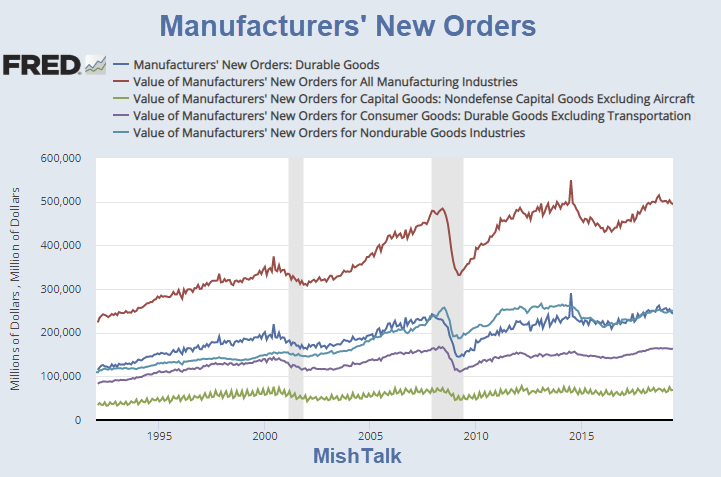
The monthly report on Manufacturers’ Shipments, Inventories and Orders, shows strong signs of a manufacturing sector that has peaked.
New Orders
New orders for manufactured durable goods in May, down three of the last four months, decreased $3.1 billion or 1.3 percent to $243.5 billion, unchanged from the previously published decrease. This followed a 2.8 percent April decrease. Transportation equipment, also down three of the last four months, drove the decrease, $3.8 billion or 4.6 percent to $80.0 billion. New orders for manufactured nondurable goods decreased $0.5 billion or 0.2 percent to $250.1 billion.
Shipments
Shipments of manufactured durable goods in May, up following two consecutive monthly decreases, increased $0.9 billion or 0.3 percent to $254.2 billion, down from the previously published 0.4 percent increase. This followed a 1.6 percent April decrease. Machinery, up four of the last five months, led the increase, $0.3 billion or 1.0 percent to $33.4 billion. Shipments of manufactured nondurable goods, down following three consecutive monthly increases, decreased $0.5 billion or 0.2 percent to $250.1 billion. This followed a 0.4 percent April increase. Petroleum and coal products, also down following three consecutive monthly increases, drove the decrease, $1.3 billion or 2.4 percent to $54.7 billion.
Unfilled Orders
Unfilled orders for manufactured durable goods in May, down three of the last four months, decreased $6.3 billion or 0.5 percent to $1,171.1 billion, unchanged from the previously published decrease. This followed a 0.2 percent April decrease. Transportation equipment, also down three of the last four months, led the decrease, $5.7 billion or 0.7 percent to $803.7 billion.
Inventories
Inventories of manufactured durable goods in May, up ten of the last eleven months, increased $2.0 billion or 0.5 percent to $424.6 billion, unchanged from the previously published increase. This followed a 0.4 percent April increase. Transportation equipment, also up ten of the last eleven months, drove the increase, $2.2 billion or 1.6 percent to $138.5 billion. Inventories of manufactured nondurable goods, down two consecutive months, decreased $0.6 billion or 0.2 percent to $269.6 billion. This followed a 0.1 percent April decrease. Petroleum and coal products, down following four consecutive monthly increases, drove the decrease, $0.6 billion or 1.5 percent to $41.3 billion.
Core Capital Goods
Econoday finds some good news in the report: “Now the good news and that’s core capital goods orders (nondefense ex-air) which rose 0.5 percent for a 1 tenth upward revision from the advance reading. The Federal Reserve is focused on questions over the strength of business spending and this result should ease their immediate concerns.”
I used to follow that line item closely, but it is way over-rated.
The theory behind core capital good is that it is a measure of business investment and thus a leading indicator of future production.
Note the line in green in the above chart. Month-to-month fluctuations are totally random, even seasonally adjusted. In the Great Recession, that item did not turn lower until the recession was half over.
Year-Over-Year Chart

Year-Over-Year Numbers

Manufacturers’ Inventories

Inventories to Order Comparison
- Inventories, are up 10 of the last 11 months to new record highs.
- Even non-transportation inventories are near the all-time high.
- Boeing may very well have skewed transportation numbers.
- But excluding transportation, new orders year-over-year are barely in positive territory at +0.28% growth.
- Overall, new orders are down 1.16% and durable goods new orders are down 2.75%.
This is not a healthy picture.
Mike “Mish” Shedlock






























The big pullback between 2014 and 2016 should have been a recession.
I don’t think we need to wait for the NBER to stick a fork in it. The question is, will TPTB keep this under wraps until just before or just after the 2020 election? Either way, they’re going to do a Herbert Hoover on Donald J. Trump.
In the shadow of ~2% rates which soon will be declining, it doesn’t matter. Corporations can do all kinds of things with such low rates. My former employer borrowed $300M (their annual revenue) at 0.9% with interest only payments. This shows up as cash to these kinds of companies on their balance sheet. We are really in the bizarro world since 2009. Rates may ping pong between near 0 and 2 for the rest of the century.
More likely rates to zero until fiat implodes for good
Opioid overdose deaths in the U.S. rose dramatically after 1999, but also exhibited substantial geographic variation. This has largely been explained by differential availability of prescription and non-prescription opioids, including heroin and fentanyl. Recent studies explore the underlying role of socioeconomic factors, but overlook the influence of job loss due to international trade, an economic phenomenon that disproportionately harms the same regions and demographic groups at the heart of the opioid epidemic. We used OLS regression and county-year level data from the Centers for Disease Controls and the Department of Labor to test the association between trade-related job loss and opioid-related overdose death between 1999 and 2015. We find that the loss of 1000 trade-related jobs was associated with a 2.7 percent increase in opioid-related deaths. When fentanyl was present in the heroin supply, the same number of job losses was associated with a 11.3 percent increase in opioid-related deaths. https://www.sciencedirect.com/science/article/pii/S2352827319300096
Got to keep the unemployed hillbillies who used to build cars and washing machines occupied. (Or else…..)
This is all govt,DOD and with prices and costs soaring straight up like a titan rocket 2 things have to happen…..1 print/borrow more money…….2 pick a fight…problem solved…….your welcome!