

A Pink Elephant and the Fed
Bloomberg’s Peter Coy @petercoy has an excellent article on Fed policy worth a good look: Don’t Think About Pink Elephants or Tighter Monetary Policy
“There really aren’t any hawks left on the FOMC,” only doves of different degrees, JPMorgan Chase & Co. Chief U.S. Economist Michael Feroli wrote to clients on Jan. 14, referring to the Federal Reserve’s Federal Open Market Committee. “Monetary accommodation” today is “far greater” than in past decades when the unemployment rate was as low as it is now—6.7% in December—Jim Paulsen, chief investment strategist of the Leuthold Group, wrote Jan. 14.
A hawkish Fed would be jacking up interest rates right now. The Fed might say, as Paulsen writes in his note to investors, that the yield on 10-year Treasury notes is only one-seventh what it was in December 1986, when the unemployment rate was the same.
“Now is not the time to be talking about exit” from bond-buying, Powell said. When the time does come, he said, “We’ll let the world know.”
Powell not only opposes raising rates or cutting bond purchases; he’s against scheduling it, talking about it, or even thinking about it too much. That may be sensible advice, but to people in the financial markets who are getting uneasy about inflation, his lack of concern could make them more concerned. Powell is like the psychologist who tells you not to think about pink elephants. From that moment on, some people can’t think about anything else.
Ostriches, Doves, or Monkeys?
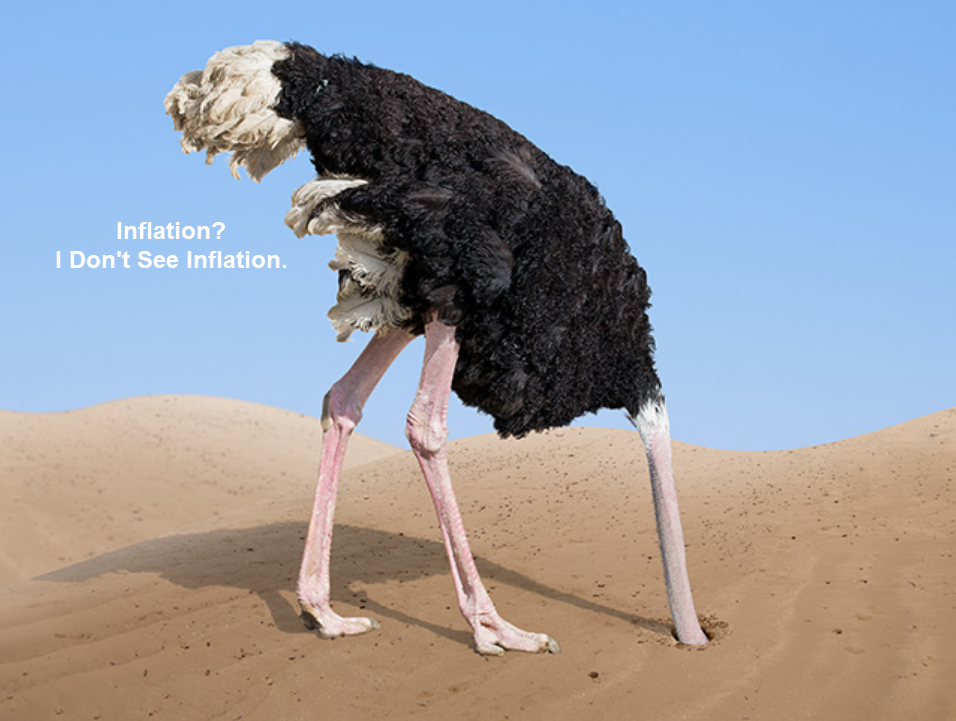
The Fed is like a cross between the “See No Evil” monkey and an Ostrich With it’s Head in a Hole.
Ostriches don’t really hide their heads in the sand, they bury eggs in the sand.
In contrast, the Fed sticks it head in the sand, planting seeds of inflation and cheerfully hopes the seeds sprout.
Meanwhile, like a pack monkeys wearing blinders, no one on the Fed can spot the inflation already present.
Look Ma, No CPI

The Fed’s head-in-the-sand rationale is likely based on the CPI.
I noted CPI Rose 0.4% in December with Gasoline the Major Factor.
The Fed ignores gasoline and food. I won’t quibble with that. But I will more than quibble with other things.
What About Housing?
The BLS does not directly include home prices in the CPI. The latest Case-Shiller home price index is up 8.4% as of the latest report which is for October.
Instead of using home prices, the BLS uses Owners’ Equivalent Rent (OER).
Ask anyone looking to buy a home what inflation looks like.
Failure to properly account for housing has distorted the CPI continually from 1998 until now.
The Fed did not spot the housing bubble nor predict the Great Recession because it did not understand the asset inflation housing bubble.
What About Health Care?

The BLS says the cost of medical care is up 15% from a year ago.
Ask anyone buying their own health care how accurate that is. Also ask anyone buying their own health care if it is only 6.97% of their budget as the BLS states.
Capital Expenses
I get the fact that the Fed and BLS consider housing a capital expense. And I understand Medical expenses are mostly paid by businesses, Medicare, and Medicaid, not “consumers”.
But what about those who do not have insurance. Do we ignore the rising costs and simply average them in?
What are we trying to measure? Or are we really trying to hide, not measure?
What About Bubbles?
The stock market and risk tolerances are also a measure of inflation albeit difficult to measure.
Add it all up and the CPI is nothing but a “head in the sand” measure of purported inflation and a very poor one at that.
Not to worry, “We’ll let the world know,” when we spot inflation says Powell who cannot see the big pink elephant standing right on the Fed’s table.
Mish






























I remember the 1980s when the media was rightfully concentrated on taming inflation and how inflation was destroying the middle class. Now the media can’t wait for inflation. Perhaps this is so because journalists are too young to understand the concept of Pandora’s box. BTW, non-hedonic price inflation as has been historically measured in the US is running over 5% (as measured by the economist Walter Williams). Do we really want inflation to accelerate from here?
Inflation does not create a influx of money. CHEAP money like we have now. Cheap money creates inflation, because the buying power is reduced. ECON 101. Debt does not increase money supply.
Jack, true, and relative to your other post above this (min wage), median wages haven’t increased @ inflation for decades.
I say it’s no coincidence that rates have dropped proportionally at the same time and that household debt has also skyrocketed in tandem.
i.e. Income imbalances appear to be increasingly offset with cheap lending.
Each recession = rate reduction = increased disposable income/buying power = more debt…etc…etc.
My point, if min wage is increased, and at the same time the Fed reverses this 40 year trend to counter inflation…what say you? Where am I oversimplified here?
Back in March rates dropped enormously, it was jaw dropping…everyone was ranting over “NIRP”, to me it seems we have to reverse, there’s no more room on this trend.
I actually minored in economics in college. Wage increases are a positive thing. MININUM WAGE has problems. 1) minimum wage was never meant to be a “livable wage”. It was meant to introduce workers, mostly younger people to get their foot in the door of business. To learn how it operates. They would then be able to prosper in their minds, wills and emotions and all the while prosper in wealth and health.
2) When minimum more than doubles, the costs of everything: housing, utilities, food, clothing, cars, entertainment, will in fact go sky high. 3) those making a little over $15 per hour now, will not see their paychecks go up one penney from where it is right now. 4)They will in fact loose buying power. 5) The costs of raw materials will rise because of the cost of minimum wages going up. 6)Amazon delivery costs will rise for all the things people have shipped to their homes. 7)That $15 minimum increase will KEEP in all wage groups in slavery, and why? 8)Because all costs are not bourn on the backs of business, they are bourn on the backs of everyone living this utopian minimum wage, society is seeking. 9)They will not rise above the minimum wage mindset, no matter how high it goes. Minimum wage is still welfare mindset. That is their mindset.
The FED not knowing what it’s doing… That’s an assumption.
Look, these guys are above average intelligent. They probably do not have many low/middle class people in their circle of friends and relatives… It seems more likely to me that they know exactly what they are doing, namely helping their tribe.
The prognosis is not good.
Why do people place their faith in bureaucrats to know what economic levers should be pulled to improve the economic state of every US Citizen? Why don’t you let these same bureaucrats take responsibility for making all your family’s financial investment decisions? Why you say….because you will be sleeping on a sidewalk soon after.
What is inflation? It is an increase in the money supply. Debt increases money supply due to fractional reserve banking. Measuring price changes does not measure inflation as prices change due to supply and demand forces. Since the advent of the telephone, phone calls calls have come down in price because productivity increases made it cheaper to provide capacity and capacity increased faster than demand. That is one example showing that measuring prices does not measure inflation.
It doesn’t matter what you call it, people in general are concerned about rising prices and whether they have enough money to live on, not an increase in the money supply. The jury’s out on whether the latter causes the former.
Just one more example of a disinflationary force…..technology….the biggest one.
When so many things are getting cheaper, it gives the Fed more room to print.
But it makes gold, commodities, real estate…anything with tangible value and a hope of beating cost inflation….look more desirable as a risk asset to hold…..as the value of the currency is driven ever lower over the long haul.
there is no under measurement of CPI. there is something called the One Billion prices project run by MIT. you can overlay the CPI vs. the projects measured one billion prices and the two indices are consistent with each other.
From Wikipedia: “The Billion Prices Project (BPP) is an academic initiative at MIT Sloan and Harvard Business School that uses prices collected from hundreds of online retailers around the world on a daily basis to conduct research in macro and international economics and compute real-time inflation metrics.” because it always pops up first in searches.
Do you comprehend weighted averages? If you blow a million on a house and take a mortgage to boot, you’re never going to pay combined for anything for the rest of your life – unless you sever all your limbs, and have a reconstructive surgery at a US hospital.
Mish has been hammering the idea for a while.
Online retailers selling trinkets do not count!
The saddest part is if these crazies and haters are overseas in some countries that Americans don’t like or don’t know anything about, such a site would not be shutdown, but celebrated for high number of visits by “ freedom fighters”, pseudonym for terrorists
I will take bets whether the fake inflation number is deliberate con or wilful ignorance. Chances are, these clowns truly believe their bullshit, and we are screwed more than we think.
Keynesian Klowns Abound!
By default, the Fed would be “Monetarist”, fiscal stimulus would be “Keynesian” Trump is apparently a “Keynesian clown”
And monetary policy has been doing the heavy lifting because fiscal policy has been disfunctional. The system works much better when the two work together, though many sillies prefer disfunctional…
Late in response, but I couldn’t agree more, our recent decade’s’ trend to cheap debt is the result of awful fiscal policy. I dislike the separation of economic schools, I think each is a component of the whole.
Mish, of course the Fed sees the bubbles. The reality is this. The Fed will continue to buy, buy, buy. Anything less would require a complete dismantling of the system (banking, government spending, political) that they were set up to enable.
The interest rate tells you how valuable the fiat currency is. Got gold?
Not quite so fast….The low interest rate indicates people think the US$ is valuable enough they are willing to hold it and not collect a return on it. And consider bitcoin, it doesn’t pay any interest…but quite valuable right now. Question is what the US$ will be worth relative to gold in 4 years. I suspect one’s view on this is correlated with one’s political views.
The price of all things tangible indicates how valuable fiat is. Fiat is a means of swapping things. It’s also supposed to be a means of storage to spend at a later date but Central Bank policy has made this ineffective. A better means of storage is now a tangible asset, just have to pick one/some.
Speaking of ostriches and monkeys–
Trump’s favorite pillow salesman (Mike Lindell) showed up at the WH to meet with Trump with a document that describes what needs to be done to overturn the election.
CEO Michael Lindell shows off his notes before going into the West Wing at the White House on Friday, Jan 15, 2021 in Washington, DC.
3:00 PM · Jan 15, 2021 from Washington,
Source…
@jabinbotsford
Jabin Botsford
The remains of my last coffee almost exited prematurely, that was funny.
Calculating inflation is a lot like calculating unemployment, just keep narrowing the band of allowable criteria until you reach a number low enough to be palatable to markets!
How much of the Biden Plan is really the Yellen/Powell Plan?
I’d bet it’s a lot.
On hiding inflation….don’t you think that this under-measurement has some beginnings way back there…..when inflation was so high?…and the optics were so bad…that they learned then how to fudge the numbers to downplay inflation….which was on fire before Volcker administered the tough love that killed that beast.
It’s always politically advantageous to say inflation is low….whether it really is or not.
If it’s low….well then, it’s okay to do even more QE and print money….
So many disinflationary forces are just dumb luck too….gas got much cheaper because of fracking.
Goods got cheap because manufacturing was so much cheaper in China without pesky labor unions to interfere with corporate profits.
Food got cheaper because of GMO’s and factory farming.
Moore’s Law made computers get cheaper ad faster so fast that it made my head spin.
People can live with no insurance…..they just can’t ever achieve financial security, because a single hospitalization will wipe out a lifetime of savings.
People can live without buying a house…..they’re worse off, because they don’t have the inflation hedge. Owning your own home is probably a better inflation hedge than owning gold….in my opinion. It’s a tangible asset, and it’s tax advantaged.
You’ve got to be kidding??? We are in the middle of a pandemic with high under and un employment. Last thing fed should be thinking about is inflation.
Also, $15 minimum wage will not have the negative impact people are so scared of, and will actually net positive economic effect. Many low end workers right now have no leverage over wages – they are just thankful to have a job. The increased income from a higher minimum wage will stimulate the economy more than any loss of jobs / businesses due to higher cost of business. Any inflationary impact will be one-off, and not ongoing.
Improving income inequality at the low end helps the overall economy, and reduces benefit payments. Increased education is not the cpmplete answer – there is much under-employment right now due to a lack of skilled work.
It is great Biden is putting a team in place that has the expertise and wisdom to address these issues in a positive manner.
Also, improving income inequality at the lower end is best way to deal with trumpism.
The interesting thing about the minimum wage is that, while on it’s surface, it appears to help the poor, and to decrease income inequality, the effect in practice is actually the reverse. That’s why big business, and big labor always strongly favor increases in the minimum wage.
Minimum wage increases crush small business. Small business is that annoying, pesky, but labor inefficient competitor for the big businesses, that they wish would just go away. Take restaurants, for example. McDonalds can engineer kiosks for ordering, and robotic cooks, so their costs barely rise. The small cafes, however, can’t, and since they had a higher portion of revenue going to labor, they are crushed. In the example I cited above, Home Depot benefits, while Joe’s Hardware is harmed. Meanwhile, Home Depot has a higher labor percentage than Amazon, so Amazon may benefit at the expense of Home Depot. The homeowner may buy his lawnmower at Home Depot instead of Joe’s Hardware, but then by his new lamp at Amazon instead of Home Depot.
In the end, the beneficiaries are the biggest companies with the least labor, and the companies harmed are the smaller ones, with the most labor. The net result is less jobs at the lower end, and in the middle, and more unemployment. The rich get richer, and the poor get poorer.
I always find it incredible that so many people use static analysis. “If we change this, and everything else remains the same, then…” The point is, other things do NOT remain the same. They change in response. In the case my my, admittedly small business, which has a high percentage of labor, what happens is inevitable. I raise prices significantly, volume falls, and I reduce my employee count. If possible, I buy equipment to reduce labor even more. Eventually I will close altogether. I’m small, though, so the 2-3 jobs I will reduce with a $15 minimum wage will barely be noticed.
I’ve always thought that Economics should be a required course in High School. If more people had studied economics, they would gain from it.
Well I”m convinced the Fed is being way to experimental and that interest rates are way too low. The Fed isn’t trying to bail out the country , its trying to bail out the preident and the legislature who aren’t doing their job. The Fed should say no. They have too many mandates. Growth, stable pricing, regulator, you name , climate. Not that thee aren’t admirable goals, just that the Fed is not the appropriate mechanism
My take…
Not going to get lost looking for the forest because the tree blocks my view.
We have a new Dem supermajority, outcries for a $15 fed min wage is prevalent.
Wage increases = inflation.
For the Fed, according to the Taylor rule, they’ll be tightening in that case.
The fed, in my opinion, is at the extreme of a 40+ year trend of continually lowering rates, and very recently it’s been a hot topic that they’re “out of ammo”.
Back in March I was rubbing my eyes in disbelief at treasuries and I’m not alone.
My gambit, March was the multi-decade extreme, we’re now headed the other way.
I’ve deleveraged, my debt’s all but gone, I’m saving/investing.
My above hypothetical also comes with implications to U.S. debt service, taxes on higher personal income brackets…etc.
Democratic supermajority? Stop smoking crack.
Party control of all 3 branches, wrong word, but no crack involved.
And yep, wrong word again, “branch” would include SCOTUS, I’ll assume it’s understood I meant house/senate/executive
I occasionally check the Moore Inflation Predictor, which is a mechanical prediction model that takes into account known information for generate predictions of future inflation. The Moore model shows that when we get to March, we will start comparing to year earlier data where prices were skewed lower due to unusually low energy prices. The result is that they expect to see inflation reported at 3-5% for the rest of the year, starting in April.
With household debt over 100%, don’t discount Fed ability to stem inflation, lessons from Greenspan’s “conspicuous consumption” in mind.
The Fed may be “out of ammo” with rates for the current 40 yr treasury trend, but if they need to reverse course, they’re locked n’ loaded.
They should call it PIP (price index predictor) instead of MIP. Inflation is an overused word. Price index very clearly indicates what they’re measuring/predicting.
I know that’s not on you.
At 3% I’ll take the under – way under as they measure it
We’ll see how it turns out. Note that it projects the overall CPI, not the CPI excluding food and energy. Energy prices were exceptionally low in April-July last year, so it is logical that year to year comparisons will show atypically high inflation during that time period this year.