

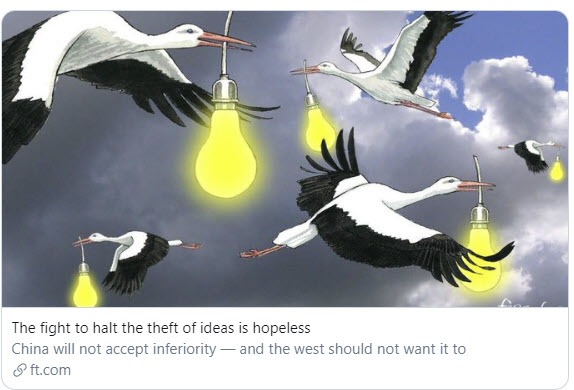
Assume we could stop 100% of IP theft by “free riders” who improve the product and pass it off as their own.
Would we want to?
Nicholas Gruen, CEO of Lateral Economics, says We’re All Free Riders. Get over It!
The free rider problem is real enough. If it costs vast sums to test a new drug, we can’t expect the market to do so if all that investment can be undercut by imitators. But here’s the thing. In addition to the free rider problem, which we should solve as best we can, there’s a free rider opportunity.
The American economist Robert Solow demonstrated in the 1950s that nearly all of the productivity growth in history – particularly our rise from subsistence to affluence since the industrial revolution – was a result not of increasing capital investment, but of people finding better ways of working and playing, and then being copied.
If, as a society today, we had to choose between addressing the free rider problem and seizing the free rider opportunity, taking the latter option wins hands down.
Free Rider Problem
Gruen quotes Thomas Jefferson: “Ideas should freely spread from one to another over the globe, for the moral and mutual instruction of man, and improvement of his condition.”
One can solve the free rider “problem” with paywalls and tight controls but tight controls also limits the number of buyers.
Gruen notes that Google generates many hundreds of billions of dollars every year but monetizes only a small fraction of that value. But $60 billion per annum is enough to make its founders rich beyond their wildest dreams.
German Firms Abandon China, US Firms Should Do the Same
A few days ago, I penned German Firms Abandon China, US Firms Should Do the Same.
The headline does not precisely match the sentiment I expressed inside. Here is my key point:
Tariffs Will Not Fix the Problem
If anything, tariffs made matters worse. And don’t expect a trade deal in pieces to do anything about IP theft either.
What to Do?
For well over a year, a friend kept asking, what would you do about it?
My answer was then and remains now “nothing”. This is not a matter for Trump to solve. Businesses need to decide for themselves whether or not it is worth it to do business in China.
That’s the key. This is not a problem Trump can solve. If businesses feel they are losing money doing business in China, they have a choice: They can decide they are making enough money anyway and it’s all worth it, or they can leave.
My headline title “German Firms Abandon China, US Firms Should Do the Same” caters to those who believe they are not making enough money or the risk isn’t worth it.
If enough companies leave, China will change its ways.
Here’s another view.
Chinese IP ‘Theft’ Doesn’t Justify Trump’s Tariffs
Donald Boudreaux, professor of economics and Getchell Chair at George Mason University in Fairfax, Va. makes the case Chinese IP ‘Theft’ Doesn’t Justify Trump’s Tariffs
Much of this “theft” is in fact in-kind taxation. Beijing requires that certain foreign companies seeking to do business in China share their intellectual property with the Chinese. Companies that attach a high value to the opportunity to do business in that large country often agree to these terms. But IP belonging to companies that are willing to forego the opportunity to operate in China is not stolen or otherwise acquired by the Chinese.
This in-kind tax is unfortunate. But IP acquired through it no more counts as stolen property than does cash paid in taxes to Beijing (or, for that matter, to Uncle Sam) count as stolen property.
Like all taxes, Beijing’s requirement of IP sharing discourages foreign companies from doing business in China. And so by making China a less-attractive place to invest, this in-kind tax reduces China’s rate of capital accumulation. In turn, worker productivity there grows more slowly, as does the Chinese economy as a whole.
In short, the chief victims of this tax are the people of China.
Second, Uncle Sam’s taxes imposed on Americans who buy imports from China is a poor remedy for China’s IP violations. The direct harm that these tariffs inflict on us Americans might be a price worth paying if they offered the best hope of persuading the Chinese to treat our IP with greater respect. But they don’t.
Fight to Halt the Theft of Ideas is Hopeless
Martin Wolf at the Financial Times writes the Fight to Halt the Theft of Ideas is Hopeless
I believe this is the first time in history I have ever agreed with a major point of Wolf.
His opening gambit is perfect “China will not accept inferiority and the west should not want it to.”
That is the correct answer to the question I posed at the top of this article.
Wolf provides a history lesson on “free riders” noting that in the 18th century England criminalised the export of textile machinery to the US. Technology managed to make it to the US anyway.
Technology transfer was unstoppable then and it is unstoppable now. And then it was the US “stealing” technology.
Here is Wolf’s key point in one short paragraph:
“China will not accept permanent inferiority. We should not want it to be permanently inferior either. We should instead want the energies of the Chinese people to build on our ideas. That is how progress occurs.”
I agree 100%.
Michael Pettis Chimes In
I found that FT article reference in a series of Tweets by Michael Pettis.

US Dominates in Global IP
The US has the top four IP spots globally and 7 of the top 12. Germany is the lone EU entry at spot 12.
Why is that?
Because as Pettis notes, “The great strength of the US is its restless and at times uncomfortable creativity and innovation, driven by a complex set of legal, financial, political, cultural, educational and other institutions that few countries have been able to match, and which is why foreigners come to the US to create the billion-dollar companies that they cannot anywhere else. The US didn’t get rich by preventing the spread of technology but rather by staying ahead of it.“
And as I have pointed out many times, the US has the largest, most open capital markets in the world. Google, Apple, and Microsoft could not exist in the EU because the EU would bust them up in the name of competition.
Google thrives because it allows people free use of its search engine. People use it because they like it. Those who don’t like it are free to try something else. From its enormous search engine profits, Google started the entire new field of autonomous driving.
Autonomous driving competition is intense. That ensures further progress. Please note that Commercial Driverless Taxis Have Arrived.
Please Keep Elizabeth Warren Out
Elizabeth Warren would bust up all four of the leaders. So would the EU. For what?
Trump Seeks to Protect Companies From Themselves
Trump finds fault in all of this.
He wants to protect companies from themselves.
At one point he proposed not letting Apple do business in China. Sheeesh, if Apple thinks it can prosper in China, that should be Apple’s business business, not Trump’s.
Meanwhile, US farmers are suffering. Ironically, even US steel companies are suffering and steel companies were supposed to be the big beneficiary of his tariffs.
Industrial Production Dives and It’s Not All Strike Related
We are in a manufacturing recession co-sponsored by Trump. Note that Industrial Production Dives and It’s Not All Strike Related.
Also note that GDP Estimates Crash on Dismal Economic Reports
This isn’t all Trump’s fault, but some of it it.
Has Trump Inflicted Enough Pain Upon Himself Yet?
Trump’s tariffs are so wrong that it prompted me to ask on October 26: Has Trump Inflicted Enough Pain Upon Himself Yet?
Since Trump is still dickering with China over “part 1” of a trade deal, the unfortunate answer is “no, not yet”.
Mike “Mish” Shedlock






























How much did we ever pay in licenses to the people who invented the wheel or figured out out to bake bread, or the thousands of other bits of progress and creativity formed the basis of our own? Of course they forgot to patent all of it and monetize it to generate special rents from some individuals in later generations to others.
If you check the court records at the WTO (TRIPS database), or San Jose, LA, NYC, Beijing or Shanghai you’ll find three interesting facts:
See this review: http://cardozolawreview.com/wp-content/uploads/2019/01/Kim.40.2.6.newcharts.pdf
Anyway, that’s fast becoming history. China already leads us in basic research in Math, Engineering, Computer Science and Chemistry and is contending for the lead in Physics. It also leads in most technologies.
It depends. If your IP is mostly an iterative, predictable repackaging, and improvement of something else, you’ll likely spend a lot more in time and IP lawyers than you’ll ever earn in the marketplace, China’s or elsewhere.
IF, however, you’ve spent, say, $200 million in R&D perfecting a true breakthrough technology, the way to protect it is not with patents, but via Trade Secrets. In the U.S., the rule of law will assist you in this effort, so long as you license at reasonable rates.
The problem with China today is: They have no IP, resulting in little societal interest in protecting someone else’s. That’s changing. Huawei alone is spending over $15 Billion per year on R&D now. The idea of keeping them caged with our laws is laughable. They’re going to run us off the road if we don’t get our act together.
A respected, global forum for arbitration is desperately needed. WTO is not it, as constituted.
Good luck changing WTO which was already a successor to GATT. Whimsically fast tracking big countries while looking smart can fix that. Start at home with the fast trackers…
Can the stock market cap be considered a true measure of technological leadership? I can happily live without ever using FB, Twitter, and other vaporware. If Europe closed itself off from US tech product, and rather enacted protective environment like China, it would also have an Alphabet, or Alibaba; it would be called maybe Nokia. US tech companies regularly go hunting for smaller European startups.
Freedom is one of the key attributes of a prosperous society, but so is the rule of law. The law must be changed, if you want to eliminate patent protection.
Most inventors risk their time and money because patent protection allows them to recoup their investment and to hopefully prosper.
From a basic moral perspective, to copy someone else’s work or ideas is not criminal, as long as those copying denote origin and do not try to claim that for themselves, nor try to misrepresent their copy as original.
There is a saying that goes something like “you only own what you can keep hold of”. An idea, once shared, is free.
So there is this intangible line between being creative, and sharing that creativity, because you cannot guarantee advancement on profit from that creative idea without sharing it with investors, and later workers, and later media, and finally putting it in the hand of any purchaser of the finished product, and at each point the idea is set free for emulation. The moment an idea is shared with anyone, as it must be except if we are completely disassociated from society, then it is beyond the control of the originator. He may still claim being inventor, or original manufacturer and so on, and there may be laws designed to reward his innovation and investment, but there are no true guarantees.
These laws are designed to protect and reward domestic initiative by granting first market share, or by ensuring royalties on use of an idea are paid. It makes sense. It also makes sense for anyone to copy a good idea, for that idea to be available for free, because it benefits others in that case.
The crux of the matter is one of profit allocation. Internationally there are many pressures on resources, there are international tensions where competition is simply not friendly and where being “nice” without first reaching an understanding is most likely a big mistake. Domestically there is the above described process of reward, as well as the inventor who will simply not profit from his idea if he shares it without protection. You notice people in most countries don’t always like each other, you give a good idea for free (by even just discussing it with a potential investor), and others will gain the profit, the inventor will find that the rest of society then has say more time at their disposal because of his idea, and yes they will also use that to compete with him, not to praise him, because they worship money and the power behind it, and it requires a fool to serve their wishes. So even though I present a slightly depressing account of human nature ( and I don’t pretend it is all like that ), well you cannot avoid that these realities exist, nor that IP can be and is used to monopolise market activity. In fact the very money we use is only property because copying it is banned, and you see the result when it is obliged in use and only a few are granted say over its manufacture.
Where does that leave us though ?
There is “you must share or you can’t be in our market”, but there is also industrial espionage and copyright, trademark, and patent violations on a large scale.
But hey, the pirates can fence their merchandise cheaper than the people that produced it.
The Jefferson quote was about philosophy, science, and math, he didn’t object to Copyright and Patents being in THE CONSTITUTION.
If China wants to get rich, it should just do ChinFlix with every movie ever made as soon as they can rip the BluRays to streams for $9.99/mo, of course not paying ANY royalties, as “ideas should be free”.
A very strong case can be made for abandoning IP and patent legislation altogether. An excellent summary of arguments in support of this approach can be found here (link to a free book download in PDF form, of Stephan Kinsella’s “Against Intellectual Property”. Note that Kinsella is actually a patent lawyer, in other words, he is not merely a theoretician on the subject, he is exposed to it professionally as well): https://cdn.mises.org/15_2_1.pdf
Obviously, his arguments are not beyond dispute and the ideas will strike many as quite radical. Nevertheless, they are an important and extremely interesting contribution to the debate – highly recommended for anyone interested in the subject, regardless of where one stands on it.
The Mish “do nothing ” policy is exactly what we have done and what the Chinese want. As we do nothing, we continue to lose. As a byproduct of the “do nothing” policy, we can watch China continue to pollute the planet, be number 1 in ocean pollution, deny basic human rights and capture the market in human organs. I guess the “do nothing ” policy would welcome the inexpensive human organs that China harvests from prisoners as a welcome benefit to society.
Oh bullshit. Welcome to the 19th century. Did Jefferson or the academics cited ever try to make a penny off an invention? I have a patent to predict whether brain surgery for a potentially fatal birth defect will do any good or not. Lawyers told me not to even try to patent it in China.
I am not independently wealthy and I have kids to feed. Patent required 2500 hours of work when I was working two jobs to put bread on the table. If I didn’t think there was a chance it would make money I wouldn’t have done it. If the corporation I sold it to didn’t think they could make money they wouldn’t have bought it. You can spout nonsense about how all the progress of the last couple hundred years is from ideas being copied but do you really think Thomas Edison would have invented the 20th century if he couldn’t make a living at it? No, he’d have been one of the best telegraph operators who ever lived instead.
This is not about the West keeping China down, it’s about theft, pure and simple. Look at all the copyright violations too.
In the last 20 years trade deficits with China have enabled it to become a major military power. No, they aren’t going to bomb Pearl Harbor any time soon but they can grab the South China Sea without the US being able to do anything about it unless we’re willing to see three or four carrier groups go to the bottom of the ocean. Is this shift in power good for the US or the West? Of course not.
For the erosion of American power what do we get? Alot of cheap crap sold in Walmart. Is that a deal?
Realpolitick trumps economics, if you want your nation to still exist on the map.
If you look around you, darned near every human creation you see, was not “invented” in order for someone to be able to run around, ambulance chasers in tow, harassing others who are simply attempting to solve the same problem Mr. Navelgazer von SelfPromoter “Inventor” claims to have kinda-sorta “solved.”
Instead, people experience a problem, then set about solving it. As long as the human condition is fairly similar across the world, people will experience fairly similar problems. Hence come up with fairly similar solutions. Waaay more similar that what “laws” encoded in something as woefully imprecise as natural languanges, could ever hope to accurately and comprehensively disentangle cheaply enough to be worth vile.
The damage incurred, from complicating something which is as baked in to the human makeup, and to progress in general, as “have problem, set about solving it”; by making every attempt at solving even the simplest thing, require a trip to your local ambulance chaser, so he can determine whether some patent troll sitting on a couch somewhere may have written up some blurb and had his army of ambulance chasers submit it to some taxfeeder at some point, and his blurb just about may have some tangential overlap with the problem you’re trying to solve; vastly, by orders of magnitude, outweigh whatever little gain may occasionally be obtained by providing a bit of extra encouragement for the occasional spend-lifetimes-and/or-billions-on-a-longshot-which-once-in-a-blue-moon-may-work inventions which extremely rigid patent enforcement may benefit.
Look, I just wrote the world’s longest and most convoluted sentence. Now I’m going to patent long and convoluted sentences, and make taxpayers pay to keep afloat a run-amuck a courtsystem enforcing my idiotic patent claim by harassing anyone else writing long and convoluted sentences into making ambulance chasers rich! Yippie!!
As an aside, medicine, as currently construed, is probably THE field where patent protection is the most important. Specifically because medicine is a field where government is trampling all over freedom to invent and experiment the way humans naturally do; by mandating all manners of insanely costly “approval” processes.
It’s pretty obvious you’ve never invented anything.
For my invention, no one has ever come near it, despite 25 years and about 50 scientific publications that screamed: DO THIS, IDIOT. I could give you many more examples. Ideas apparently don’t grow on trees.
Bottom line: a company will never bring an invention to market unless they are sure they can make money off it. That is why patent offices exist, to help out in that respect, and also to make sure the IP is accessible: the description of every patent the US has ever issued has been entirely public.
Go to the patent office website and look up a few patent descriptions if you think the descriptions are imprecise. Believe me, the patent office tries to reduce the scope of the IP you claim to as little as possible and they make damn sure the legal definition of that IP stays within the box. They see it as part of their job and most of them seem to enjoy it as a game of some sort.
Medicine is a great field for patents because everyone dies and would like to postpone the day. Government has nothing at all to do with it, aside from some of the research funded by NIH.
You are correct that some medical patents are very expensive. Development of drugs is extremely expensive, showing they actually do something, which the FDA oversees, is also expensive. My invention, I didn’t have to show whether it was dangerous or not, or if it even worked.
Ambulance chasers chase MDs. You can’t sue the federal government, you know….. A patent just says you
If your “invention” was all that, you’d have people do a lot more than come near it…… Just saying. Heck, if noone else, at least some Chinese guy would bother “stealing” it, right?
If companies in the US needs to be sure they can make money off of something before they undertake it, thank goodness there are non US companies still willing to take some risk. Risk/Reward and all that…
If patent descriptions were meaningfully precise, a machine could precisely determine exactly whether what you are currently doing, violated any existing ones. Cheaply enough not to be a gigantic enough drag on innovation to outweigh the meager benefits patents may have hundred to one. At least. Nothing slows down innovation more than anyone doing anything even remotely, trivially, novel, having to waste massive effort dealing with ambulance chasers offering opinions about whether some patent troll may sue you. Smart people faced with a problem, solve it. That’s how humanity is moved forward. Not by a bunch of idle dunces trying to set up roadblocks against said smart people doing so.
In medicine, there are laws de facto banning the kind of small scale tests and experiments which is behind almost all innovation and progress in other fields. Doctors simply cannot tinker around like software engineers can. Which is why medical research is almost comically expensive and cumbersome, compared to almost any other field. Some may think that is a good thing. But regardless, those bans and regulations are why medical research is expensive enough to serve as a better argument for patent protection than pretty much any other field. If medical researchers were not barred from engaging in the kind of tinkering software engineers do on a daily basis, medicine would progress by a million babysteps as well. Like other fields. And patents wouldn’t serve any net positive purpose there either.
And…if you can’t see paying $1,000 for a new iphone is nuts….I rest my case.
Please Keep Elizabeth Warren Out
Elizabeth Warren would bust up all four of the leaders. So would the EU. For what?
Ummm….LOWER PRICES.
Since RR, antitrust enforcement has declined. That’s how these oligarch’s got so biug because they were allowed to buy up their competition.
When you make like – what is it – 70% profit margins and pay slave labor rates in China, you lack rudimentary common sense if you can’t see monopoly in that.
During the Cold War, countries could pick which superpower to align to. Nowadays, the same decision is made between the US and China. As many in South America have found out, the alignment with China is not all that is cracked up to be.
It would seem as though Mish’s anti-tariff do-nothing solution is equivalent to Lenin’s “we’ll buy the rope from the capitalists to hang them with” except that with China Mish would just give them the rope or let them steal it. Because, it’s nicer when everybody just shares everything. I don’t think Mish understands the communist’s objectives.
A trade deficit is not a “problem” – on the contrary. It is a sign that people from other countries want to invest in your country (the trade deficit is balanced by a capital account surplus) and are willing to accept your currency for their goods. It is a sign of strength. Trump and his advisor Navarro are economically ignorant with respect to trade. Note that I am not an “anti-Trumper” – trade is my one major disagreement with him (OK, I hate his deficit spending too). I strongly support him on his drive to cut down regulations and taxes, end America’s useless wars, and pull out of that climate treaty abomination. I think he has achieved more than most of his predecessors. But he was and remains utterly misguided on trade.
You know it is not as simple as that PT, and Trump hasn’t much cut the trade deficit either.
The biggest complaint with large trade deficit is the structural change that accompanies it in that deficit country, with fiat the foreign reserves held by foreign countries carry an interest tax, or are used to speculate in the host country, and the country hosting the deficit has every political reason to lower the price of money while others are accepting it. The resulting shifts in domestic reality are not always positive or balanced. It’s not tennis to the Austrian view, under a gold standard your view would make sense though.
But the debt used and accumulated to finance a trade deficit IS a problem. I think many people confuse or lump the definitions of debt and trade deficit together.
Pater your message implies that the purpose of Trump’s trade war is to alter the balance of trade. What if the purpose is actually to stop China from stealing US technology, and prevent China using that for the well known Marxist objective of advancing world communism through economic and military superiority?
It is true, of course, that productivity and standards of living grow because of the advancement and spread of intellectual property. It is equally true that there is little reason to “invent” if you don’t get any benefit from it. Thus, the ideal system will both encourage “invention” by protecting the inventory for a period of time, but also encourage the spread of the invention, by limiting the time of protection. That is what the US Patent system was designed to do.
I would argue that the rules we have in the Patent system were developed in a time when the economy and technology advanced slowly, so a long period of protection was appropriate. As the economy moves faster, and the rate of advancement advances, a shorter period becomes more appropriate. Patents today last about 15 years, but perhaps that should be cut in half?
As for the rest of the article, I find it ironic that much of the credit for the high standard of living in the US is credited to the “…complex set of legal, financial, political, cultural, educational, and other institutions that few countries have been able to match..”, and to the fact that “…the US has the largest, most open capital markets in the world”. I completely agree. Our free market system is the most efficient in the world, and while people love to hate “bankers”, our efficient capital markets are an efficient wealth creation system, allowing novel, productive ideas to spread and thrive. Develop a new idea with a high potential for profit, and you can access the resources you need to make it thrive.
All that said, intellectual property theft is just that, theft. If a company wants to sign away their IP to do business in China, that is their right. If a Chinese company infiltrates and steals IP from companies that have not signed it away, it is theft, pure and simple. If China won’t enforce the valid rights of people in other countries to IP, that is a problem that needs to be addressed. In today’s market, let’s say I invent a new kitchen widget that every cook would want. By the time I get it to market, I will find that someone has stolen the idea, and that there are cheap Chinese knockoffs that are in stores before mine ever gets there. That is the kind of situation that discourages invention and advancement, not encourages it.
Patents are generally issued for 21 years. That’s not a whole lot of time to get a patent (10 years in my case), set up a business, build a product, market it, and turn a profit on a huge investment. Technology is increasing at a more rapid rate because there’s money to be made. Cut patents down to 15 years and alot of stuff will never be brought to market because there’s no way to make a profit.
One of the problems with patents is that you need to file in individual countries or blocks to gain protection in their particular geographic area. This is expensive and very time consuming.
As to products not coming to market due to expense, that isn’t true at all. The idea will just be created in a cheaper country and there are more than 100 to choose from.
Ultimately though, all a patent gives you is the right to sue someone who violates it. And that can be hellishly expensive and likely out of range of affordability for anyone who isn’t a deep pocket corporation.
I suppose anyone in a third world country could have thought of my patent, but not without top notch MRI scanners at 5 million a pop, or $250,000 in basic clinical research. Of course, in third world countries all the patient would have died before they could have been identified. So yeah, cost is an issue.
“If a Chinese company infiltrates and steals IP from companies that have not signed it away, it is theft, pure and simple.”
If the American Patent Troll and Ambulance Chaser Association lobbies the Tweeter in Chief to extend “IP” “laws” to the point where even taking a picture of a mouse violates a Disney “copyright,” and allowing an online customer to click once instead of twice to buy something violates a “patent”; the laws themselves are no more valid, nor worth bothering with, than if the same dunces declared it theft for people named Jacob to inhale air without paying for it.
The US is pretty tight with patents. The algorithms behind a one-click purchase aren’t simple, but I doubt very much they’d be patentable anyway.
Yes, the algorithms behind a one-click shopping process are not only simple by now. They were simple in 1990. The only reason noone bothered, was not because solving them were in any way hard, but simply because online shopping was not a problem anyone cared much about solving back then.
By the late 90s, it was a problem worth solving for some in the US. So they did. Easily. As once you have the problem, it’s not particularly hard to solve. By 2010, it was ditto for some actors in China. So the natural thing for them to do, was to, again, solve it. Again, easily.
Which is the case for the vast, vast majority of patents out there.
In any case, all a patent does is to help you sue someone for IP theft. If you hire the lawyers and bring a lawsuit the Patent Office will say, ‘yeah, this guy invented it’, and then it’s up to you to win the case. That’s the game.
The description of every patent the US ever issued is available on the USPTO website. The view of the patent office is that, yeah, we’ll give you some half assed protection if you can hire better lawyers than Apple can, but in turn you have to make everything about the invention public to anyone with an internet connection so the idea can get spread around. A patent is really a two edged sword.
Software patent a total c.r.a.p. For example, Nokia patented the call display idea; a plain hashtable lookup in software terms, and collected royalties for years.
If anything the US patent system is an obstacle to competition designed to lock out small players, and the total shark system at its worst.
China did well to show it a finger.
Try to square all of this blather about principles with the continued approval Huawei.
If “national security” can be given away, how seriously to take the bitching about China “unfairly” copying the things that they were hired to make or sell?
It’s all negotiating chips, not beliefs.
If nothing changed except Xi saying that Trump was the “bestest big-handed negotiator in the world, ever”, then the trade war would end.
It’s about image, not results.
Intellectual property includes a great many things, not the least being patents. Trademarks would also be fair game under this argument, and anything copyrighted, including movies, books, and music. I’ve even seen Chinese ‘visitors’ go to industrial design student exhibits/thesis shows in the US, and photograph everything.
The great horror of taking pictures at an exhibit! Makes the Holocaust seem positively benign, no doubt!
It becomes a problem when student ideas/and work are stolen and produced in China, and shipped back to the USA. Why bother innovating, or making a product that others can replicate after you’ve done all the work?
I wonder what will happen when Alibaba calls itself ‘Amazon’, or some factory calls itself ‘Intel’, and the products look exactly the same, but work like crap.
Not sure what the Holocaust has to do with it, though. I do hope your issues are benign.
“Why bother innovating, or making a product that others can replicate after you’ve done all the work?”
Yes. Why indeed bother doing something which someone else can do cheaper and more efficiently.
Instead, find something to do where you actually have real edge. Instead of standing around cheering for a gang of jackboots to beat others into pretending you have one, even though you don’t.
“This is not a problem Trump can solve. If businesses feel they are losing money doing business in China, they have a choice: They can decide they are making enough money anyway and it’s all worth it, or they can leave.”
Most of these “businesses” are managed by short term (1-3 yrs) CEO’s and BOD who are highly compensated with stock grants or options… They are planning for next quarter not 5 or 10 years out. Simply put under the current model you can’t trust these folks to do what is right for the long or for that matter even the medium term.
Exactly, the greedy capitalists would sell their mothers for profit if they could. They have no loyalties. That’s fine but unrestrained capitalism can be destructive in the long run. This is where one of the functions of govt comes in. It is to insure a fail and level playing ground domestically and also to protect the interests of the nation from malevolent foreign govts. The capitalists are only interested in a profit no matter who it hurts. I completely disagree with Mish’s premise. Why didn’t we allow this crap to go on with Russia during the cold war and now with NK and Cuba?
“The capitalists are only interested in a profit no matter who it hurts.”
And Dear Leaders are only interested in personal aggrandizement, power and ultimately “profit.” Again, no matter whom it hurts. In every organization, the scum always rises to the top. That’s how organizations work. All of them. Not some.
The only difference between corporations and governments, in that regard, is that wrt corporations, you can chooses to route around the worst of them. Try doing that with Kim or Donald.
While I agree with most, it is a complicated subject led by a complicated formula of interlocking greed. Managers while optioned to be greedy are under pressure to move value. This creates a short-term demand that is equaled by short-term or immediate results. Think quarterly, rather than decades, as was the former. On the other hand it is a national security issue. Do we or don’t we? If management has no national interest, volunteered or by demand, it creates a shareholder conflict. Long-term thought or short-term need? Short-term demands by shareholders are difficult if not impossible to curtail not only by greed but politically. Perhaps the only answer is….Keep my enemies closer.
Trump is trying to protect Americans from the theft and the complicit companies that profit by it. Businesses are very short term as that is how incentives are set up. If we just let this continue, we will lose. Changing the incentives and protecting IP is imperative to the interests on US citizens. I always wonder how people would feel about IP theft if it was their work that was being stolen. Examples would be music, books or maybe Mish’s blog. Would the owners of this be ok with someone copying their work, passing it off as original and profiting on it? The could price the product or the associate advertisements at a lower cost. The consumer wins!! So is this OK?
The theft of ideas is not the same as the theft of IP. In China’s case they plant employees inside western corporations who steal IP and send information back to China. The last two companies I’ve been with had multiple incident of Chinese employees stealing IP and sending it back electronically to unknown network locations in China. There are likely employees in many US technology companies who are undercover spies for the Chinese government or Huawei who is majority held by the Chinese government.
And how do you propose to address international industrial espionage ? It all, in the end, depends on the country that is hosting the facility. There are US laws addressing the issue, but it still depends on interesting the legal system of the host county in the investigation, trying and punishing of the spy.
And then there is this…
….The United States engages in economic espionage and doesn’t deny it. As former CIA Director Stansfield Turner stated in 1991, “as we increase emphasis on securing economic intelligence, . . . we will have to spy on the more developed countries—our allies and friends with whom we compete economically.” Former CIA Director James Woolsey acknowledged in 2000 that the United States steals economic secrets from foreign firms and their governments “with espionage, with communications, with reconnaissance satellites.”…. After acknowledging that the United States engages in economic espionage, DNI Clapper said in 2013: “What we do not do . . . is use our foreign intelligence capabilities to steal the trade secrets of foreign companies on behalf of – or give intelligence we collect to – US companies to enhance their international competitiveness or increase their bottom line.” This very carefully worded statement is the only admitted U.S. limit on economic espionage. Note what it permits. It permits economic espionage of foreign governments and institutions. It even permits theft of trade secrets from foreign firms. It just doesn’t allow such theft “on behalf of” U.S. firms, and it doesn’t permit the government to give the stolen information to U.S. firms. Even this limitation is qualified yet further. The USG says it does not steal trade secrets on behalf of U.S. firms (or give stolen trade secrets to U.S. firms) in order “to enhance their international competitiveness or increase their bottom line.” But it would be consistent with this statement for the USG to steal trade secrets on behalf of U.S. firms, or to give the stolen trade secrets to U.S. firms, for some other purpose….
https://www.lawfareblog.com/precise-and-narrow-limits-us-economic-espionage