

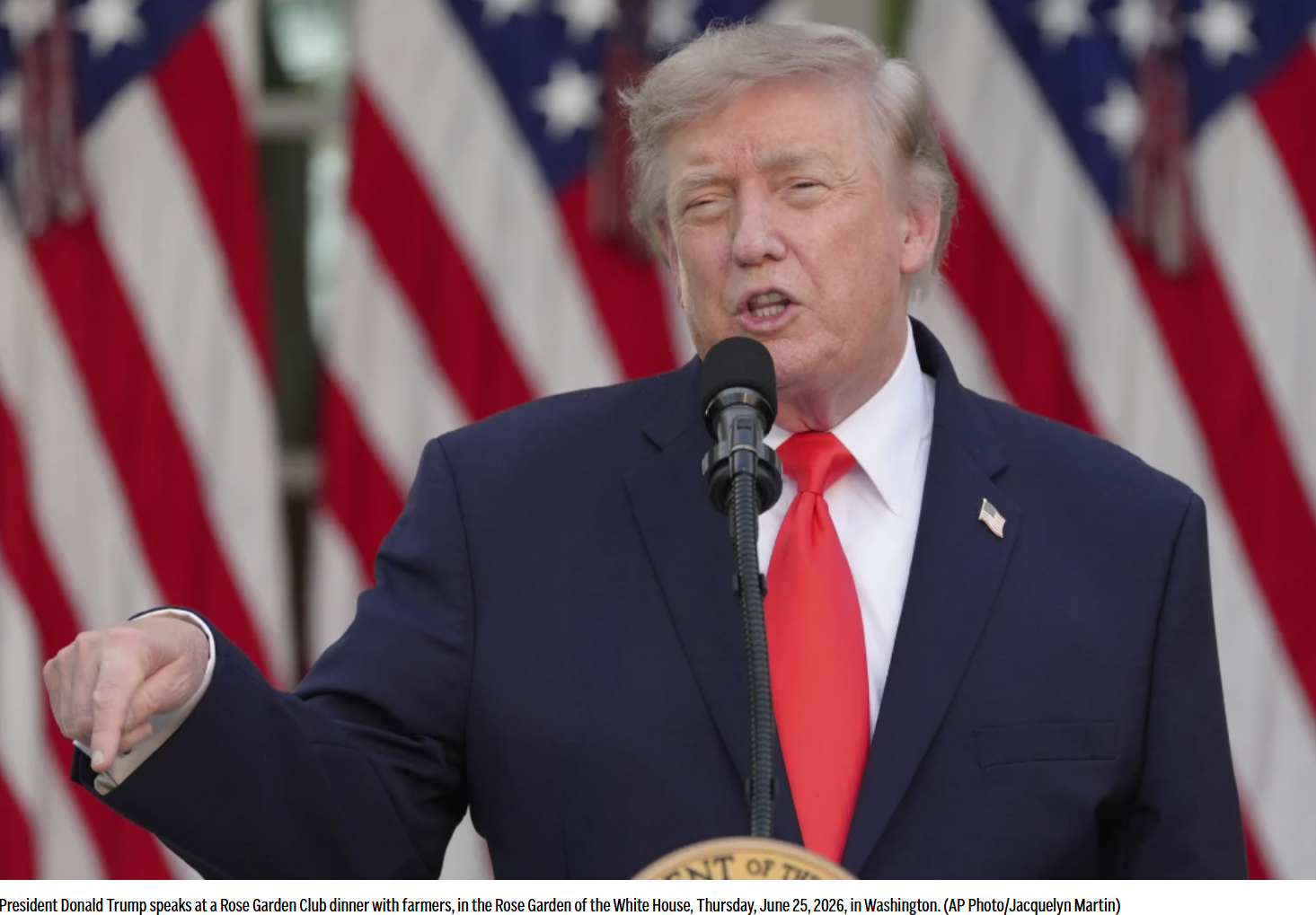
Another trade war looms over European implementations of a DST.
Truth Social: Numerous European Countries have been discussing the imminent implementation of a Digital Services Tax on American Companies. Some of these Countries are close to actually doing this. Please let this statement serve to represent that any Country that imposes such a Tax will immediately be met with a 100% TARIFF on any and all Goods sent to the United States of America. This TARIFF will supersede Trade Deals made with the Country, whether implemented, signed, or not. Additionally, the 100% TARIFF will be immediately imposed, if they proceed. Thank you for your attention to this matter. President DONALD J. TRUMP
Jun 26, 2026, 10:20 AM
The Digital Services Tax (DST)
- What it is: A tax on the gross revenues that large multinational tech companies generate from providing digital services (such as online advertising, digital marketplaces, and user data transmission) in countries where they may lack a physical presence.
- Who pays it: It largely targets dominant U.S. technology conglomerates.
- Where it applies: There is no EU-wide tax. Instead, individual nations like France, Italy, Spain, and Hungary have enacted their own unique DSTs.
- Controversy: These unilateral taxes are a major source of international trade tension, with the U.S. threatening retaliatory tariffs on European goods.
Trump Howls at the EU
The AP reports Trump threatens 100% tax on European imports if countries impose tax on digital services
President Donald Trump on Friday threatened a 100% tax on imports from any country that imposes a tax on digital services from United States companies.
The move could lead to a larger showdown that could increase prices and hinder economic growth, possibly setting off a larger trade war if the 27-member European Union was compelled to retaliate.
“Unilateral measures targeting such legitimate policies are unjustified. If pursued, the EU will respond swiftly and decisively to defend its rights and regulatory autonomy,” said Olof Gill, a spokesperson for the European Commission on Friday.
He defended taxation on technology companies as “non-discriminatory” and applied equally to “all large companies, regardless of their origin.”
The threat comes ahead of Trump’s July 4 deadline for the European Union and the United States to start implementing a tariff deal that caps tariffs on most EU exports at 15%.
The European Union in May finalized a trade deal with the United States that caps most tariffs on EU exports at 15%. The deal followed months of debate within the EU after European Commission chief Ursula von der Leyen tentatively struck the deal last year while visiting Trump’s golf course in Scotland.
Digital taxes were not part of the agreement and have remained a sticking point between the U.S. and the European bloc.
Britain, which is no longer part of the EU, has since 2020 levied a 2% digital services tax on revenues earned by search engines, social media sites and online marketplaces that “derive value” from U.K. users.
The British government said in a policy document at the time that corporate tax rules for digital businesses had “led to a misalignment between the place where profits are taxed and the place where value is created.”
The U.K. tax includes thresholds, so mainly large international companies will pay it. The tax was designed to “ensure the large multinational businesses in-scope make a fair contribution to supporting vital public services,” the document said.
100 Percent Tariffs? How?
The Supreme Court wisely struck Trump’s reciprocal tariffs.
Then a trade court struck Trump’s Section 222 replacement tariffs.
On February 20, 2026, I commented Supreme Court Strikes Trump’s Reciprocal Tariffs In 6-3 Vote (I Told You So)
Forgive me for bragging, but I got every justice correct.
On May 7, I commented Trade Court Sends Trump’s Section 122 Tariffs Down the Drain
Gee, I get another Tariff “I Told You So.”
Rule of Law 2, Trump’s Tariffs 0
In a foolish effort to get around reciprocal tariffs, Trump turned to Section 122 tariffs. As expected in this corner, the court struck those down too.
My expectation on any appeal is the same. The case on merits is clear.
Current Status of Section 222 Tariffs
- The administration appealed immediately to the U.S. Court of Appeals for the Federal Circuit (CAFC). skadden.com
- The Federal Circuit has issued administrative stays (extended as recently as mid-June), so the tariffs remain in effect and are still being collected for nearly all importers while the appeal plays out. reuters.com
- The Section 122 tariffs are scheduled to expire automatically on July 24, 2026 (150 days from their Feb. 24 effective date) unless Congress extends them — which is considered highly unlikely. skadden.com
Expect More Refunds
Trump should and will lose the case if appealed.
All Trump has is Section 301 tariffs and they are not so easy to implement.
Key Requirements for Imposing Section 301 Tariffs
- Investigation Initiation: USTR can self-initiate after consulting stakeholders or respond to a petition from an interested party (e.g., firm or industry group). USTR decides on petitions within 45 days. congress.gov
- Consultations and Investigation: USTR requests consultations with the foreign government. For trade agreement violations, formal dispute settlement is required. Investigations generally last up to 12 months for discretionary cases (unreasonable/discriminatory practices). Mandatory cases (e.g., trade agreement violations or “unjustifiable” acts) have stricter timelines. congress.gov
- Public Input: USTR must seek public comments on proposed actions and often holds hearings. This builds an administrative record. brookings.edu
- Determination: USTR must find that the foreign practices burden/restrict U.S. commerce. Actions are mandatory for certain violations (e.g., trade agreement denials or unjustifiable acts) and discretionary for unreasonable/discriminatory ones. congress.gov
- Action Selection: Tariffs (duties) are prioritized over other import restrictions. The response should be equivalent in value to the harm caused. USTR can also suspend trade agreement concessions or negotiate binding agreements. law.cornell.edu
Potential Legal/Practical Issues
- Procedural requirements — Unlike unilateral proclamations, Section 301 requires: A formal investigation (or reopening one), public comments and hearings, and a determination that the foreign practice is “unreasonable or discriminatory” and burdens U.S. commerce.
- This takes time (months, not “immediately”).
- Section 301 has no statutory cap on rates, but actions must be proportionate to the harm. A blanket 100% tariff on all goods from a country would be an extreme escalation and vulnerable to legal challenge It would also need to follow the administrative process.
- Superseding trade deals — Possible under Section 301 (it can suspend concessions), but this risks WTO disputes, retaliation, and complications with allies. Europe has already finalized some trade elements with the U.S. recently.
- Political/diplomatic blowback — Many European countries (France, Italy, UK, etc.) already have DSTs targeting Big Tech revenue. A 100% threat could unify EU retaliation and strain relations at a sensitive time.
- Court precedent — After the Supreme Court limited IEEPA and the CIT struck down Section 122 (with appeal ongoing), aggressive unilateral tariffs are on shakier ground. Importers and foreign governments could challenge this quickly.
Rhetorical Noise
A full 100 percent blanket tariff response is nothing but rhetorical noise whether Trump understands that or not.
The EU and UK certainly understand the above sentence.
Meanwhile, the Section 122 150-day clock is winding down.
Trump is neutered on today’s over-the-top threat. However tariff damage is real and ongoing.
Ongoing and Upcoming Tariff Damage
Blanket tariffs on steel, aluminum, and other products are extremely damaging.
Trump can do still more damage with the USMCA deal coming up for review on July 1, 2026.
But Trump will never see the stupidity of it all. This year in the name of fighting inflation (that he claims is nonexistent), Trump has rolled back numerous tariffs.
Trump Tariff TACOs
- Agricultural and Mobile Industrial Equipment: Decreased tariffs on combines, harvesters, bulldozers, and forklifts to 15% from 25% for trade-deal countries.
- Metals: Lowered the duty rate to 10% for specific capital equipment imports from countries utilizing at least 85% U.S. melted/poured steel or aluminum.
- Food and Produce: Exempted key food imports from reciprocal tariff rates to lower grocery costs. Products benefiting from these reductions include coffee, tea, bananas, avocados, pineapples, tree nuts, and select beef cuts.
Related Posts
March 13, 2025: The Amazing “Success” of Trump’s 2018 Aluminum Tariffs in One Picture
I hope you can take a bit of headline sarcasm because the true story follows.
February 13, 2026: Trump to Roll Back Some Steel and Aluminum Tariffs Due to Inflation
The Financial Times discusses tariff rollbacks.






























President Carnival Barker has spoken… if only the globe’s fate weren’t delicately resting in his fat, sausage-finger hands.
Remember the tech bros at the inauguration?
I think the EU can safely ignore this one.
Trump’s messaging is quickly becoming irrelevant.
You call this a message? 😉
How many times has Trump pompously announced, “I’m the smartest man in the room!” Candidly, if his vocabulary’s any indication, I’d place him near the other end of the spectrum.
Trump’s a loudmouthed attention-seeker, who’s really, really stupid…he’s got another 2.5 years if America can endure his huffing and puffing.
The Donald spouts his Decrees on a regular basis nowadays. Most of them he ends up doing a Taco on ……and also on top of that the Courts overturn many …. So today when Donald posts a decree that finishes with ….. “Thank you for your attention to this matter. President DONALD J. TRUMP.”…….. It still does get my Attention … to quickly click them into the Junk Mail section.
I thought sure we’d get our next post on the latest strikes in Iran…after Iran struck a Singaporean tanker…all, of course, after markets were closed.
Still no post on the 3 far far left socialist choices in a sparsely attended primary in NY.
The blog posts about the “blue wave” but one might consider that the mainstream Democrats are in a quandary if those extremists are the ones driving policy, jeopardizing said blue wave or at least what it may mean. It may trigger defense mechanisms if Mamdani-like policies are headed to Washington. God help us if they get even more traction. You’d think losing in 2024 would have wizened up the Democrats and given Republicans pause. Instead neither side learned one darn thing. Methinks we are gonna find out what extremism really looks like, not the plaything of a situation we have thus far.
I rather doubt the war is going anywhere for reasons posted many times.
I may change my mind, but there are more interesting things goin on.
I don’t care about 3 NY seats. But I may comment on Trump’s McCarthyism.
Yes, things are ridiculously extreme
Most people want a middle of the road government. I don’t understand why these political parties have to move toward the extreme ends of the spectrum. Is it the desire to differentiate? Listen to your electorate and move toward the middle. You will be rewarded.
I don’t think it’s so much a matter of moving towards the middle as of being sensible. A lot of centrists are just opportunists who try to get into positions of authority by working out what most people think (not worrying about whether they are right) and claiming to believe that. A lot get elected, because as skilled actors, they are able to deceive people. I know some “extremists” aren’t very attractive either, but at least (I think) they do usually really believe what they say.
Disclosure: a lot of people tell me I’m an “extremist,” so I have come to see myself as one of that set. At least that way, I don’t have to associate with people who believe what they were told at university or in church, or who are trying to pretend to be stupid.
P.S. Some of the people I meet really ARE stupid, but so are a lot of centrists: they just don’t know it because they got passing marks at school.
You are mistakenly assuming they give a rat’s patootie about the electorate. What gave you that crazy notion?
Extremism? Maybe you have not seen the extreme Christian fascism which is being shoved down the throats of Texas schoolchildren. Meanwhile Republican pedophiles run loose sodomizing children in churches and schools at every opportunity. We are truly living in some sick dystopian vision of depraved old white men.
Texas Board of Education approves Bible stories as required reading in public schoolsTexas, which educates roughly 1 in 10 of the nation’s public school students, has been at the forefront of a charge to incorporate more religion into classrooms.
The great thing about Christianity as a religion in modern times is that nobody actually believes it. While they are telling children nonsense about how Jesus dies for our sins, at least they aren’t telling them modern nonsense about women’s lib and racial equality that some people actually believe.
I grew up under Christianity and hated being lied to and being intimidated into regurgitating lies. But when you look at history, it seems that Christianity has actually been less harmful that all the other religions: science developed in the Christian world. Someone writing about Nietzsche said that Christianity urged people to learn everything they could about God’s world, until they eventually realized that they didn’t need God. I think Martin Luther, King Henry VIII of England, and other people like them also deserve some credit for destroying the centralized control of Christianity, even if that was not their intention.
Going right back to the foundation of Christianity as a more-or-less monotheistic religion, I wonder if in an anthropomorphic way it wasn’t an improvement on polytheistic religions, because it encapsulates the idea that truth is monolithic: there is only one truth. If, as Ayn Rand had one of her characters say, you are using logic and find a contradiction, check your premises: you will find that one of them is false.
TL:DR you foreswear the indoctrination that was successful on you. TFS
I remember when we had separation of Church and State. Then Jesus decided we all need to learn his religion. No wait, that was corrupt humans who made that decision.
1-star Mishelin award for best comment of the thread.
At this point I’d vote for an out and out communist over whatever’s going on in Texas. At least Russia managed to look nice at one point, I don’t recall any such time in Texass between the slavery and the lynchings and whatever’s going on with them now. Honestly I wonder why migrants even try when the state waiting for them is just as bad as whatever place they left.
Immigrants in Texas – American Immigration Council
Immigrants in Texas Texas has a long history of immigration, with the majority of immigrants hailing from Mexico. Immigrants now account for one-sixth of the state’s total population and support the local economy in a growing number of industries.
They seem to be a big and very positive force in Texas (1/6 the population). In fact, it appears they can’t live without them…
I lived in Corpus Christi Texas for around 4-5 years, and it was lovely. It was some time ago, so perhaps things have broke bad since then, but I find that hard to believe. I liked it there, and so did everyone else it seemed anyway…
Time to give Texas back to Mexico?
Not necessarily as big an issue. Depends on how it’s implemented. In my senior yr public HS English class we read portions of the bible as a work of literary art. This in a deep blue state with nearly half of the school Jewish in the 80’s. Don’t remember if we read portions from both the “new” and “old” but of course the Jews aren’t keen on the second. It was “controversial” but honestly most students weren’t orthodox and the school board wasn’t some out of control body. Most of us were just more eager to get the hell out of school once and for all!
Maybe I’ve been listening to different people. I thought the purpose of letting unaccompanied children into the United States was to gratify the lusts of the “carers” who would take charge of them, and that the Democratic Party establishment actively associated with people who held perverted parties at which children were tortured and raped.
Are you thinking of Hillary Clinton’s underground baby pizza parlor again? That’s so out of fashion these days.
How do you know this hasn’t been their dream all along, to rail little boys and girls willy-nilly? The mask sure comes off all the way, when it is removed.
“You’d think losing in 2024 would have wizened up the Democrats”
What were the far-left socialist policies being spouted by Biden and/or Harris in the 2024 election? I recall standard liberal corporate Democrat stuff, ala Eisenhower’s policies in the 1950s. Hopefully, I’ll be informed shortly, but I’m not counting on it.
“You’d think losing in 2024 would have wizened up the Democrats and given Republicans pause.”
Erm… it is the establishment Ds who supported the same things now as they did in 2024. THAT is why they lost in 2024 – they were basically the Republican Party with the “D” label. The DSA insurgents have made it clear that it’s not the way to go.
It’s almost as if Mike, and not you, are in charge of what he posts. Almost.