

On average, tariffs are a jobs killer. They protect one industry while costing others.
Manufacturing was dismal in 2025. 2026 is off to a weak but positive start in 2026 averaging about a thousand jobs a month.
Change In Manufacturing, Construction, Private Education and Health

Construction has had a few great months but its sporadic and tied to AI and utilities, not residential or office construction.
The big source of jobs has been private education and health care, related to the mass aging of baby boomers needing health care services.
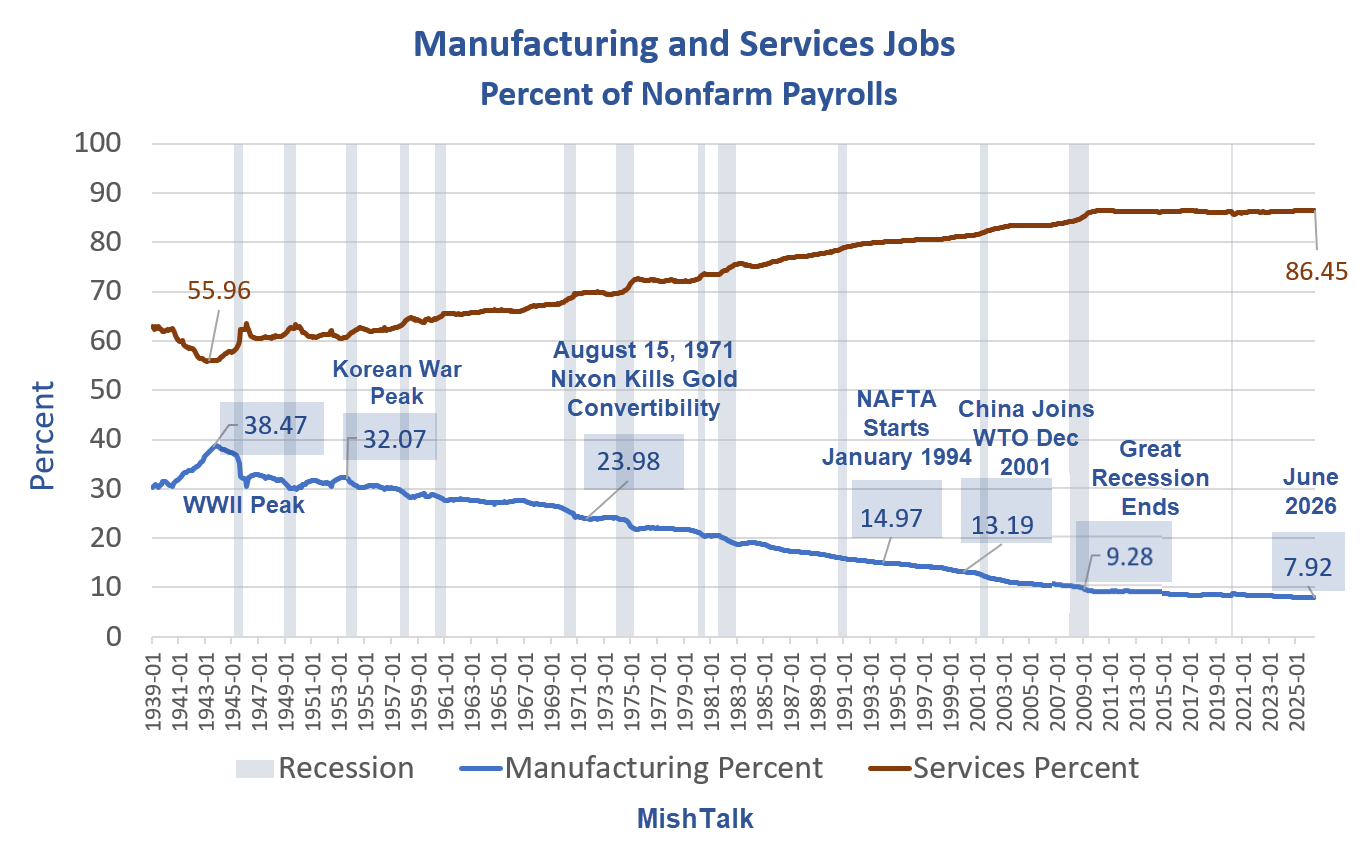
Manufacturing and Services Jobs Percent of Nonfarm Payrolls

Manufacturing Percent of Nonfarm Payrolls
- 1943-01: Manufacturing peaks in WWII at 38.47 percent of nonfarm payrolls
- 1953-09: The Korean War peak was 32.07 percent
- 1971-08: Nixon killed gold redeemability on August 15, 1971. The manufacturing percent of jobs was 23.98 percent.
- 1994-01: NAFTA started on January 1994 with manufacturing percent of jobs at 14.97 percent.
- 2001-11: China Joined the WTO on December 11, 2001 with manufacturing percent of jobs at 14.97 percent.
- 2009-03: The Great Recession ends with manufacturing percent of jobs at 9.28 percent.
- 2026-06: Manufacturing percent of jobs is a new record low 7.92 percent.
Trump Promised to Revive Manufacturing
Donald Trump first campaigned heavily on the promise to restore American manufacturing jobs during his initial presidential run in 2016.
He reiterated these pledges during his 2024 campaign, where he vowed to make the U.S. a “manufacturing powerhouse”
Tariffs Aren’t a Cure-All for Factory Malaise
Bloomberg reports Trump’s Blue-Collar Base Worry Tariffs Aren’t a Cure-All for Factory Malaise
Trump’s biggest economic promise has always been a tariff-driven resurgence in manufacturing. And the case for that actually happening remains weak. Import taxes have contributed to higher consumer prices. Yet there are actually 38,000 fewer people working in American factories than a year ago, according to data released last week. Which explains why some of Trump’s blue-collar supporters have doubts about his methods.
In 2016 Trump offered protectionism as a solution to the economic woes of American factory towns like the one I visited last week. A decade on with a mid-term election looming some of the union members who cheered him on are having doubts about how things have played out.
USMCA Reviews
The union man I sat down with campaigned for Trump in 2024 in the belief that his tariffs would help give the shuttered factory a new life. But they didn’t. And so now he feels betrayed and not so sure about the path Trump is on.
Last week’s move doesn’t end the largely tariff-free commerce that has taken place since the North American Free Trade Agreement went into effect in the 1990s. It’s a long way from Trump’s 2016 campaign promises to kill NAFTA altogether.
We are living through a giant economic experiment while contemplating the end of global orders and the consequences. The reality, though, is that despite the certainty you often hear in Washington about this moment’s importance, many Americans aren’t convinced they are benefiting.
Which means you can sit down with a union man with proud anti-free trade credentials and be surprised. A protectionist may be in charge but that union man still isn’t sure anyone in Washington is delivering what he needs.
Trump Manufacturing Results
- January 2017: 8.47 percent
- December 2020: 8.54 percent
- January 2025: 8.01 percent
- June 2026: 7.92 percent
Net Manufacturing Jobs 2025-2026
- 2025: – 113,000
- 2026: 18,000
- Total: -95,000
Tariffs did not and will not revive manufacturing. Biden kept in place all of Trump’s tariffs. Then Trump added more tariffs.
Between January 1, 2017 and today, the US economy added 271,000 manufacturing jobs. In contrast, nonfarm payrolls rose by 13.576 million.
The demise of manufacturing is a result of increased productivity, Nixon Shock, and China.
NAFTA did not hurt manufacturing jobs. If anything, NAFTA saved jobs by making the US more competitive.
How Tariffs Hurt
There are currently 12.6 million manufacturing sector employees. But the net beneficiaries is much less.
For example, the automakers sure love tariffs on cars and trucks. But they don’t love tariffs on steel, aluminum, or imported parts needed to make cars and trucks.
Consumers don’t love any of this because prices rise and their relative standard of living declines.
The US population is about 342.6 million people. All but some percentage of 12.6 million are net losers on tariffs.
No Manufacturing Renaissance
- Looking ahead, labor productivity is going to increase, meaning fewer workers to produce more goods.
- Boomers are going to need more health services, not bigger, more expensive trucks.
- Zoomers are not going to be buying huge cars or trucks to replace falling boomer demand.
Don’t expect a big manufacturing renaissance, because it isn’t coming.
The idea that tariffs protect jobs is proven nonsense.
And the more Trump tries to bring jobs back with tariffs, the worse things will get for small businesses dependent on imports and all consumers.
Nixon Shock
For more on the role of Nixon Shock and the impact it had on trade imbalances, please see Gold and Silver Surge to New Record Highs, What’s Going On?
Tariffs cannot and will not fix problems related to Nixon ending the redeemability of gold.
Credit exploded and so did trade imbalances.
Related Posts
May 23, 2021: Trump’s Steel Tariffs Failed Miserably, Biden Should Scrap Them
The latest jobs report said manufacturing employment fell 18,000 in April. It’s 515,000 below the pre-Covid mark of February 2020. With the stroke of an auto-pen, Mr. Biden could lift the burden of 25% tariffs on steel and 10% on aluminum, helping the economy emerge from the pandemic. So what is he waiting for?
September 6, 2025: Trump’s Aluminum Tariffs Seriously Backfire Already
Tariffs did not and will not bring production back to the US.
July 1, 2026: Manufacturing ISM Up 6 Straight Months, Employment Down 33 Straight Months
Price growth moderated but have input prices have rapidly increased for 21 months.
July 6, 2026: ISM Services Prices Paid Increases 109 Straight Months, Growth Slows
The ISM services growth slows a bit. Exports and imports treading water.
June 25, 2026: PCE Year-Over-Year Inflation Up 4.1 Percent, Fed Over Target 63 Straight Months
The Fed’s target is 2.0 percent, actual is 4.1 percent, up 0.4 percent from last month.
I have been on the right side of this debate for something like forever.






























Weakening of the US dollar is what brings jobs on-shore. This can also be achieved with increased productivity. Manufacturing automation and AI has the promise of onshoring manufacturing but these will be highly skilled jobs requiring specialized education. Shipping products around the world for the cheapest labor has a cost too.
Conclusion: We do have some Wins:
Mexico, Asia, Canada, Central America and others, have Lost Jobs to the U.S. as a result of U.S. policies., Trade Agreements, and shifts in locations closer to the U.S. to name a few.
Definition: Tariff
The bizarre belief that you are going to make consumer’s lives “better” by increasing the price they pay for everything.
Doesn’t the historical record show that, if you have a large enough home market, protectionism can allow you to catch up on technology after you have fallen behind?
It worked for the U.S.A. after the Civil War. It worked for Japan.
The American public may have to put up with inferior products for a while as their industrial companies are re-learning their old trades.
Its not the 50s We are a mature market. Everyone pretty much has a washer / fridge/ car phone etc. and only needs a new one if the old one breaks. Its not the same as say japan after ww2 or china today.
Neomerchantilism (that is what you are describing, sorry for using long words on you) can work -BUT only if there is another country ready, willing and able to absorb your surplus.
Otherwise, learn well the Law Of Comparative Advantage. There is literally no one person alive that can make a number two pencil from scratch, harvest the trees, mine the graphite, harvest and cure the rubber, make the paint and the ferrule, etc.. Yet pencils ae plentiful and they can be bought for pennies.
This is why most of us have a job and earn money, rather than try to do everything for ourselves.
Did you think I couldn’t handle a word that long?
I do know about comparative advantage. I once worked for a man (my father) who didn’t know about it, and tried to do nearly everything for himself. It didn’t work out too well for him.
As I see it, the problem with trying to be too doctrinaire about economics is that you leave out the military and government sides. The “just-in-time” inventory system is another example of that. It works fine until you have some sort of shortage. If you have no redundancy, everything stops.
I would have thought that it should always have been obvious that exporting your manufacturing skills to China would leave you vulnerable to intimidation from China. Allowing China to drive all your rare earths producers out of business leaves you dependent on China for rare earths. I don’t see that that is hard to understand.
I suspect that it may not have been entirely unknown to the globalists; whether they fostered this silly idea of focusing only on economics I don’t know.
And even those numbers are fudged. In the 1990’s route drivers for soft drink, beer, bakery, etc companies were treated like UPS or FedEx (service jobs). They changed the classification to make manufacturing jobs look better. Just like the fed changing how inflation is calculated.
We exported pollution to China. Sorry but nobody wants it back.
But now China is selling itself to he world as the new source of cleaner tech. And we re doubling down on hydroocarbons.
Why would you build a manufacturing facility in the US where land and labor are more expensive and taxes are higher? It’s too expensive to manufacture here, so they don’t.
Toyota just announced that they will move production of Tacomas from Mexico to Texas. I guess that is good for those who get hired in Texas, but if the price of a Tacoma increases as a result then it might not be so good for American consumers.
Not that simple, they have a brand new Tacoma plant in Guanajuato that will make most Tacomas and repurposing or shuttering an old Baja plant and moving some Tacoma production to San Antonio. It’s a win for Texas manufacturing but a very small win
There is a whole world full of people who will work for less and areas where things cost less to make.
Not sure what the answer is. Seems our standard of living will get lowered and the theirs will get raised until it averages out.
Sheesh.
Workers willing to accept lower wages could bring jobs back.
Investors willing to accept lower returns on their capital could bring jobs back.
Don’t hold your breath.
At some point there is no use in going to work if your wages are lower than your cost of living.
Costs can be cut with changes. A person living alone in a one bedroom apartment can reduce their’s by switching to a shared place. Lots of other ways, too, such as minimal eating out. Then they can build savings, retirement.
The numbers differ but something like 44 percent of people can afford to pay a 1000 emergency from savings.
If your there your pretty close to the margins.
Crappy car/ no health ins / no way to pull yourself up because the slightest problem will knock you back three steps.
turning out really educated robotic engineers and capital but frankly that will translcate into few jobs as we are not in the 70s anymore
Here’s the 1st World – 3rd World manufacturing dichotomy I see:
Unskilled people in 1st W want to make $40-$50/hr + expensive benefits doing a 3rd W job that’s only worth $4-$5/hr + minor benefits.
It’s hard to tell children no but that’s why we need leadership.
Americans think manufacturing jobs are good, high-paying jobs, but that’s only because those jobs were heavily unionized. And Americans hate unions.
The problem is or unskilled labor needs to make 40 or 50 to live. ( depends on area).
I have been associated with three US manufacturing companies. One started in the 1970s and the others in the late 1980s. All three are still in business. They sell very high quality goods, two are luxury level, to wealthy people who have a lot of disposable income because they buy their everyday junk at places like Walmart and Costco.
What will? Nothing. I feel like that should be self evident, or observable reality at this point.
If the USA is not a military world order guarantor, and is not a manufacturing superpower, what is our value-add for the world? Luxury golf courses?
That would require Americans to produce things that other people want and are willing to pay for, which all are non-starters. We’d have to actually work! Like the poors!
I guess alternative is to keep doing what we’re doing, producing farm commodities, dodgy investment securities, and overpriced weapons systems that we can strong arm others into buying.
Medical care is a huge burden for American manufacturers.
No lie. By any objective measure, US healthcare delivers substandard results, as does so at exorbitant cost.
However, those exorbitant costs mean profit$, so the system will never be reformed, except perhaps in terms of window dressing and optics.
Great discussion about job creation and manufacturing, but one comment got me: turning out plumbers a retreat into past. If I wanted to, I could still go out any day and bill $150/hr just doing something I learned in late 70’s, plumbing. Now I know it’s not a mass solution, but how many with gas fired boilers can diagnose why the house is cold? Cardiologists don’t know how to do this. I also have two masters degrees in low temp physics and physical chem. We still need plumbers who know how to think. And lets not forget electricians.
Welders. Expert tool and die makers. Pipefitters. Metal fabricators. Generations of expertise that cannot be learned on the job or after a two week orientation course, all left to rot.
Not only do we no longer know how to make things, we no longer know how to make the things that make the things.
Elon Musk is going to build robots at his plant in California. Those jobs will be going away in a decade.
There have been robots that do many of such tasks for decades. Elmo is building robots to get rid of cooks and maids and chauffeurs that will meet the needs, but not the desires, of his buddies in the Epstein class. For their desires, they’ll continue raping the cooks, maids, chauffeurs and their children.
The people who believe in Trump‘s mad tariff idea are the same people who lost almost $4 billion on Trump‘s meme coins. It looks like you can fool some people all the time.
How weak was the nation’s cognition when one straight-from-sitcom-casting TV personality’s toss-off fantasy sales pitches altered the nation’s whole trajectory? When was taxing the plebes on imports going to suddenly recreate a global economy, of decades’ making? I’m not saying it was perfect before (subprime/credit card lifestyles were similar free-riding delusions, along with a worldwide endless war on terror, remaking Iraq into another Houston on borrowed money). But jeez.
These major sales pitches of the last 25 years have been body blows to the USA. And this was supposed to be our unipolar moment.
I say, PT Barnum grossly underestimated.
Depends on what kind. A lot is being said lately about “old-style simple appliances that last for a long time”. How long would such factories exist with such a model and how expensive the product, is a different discussion.
Then you also need long-term knowledgeable workers with iron-clad contracts to support such a model, throughout the pipeline (from floor workers to dealerships). And a solid management with minimal or no corruption. And currency protection (or pro-American manipulation) of some sort.
And then it would take only one change of government which will impose “green new deal” etc. to destroy all the above by jacking up energy prices by 250% or so (see current Germany).
Ever heard of “planned obsolescence”?
“Then you also need long-term knowledgeable workers with iron-clad contracts to support such a model, throughout the pipeline (from floor workers to dealerships). And a solid management with minimal or no corruption. And currency protection (or pro-American manipulation) of some sort.”
Right. You need lots of government regulation of the free market. And that’s true in today’s global market. I can guarantee you that German, Japanese and Chinese manufacturers work very closely with their governments to make sure all of those things are always in place. And in the US, it is not just a change in government administration that can wreck everything. It is also changes in corporate leadership, and the desires of major shareholders and banking interests. The USA simply doesn’t have the intellectual framework to successfully compete on a global scale against the major manufacturing powers.
A german company with over 500 employees is required by law to have the union elect 1/3 of its supervisory board. A german company with over 2,000 employees must have 1/2 of the supervisory board elected by the union.
The plan was to manufacture low value added products in third world countries, and China was a perfect case: cheap reliable labor that is eager to learn.
That egghead plan however backfired as China figured out the game and turned it on the eggheads.
Now the options are stark, but perhaps not as bad as for self-defeating EU.
We need manufacturing to return as it is important for our security in supplying our material needs, military requirements and for generating national wealth. This is different than bringing back manufacturing jobs. With AI, automation, and robotics, manufacturing becomes more productive while labor intensive manufacturing is less productive and therefore less competitive. To focus on the labor component means politicians will focus on vote buying and penalize constructing plants with maximum use of AI, automation and robots. The US will not maintain its competitive position focusing on maximum labor.
There are examples of this strategy working in real time. The automotive industry has been automating at the expense of labor for years and fought unions in labor negotiations over the implementation and reductions in required labor. Retail distribution centers extensively use robotics to optimize productivity.
For me, to focus on manufacturing labor is a path to failure and will divert from focusing on maximum manufacturing efficiency that will be a potential successful path.
The issue is Americans are not patriot enough to work for low wages in factories.
At 81, I have a unique take on this. In the summer, I worked in a factory (Republic steel) back in the 60’s while a college student. There is no way this can or should be resurrected today. Many of the union workers did virtually nothing and stayed in the mill for 50 years or more sitting not working. They only needed to show up and cash a check at the end of the month. The mill was built on 1909 and was maybe two miles long, employing tons of drone like workers. The pollution was horrible, one side of the Mahoning River rained red, the other black. The river itself was thick with sludge. All sorts of health problems resulted from the pollution, and their cancer belt was no mystery. We can’t tolerate this level of inefficiency and environmental damage today.
Same in Greece in the 1980s. The “friends of the socialist party” would just go to get their checks. Only new workers worked, the older ones were sitting in the nearby coffee shops. In rare cases where almost all wanted to work, they had no materials or the factory would be on strike of come sort (during which they were getting paid their entire salary). The goal was to bankrupt the businesses and nationalize them.
Party friends and union supervisors made good money back then… of course, the country was de-industrialized.
Back then, most of our home appliances were Greek-made (Pitsos, Izola), good quality too. Papandreou in the 1980s managed to leave zero appliance factories in Greece. Other industries followed, due to the EU’s production quota system. And universities surrendered to trust-fund communists.
Today only tourism survives. The socialists got elected by saying “our children won’t be the waiters and servant of the capitalist tourists“, and they achieved exactly that!
The AFL CIO always sounded like the communist party. The area I grew up in now has a family income of 34k/year, with two people working. No reasonable entity would invest there given what unionization did to the place. A few did prosper though, usually through connections etc.
Which in reality is weird, because the actual communists (Stalin, Mao, Pol Pot, etc.) were obsessed with high production goals and worked people hard.
What they are promoting now (also the current Democrats in the US), is a corrupt race-based or cast-based Latin American socialism. Mamdani is the new Chavez (almost identical language and politics), but with an advantage: he has a US State and the Federal Government financing his tribalism experiments.
Mamdani balanced NYC’s budget. Perhaps Republicans can use a little socialism.
Well it’s easy to balance a budget if daddy (the State) sends the funds.
A Chinese colleague said the same about Portugal. They just sit around and drink coffee. Europe has forgotten its roots, and am not sure if it can rediscover them.
I lived in Europe until 30. A chunk of the population works very hard, the rest are sitting. Huge numbers of young people are leaving Greece and Italy (the entire South actually) to find jobs, local economies depend solely on government pensions and hand-outs and very frugal living. If America decides to really isolate herself, it’s only then that the Europeans will come to their senses, even if it’s late in the game (no more free defense, free dispute resolution, free grand-standing, free oil and commerce protection, etc).
Spending 50+% of the world social spending has consequences, and if you spread it to all comers, they will come in droves.
Voting for dumb fux looks like a sure election winner.
Good time roll on, until the money runs out.
On the defense side, some Euro analyst estimated decades and trillions behind the US umbrella.
Not that I support military spending, but if you poke the bear what do you want?
Yes my family is from Canfield in the Mahoning Valley. Also from Cuyahoga. I am 85. No way we will survive a return to pollution. Young people take clean air and water for granted. I am sort of surprised at nice people like Mish for not recognizing this. (I have been reading his posts since forever)
America’s sea of debt is fuelling the need for a rate rise
https://archive.is/Y020J
good article
“Trump’s Tariffs Did Not Bring Back Manufacturing Jobs. What Will?”
Another world war would definitely reshore manufacturing for awhile.
Another world war would ensure the end of civilization as we know it.
SMH….yes, thank you captain obvious. It was a tongue and cheek joke. Man folks here are wound way to tight.
It’s like being in a room full of boomers….oh wait………….
It’s funny how China doesn’t need a war to keep their manufacturing sector humming along. Maybe if we had spent the money for the cost of 13 aircraft carrier groups to use in our infrastructure and prop up manufacturing our country would rest at number one of industrial nations instead of heading for third world status. By the way that would still leave us with one carrier group to match China’s single carrier group.
You sound like a commie! Why why why do you hate our freedum?
Do not adjust your set. That was sarcasm.
The short answer and reality … is nothing will bring back manufacturing jobs to the US or any other western developed economy, … because robots and AI are the future to manufacturing not people … the problem is the politicians will never admit this because they can’t get elected otherwise without promising job creation … manufacturing will continue to move, globally around the world the countries where employment is cheap … that’s just a fact … no tariffs will ever counter balance that they will just completely destroy global trade ‘
Who is the leader of robot development and manufacturing? One guess….China. Our current system of “capitalism” is failing and unless major changes are made to our system we will continue to fail. Our system is now geared to return short term profits to the 1% ignoring or worse, taking advantage of the 99%, that must change.
The ecology and economy of this planet for optimal functioning and quality of life simply needs fewer humans, full stop. A species design defect keeps us in constant competitive dynamics hell.
If it doesn’t change, until the Epstein class has armed robots, the working class will bring out the guillotines.
The only manufacturing that can profit in America is one that can make money in a very expensive place that has something to offer. I think what we have to offer is manufacturing experience. It’s easy to make a widget but try making 14 million a day. This has been our claim to fame since the 1940s.
We aren’t very good at short run commodity products. We’re never going to be able to compete with China on Halloween costumes. We do better with insanely high volumes and some specialization but I fear that is fading.
But our experience is going to turn us into a services nation and not a commodity nation. Without a strong base of education we will not hold on to our position regarding experience, services, or logistics.
Promoting plumbing over a college degree is only a retreat into past centuries
Replying to you here since for some reason it’s not allowed in my thread:
There was trade in the middle ages but it was mainly between neighboring towns. The creation of banks and modern monetary systems allowed the birth of the thalassocracies that wrecked the world and created a new and different type of serfs…
“Are you going to remove trade between States because that’s not to the benefit of Iowa to have to import goods from Illinois.”
I would greatly limit the free exchange of goods between NON-HOMOGENEOUS parts of the world and would calibrate those limits on the degree of disparity.
As for those 2 states, they are both part of the same country so since the goal should be to do what’s good for the country AS A WHOLE I would NOT limit trade between Iowa and Illinois because if IIllinoisans are richer than Iowans and as a result of uninpeded free trade IIllinoisans become poorer and Iowans richer that’s a good thing for the country overall and, most importantly, that would just change (and make it fairer) the distribution of the wealth of the country, it would not diminish it.
In other worlds, are you OK with making richer the poorer parts of the world by making *us* poorer? Because that’s exatly what’s been happening with the globalization of trade.
Whose interests do you care most?
I don’t know about you but I care about my immediate family, my extended family, my circle of friends, my country, my “extended kin” (native Europeans) and then the rest of the world. IN THIS ORDER of importance.
Talk about being cluesess…
“The only manufacturing that can profit in America is one that can make money in a very expensive place that has something to offer.”
Or things that are not sold primarily on the basis of price. Things like industrial transformers, bespoke electrical switching mechanisms, satellite communications, etc., etc..
Switzerland, a tiny country with few natural and human resources, has significant industries, even heavy industries, which are competitive because they focus on specialized products with high value added.
BS. What would bring back manufacturing to the West is the end of what took it away: globalism.
Stop the free flow of goods around the world and manufacturing (of course after a huge shock, but we are going to eventually get one either way) would “magically” become local again…
Tariffs are simply (way) too little too late, especially in the clownish way they have been implemented by this administration.
Stop the free flow of goods around the world and manufacturing
So willingly do to ourselves what it is done to other countries as punishment and to bring down their governments and cripple their societies. Sounds like a great plan. Maybe we should drop a nuke or two on ourselves for good measure since we are at it.
That’s not something that a single country will ever do alone and there will never be the political will (bought and paid for by powerful private economic interests) to do so; that’s something that will happen when external factors will force the world, or big enough parts of it, to do it. For example WWIII or huge energy price increases. In other words whatever makes trasporting goods from one side of the world to the other impossible or anti economical.Sooner or later it will happen…
Until then, the people of the richer parts of the world will “happily” keep on getting poorer and the race to the bottom will continue.
“Maybe we should drop a nuke or two on ourselves since we are at it.”
One or two wouldn’t be enough, but a couple of dozens may bring peace to the world… Just imagine a world without the US, Israel and Perfidious Albion… Bliss.
Just take out DC and leave the rest of us alone.
Perfidious Albion- No. Much better to nuke Italy and Russia. 😜
Let’s put it to a worldwide vote! 😊
Do you think that Perfidious Albion would “win” it 10:1 or would it be more close to 100:1..?
We all know that Perfidious Albion is not an offense, it’s a description.
N.B. And that’s beside the fact that NOBODY can nuke Russia without disappearing from the face of the Earth while the UK at the moment can’t manage to keep in the water even ONE of its 4 nuclear armed submarines which are its only nuclear “deterrence”…
What a positively horrific concept.
The only thing that got the world out of the Middle ages was trade. Are you going to remove trade between States because that’s not to the benefit of Iowa to have to import goods from Illinois.
I’m sorry but you are profoundly clueless
I replied to you after a different comment you posted here because when I tried to edit several times (to correct grammar and spelling mistakes) my answer here it was marked as spam (as it often happens here…).
You could have shortened the article significantly. The answer is that nothing will bring back manufacturing jobs and anyone who tries to say differently is either lying or delusional. The 1970’s are gone and aren’t coming back.
Any new factories will be mostly to all automated using robots and run by AI. There will be precious little work for humans in these factories. Maybe as janitors?
You have actually, for once, penned something that is common sense and accurate.
the Janitor will be a robot too, probably made in PRC.
Tariffs did protect the nascent competitive industry in the US from its competition in Europe. There’s barely any competitive industry left in the US to be protected by tariffs. The industry that the Orangutan wants back, the one that can build arms and munitions for war, when government thrives, will not be resurrected through tariffs.
the idea of factories making ironing boards, paper staples and hair dryers returning to the USA as something desirable and positive is the pinnacle of economic illiteracy.
Manufacturing might come back when wages in the US are lower than in Vietnam.
Which is exactly what has been happening with globalization: a race to the bottom.
Alternatively, stop goods coming in from Vietnam (and anywhere else) and what can be done in the US WILL eventually be done (again) in the US…
Would that cause a HUGE shock in the short to medium term? Of course but we are going to eventually get one either way.
Will it ever happen? NO, we will never do it. It will happen only when we are forced to.
Rhetorical question?
Or do I score points suggesting we get rid of the tariffs that didn’t help…
so consumer dollars can buy more shit?
Sooner or later, it will become apparent that taco talks through a different orafice than the rest of us and what he says or promises is no more than verbal vomit.
At least Trump is trying his best to bring manufacturing jobs back, unlike the previous 4
Administrations. Ross Perot was right, when he stated, ” if Nafta is signed, you’ll hear a giant sucking sound of jobs leaving” the Nation didn’t believe him & voted for blow job Clinton.
Basic manufacturing was already leaving the US long before NFTA was ever a thing.
I don’t want low margins, high polluting and and energy hungry factories back and neither should you.
Ross would have saved us, pero…