

Please consider The Next American Car Recession Has Already Started
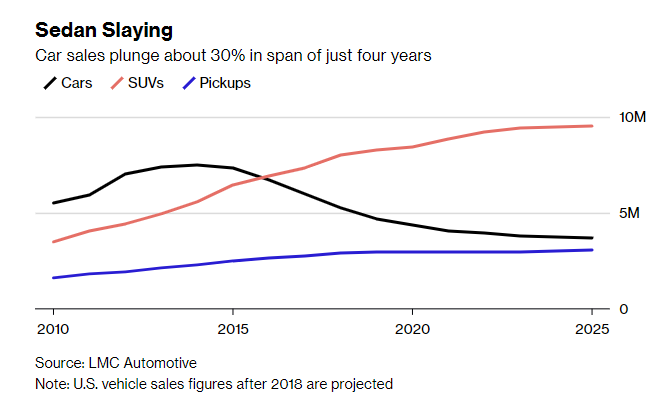
Detroit is in the grips of a car recession marked by the collapse of demand for traditional sedans, which accounted for half the market just six years ago. Buyers have made a mass exodus out of classic family cars and into sport utility vehicles. Familiar sedan models such as the Honda Accord and the Ford Fusion made up a record low 30 percent of U.S. sales in 2018, and things will only get worse.
Sales of the passenger-car body style that’s dominated the industry since the Model T will sink to 21.5 percent of the U.S. market by 2025, according to researchers at LMC Automotive, relegating sedans to fringe products. That leaves automakers with excess factory capacity that can turn out about 3 million more vehicles than buyers want. And overcapacity is precisely what spurred losses the last time a recession wracked the industry.
An optimist might seek solace in the better-than-expected profit predictionissued Friday by General Motors Co. But a deeper look at the numbers reveals that the biggest contribution to the company’s rosy forecast were cost-cutting plans—including closing five North American plants—which it said will help boost profit this year by as much as $2.5 billion.
The overcapacity plaguing U.S. automakers is the equivalent of 10 excess plants, which would account for at least 20,000 jobs directly, and thousands more as it ripples through the suppliers and support services to the massive industry. “GM has taken some actions, but they still have some well-underutilized plants,” Schuster said. “So we may not be done with this yet.”
GM Halts Sales Reporting
On April 3, 2018, GM announced it would end monthly sales reports. Its pretext was that “quarterly figures were more useful.” Yeah, right.
That was the first guaranteed clue that something was amiss.
On April 25, in its First Quarter Results, Ford announced it was giving up on cars totally, except Mustang and Focus.
Winning Ford Portfolio
- By 2020, almost 90 percent of the Ford portfolio in North America will be trucks, utilities and commercial vehicles. Given declining consumer demand and product profitability, the company will not invest in next generations of traditional Ford sedans for North America.
- Over the next few years, the Ford car portfolio in North America will transition to two vehicles – the best-selling Mustang and the all-new Focus Active crossover coming out next year. The company is also exploring new “white space” vehicle silhouettes that combine the best attributes of cars and utilities, such as higher ride height, space and versatility.
- The company’s battery electric vehicle rollout starts in 2020 with a performance utility, and it will bring 16 battery-electric vehicles to market by 2022.
Ford Sales Plunge

By the way, Focus sales fell 66% in November from a year earlier. That’s one of the two models Ford will keep. , Ford reported that its sales for December were down 9%. Ford’s fleet sales and car sales both cratered, falling well into the double digits, or -19.5% and -27.8%, respectively.
Ford Halts Monthly Reporting
In January, with December sales down 9%, Ford followed GM by halting monthly sales reports.
The message is pretty clear: When sales are bad make like an ostrich and stop reporting the numbers.It;s not just the US.
Chinese Annual Car Sales Slip for First Time in Decades
The Wall Street Journal reports Chinese Annual Car Sales Slip for First Time in Decades.
Chinese passenger-vehicle sales fell last year for the first time since 1990 as economic uncertainty weighed on consumers, producing a wreck for Ford Motor Co. , General Motors Co. and other manufacturers.
The collapse in sales looks particularly challenging for foreign makers. GM and Volkswagen AG sell more vehicles in China than anywhere else, while Ford, Peugeot SA and Hyundai Motor Co. face acute overcapacity problems.
EU New Car Registrations Drop 8%
Let’s finish our auto roundup with the EU where car sales fall for a third-straight month.
New car sales in the European Union fell in November, marking the third consecutive month of decline as demand continued to contract in most European markets.
New car registrations, a reflection of sales, fell 8.0% in the EU compared with a year earlier to 1.12 million vehicles, the European Automobile Manufacturers’ Association said Friday.
That report came out on December 14, so another bad report is due soon.
Not Just a Car Recession
- Industrial Production in Germany, France, Italy Production Collapsed Collapsed: Europe is Likely in Recession Now.
- Moreover, China Trade Data is Nail in the Coffin of Global Economy.
Let’s cut to the chase. This is not just an “Auto Recession” as Bloomberg labeled it.
The global economy is slowing immensely and a global recession is at hand. The US will not be immune.
Mike “Mish” Shedlock






























Trucks and SUVs are more cyclical than sedans. Also, negatively correlated with gas prices, although, gas prices are negatively correlated with GDP. I would expect economic weakness to result in a mix shift back towards sedans, but overall vehicle volume to decline.
So Ford will now offer only one color choice to save $50 bucks per vehicle. You can get any color you want as long as it’s white. Automobile design has changed a lot and not for the better. The last brand worthy of any respect is Jeep.
I think Tesla Model 3 sales was up. Despite everything else being down.
Might want to mention that in the article.
“Buyers have made a mass exodus out of classic family cars and into sport utility vehicles.”
As I may have posted here before, sedans have never been a good idea as the space above the trunk, behind the rear window, is wasted.
But, demand for everything is dropping, worldwide. Cheap money during the past decade, borrowed from future spending, has artifically kept demand up as populations have aged and are set to decline in many countries. Big changes are happening everywhere and bigger ones are coming.
With the ridiculously overcrowded roads and extreme difficulty finding parking, owning a car is becoming more trouble than it’s a worth. Ride sharing services and electric bikes make not owning a car a very viable option.
My electric bike is fantastic. It is like riding flat everywhere. For any trip less than 2 miles, it is just as fast as a car, especially if I go to the center of my town where parking is a headache. We have these bike cages that are always available and cost 5 cents per hour, so you can leave your helmet etc on your bike. The motor is strong enough for all the hills I have to deal with even with panniers full of groceries.
It’s very difficult to predict the product mix of vehicles without making an implicit assumption regarding the future price of gas. The predictions above seem to be based on the assumption that gas will remain in the $2/gallon range. If prices were to return to the $4-5 range, or higher, we would see a move away from SUV vehicles, and back to lower vehicles with a smaller cross section (i.e. sedans/hatchbacks) because those get better fuel mileage.
An increased move to all-electric vehicles will also most likely mean a return to sedans, for the same reason. A better aerodynamic profile means a more efficient vehicle, and a longer range.
Their is an incredibly more competition in the car space, the cheapest we have in town I believe is now the Mitsubishi, brand loyalty is no longer, which is where it might seem GM/Ford are taking a hit. Well, maybe brand loyalty with Toyota, I’ve sure got it. Whoever will continue to make a good dirt cheap point A to point B kind of car should still do well selling cars. SUV’s are just the thing now, I look out into our employee parking lot and cars are definitely diminishing. I am so fine with driving a car myself.
The other issue — you have heard this before — is that cars last a lot longer than they did in the 1950s, so to maintain a pool of them of some size you need to make rather fewer of them every year.
I desire a basic car. Back up camera is fine all the rest of the ‘driver assist’ stuff I do not want! Wish me luck on my quest!
Nissan Altima 2010 3.5 (Maxima V6 engine) era has none of the screens and extra garbage…mine is 9 years and running without issue
No kidding. All I need is A/C, ABS, USB port(s), & I’d like cooled seats with ZERO need for heated ones.
ABS is really ASB – Anti Stop Brakes. I have an old Ford Exploder that hasn’t exploded yet, so I drive that and love it… one reason, the ASb system quit working. Everything else on the car works. Have a new Grand Cherokee and hate tha damn thing for a list of reasons way too long to mention here.
Today’s car is bland, identical, and expensive. The regulation is such that it becomes very difficult to differentiate your vehicle from any other. High end sports/muscle cars are just slight variations that are designed to evoke nostalgia not attract new buyers.
With the rise of Uber and Lyft there’s even less attraction for young drivers. They’re used to waiting for a vehicle to arrive, so for them transportation as a service is already the norm. If GM follows though with their vehicle service ideas they might have a winning business plan. But if history has taught us anything, GM will find a way to screw that up too.
My Honda hatchback has 210,000 miles on it, purrs like a kitten, and has never had any kind of unexpected or expensive repair. My last car was American and started completely falling apart at 160k, not worth repairing by 180k. And that’s good for an American car. There are still differences where it counts: reliability and value. And when the next oil price shock eventually comes, US SUV manufacturers that gave up on budget conscious vehicles will be in a very bad place.
All vehicles are remarkable in their build quality and long-legeness these days. My work truck, a 2011 F-150, has 288K miles on it and has only been in the shop for brakes and a minor coolant leak a few years ago.
Honda’s cylinder deactivation scheme (only exists to meet CAFE standards on the Pilot and Ridgeline) causes a massive amount of oil consumption, and Honda doesn’t consider it a recallable issue.
When I see headlines like this, it generally signals the end of a trend. SUV’s and trucks symbolize power over the elements and risk taking, which happen at the end of bull makrets. Ford and GM are in for a world of hurt when drivers all of the sudden want sedans and coupes because they are more cost effective to own (fiscally conservative), which happens in bear markets.
Also, most of my friends and myself believe that there are three trends that make buying a new car at the moment a bad idea:
It doesn’t look like the news is going to get better. Small tax refunds this year will likely reduce the bump seen when the checks arrive.
Shifting tastes don’t necessarily equate to a recession. They do suggest a realignment. Automakers ahead of the trend, like FCA, will do very well. Automakers stuck with sedan capacity will suffer and lose share as other competitors step in with cars that people actually want to buy.
Cars have also gotten quite good and quite expensive. With a modern car with decent maintenance schedule adherence, you can keep it on the road without major problems for a decade or more — and with cars costing over $30K, I suspect lots of people will be holding on to their present ride for a lot longer than they used to.
August 1st, 2018 (but Jeep sales soar…). My wife got her new Jeep Grand Cherokee on that day, Lol. She loves it and I hate the damn thing. I’m driving her old Ford Explorer cuz I like it way better… and I used to work for FCA. The auto companies have made it this far only because of cheap money, off shore lease sales, and storms of 2017-8. Now that my wife has her new car, that she never drives.
Total vehicle builds are still down. Read Jeffrey Snider
Isn’t total number of vehicles sold the most important number? Also, if pickups and SUV’s make up more of the vehicle sales then that increases the top line tremendously over cars. If a person buys a F150 instead of a Focus that’s a 30% higher price. Sedan sales are in recession, not vehicle sales.