

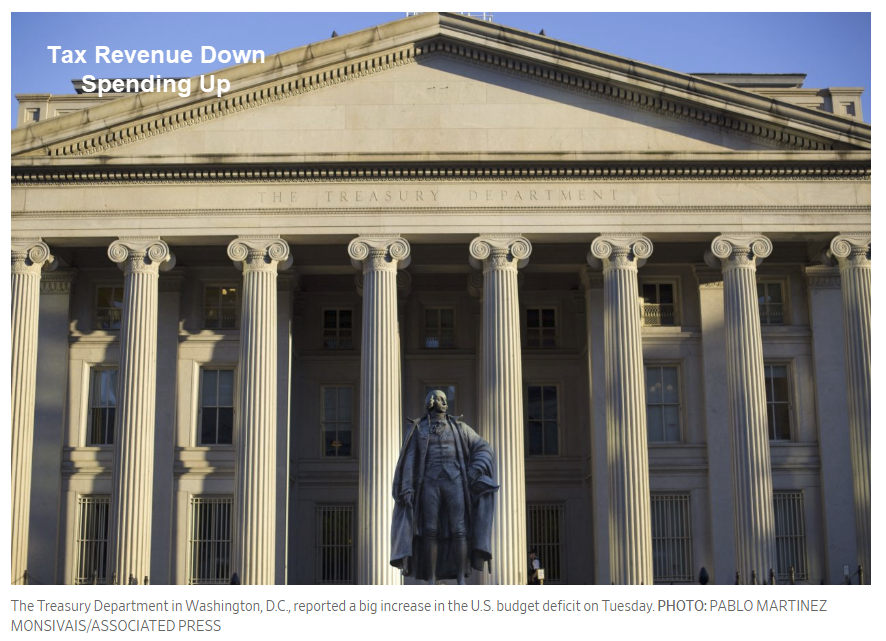
US tax revenues are down and spending is up. The net result speaks for itself: U.S. Budget Gap Widened 77% in First Four Months of Fiscal Year.
The government ran a $310 billion deficit from October through January, compared with $176 billion during the same period a year earlier, a 77% increase, the Treasury Department said Tuesday.
Federal outlays climbed $115 billion, or 9%, in the first four months of fiscal 2019, which began Oct. 1, driven by higher spending on the military, veterans’ affairs and interest on the debt. Total receipts declined $19 billion, or 2%, due to weaker corporate and individual income-tax collection.
Part of the percentage increase in the deficit was attributable to a shift in the timing of certain payments, which made the deficit appear smaller in the first four months of fiscal year 2018, the Treasury said. If not for those timing shifts, the deficit would have risen 40.2% so far this fiscal year.
On a 12-month basis, government revenues declined 1.5%, while outlays have risen 4.4%. The budget deficit rose to $913.5 billion for the 12 months ended January, or 4.4% of gross domestic product.
Comment of the Day
My award for comment of the day goes to Director Keith Hall of the nonpartisan Congressional Budget Office.
“It’s hard to imagine this is sustainable,” said Keith Hall
Indeed.
Mike “Mish” Shedlock






























If interest rates go to .0000001% then debt turns out not to grow. As R approaches 0 then interest on the debt is effectively 0. Then we find out if our owners actually want us to pay them the principle.
Part of it is rising interest rates and part is people not withholding as much, as is evidenced by their shock over having to pay more taxes this year. Not defending out of control spending, but it’s not as bad one would gather.
“It’s hard to imagine this is attainable,”
According to the US Treasury report, at http://www.treasurydirect.gov, the debt increased by $375.47 billion from 10/1/18 to 1/31/19.
And they said MMT would never work!
As a simple con, aimed at scamming economically illiterate, progressively indoctrinated halfwits, there’s no a priori reason to assume it couldn’t work…
Smoke-and-mirrors accounting… These deficit to GDP percentages are bogus becuase they exclude a bunch of stuff. The difference between the beginning and ending debt-held-by-the-public numbers across any one year span is higher than the “headline” deficit number for the same timeframe. This means that in reality we’re running more than a 4.4% deficit.
VAST majority? Numbers please. Don’t forget to exclude social security recipients who already paid into the system.
The vast majority of SS recipients are getting far more back than they paid in, even if you adjust for inflation and a decent return. We need to cut SS by 25-50% immediately to reflect reality.
If anyone “paid in” to something, there would be a pile of the money they “paid in,” sitting somewhere. There isn’t. Ergo, noone “paid in” to anything. About as elementary as logic gets, this side of a Sherlock Holmes novel.
Handing your money to a bunch of conmen, so that they can blow it on hookers, blow and self aggrandizement, does not constitute “paying in” to anything. It just constitutes handing your money to conmen. So that they can burn it. Leaving nothing.
Trickle down to the rescue. :>))
Who woulda thunk it?
Vast majority of Amerikans,now getting a check from gov’t,handout from gov’t,paycheck from gov’t,subsidy from gov’t,loan/contract from gov’t,entitlement from gov’t,retirement from gov’t well lets just say…..every GD thing from gov’t that number is chump change to whats in store.Produce nothing (less than nothing)but consume everything (on credit)……keep pretending trump!!
Well, that didn’t take long: Tesla’s Elon Musk, facing contempt charges, says semi-secret meeting was a mistake
See addendum to this
Japan has been doing it for decades. How does that work?
One way to end up with a decent amount of wealth and capital, is to start with the biggest pile the world has ever seen. Then, year by year, burn a decent chunk of it. The US has been at that game since the late 60s. Japan since the late 80s. Leaving the US still ahead in the burn-your-capital-’til-there’s-nothing-left race.
Speaking of capital destruction …
Japan’s debt is historically more focused in the domestic market. Now more so, at the BoJ.
US debt, on the other hand, is mostly in foreign hands.
Japan gets away with it (for now) for a few reasons:
I like Japan a lot as a country, but they won’t get away with printing forever.
Important differences…