

How Long Will the Coronavirus Lockdowns Go On?
Here’s the key question of the day: How Long Will the Coronavirus Lockdowns Go On?
It will soon be clear why Covid-19 can’t be allowed to rage through the country untamed. The intense restrictions—telling Americans to stay inside in New York, California and other states—are necessary.
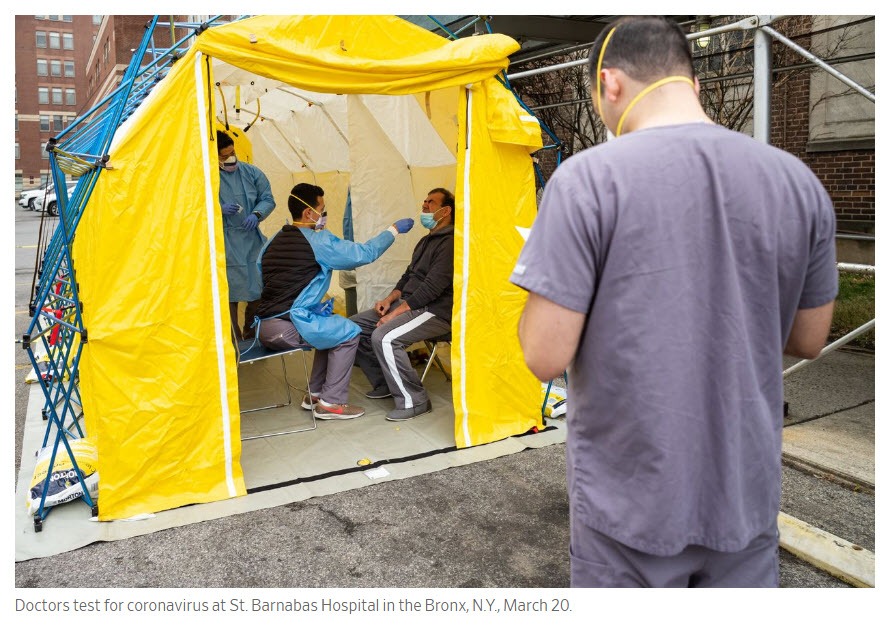
For this to work, the U.S. will need widespread testing to know where and to what extent the virus is spreading. Testing capacity has increased significantly in the past few weeks thanks to relentless efforts from public, academic and private labs such as Quest and LabCorp. Producers of testing kits are also working overtime. A new test developed by Cepheid can be deployed in a doctor’s office.
By the end of next week, the U.S. will have the capacity in place to screen more than 75,000 people a day.
Another step: serological surveillance, which means blood tests to detect antibodies developed to fight the novel coronavirus. These antibodies confer immunity and can reveal whether a person has been exposed. If a sizable portion of a local community has some protection, authorities can be more confident in relying on less invasive measures. Once deployed, serological tests are cheap, straightforward, and easy to scale.
One strategy would be to infuse convalescent plasma—antibodies from the blood of patients who have recovered from Covid-19. This could help boost the immune response in those recently infected. Arturo Casadevall of Johns Hopkins outlined such an approach in these pages last month. Another approach uses antiviral drugs to target the virus and block its replication. Pharmaceutical companies are pulling antiviral drugs off the shelf and testing them rapidly.
Perhaps the most promising option for now is antibody drugs engineered by biotech companies that target features on the virus’s surface. This strategy was used with success against Ebola. These medications can be given as a prophylaxis to prevent infection for doctors or older populations at high risk of exposure, and can also be used on infected patients. Regeneron developed one such treatment against Ebola. The company has a product in the works to target Covid-19 that could be ready as soon as this summer.
The above article was a WSJ Op-Ed written by Dr. Gottlieb, a resident fellow at the American Enterprise Institute, and a board member of health-care companies. He was commissioner of the Food and Drug Administration, 2017-19.
Two Key Fundamentals
- Population of the United States: 327 million
- Testing Capability: 75,000 Per Day
Basic Math
327 Million / (75,000 / Day) = 4,360 Days
In about 12 years, we can test everyone.
Hooray?!
How a Boy’s Blood Stopped an Outbreak
Here’s a technique that appears more promising: How a Boy’s Blood Stopped an Outbreak
It isn’t every day that a school physician’s work gets published in a medical journal. But it happened in 1934, and the story contains a lesson for the coronavirus epidemic.
A Pottstown, Pa., boy identified as C.Y. was exposed to measles. The boy was quarantined in the Hill School’s infirmary; he developed a severe case of measles but recovered. Yet he infected two other students, who exposed others.
Fearing a wider outbreak, the school doctor, J. Roswell Gallagher, took serum from C.Y. (as well as some from a public-health lab) and administered small amounts to 62 boys at risk. Serum can be extracted and prepared from a simple blood draw. Only three of the 62 boys developed measles—all mild cases. This was a remarkable victory against a highly contagious disease. The episode was important enough to warrant publication the following year in the American Journal of Public Health. (Decades later, Gallagher pioneered the field of adolescent health. He died at 92 in 1995.)
How did it work? The simple explanation is that patients who recover from an infectious disease often produce antibodies that can protect against later infections with the same microbe. This immunity can be transferred by giving serum to those at risk of infection.
In the early 20th century, physicians realized that they could prevent certain infectious diseases by taking serum from recovered patients and administering doses to those at risk of infection. This approach was used to stem outbreaks of measles, polio and mumps. Modern medicine continues to use antibodies from human serum to prevent certain infections such as rabies and hepatitis B.
If the FDA (Federal Death Agency) and CDC insist on years worth of trials, how many will die while waiting?
Mike “Mish” Shedlock






























You don’t need to test everyone in the US.
I’m not an epidemiologist or in public health, but I think the idea is you can still control it with targeted testing based on contacts, location or symptoms for highly targeted isolation.
South Korea has the most extensive testing, and they have achieved reasonable control without large-scale shutdowns of schools and businesses. As of March 8, South Korea tested about 3500 per million people, where as the US had only tested 5 per million people! Instead of highly target testing, thorough contact tracing to capture and isolate every possible case, we have relied on blind, indiscriminate mass isolation as a strategy. (Google “Business Insider Coronavirus test per capita” for the reference)
So to get to South Korea’s level in the US, you would need 3500 x 330 tests for the 330 million people in the US, or about 1.2 million tests. At 75,000 tests per day, you’d only need about 15 days. That will keep it from spreading too, but at a huge cost to our economy.
It’s a bit detailed, but this thoughtful article (especially 2nd half) lays out nicely the strategies different countries have used in each country with cost-benefit analysis, weighing society costs of life and money of each option. It also discusses a path out, or exit strategies for dealing with CoronaVirus. You can dispute the all the actual numbers, but it’s the ideas and concepts that are highly important.
The number per week is going to keep ramping up a great deal. Only testing people with symptoms an epic fail, because the disease can be asymptomatic and still carried.
Consider. 75,000 tests per day means it would take 4,466days to test everyone in America. This would be worse than useless. When they can test all 335 million of us in 3 days they will be able to isolate those infected from those uninfected, and the real problem is many infected will still show as negative till they are actually pretty sick. It will help but not alleviate the need for distancing.
WHAT IS THE RELIABILITY OF THE SWAP TEST?
What did happen to these informations given on Chinese videos by at least one Chinese doctor (one month ago approximately on ZHENG tweets) about the fact that the nose swap test gave a lot of false negative. He pretended that when using a blood test he got much more positive results.? He was treating around 40 patients with Covid-19 diagnosed as per their lungs scans (they used portable scanning machines for detection amongst other means) but only 5 were covid-19 positive with the swap test, when almost all of them were positive with the blood test.
Have they improved the sensibility of these swap tests used in Europe and US?
If the swap test is still so unreliable that is one more reason to make a severe containment besides the fact that it is as of now impossible to test the whole population as shown correctly by MISH calculations.
Furthermore, everybody refer to the improvements in China but not one Western country is able to make as severe a containment than in WUHAN as an example.
I saw the Cuban medical team ( EBOLA) disembarking to assist ITALY and I saw the Chinese team ( COVID-19) disembarking in ITALY for the same purpose. The Cuban medical team upon arrival in the airport of a country severely infected like Italy were NOT WEARING A MASK (unlike all Chinese personnel ) The Chinese will hopefully teach Italy how to contain the virus (provided they listen and act accordingly)
SWAB
“In about 12 years, we can test everyone.”
75,000/day by end of week doesn’t imply more cannot be done by the end of next week…..
At some level of testing, testing ability ceases to be the weakest link, though. Then alleviating other bottlenecks become number 1 priority.
In China they did this on a pretty large scale. They also used chloroquine and remdesiavir and a number of other things, and have published a slew of papers on clinical trials. Hard for me to grasp why everyone is talking as if we are at square one when the Chinese have pioneered all this stuff 6 weeks ago.
On the other hand: some people will need to be tested more than once, celebs maybe even weekly, pushing the numbers in the other direction.
In a perfect world, the 75,000/day test capacity is rapidly deployed where needed, used prudently, and we eliminate one of many supply/demand issues confronting our medical heroes on the front lines. It is a small victory, but a victory nonetheless.
IMO, the FDA & CDC should simply enact public testing on those that have been informed & are willing.
Times are a changing. And we must adapt. And, as always, time is of the essence.
We’ve made it through every pandemic in the past 500 years without testing a single person, and without shutting down a single economy. It’s beyond incredible how far out of hand this whole thing has gotten. The economic fallout is going to dwarf the actual disease problems by a factor of 100x, at a bare minimum!
If we didn’t test a single one, how did we know there’s such a thing called the Spanish flu? We didn’t shut down the economy back then and well tens of millions died.
Why don’t you go get the coronavirus and then later report to us how it went?
Yes, this is something we need to pay more attention to as more time passes…link below is updated daily with many highlighted links….food for thought.
“However, by now it is clear that certain regions in Northern Italy, i.e. those facing the toughest lockdown measures, are experiencing markedly increased daily mortality figures. It is also known that in the Lombardy region, 90% of test-positive deaths occur not in intensive care units, but instead mostly at home. And more than 99% have serious pre-existing health conditions.
Professor Sucharit Bhakdi has called lockdown measures „useless“, „self-destructive“ and a „collective suicide“. Thus the extremely troubling question arises as to what extent the increased mortality of these elderly, isolated, highly stressed people with multiple pre-existing health conditions may in fact be caused by the weeks-long lockdown measures still in force.
If so, it may be one of those cases where the treatment is worse than the disease”.
Really Mish, you think we need to test everyone right away? Only people showing symptoms need to be tested and few of those will be positive. Of course a week later any tested person could become infected. It is silly to suggest testing everyone every week. As long as people showing symptoms can be tested it is good, and besides the ability to test more every week should be on the increase.
Are any epidemiologists suggesting that we don’t need a lot more testing in the US?
No, but manufacturing facilities and supply lines are at their limits, so they are probably suggesting alternatives.
“Only people showing symptoms need to be tested…”
What about those with no symptoms who were in close contact with people who test positive?
You can be asymptomatic and have it and transmit it. So yes everyone needs to be tested. Also if the probability of reducing it in the general population would be better off once if everyone who doesnt get it is injected with immunoglobulins to generate antibodies.
Are lawyers pretending to be legit epidemiologists now too? I thought silicon valley tech bros had that angle covered.
The S. Koreans did not test everyone yet have the situation under control without lock downs. Look at the NY results so far – 85% that got tested are negative. And these are people who thought they had it. We are going to kill the economy out of paranoia
The more I look at the economic ramifications, the more I believe this quarantine is not about a virus. The helicopters we will be hearing will not be Helicopter ben, it will be the venture (vulture) capitalists.
Testing everyone has never been feasible in the first place. But if you test enough and do contact tracing, you don’t need all these draconian measures. The problem with the US is obviously, we did not do both. We are now doing more testing, but not doing contact tracing. If we don’t do both, we can’t build a model to determine which areas are clean vs infected. Supposedly our tech industry is so good, it already knows what you want to buy before you want to, but it’s been crickets so far.
Does South Korea have it completely under control?
They had an explosion in a small area and they did lock down that small area, but they are having new cases outside that initial explosion area. 87 new cases on Friday, 147 new cases on Saturday and 98 new cases today. Also they just hours ago shutdown all gyms, churches, clubs, etc…nationwide for 15 days. Don’t forget that they already had closed many schools.
Deaths in South Korea and Japan remain low.
I can’t help but wonder how the radiation levels from Fukushima over the past 9 years effected their immune response prior to the roll out of 5G, then Covid19?
Complex stuff…?
Japan was expecting a coronavirus explosion. Where is it?
Japan had 46 new cases today – so it isn’t a done deal that they will avoid a disaster. Especially with some Japanese insisting that the Olympics go on as planned with lots of Covid-19 carrying spectators descending on their country.
I agree, time will tell. Canada has already pulled out of the Tokyo Olympics. Excess mortality rates in Europe are still normal so far….. https://www.euromomo.eu/index.html
Wow, NY is 15% positive? Testing is still way too low, then. S. Korea is running 0.5% positive last I saw. That’s how you control it – you test so much that you catch every case, and vastly more than that.
The economy is not going to be killed. There will be some short term economic pain, but once this passes, there’s no reason the economy won’t be able to return to normal.