

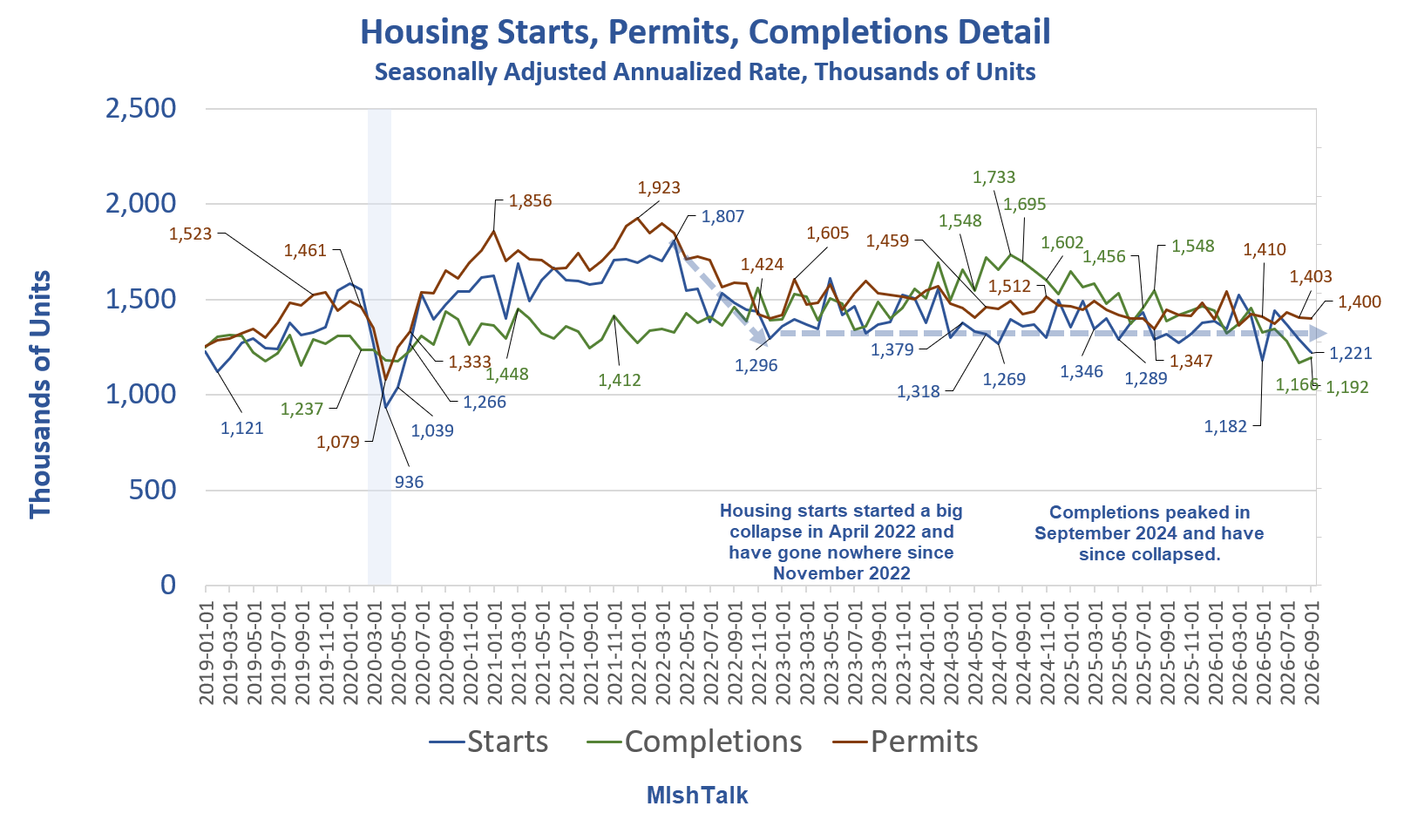
The housing trends remain flat to down: starts, permits, completions, and sales.
September 2026 New Residential Construction
The monthly New Residential Construction report for September 2026 shows a decline in starts and permits, but a rise in completions.
Housing Starts
- Privately-owned housing starts in September were at a seasonally adjusted annual rate of 1,221,000.
- This is 5.2 percent (±11.8 percent) below the revised August estimate of 1,288,000 and is 7.4 percent (±11.5 percent) below the September 2025 rate of 1,319,000.
- Single-family housing starts in September were at a rate of 859,000; this is 4.6 percent (±10.0 percent) below the revised August figure of 900,000. The September rate for units in buildings with five units or more was 349,000.
Building Permits
- Privately-owned housing units authorized by building permits in September were at a seasonally adjusted annual rate of 1,400,000.
- This is 0.2 percent below the revised August rate of 1,403,000 and is 3.0 percent below the September 2025 rate of 1,444,000.
- Single-family authorizations in September were at a rate of 845,000; this is 4.0 percent below the revised August figure of 880,000. Authorizations of units in buildings with five units or more were at a rate of 503,000 in September.
Housing Completions
- Privately-owned housing completions in September were at a seasonally adjusted annual rate of 1,192,000.
- This is 2.2 percent (±10.8 percent) above the revised August estimate of 1,166,000, but is 14.0 percent (±11.1 percent) below the September 2025 rate of 1,386,000.
- Single-family housing completions in September were at a rate of 840,000; this is 2.4 percent (±10.8 percent)below the revised August rate of 861,000. The September rate for units in buildings with five units or more was 339,000.
Note the margins of error on single-family housing starts ±11.5 percent.
Single Family vs Multi-Family

Single Family vs Multi-Family Details SA in Thousands
- Total: 1,221
- Single Family: 859
- Multi-Family: 362
Housing Permits

The Covid permit rebound was sharp, in two phases, culminating at 1.923 million in January 2021.
That was followed by a slump to 1.398 million permits in December of 2022.
Since February of 2023, it’s been a meander to nowhere.
You cannot start what isn’t permitted.
Housing Completions

The wave of completions surged 1.7 million units in August of 2024.
Conventional wisdom was the surge in completions would lead to falling home prices and a big drop in the price of rent.
Neither happened.
Prices vary greatly by region with declines in areas hugely overbuilt. However home prices are still rising nationally and the widely-expected decline in rent never happened either.
Housing Units Under Construction

Units Under Construction Details
- Total: 1,280
- Multi-Family: 693
- Single-Family: 587
Despite the big decline, there is still a large number of units under construction. But who can afford to buy?
On the surface, this will put price pressure on units as they complete. But many of these are pre-sold, I believe to buyers who will regret buying.
And people have been predicting a huge price collapse in homes and rents on the basis of completed supply. Neither happened despite the surge in completed homes.
Mortgage Rates

The average 30-year mortgage rate is 7.40 percent, up from 5.99 percent in February according to Mortgage News Daily.
Related Posts
January 30, 2026: Dear Zoomers, Trump Says He “Wants to Drive Up Housing Prices”
Somehow, I doubt Gen Z will like this message.
September 24, 2026: New Home Sales Rebound in August but Housing Remains Stagnant
Housing sales, new and existing, have been comatose for over 3 years.
October 13, 2026: Existing-Home Sales Meander Nowhere for Nearly Four Years
Since December 2022 sales have gone nowhere.


I am shocked – shocked to learn that the average person finds it difficult to afford a $393,700 (median US new home price) house.
“Rise of the Machine Economy” – The economy will increasing become “of the machines, by the machines, for the oligarchs”. Because the value of machine output is rising relative to human output, investment in machines will continue rising relative to investment in humans. That means more data centers stocked with trillions of dollars of semiconductors and less into food, housing, and medical care — especially the “middle class luxury” tier: cow herds, single-family homes, and private hospital rooms. (Welcome to steerage class.). As a % of personal income, food and housing per sqft will become more expensive (not less) as less money goes into stuff for humans and more into machines. And our oligarchic system means the K-shaped economy will bifurcate further.
And, BTW, crypto solves problems for a machine economy, not a human one. To many of us humans, it seemed pointless, because we already have electronic payments and fiat currencies backed by nothing. But crypto isn’t for us. It’s for machines that need to settle with other machines without a human in the loop.
The housing market deep freeze will continue until the covid-era price mismatch is resolved. Either through a sudden and large national wage increase, or via much more significant price cuts (I find one of these to be far more likely to happen than the other).
Its much more likely to be resolved by time.
The amount of free money that was added by the Covid giveaways ran into the trillions. It’s still sloshing around in the system. Probably won’t work its way through (ie into the hands of the ultra rich) until 2030 or so.
Essentially if prices more or less stagnate for another 4-5 years (to go with the last 2 years of stagnation) that works out to 6-7 years of stagnation and given inflation and 3% wage increases that is essentially a 20-25% price reduction via inflation.
I don’t think so because 15% of the US economy is real estate (and the knock-on industries) so while this crazy stalemate drags on and on…how do the realtors and mortgage people put food on their tables and make their own mortgage payments/rents? Even with no “actual” recession soon nor any AI burst, they’ll still predictably be the upcoming foreclosure victims that will drag prices down long before wages skyrocket.
Interest rates and house prices are inversely related.
This is why programs to “make housing affordable” (by making it easier/cheaper to get a mortgage loan) have the effect of goosing housing prices, thus making housing less affordable.
Same goes for how programs to “make college more affordable” drive up tuition costs.
The person who downvoted your comment has no idea how the world works.
BTW, this effect of making housing or college more expensive is entirely intentional.
A national homebuilder has closed on nearly 500 acres in southeastern Lakewood Ranch FL where it plans to construct 1,000 homes. PulteGroup calls the community EverCreek, which will be developed by its subsidiary Pulte Homes. Terms of the 464-acre property sale were not immediately available.
Still building like crazy in Florida. Where is everybody coming from? I think some of the major builders are going to get burned.
I know that area of the country and recently returned from there Many of the new residents are from E European countries and Russia https://www.visitsarasota.com/article/experience-north-ports-rich-eastern-european-culture
IOW “People leaving economies ruined by adjacent war.”? Is my characterization fair?
At least we won’t get nuked by Iran. /s
Hard for an entry-level or mid-level buyer to accept how much more the mortgage will cost, than recently. Savings gathered over time to get started, suddenly aren’t enough. So a hopeful buyer waits out interest rates, and/or goes back to building up the buy-in fund. I think high interest rates will be sticky, along with inflation, unless there is a big crash.
The exception now is at the high end, where cash offers are plentiful, or financing can be customized.
The graph of housing units under construction shown looks bad over the 56 years, but in reality the situation is even worse because it is critical to normalize this data for population growth, about 60% over the time span used. The absolute peak remains in the early 70s. The 2006 peak isn’t as impressive on a per capita basis, not really matching the early 70s peak despite looking like it did in the graph. And the current time point is a disaster, on a per capita basis we aren’t building anywhere near what would be expected for a period of economic growth. Mish is it possible to do a graph on a per capita basis?
The situation is nowhere near as dire as you imagine.
https://www.macrotrends.net/global-metrics/countries/usa/united-states/population
Take a look at say 1971. US population was 202 million with a growth rate of 1.29%. That’s a additional 202*.0129 or 2.6 million people.
Now look at 2025 the most recent full year. US Population was 343 million with a growth rate of 0.52% (1/2 of 1%). That’s an additional 343*.0052 or 1.78 million people.
Technically we needed more housing starts in 1971 than in 2025.
Q: what was the multiplier for avg salary to avg house cost? Ie how much of your life is tied up in it?
1971: Salary: 10k House: 25k
About 2.5 years salary.
2026: Salary: 65k. House:400k
6+ years salary
And that’s just principal.
Apples oranges
Most of the houses being built today are much bigger and have more consumer-driven amenities (like garages, basements, etc.) than they did in 1971.
So more apples-to-apples comparison than you are implying (on a square foot basis with amenities). If people want more house, they have to pay for more house; they know that going in.
very true. i’ve always enjoyed going to old parts of USA and seeing what the cost to rent a 2 bedroom house/apt in man hours of a median worker a hundred years ago versus today. you can do the same with the same 100 year old craftsman bungalow in many cities and towns. as a multiple of median hours worked. if you do it for calories expended for those hours, life is getting much easier each decade. hell our farmers and labor class are many times obese. a century ago they were lean and mean.
Cool, good comparison point to a world pre plastics, telecommunication, hell automobiles
What about to 30 years ago chief?
Compare the quality of amenities in a modern car to those of the 80’s. In the case of many car models (though not trucks) the cars cost the same today as they did in the 80’s in real terms…even thought the cheapest ones are still laden with computers, cameras and power everything. So that’s just the natural deflation of goods at work (thank competition, technology, automation, and efficiency). While yes, builders are in fact building way too many houses of the too-big variety, it’s still largely an apples-to-apples world in residential RE.
A good example of how basic cars were, is the 1991 Acura Integra, it didn’t have a single cup-holder, even though it was built by a luxury carmaker
Correct.
In 1971, the home I lived in with my parents (their starter home) was a 3/1 1200 sq ft home (built in 68) with an unfinished basement and no garage. Exactly as you describe.
They don’t build many homes like that these days.
Definitely not in cities where jobs are ffs
Then give me less house so I can afford one!!!
It’s not like these starts are going to be affordable!
Sheesh
That is another good way of analyzing the data. I would be very interested to see a graph of housing starts normalized to nominal increase in population size per year (e.g. starts per 100.000 people added) over the 56 year period. It is hard to tell from a simple raw graph of housing starts what the magnitude of the problem is. Maybe as you say, we don’t need as many starts, so it is not really a problem.
I thought this was interesting enough to run it through Gemini and generate a metric of housing under construction per person added. During the 1970–1986 era this metric hovered between 0.70 and 1.00. Post GFC,between 2008 and 2017, the ratio fell into the 0.20–0.47 range, leading directly to a national housing shortage. Post-Covid (2020-2023) the value spiked to 1.5. For the past 3 years the value has been about 0.73. So from this perspective, the amount of housing under construction is about equivalent to the long-term 1980s–1990s averages. It could be argued that there is no problem, housing under construction is about where it should be, the feeling that things are bad is mostly driven by a return to normal levels following the distortions of the post-COVID era.
I bought my first house in 1991 in Central Florida at age 29. The rule of thumb at the time was never, ever buy a house for more than 3 times the husband’s income. I made about $40k/year at the time so I figured I could do about $120k. I ended up buying a 3/2, 1500 sq ft in a decent neighborhood for $82k. About double my salary at the time.
Today, the median income for a full-time worker is $56k (I guess I was doing ok at $40k!). The house I bought back in the day is valued at $312k today, almost 6 times the median, which is probably low because it includes women folk (sorry ladies). So, yes, houses are wildly overpriced relative to income, at least in Florida. And don’t get me started on homeowner’s insurance!
I’m guessing though that housing is no longer that big an economic factor in the US. When I was young housing development was a major driver of the economy, and a slow-down meant a recession. It doesn’t appear to be that way anymore.
That 1991 rule would have to be amended today to be the household income rather than the husbands.
So if the median income is 56K a 2 person household would be 112K and your home at 312 would be within their 3x income range.
I think the cost of children (2) should be in the mix someplace. They are costly, and must be considered. I went through it, and it took a lot of work in and out of the home. Not to mention 3 jobs ongoing to break even.
Many don’t want them, so your calculations would get you approved. Just wanted to add that in.
Twice as much work for the same house! What progress! At least the kids are getting quality time from the state!!
And while we’re at it, how many working stiffs here feel confident they’ll even have their jobs in 6 years time?
Those of us not born on third base feel the pain
I just saw a video of a robot sorting packages on a conveyor line…I think for a shipper like UPS or Fedex…have to turn packages upright to read the barcode further down the line. The article also showed a robot that was on a treadmill for 9 straight days….1.2 million steps, clocked around 350 miles. I believe engineers wanted to see how the robot would hold up over an extended period of time.
pro tip. if you were born in usa in the past 90 years you were born on 3rd base, with a nice lead off the bag.
90 years ago, sure. 25 years ago? You might want to rethink the notion of American exceptionalism.
Burdensome personal/federal debts, degraded schools/hospitals, and declining international rankings for many metrics are more like leaden shoes on a baserunner.
That’s the result of women entering the workforce.
The first dual income families benefited because they were ahead of everyone else. But those dual income families also bid up the prices of everything because they had that much more money.
That meant that all families who wanted to compete that didn’t have a Doctor/Lawyer/business owner income had to have 2 working parents just to be at the same place that single working parent families were at.
The end result is that dual income families are a necessity now. The greatest trick the government ever pulled was getting women into the workforce so that they could tax child care (day care) and housework (cleaning services, eating out etc).
Bull, that’s the result of capital eating labors lunch