

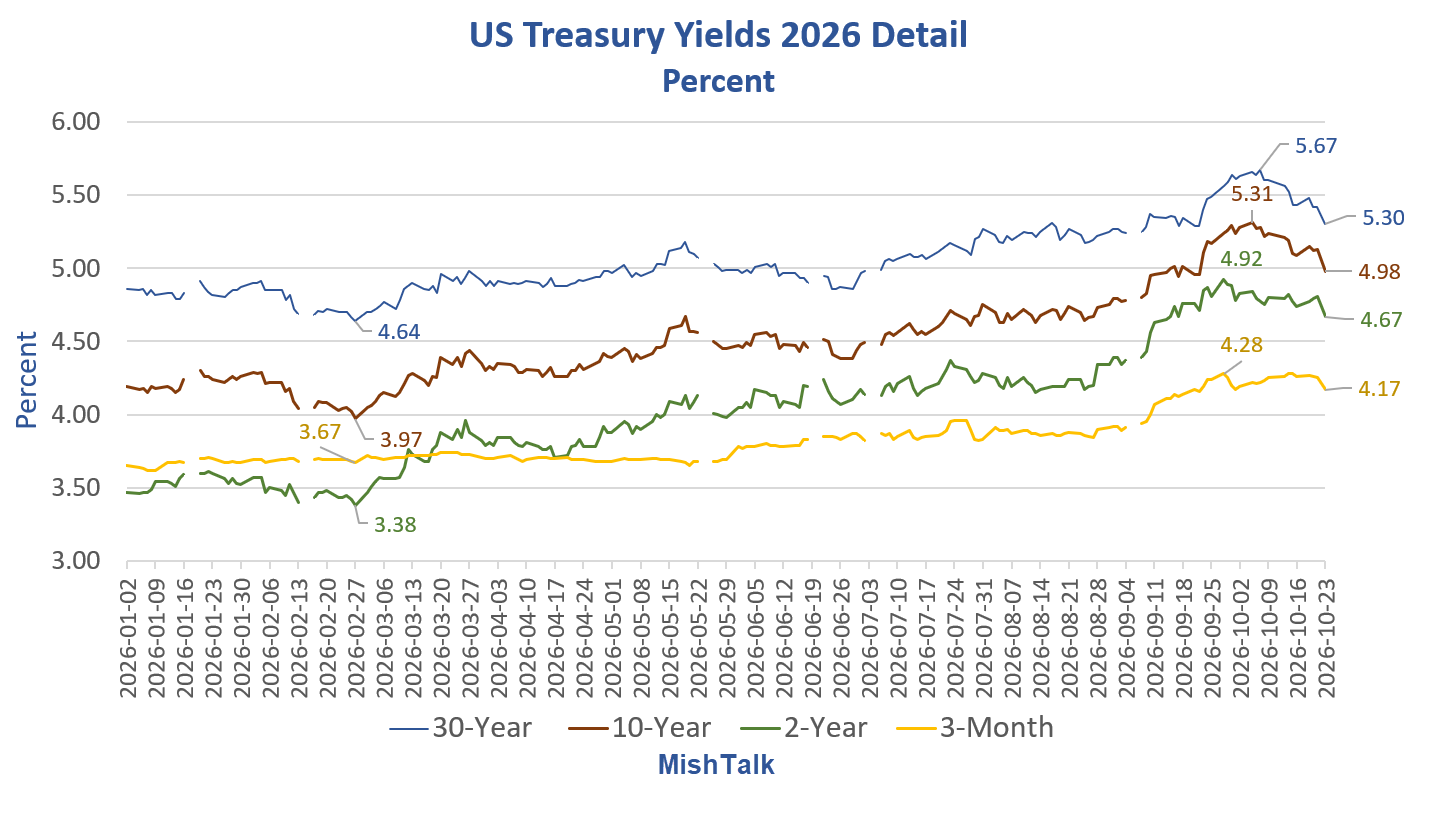
It’s not sinking inflation or falling oil. So what is it?
Yield Synopsis
- 30-Year: 5.30 percent down from 5.67 percent on October 7
- 10-Year: 4.89 percent down from 5.31 percent on October 5
- 2-Year: 4.67 percent down from 4.92 percent on September 28
- 3-Month: 4.17 percent down from 4.28 percent on October 15
The Fed
- The Fed meets on October 28 with little chance of a hike
- The Fed meets next on December 9 with a 75 percent chance of one quarte-point hike and an additional 7.5 percent chance that the Fed hikes by a half point.
That’s almost no change from a week ago, so this does not seem to be the catalyst.
Not Falling Inflation
Inflation has been hot. The CPI, PCE, and PPI have all been above consensus estimates.
The Cleveland Fed inflation Nowcast is for another hot PCE report month-over-over month of 0.47 percent for September with year-over-year PCE of 3.72 percent for October.
Something Consequential
I don’t buy the recession theory yet. I do believe an AI-related credit bust is coming.
AI Bust
Corporate Credit Spreads
Nick Timiraos WSJ Columnist
Tech Jitters
Darker Side of the AI Boom
AI Default Risk

Please consider Falling Treasury yields may be hiding a darker story about the AI boom
Let’s take a step back and check on the key market drivers this week. The US-Iran conflict is still raging on and geopolitical tensions remain high. So, that is underpinning oil prices once again with WTI crude breaching $100 and Brent crude hitting $114 – its highest since May.
Now, that sounds like a familiar backdrop for the bond market, doesn’t it? Higher oil prices mean stronger inflation pressures, which should normally push up Treasury yields. Well, that has not been the case this week.
Instead, Treasury yields have fallen sharply, with 10-year yields even slipping back below the 5% threshold in overnight trading and holding thereabouts since. But wait a second, shouldn’t falling yields then buy some relief for stocks?
You would certainly think so, especially when surging Treasury yields have been such a major bane for equities over the past two months. And yet stocks have been battered this week, with AI names in particular bearing the brunt of the pain. So, what gives?
It’s one thing to suggest that investors are perhaps starting to worry about growth conditions again. But considering how long that narrative has been brushed aside and the extent of the damage we are seeing in AI stocks, I think there is perhaps a rather different problem brewing beneath the surface.
Let’s jump straight into it and start with CoreWeave, shall we?
That’s not the most familiar name in the AI space. However, CoreWeave might well have been the stone that started an avalanche of worries about debt financing in the entire sector.
Just take a look at the chart [above], which shows how the cost of insuring against defaults among major AI-related companies has surged over the past year i.e. change in CDS spreads.
CoreWeave stands out like a sore thumb, with its CDS spread widening by more than 500 basis points over the observed period.
And while CoreWeave is clearly the standout, the chart also shows that the worries aren’t confined to just one company. Oracle’s five-year CDS has climbed towards 300 bps, while Meta and Nvidia have seen theirs approach 100 bps.
In the case of Oracle, it is being traded like junk credit due to aggressive debt-fueled infrastructure loans. Meanwhile, the five-year CDS level for Meta is near its historic peak so that helps to put things into better perspective. Having said that, I wouldn’t put all these companies in the same risk category. Meta and Nvidia clearly have much stronger financial positions and liquidity than CoreWeave for example.
However, it is clear that investors are beginning to question something bigger. And that brings us back to the same question we’ve been asking all year, that is who is going to pay for the enormous AI infrastructure boom, and how long before those investments generate sufficient returns?
CoreWeave relies heavily on debt to finance data centres and computing infrastructure. Meanwhile, Oracle is also committing massive sums to AI expansion and Meta is also pouring billions into infrastructure. As for Nvidia, their fortunes are very much closely tied to that spending cycle.
The major concern here is that if financing becomes more expensive or AI investment slows, the consequences could spread across companies that depend on one another for revenues, financing and growth.
Does anyone believe profit will support the money being spent, most with circular financing?
AI Race Puts $3.5 Trillion at Write-Down Risk
Bloomberg reports AI Race Puts $3.5 Trillion at Write-Down Risk, Gartner Warns
On October 18, 2026 I noted Data Centers Need $8.5 Trillion in Revenue Through 2030 to Cover Spending
How likely is that?
The AI Bubble Will Burst
But what inning is this? 7th, 8th, or 9th?
If you prefer to think in years, is it more like 1997 or March of 2000?
This is a theme I have been discussing for a long time.
Related Posts
April 30, 2026: AI Provided Nearly All the GDP Growth in the First Quarter
Let’s go over the AI-GDP math to see how I arrive at the numbers.
July 24, 2026: How Much Has Big Tech Overspent in AI Buildout?
Some ask whether or not big tech overspent. I ask by how much.
July 31, 2026: How Much Did AI Spending Contribute to Second-Quarter 2026 GDP?
Five charts show the AI impact for every quarter starting 2025 Q1.


Excellent Post here! Spot on, no politics just good info. Reminds me of old times. Have a great day!
Given current levels of debt (on the books, plus future obligations), I feel it’s obligatory to double quote words like “safe” and “quality”.
Big panic a few weeks ago when we hit the $40T debt level now we are at $40.4T as the pigs in power continue to feed at the trough. We will be bumping up against the debt ceiling likely before next summer. The knives will be out this go round. Trump might get defunded and his precious ballroom leased out for a McDonalds.
Ai made the mistake of suggesting it can be used everywhere by everyone. It can’t. People don’t trust it anymore.
The Sony PlayStation has been reversed engineered so that you can play any game from the PS5 archive on a computer for free thanks to AI reverse engineering the entire library.
Banks are now reporting AI conducting business on their own. Don’t know for what ends, it’s vague.
The infrastructure is quite unsustainable. People are figuring that out. City councils who push data centers through are finding they now have to flee.
Maybe it’s isolated but I don’t think it is any more than housing was isolated in 2008. We just don’t know by how much.
And the best part, no matter how badly AI collapses the orange Jesus will do everything to bail it out at the expense of the country. Inflation will be here for another decade at least.
Why can’t we just say “the Government will do evertyhing to bail out”….Silicon Valley Bank was mentioned in the article, happened in 2023. The Great Financial Crisis was alluded to in the article, happened in 2009. 2000/1 was mentioned in the article. Democrat, Democrat, Republican. Right when I see “Orange Jesus” I just shake my head. I comment all the time I’m okay with a bustup but I’m confident most here would be looking for, in your terms, Orange Jesus to do whatever to hold up their assets and prevent contagion–because as you indicated, it’s NOT isolated. Just as we saw in the Biden Administration, Obama Administration, Bush Administration, Clinton Administration. The assault on the US Taxpayer and the outright theft of the US Treasury has been ongoing. Sadly it looks like end of Empire type stuff. Fiat does that like middle school popcorn seed poker games. Creates such massive dislocation and misallocation of “capital”, where capital was put in double quotes for ya.
I was just happy to see an economic post as I was wondering what may have caused the huge collapse in yields. The dramatic rise in yields followed by the rapid fall are great topics for an economic blog as that was a large and timely round-trip in a short time. Now, which direction will it go next?
Our township, for the first time ever, was forced to take on debt to finish an expensive emergent infrastructure issue. I consider it a sign of the last domino to fall.