

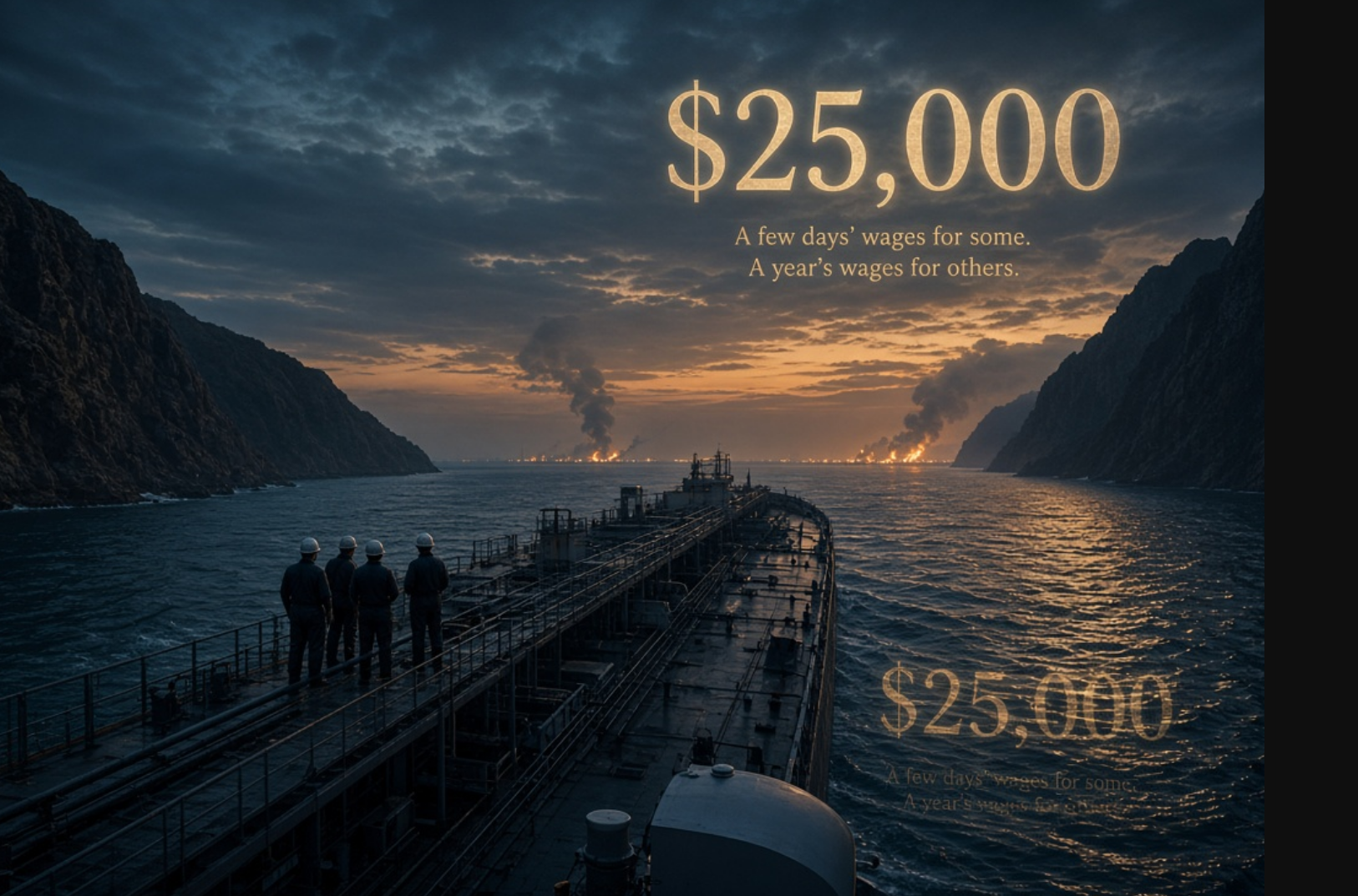
That’s more than a year’s pay for a round trip that takes under a week.
$25,000 Per Round Trip Is the New Going Rate
The Wall Street Journal reports Sailors Get Up to $25,000 a Trip to Sneak Oil Out of the Gulf.
Oil is pouring out of the Persian Gulf at the fastest rate since the start of the Iran war, even as a recent uptick in attacks threatens the flow. The cost of getting it out is eye-watering: up to $40 million for a multiday trip.
For Gulf oil producers, it is worth it. Leaving the oil stranded is still economically worse than taking on the freight cost and selling oil at thinner margins.
So producers inside the Gulf have turned to hiring very large crude carriers, known as VLCCs, to complete a perilous journey known as a “shuttle run.” Carriers enter the Persian Gulf via the Strait of Hormuz, load at ports there, exit from the strait, then transfer the oil to another vessel waiting just outside of the waterway.
These are the new economics of the strait, where a wartime gold rush has pushed producers to swallow record freight costs just to keep crude moving; shipowners are reaping some of the best returns the industry has seen in decades; and the sailors who make the dangerous crossing are being paid like never before.
Shuttle runs weren’t necessary before the war. But when Tehran started hitting commercial vessels in the strait, buyers in Asia and elsewhere became reluctant to send their own ships to pick up oil from inside the Gulf. Now oil producers are shelling out between $30 million and $40 million for a round trip in and out of Hormuz—or $15 to $20 a barrel excluding insurance, according to shipbrokers.
“For many shipowners, the current market is generating revenues at levels rarely seen in the industry’s recent history,” said Dimitris Maniatis, founder and chief executive of maritime-risk company Marisks.
Ferrying oil directly from the Persian Gulf to global markets is also more expensive than ever, contributing to the appeal of shuttle runs. The cost of hiring an oil supertanker to sail from the Persian Gulf to China topped $1.2 million a day in late September. On the eve of the war, that cost was about $231,400 a day, according to maritime data provider Clarksons Research. In early January, it cost less than $40,000 a day.
The shuttle-run bonanza is trickling down to individual sailors. Those willing to perform the war-zone trips—many from India, the Philippines and China—are being lured with payouts worth two or three times their typical monthly salary. One Shandong-based ship-staffing company is even offering as much as $25,000 for a round trip as reward, according to seafarers and recruitment advertisements seen by The Wall Street Journal.
“Given the millions being made at the moment, that’s absolutely nothing to the shipowners,” said Richard Matthews, director of consulting and research at shipbroker E.A. Gibson.
Dangerous journey
Two seafarers on two different VLCCs shared their recent experience with the Journal. One of them, the first mate on a shuttle tanker, said he had been in and out of Hormuz twice in the past month. Both trips were at night—with the windows shut and lights turned off.
During each transit, his vessel lost GPS signal for hours and navigated using old-school methods such as using radar signals to calculate the angle and distance relative to islands and headlands to determine the vessel’s position.
He said half of the crew quit after completing just one round trip, but the ship management company had no problem replacing them after promising extra pay. He was paid three times his monthly salary for the days transiting in the conflict zone, he said.
How Big Is the Risk?
The International Maritime Organization’s tally as of 5 October 2026 is 91 confirmed incidents in and around the Strait of Hormuz and the wider Middle East since the war started on 28 February, with 24 seafarers killed. That is roughly one confirmed incident every two to three days over seven months, though the hits come in clusters rather than evenly.
UK maritime authorities logged another string of tanker strikes on 2–4 October, and the Wall Street Journal noted seven ships hit since 28 September after a quieter stretch.
The Joint Maritime Information Center still rates the threat as severe and deliberate attack as highly likely. Most of those incidents damage the ship and do not kill anyone. Fatalities are the tail: on the order of one death for every few hits, not every transit.
Pre-war traffic was about 138 ships a day. Wartime transits are far lower — on the order of 1,500 or so commercial passages over long stretches of the conflict, many of them U.S.-facilitated — so a crude incidents-per-transit figure is a few percent, not a coin flip.
Dark shuttle tankers doing the in-and-out Gulf runs are the ones owners are paying up for, and they are a subset of that traffic, so their hit rate is higher than the average transit.
War-risk insurance has also been quoted as high as about 10% of hull value for a Hormuz transit, which is the market’s way of saying the loss risk is real even if any single sailor almost always comes back.
How Big Is the Reward?
Owners are clearing millions on freight that has run past $1 million a day, so the crew bonus is cheap next to the charter.
For a junior rating or cadet earning around $1,500 a month, $25,000 for a few days is more than a year of normal wages, in a week or less.
Related Posts
October 1, 2026: The War in Iran Is the Biggest Self-Inflicted Political Mistake in Decades
Iran is one of the least popular wars in history.
October 4, 2026: Governor Abbott Declares Texas Disaster Allows “Red Diesel”. Will It Help?
Abbot’s declaration expands the use of dyed diesel on Texas roads.






























One thing is for certain. Iran no longer controls the strait completely.
A shitload of oil is getting out and oil companies will do anything to support Trump.
Follow the Monet!
Hi Mish,
A long time lurker and prior subscriber, just renewed after worrying a little bit like some folks where you did your “Did Mish change…” post.
Anyway, just food for thought on resource input, do you also follow sites like gcaptain.com when you segue your research into maritime areas?
Cheers,- MikeD
Long ago I followed Naked Capitalism.
Not anymore, for no particular reason.
I see a wide variety of sides.
I subscribe to WSJ, NYT, WAPO, Bloomberg, Project Syndicate, CATO, and I an very active on X where I see all kinds of stuff
So, Left, Right, and Libertarian
I avoid ideology, as it short-circuits critical thinking.
Watch out for “as much as”. Those are words that often hide a lot of breathless BS.
“So producers inside the Gulf have turned to hiring very large crude carriers, known as VLCCs, to complete a perilous journey known as a “shuttle run.” Carriers enter the Persian Gulf via the Strait of Hormuz, load at ports there, exit from the strait, then transfer the oil to another vessel waiting just outside of the waterway.”
Is this sentence generated by AI, because it doesn’t make sense?
VLCC wait outside Hormuz, small vessels shuttle the oil to them whereas it sounds like the opposite.
Some serious money to be made there now if rates are 25K for a few days work. Even if it’s 10-15 per trip one could earn enough in a month to put down a big down payment on a house.
Yes, there are risks. But the deaths compared to the number of sailors who have made trips since the start of the war is very low percentage. Remember Uber Eats, Grub Hub, Door Dash drivers regularly deliver in the hood and probably face the same chance of being killed for $15 bucks an hour.
Start a reality TV show, and get a complete feel for our times. Cut to the anxious wives and hungry kids. “You’re fired upon!” could be the catch phrase.
This sounds like one of yippee’s stories, about money to be made at the end of an empire.
Are Yippee and ALX the same dude?
I would be interested to know how much distillate (diesel, gasoline, aviation fuel) is getting out or if this is just crude. I have read that the VLCCs being used for the shuttle runs are older and dirtier, so not really appropriate to transport distillates. $20 a barrel shipping also may explain a lot of the difference between “paper” oil prices and “real world” prices.
Translation: to the Epstein Club a human life is worth $25000.
Well there you go, a way to beat inflation brought to you by Trump & Co.
And the kicker here is we all know Trump will screw things up even more.
Do worry, Trump, Walrus, GOP, and democrats will find a way to make things even worse.™
Is anyone profiting from these day rates? Where’s PapaDave? I wonder if oil rig rates are climbing, CNBC’s Farmer Jim is always recommending Transocean (RIG).
Everyone in the oil industry is gushing profits right now.
My companies stock has almost tripled since the start of 2026 and we are just in oil and gas services (ie supplying equipment to the drilling companies both on and offshore).
10% of my net worth is in XOM, has been since 2019.
Kinda a roller-coaster ride, but I’m happy at the moment.
If I was on that ship (and I spent 2.5 .months working on a fishing vessel) I’d be hugging the Oman side of the ship on each passage thru the Strait.
$25K for a week would seem pretty worth it to me, but I’d probably sleep with my life vest on – if I slept at all!