

I Hear the Train a Comin’
Covid19 will take all of the blame, but freight indicators show a recession was on the way even without that massive economic disruption.

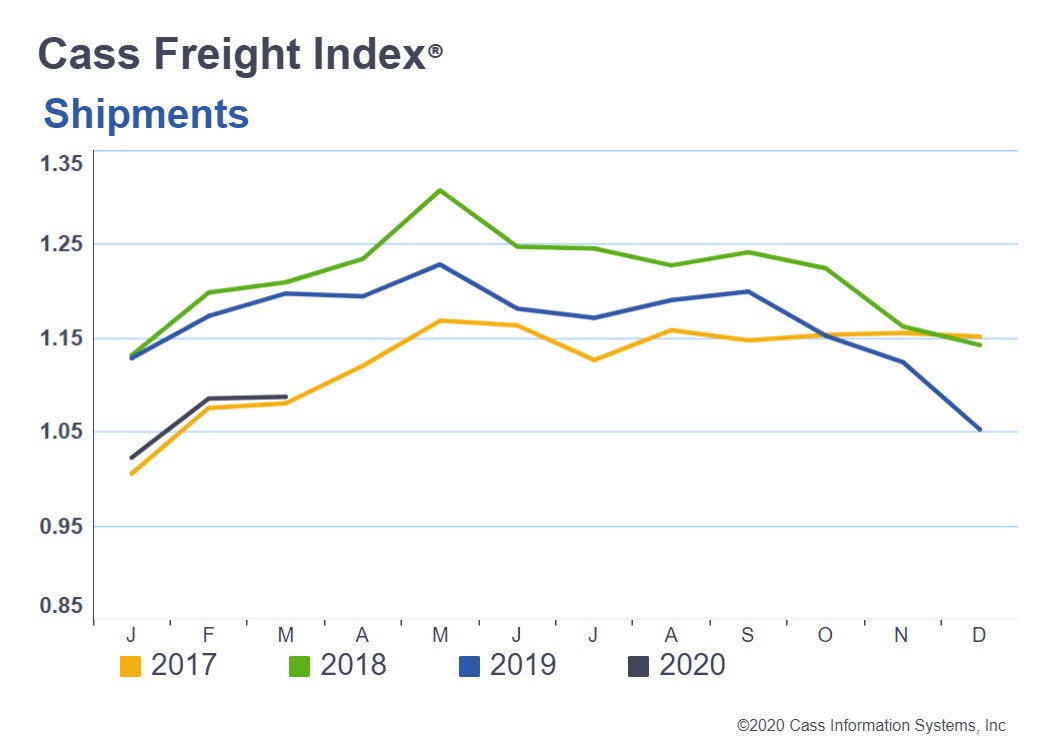
Please consider the March 2020 Cass Freight Indexes.
The Cass Freight Index showed a weak U.S. freight market to end 2019 and to start 2020, and just as we were seeing signs of coming off the bottom, we get the coronavirus and all related smacks to an economy that was already struggling to gain traction.
This has quickly gone from a China production concern to a U.S. (and global) consumer spending problem. No business, no jobs, and no income for many leads to much less freight moving around.
US Rail Volume Comps – Cass March 2020

Truckload linehaul rates – Cass March 2020

This index turned lower in mid-2019.
Cass Truckload linehaul Index – March 2020

Intermodal Volumes Cass – March 2020

Cass Conclusion
All historical truckload and intermodal data was restated in November 2019, with an extremely high correlation to the previous data.
We hope the Cass Indexes bottom in April, and the quicker businesses can reopen, the better readings we should see in May and June.
Unrealistic Hope
There is no harm to hope, but expecting a quick, sustained recovery is another matter.
Ever since Cass outsourced production of this report to Stifel, the Csss report been one of rampant overoptimism.
The original writers (named Cass) were sounding recession signals whereas Stifel writer David G. Ross, spoke of signs of a freight bottom for the last few months.
We can never prove which view is correct, but seeing signs of a bottom in a recovery that was already the longest in history seems more than a bit questionable.
Realistically, we should now toss ideas of a bottom in April and face the fact the Covid-19 Recession Will Be Deeper Than the Great Financial Crisis.
Don’t expect a V-shaped recovery.
Mike “Mish” Shedlock






























This year was finally about to crack the everything bubble…and then the virus hit. The central banking cabal have an escape route for now, i.e. blame the virus.
t is a slow day in the small Saskatchewan town of Pumphandle, and streets are deserted. Times are tough, everybody is in debt, and everybody is living on credit.
A tourist visiting the area drives through town, stops at the motel, and lays a $100 bill on the desk saying he wants to inspect the rooms upstairs to pick one for the night. As soon as he walks upstairs, the motel owner grabs the bill and runs next door to pay his debt to the butcher.
The butcher takes the $100 and runs down the street to retire his debt to the pig farmer.
The pig farmer takes the $100 and heads off to pay his bill to his supplier, the Co-op.
The guy at the Co-op takes the $100 and runs to pay his debt to the local prostitute, who has also been facing hard times and has had to offer her “services” on credit.
The hooker rushes to the hotel and pays off her room bill with the hotel owner.
The hotel proprietor then places the $100 back on the counter so the traveler will not suspect anything.
At that moment the traveler comes down the stairs, states that the rooms are not satisfactory, picks up the $100 bill and leaves. No one produced anything. No one earned anything…
However, the whole town is now out of debt and now looks to the future with a lot more optimism.
And that, ladies and gentlemen, is how a Stimulus package works.
What tourist??
Nobody in that town was in debt to begin with. They all had a $0 balance sheet according to your story. They were all owed $100 from someone and owed $100 to someone else, therefore were not in debt. The point of stimulus is to stimulate the economy and make work (service or production of goods happen). No stimulation happened here because no work was done. In addition, the motel owner stole the $100 from the tourist. He had no way of knowing he would get the $100 back before the tourist returned to the front desk. That’s called stealing. Which, I guess, is the way stimulus works in the country anyway. Steal the money from the citizens without asking and on credit for future work to be done and give it to other people.
Hooker in a small Saskatchewan town? Ha, try harder. 🙂
“We hope the Cass Indexes bottom in April, and the quicker businesses can reopen, the better readings we should see in May and June.”
…
Yes, by all means businesses will reopen like a light switch.
Never mind the 20 million or so lost jobs, destroyed supply chains, leverage to the hilt biz paying bills for a month … or two … on non existent revenue, consumers attitudes going forward, etc.
Fast forward to June / July everything will be back to normal …
“The Cass Freight Index showed a weak U.S. freight market to end 2019 and to start 2020”
…
January and February helped by mild weather.
Mish – you mean no V shaped recovery in the economy.. Stock market is a different story since that seems to be driven mainly by what the FED does.. Economy can be in a depression yet the stock market would be hitting all time highs. No?
What happens when the companies that form the stock market are out of business because of the economy?
Wait for Earnings report and watch the indexes!
Any connection of equity prices to earnings is approaching zero, so all time highs wouldn’t be a surprise (though it would be a shock). The stock market is going to be nothing but a casino for a looong time — just day traders trying to screw each other, day after day.
The stock market is just The Fed’s most public welfare agency. It’s one of the main mechanisms by which they redistribute wealth, from those who produce it, to their favorite incompetents. It has no more, nor less, relation to “the economy” than any other welfare agency. Like the rest of them, it does tend to dole out more money when “the economy” is proclaimed to be doing poorly, so I suppose there is some connection.
Yeh. My educated guess is that there would have to be another 50 million unemployed for the stock market to fully recover. Sorry, can we still call it a “market”, or should we have a better name?