

If you want to pay more and get less, it’s a great idea. 
Chinese Cars Have Arrived in Small Numbers
The Wall street Journal reports The U.S. Wants to Ban China’s High-Tech Cars, but They’re Already Here in El Paso
Just 5 miles from the U.S. border, a bustling commercial strip here offers the buzzy Chinese car brands currently blocked from the American market.
A Geely dealership features the all-electric EX2, a sleek compact that starts at only around $20,000. A bulky hybrid pickup truck sits next to a charger outside a BYD dealership. Great Wall Motors boasts some beefy gas-powered sport-utility vehicles, one advertised with the slogan “Be More Tank.”
Luis Hernandez, a Geely salesman, said he has poached many longtime Ford and Chevrolet owners attracted to the affordable sticker prices and whiz-bang Chinese technology. He recently sold two Geely Emgrand sedans, which start at around $17,000, to a Mexican family for their two daughters to commute to college in El Paso, where the sleekest Chinese cars are now attracting attention.
“If they were allowed to be sold in the United States,” Hernandez boasted of the Chinese models, “they would destroy the American car market.”
“I’m telling you, it is very difficult—not to say impossible—to compete,” said Hyundai Motor Chief Executive José Muñoz. “We cannot compete at the same price as the Chinese in the market where we operate. Otherwise, we will be losing money.”
So far, the many Chinese car companies that want to expand into the U.S. have been kept at bay. The U.S. has applied sky-high tariffs to vehicles imported from China, and regulations make it nearly impossible for such vehicles purchased in Mexico to be registered in the U.S. A trio of senators has urged the Trump administration this month to ban Chinese vehicles sold and registered in Mexico and Canada from entering the country; several dozen House lawmakers sent a similar letter this week. A Senate bill to prohibit China’s carmakers from building cars in the U.S. is being crafted.
BYD, Geely and Great Wall Motors are now among the biggest carmakers in the world. They have been gobbling up market share in Europe and other parts of Asia. In Mexico, Chinese vehicles account for a quarter of total sales. Soon, Canada will allow tens of thousands of inexpensive Chinese EVs to be imported.
Sen. Bernie Moreno (R., Ohio) said the bill he plans to introduce would “hermetically seal” the U.S. from Chinese automakers. Chinese cars from Canada or Mexico couldn’t be driven into the country. American car companies couldn’t pursue joint-ventures with Chinese automakers. Chinese car companies that own U.S. brands, such as Geely-controlled Volvo and Polestar, would have to divest themselves of those brands by 2030.
At Geely’s dealership, Hernandez, the salesman, said the store’s top seller is the entry-level, gas-powered Emgrand, which would compete in America against compact cars such as the Nissan Sentra or Hyundai Elantra.
Hernandez said he was in the process of selling one to a Mexican local who works as a lifeguard in El Paso. “People come, they see the difference, and they’re impressed,” he said.
That is exactly what U.S. car executives are preparing for.
“The Chinese are going to find a way to get to the U.S. market,” said Nissan Americas Chairman Meunier. “It will happen.”
Edmonds Review
Please consider Tested: The Geely Galaxy M9 Proves Chinese Cars Could Be Seriously Competitive in America
- The Geely Galaxy M9 is a three-row SUV made in China and sold outside the U.S.
- This extended-range plug-in hybrid offers a Geely-estimated 800-plus-mile range, blending the best of gas and electric power.
- The Galaxy M9 starts around the equivalent of $25,000, but it would theoretically compete with vehicles costing twice as much, like a fully loaded Hyundai Palisade, Kia Telluride or Toyota Grand Highlander.
- In track and on-road testing, this three-row SUV exceeded almost all of our expectations. Chinese cars are ready for prime time in America.
Geely Galaxy M9: What is it?
Geely is one of the world’s largest automakers, selling millions of cars each year in markets all over the globe. Within the company’s portfolio are a few brands you recognize, like Volvo, Polestar and Lotus, along with a few you probably don’t, like Lynk & Co. and Zeekr.
The Galaxy M9 is Geely’s new flagship, a three-row SUV similar in size to a Kia Telluride. It runs on both gas and electricity, and in this highest-performance all-wheel-drive Pilot trim, makes 858 horsepower and 859 lb-ft of torque. It also offers a Geely-estimated 808 miles of driving range — 130 of which are purely electric. In China, Geely’s home market, the Galaxy M9 starts around $25,000 when converted to U.S. currency. And while that obviously doesn’t translate to a theoretical American price tag, even at $50,000 or $60,000, the M9 would hold its own against a fully loaded Hyundai Palisade or Kia Telluride.
The Galaxy M9 can offer solid range thanks to its large 41-kWh battery pack — that’s bigger than what’s used in most other plug-in hybrids — and a turbocharged 1.5-liter four-cylinder engine. The gas engine can act as a generator to charge up the battery when it’s dead or power the wheels directly, if some extra oomph is needed.
Track tested
On our scales, the Galaxy M9 weighs in at 5,771 pounds with a full tank of fuel. That’s a bit heavier than a BMW X5 plug-in (5,627 pounds) but a bit less than a fully electric Kia EV9 (5,838 pounds).
On our acceleration straight, the M9 hits 60 mph in 4.2 seconds; Geely estimates a 0-to-62-mph time of 4.5. The M9 completes the quarter mile in 12.9 seconds at 98.6 mph. That puts it in great company with the BMW X5 plug-in (4.6 seconds to 60 mph; 12.8 seconds in the quarter mile at 107.4 mph). A three-row luxury SUV like the Lexus TX 550h plug-in is left in the dust by comparison, needing 5.6 seconds to hit 60 mph and 14 seconds in the quarter mile.
One of the M9’s best showings is in our 60-to-0-mph emergency braking test. It takes just 110 feet to come to a stop — that matches a BMW X5 M, a bona fide performance SUV. Another notable number for the M9 comes in our sound test, which measures how quiet (or not) a car is at idle and on the move. The M9 registers 32.5 decibels at idle, a figure that even whomps the Rolls-Royce Spectre. Clearly, Geely isn’t messing around when it comes to luxury.
The M9’s only non-superlative showing happens on our 200-foot skidpad, where it achieves 0.86 g of lateral grip. While that’s not poor, it’s worse than the EV9’s 0.91 g and the X5 PHEV’s 0.89 g. When pushed hard around a corner, the M9 is a step behind the competition.
How about electric range?
Geely’s advertised 130 miles of all-electric range is huge — it bests any other plug-in hybrid on sale right now. That warrants a loop on the Edmunds EV Range Test, where we aim for a 40-mph average speed and 40/60 split between highway and city driving. Unfortunately, at the end of our test, our testing equipment showed 101 miles traveled, which is less than expected but still very notable for a plug-in hybrid. That’s plenty of electric range to handle multiple daily commutes.
And commuting is where this SUV excels. The Geely is well-suited to easygoing driving, whether in the city or on the highway. Its suspension is super softly sprung, which is kind of a double-edged sword. On one hand, the M9 does a remarkable job of defeating potholes and subpar pavement. But it also means this SUV moves around too much while driving, like the car is unsettled.
The rest of the driving experience is lovely. When the M9’s engine does kick on, it does so quietly and without interruption. There’s always more than enough power to get the M9 up and moving in a hurry. And regenerative braking can bring the car down to a stop smoothly without the need to touch the brake pedal.
All the tech and then some
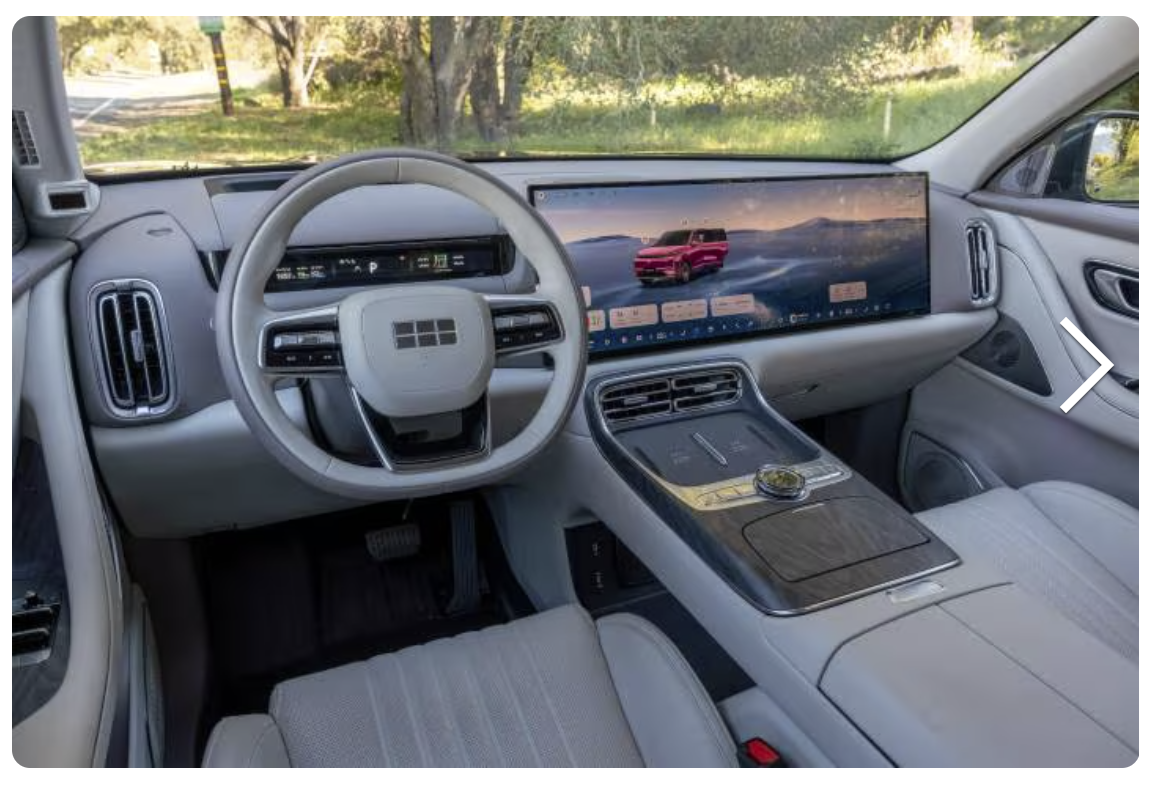
When you first open the door, it is impossible to notice anything other than the 30-inch screen. This display offers 6K resolution and has iPhone-like responses. Tesla and Rivian are among the best in terms of infotainment responsiveness, and this Geely is right up there with them.
Because this M9 is a Chinese-market vehicle, some of its functions — like navigation and web browsing — are not available for testing in the U.S. But there are still a lot of cool features. For example, the car has an exterior-mounted speaker that can play songs or, um, whistle at pedestrians. More interesting is the flip-down entertainment screen in the second row that has the same excellent resolution as the one up front and offers content streaming and games. There are also USB-C ports for every passenger to keep their devices charged.
So, what’s the verdict?
Could the Geely Galaxy M9 work in the U.S.? Yes, absolutely. This could be an incredibly competitive SUV in a class full of strong contenders. The generous electric range is a great feature to have, and the ability to travel hundreds of miles with a gas extender is a feature that would put many EV skeptics at ease.
Global market and political factors continue to muddy the waters for Chinese brands entering the U.S., but the door is neither completely open or closed. If Geely can pull it off, the Galaxy M9 has a big chance of finding success here.
Want a Great Commuter Car for $25,000?
Would you want one of these for $25,000? How about $35,000? That would be a 40 percent tariff.
Trump said China could sell cars here if it built them here. But Congress wants to stop that too.
How Might China Respond?
Congressional and administrative nitwits never address such questions.
This is how the war in Iran started.
What if China passed a law in response banning US car production in China?
This is the big vulnerability. U.S. firms have massive exposure:
- Tesla: Giga Shanghai produces ~40-50% of global output (hundreds of thousands annually, serving China + exports). Retaliation could include regulatory delays, higher taxes/fees, favoritism for domestic EV giants (BYD, etc.), or supply chain squeezes. Tesla has already faced pricing pressure and competition there.
- GM: 1.8–1.9 million vehicles via JVs in 2025 (30%+ of global volume). Highly exposed to any crackdown on foreign JVs.
- Others (Ford, Stellantis via partners): Smaller but still at risk, especially with ongoing JV talks.
China could slow approvals, impose “national security” reviews, boost local content rules, or use antitrust/anti-monopoly tools—without a full ban, just enough to raise costs and erode market share.
- Even under the fragile U.S.-China trade truce (from late 2025, expiring Nov 2026), China has expanded options:
- Tighter rare earth/mineral export controls (already disrupted U.S. auto supply chains before).
- Laws punishing companies that shift supply chains away from China.
- Mandates for domestic substitution (e.g., 50%+ local equipment in chips, bans on certain foreign AI/cybersecurity tech in state sectors).
- Potential curbs on solar/tech exports, investigations into foreign firms, etc. reuters.com
A U.S. ban on Chinese auto plants could trigger targeted actions against U.S. brands in China.
China often prefers calibrated responses to avoid self-harm (its economy faces headwinds; foreign investment is still valued). But precedent favors retaliation if core interests (EV/tech dominance) are hit.
In short, yes—China would likely hit back, targeting the profitable U.S. presence in its massive auto market and critical inputs. This is what makes auto policy a high-stakes poker game. Protectionism protects some U.S. jobs, at huge expense. And it risks broader supply chain pain for Tesla and GM. The result is higher costs for consumers.






























There is a whole world full of people willing to harder for less. Wants to pull wages lower in wealthy nations. The problem is how the cost of living is maintained.
Same thing in the us.
People complain about ca being expensive. It is. But people dont compare wages for similar jobs.
So the take the income they saved in ca and move to cheaper states during retirment.
The average monthly cost of living in Shenzhen (single person) is ~$939. A BYD assembly line worker there makes on average ~$1150 before benefits, taxes and other deductions. He/she is working up to 16 hours/day.
The Stoic in me admires their tenacity…from afar!
Its pretty amazing what a country that prioritizes hard work, learning, and improving the lives of its citizens can accomplish.
Kind of like the earlier days of the USA- which has mow turned into a plutocracy with overstuffed, spoiled. Citizen hypocrites, demanding more free shit because they feel entitled.
Free markets are a bitch if you’re not competitive anymore
The sad part is we don’t even want to try. Americans have come to hate capitalism and love monopolists.
May be true for the far left loonies in Portland and SF parked in coffee shops popping zits and dying their hair blue, but the rest of the country is quite different.
?
Ah, the land of the free.
China owns and runs a fair percentage of the US pork industry (Smithfield Foods and a large number of brand names from the past). When you go to the grocery store, which meat is the most affordable? Trump and RFK Jr. are gift wrapping American science and just letting China have it. Already, when you go to Google Scholar, the dominance papers authored by Chinese scientists is readily apparent.
The Chinese didn’t need American science. They needed something slightly different: the American process of science. They needed to know how science works. How to find and educate budding scientists. They got that in spades and are blowing past the US in critical future technologies.
As I have long predicted, eventually the wall that the Chief Pedophile of the United States is constructing will be used to keep people IN and foreign goods out. The US is becoming more and more like North Korea every day. Get a second citizenship and escape while you can still do so.
Apparently you don’t know that House Democrats are the ones asking Trump to keep China out the U.S. market. Nor, do you apparently realize that liberal(ish) Europe is also waging a tariff war with China.
This is bipartisan legislation
bipartisan – agreement on where and how much and whom to grift from.
Bipartisan shortsightedness. Both parties want America to go back to our 1950 heyday. The only difference is that the Democrats want high paying union jobs and Republicans want low paying nonunion jobs. Instead we watch the world pass us by.
My only comment here is that a PHEV with the electric range stated combined with the fallback of a gas hybrid to continue on with my trip is ideal. As our population ages the need for long or multiple commuter trips shrinks BUT the flexibility to drive a longer distance is critical for a one-car household. I went from driving 75 miles per day to 7,000 miles per year. Embarrassingly simple life post retirement but it’s the actual number and I’ve seen it with 3 other familial retirements. You think you’ll do all these things in retirement, and you will do a few of them, but you’ll drive a lot less and a PHEV with 130 miles of electric and nearly 800 miles range is insane. I’d take that!
Tangential comment from me here…
I’m not a believer in 100% “free trade” because every country should reserve the right to have some protectionism depending on the circumstances. But generally, trade between countries should be as free from tariffs and restrictions as possible.
The reason I am not a “free trader” is because if you take the concept to its fullest, you not only have free movement of goods, but also free movement of all labor, as they have in the European Union.
If you apply that concept worldwide, then anyone anywhere can freely immigrate to any country without restriction. You also essentially get a “one world government” because countries would lose a high degree of sovereignty with completely free trade. So no, I’m not a free trader.
Back to the topic of trade though, I think it’s sad that the major superpowers of this world (U.S., EU, Russia, China, India) can’t all get along in trading with each other and be peaceful about it with no wars between them because historically, war and military action is ALWAYS about control of resources.
Thus we now have the Iran War, which is ultimately a play against China and their access to oil. The U.S. started being hostile economically to China about 10 years ago with the start of “trade wars” and it’s been escalating ever since.
The Iran war and trade hostilities are likely to lead to a hot war with China who has a population of 1.4 billion very nationalistic people and the most extensive manufacturing base in the entire world which can be directed to produce war materiel. Watch out when that happens, because I don’t think the U.S. would fare well in a war with China.
Like I said, it’s too bad we can’t just trade peacefully and get along.
If you’re so uncompetitive that you need a 100% tariff to stay in business, how about doing us all a favour & shutdown?
The plan appears to be to keep costs high and wages low for the American consumer. That way every possible dollar can be squeezed out of them. Record high profit margins for American companies while record low percentage of GDP going to labor.
The company store.
I remember Trump being apparently disgusted at the number of imported cars in NYC. Mostly German if I recall correctly. I always thought competition was supposed to be a good thing, that it would push us to innovate and build better and more desirable products. Protectionism has just the opposite effect.
A good question is would allowing China to manufacture cars in the US benefit American consumers and workers?
As an example:
As of early 2026, BYD employs over 110,000 to 120,000 engineers and technicians in its research and development (R&D) departments. This massive workforce, spread across 11 major research institutes, makes it the largest R&D team among automotive manufacturers globally. The company has focused heavily on hiring, with a large percentage of new recruits holding advanced degrees.
Across all roles BYD employs about a million people.
General Motors (GM): Approximately 20,000 engineers are based at the Warren tech center, with another 5,000 at the Milford Proving Grounds.
Sector Scope: Motor vehicle manufacturing employs a large share of mechanical engineers in the US, with significant roles in design, production, and R&D.
Industry Trends: The shift toward electric vehicles (EVs) has accelerated hiring, with manufacturers like GM adding thousands of positions for propulsion and software development.
Total Industry Employees: Automakers in the U.S. employ roughly 436,000 workers across all roles.
Hermetically sealing the US market is insane. Millions of visitors from Canada and Mexico would be prevented from visiting and spending money. Makes ZERO sense.
Building the Chinese vehicles here is what’s going to eventually pass. Keeps Americans working and gets access to the technology. Plus it will allow Ford and other auto makers to partner and license technology from Chinese companies.
The one thing I do think could easily pass is that all those cars would be prevented from Internet access to stop spying or more importantly China’s government from shutting down cars remotely. Or that any software in the car had to be done in America (another good compromise).
That Galaxy M9 with it’s 100 mile range would be perfect for probably 80% of daily commuters (definitely my family) leaving the gas engine only for extended trips / towing.
June Brent $117 and WTI at $105. And just a hair away from 5% on 20 & 30.
https://www.cnbc.com/markets/bonds/
This keeps up, people will scream for Chinese EVs…..Lol.
You don’t have to worry much about Canadians wanting to visit the US, in Chinese cars or otherwise. For at least a generation.
It’s shocking to see how quickly we have abandoned our principles and how deeply we are scr*wing ourselves. We dropped our free-market happy talk where we can no longer compete, and we spend trillions protecting unnecessary military bases (and Israel) instead of on education and infrastructure that would enable us to compete in the future. Trump loves talking tough and insulting people but isn’t improving our country. We deserve what we get and karma is coming.
Stupid SHOULD hurt.
Because the principles were ever always only justifications.
We talked piously about “free trade”- but only as long as this was in our interests at the moment. Whenever free trade was not in our interests, we dropped it like a hot turd.
Historically over the longer term protected markets almost always fail in round about ways. I.e. trying to protect the US market from Japanese cars in the early ’80’s ended up with the US having Pinto’s and Vegas – rolling junk. And now look, Toyota & Honda went on to kick *ss. Detroit got fat and careless. Why protect lazyness?
I’ve already got my Canadian friends scouting for a BYD for me. Unfortunately they’re still pretty rare up there.
Its already happening again US cars are way overpriced and quality is declining. Cars like housing are becoming unaffordable. I had a GM Acadia as a loaner vehicle while my full size SUV was in the shop for the umpteenth time,( took them 2 months to fix) and the Acadia had the sticker in it as it was new. A middle of the road vehicle stickered at 57k. Unbelievable. I am going to look at foreign vehicles for my next purchase GM quality has left bad taste in my mouth.
I bought my wife an Acadia in 2021, slightly used (3k miles) for 26k. The dealer was a friend. I’ve had no problems except when my wife ripped the drivers side mirror off backing out of the garage. Price to fix: $700. You have to tear the whole door apart to get to the 3 screws that hold the window on, and they don’t store spare mirrors painted. So the dealer gets to charge for a custom paint job. That caused me to remember why I hadn’t purchased GM products in decades.
Unions and Jobs, Gm used to have rooms were there workers sat around and played cards, Auto industry has to stay busy.
I look forward to never buying another rolling junk pile that Americans build and call a vehicle.
The day they start selling them in Canada, I’ll be at the BYD dealership, in line to purchase.
And I’m repeatedly told by the MAGA crowd here that ‘Murica is the best at everything, the best people, the best technology, the best worker, blah, blah blah and then we see the sheer TERROR of China’s manufacturing capacity.
But the problem is worse than most people think, with a demographic death spiral, there won’t be enough people to work in all the auto factories and other factories assuming it all came back to the US somehow.
We still have 10,000 boomers retiring every day. Unemployment is fairly low now so where will the people come to fill all those manufacturing jobs? It won’t be immigrants with this bigot/racist administration.
https://www.forconstructionpros.com/business/labor-workforce-development/article/22965122/vs-construction-construction-labor-shortage-persists-amid-continued-workforce-pipeline-challenges
Yes, quality of life will decline exponentially here with repubs or dem clowns running things. There’s an easy way to get all that cool and cheap tech like those Chinese cars, just exit and go live where you can enjoy your best quality of life.
Those that stay behind will be paying higher taxes to support the geezers, higher utility rates to support the data centers, and higher costs all around as the labor ages and depletes. Many are already seeing that reality and it will only get worse.
Do worry, Trump will find a way to make things even worse.™
Usonian vehicles use Victorian technology from the last century. Having checked out Chinese cars in person, they seem to have come from the future. No wonder that even Ford’s CEO recognized their superior quality and technology. Alas, no wonder that he’s also pushing to ban them, lest his family have to move out of Grosse Pointe to Flint.
Even the Japanese are impressed with these cars. China has really stepped up in the past couple decades.
And its not just cars. I can’t think of anything the US produces that equivalent Chinese products aren’t better at. Yes there are a lot of low quality Chinese products. But they are mostly designed to be that way for the US market. At the higher end, they have outstanding products. Of course, American consumers aren’t allowed to see them.
This is how USA is going to be left behind, slowly but consistently. If you see how China rose to power is they attracted everybody there, then via theft/copying took all that technology and now based on this technology are moving forward. China is technologically ahead of USA and this gap will increase.
Now how USA can close this gap. I would say do what China did, invite them to build here to learn new technology coming from China.
What we do instead is just close border, dig our head in sand and pretend this doesn’t exist.
The US stole and copied European knowhow until they became competitive. That’s how the domestic automotive and chemical industry came about.
The question in my mind is how can they produce so inexpensively? Is there government subsidies? I know labor is less but it would be intersting to see how much a US manufactured Chinese vehicle would cost in the US.
They are subsidized by the government, but not in the way most folks think. The Chinese government owns the banks. So if they want to produce electric cars, they find great engineers who want to lead the effort. Then the banks loan them whatever money they need to get production going. If they aren’t profitable due to bank debt, the bank will extend or write off enough debt to make them profitable, at a loss for the bank. The bank is then made whole by the government. But what is really interesting is the management system. The leaders (the original engineers) can get quite wealthy. But they are held accountable by the government for meeting production, employment and wage growth. Those who make the grade are held in very high esteem by the CCP and population. And for the final nail in the American coffin, the government creates dozens of competing companies who actually have to compete vigorously against each other and foreign competition. They are constantly looking for ways to drive down costs. This is not just in car companies, but across production in the economy. And it appears there is no way our traditional American “free market” monopoly system can compete.
The Chinese are out-smarting America on all fronts. They will NOT impose restrictions on THEMSELVES (by Punishing American Manufacturers There).
Only America POKES ITSELF IN THE EYES like that.
Can America do anything right?
As Churchill said, “eventually, after trying everything else.” That’s a phlegmatic way of calling Usonians stupid.
I think he said it all fancy, like them egghead Europeans like to, something like “after they have exhausted all other possibilities”
Why can’t them fancy folks talk like real men?
Churchill was right…
– Congress seeks to prevent China from building cars in the U.S. Is this a good idea? > I have been struggling with the idea of allowing China to sell their cars here period. I can’t help myself from the thought of new technologies, and how easy it would be to potentially sabotage some vehicles.
– Chinese Cars Have Arrived in Small Numbers. > This means nothing. It shouldn’t be about the money either. Our Unions obviously drive a lot of politics in our Country, and so don’t our Oil Companies. We could have had all of these things done by ourselves decades ago, f not for the Power, Control & Money.
>> Take the money you will spend for this debacle, if it occurs, and instead use it ALL (no hands in the jar)to give any legal citizens buying a new gas vehicle, that is made in America, or approved for purchase in America, that gets 50 MPG+ a 25%? Discount on the purchase. The Govt. can work out the details of the hit to the Unions for there cut in pay to allow it to continue (cuts will go into effect in 2 Years time) and the way the transition works out.
– If they were allowed to be sold in the United States,” Hernandez boasted of the Chinese models, “they would destroy the American car market.” > Another fact to consider. We will be getting that much closer to “You will own nothing” phase perhaps…
>> Keep the jobs in America, a cut in unions pay, but not benefits, American made products we can trust, and I think we will do fine.
One caveat however… The Politicians have to stop allowing themselves to be coerced, shall I say, into holding out, but not with their hands,
Just a reminder that Chrysler (Stellantis) is HQ’d in the Netherlands and biggest shareholder is the Italian Agnelli family.
I had a 74 valiant, and despite being nearly indestructible, body wise, it was junk at 95,000 miles.
If it didn’t rust out, it should be in a museum. In the north, most American cars rusted out after a few years.
I had a 1990 Honda Civic, I drove it for almost 200,000 miles then gave it to my son. My 17YO son used it for a couple of years delivering pizza and then long distance commuting when he was working construction. At 366,000 miles the manual trans gave up and he junked it. We probably could have replaced or repaired the trans and drove it longer but he bought a beautiful Mazda RX7.
It’s a great idea if you want Americans to continue to use outdated, inferior cars.
Read the latest Consumer Reports magazine. GM in particular is making inferior junky cars – which they classify as “worst” (I’m not kidding). This fear of China is leading the US towards inflation and inferior vehicles – that people will be coerced into buying. Notice too the latest TV commercials by GM advertising ‘reliability’ when their products are anything but. As I say this, I have to take a trailblazer to the dealer tomorrow because no one else can figure out what’s wrong.
So are we cutting quality and safety to keep our pay higher, that leaves us with an unsellable product? There go those jobs in short order if that occurs…
YEs, it’s a good idea. China is an adversary. They have agents here and we have agents there. We spend billions to undermine it and they do the same. It’s not unlikely that one day we’ll be at armed conflict with China.
So it’s a bad idea for China to make and sell their cars here. Cars are now computers on wheels, especialy CHina’s e-cars. It’s entirely believable that the cars, or some of them, may be weaponized in some way, which a shutoff switch or something which i cant’ even think of.
not to mention it will kill the demostic industry, but that’s secondary.
You think China, or any other enemy actor isn’t capable of hacking the half assed security in American cars?
i think it’s a lot easier if the hacker builds the car and the systems to be hacked. don’t you?
I would hope it would be a whole lot easier to monitor the entire situation (inventory, cameras, etc.) at home working with us side by side. Not that it couldn’t happen too, I am not into that stuff, but odds decrease immensely I would guess.
At 81, I’m old enough to remember the world before Honda and Toyota. There were the junkers manufactured by the big three and no competition from quality foreign brands. Those 1970’s gas hogs often failed when you drove them off the lot. My new Duster developed issues before a got it home. Competition is good and protecting inefficient rip off artists known as the big three is bad.
I’m in my mid 70’s and I remember those days also. It was just as you say. My parents bought a new car (GM product if I remember correctly). The engine quit running one morning, stranding my mother in urban traffic. This was in the first month of ownership.
As a child, I’d spend my Saturday mornings helping dad fix the family car. After Honda and Toyota arrived, I’d spend my Saturday mornings with dad in the park.
Kevin Walmsley of Inside China Business posted an excellent vlog entry on this last week. He did a deep dive into the domestic cost of ambulances vs those in China. Well, look at it and make up your own mind, but it’s fair to say their cost advantage is undeniable and massive. It’s also fair to say we are heading for nothing but more trouble where these issues are concerned. Protectionist trade policies are unlikely to fix the problem.
https://www.youtube.com/watch?v=8JcCISp5S64&t=3s
Excellent video and goes to the heart of having a good exit strategy because this tomfoolery ain’t going to stop until the whole system breaks in America.
You’ve earned a 1-Star Mishelin award for astute & informative commentary.
Individual Chinese people are nice but their government is not. Keep China out of the US. There is only a fig leaf separating a Chinese company from CCP control. National security has been compromised by allowing Chinese electronics with internet access to be sold. They have sent spies and IP thieves to the US. Security in not negotiated.
Is it worth paying 5-10x as much for our ambulances and fire trucks, to keep these Chinese products out of the USA?
yes
Meanwhile in America, cars routinely send all their data to the manufacturer, which may or may not be sold to the government providing another piece to the surveillance state without oversight.
And many can be disabled remotely. Every OnStar vehicle can be killed with a single phone call even if you don’t subscribe to OnStar.
And your phone, the big bro companion we are addicted to.
I would be far more concerned with how the US government & corporate data sharing is used than the CCP. I am more concerned about the federal government deciding I need to be detained for my political views than the CCP.
“I would be far more concerned with how the US government & corporate data sharing is used than the CCP”
Why?? this makes zero sense if you live in the US.
What are you talking about…. of course US citizens should be more worried about their own government! Use your brain! What threat is the Chinese government to me, a US citizen? ZILCH!
my brain tells me the risk is additive/cumulative.
in other words, the U.S. government can do what it can do NOW.
whatever your concern about the U.S. government, how is giving China more of an ability to do it too better?
Yeah well your brain is letting you down. We’re talking about exchanging autos here, not governments.
Is it about protecting inefficient US producers or keeping the Chinese out of our markets?
Yes
It’s interesting, greedy American Capitalists are killing Capitalism, I wonder what will replace it and when. I think the change from whatever we are to what we will become will be very painful for everyone.
Touching on a conversation way overdue imo. Not to sound silly, but when is enough, actually enough. I’m not advocating anything by that, other than to ponder the thought.
With billions sitting around non-productively, but maybe making money just the same, but all going back to the same base of money being held eventually, until they sell again. Ex. Gold & Silver of late.
The have nots, but not by choice, and there should and would be a real contract to sign off that you meet them, and with penalties. Enough with the freebies!
“With billions sitting around non-productively, but maybe making money just the same, but all going back to the same base of money being held eventually, until they sell again. Ex. Gold & Silver of late.
The have nots, but not by choice, and there should and would be a real contract to sign off that you meet them, and with penalties. Enough with the freebies!”
It’s 3:27 AM EDT and I can’t sleep so I’ve read this like five times and still don’t understand what you mean.
So people invest money by buying Gold for ex. Say 1M$ is invested and 1 year later they sell the gold for cash of say 1.2M$. So the cash was invested, but not into something adding value. It’s simply making profit off of the rise in value of a product. All legit and no issues, but the fact that it’s non-productive in the sense of creation, other than additional wealth of course.
Take that same money, and invest it in a manufactured item. That creates demand, which creates jobs to fill that demand, so it’s a productive use of money. I understand the difference obviously, I am simply making the point, that more money needs to be invested in creation, and provides the cash profit too. Cash invested for cash is only making the player more wealthy. Cash invested in a product (Ex,) makes many people more wealthy. This I am stating: That we need to look much closer at how and why we are investing. Is is helping just the investor or others as well. Same profit, same motive, but includes others into the joy of growth, and prosperity is all I am suggesting.
If referring to the bottom half, I thought it was self explanatory, but basically stating: If you apply, and you must “sign off” for cash handouts, because you claim to be poor, and the following applies, then you will pay the penalties (TBD, but ex. 1 year soup kitchen work, 100 hours of trash detail along highways, Full Name clearly and boldly printed on the back of the shirts that you must wear mandatory, and things such as these).
You need a deterrence that helps society, that they were abusing, but send a message it won’t be tolerated. Your ID points to all whom you are and how you think. Maybe this can help one change that about themselves.