

Trump has an increasingly hard time winning in court. Blame Trump not the courts.
Another Unconstitutional Trump Action Bites the Dust
Federal Court Strikes Down Trump’s $100,000 H-1B Fee Proclamation.
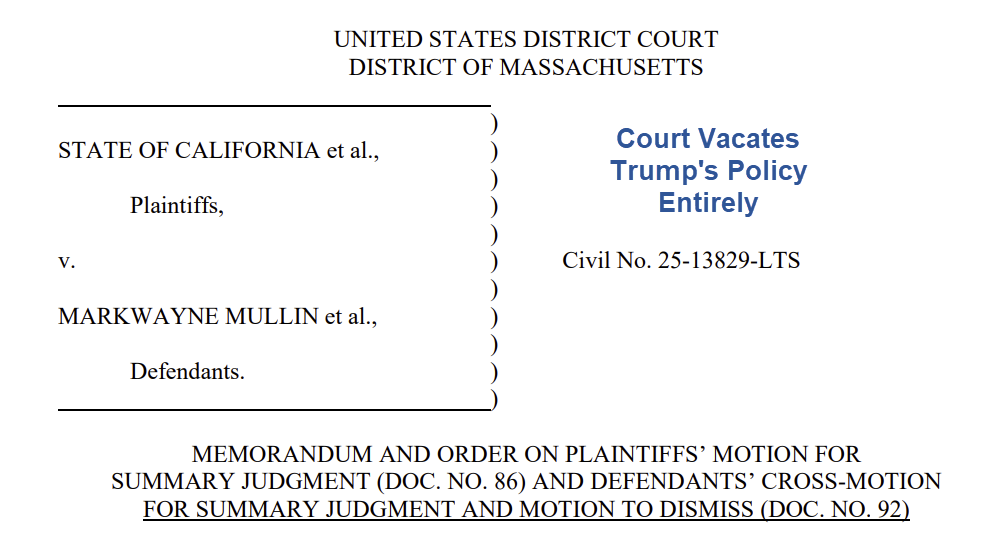
On June 8, 2026, U.S. District Judge Leo T. Sorokin (District of Massachusetts) issued a Memorandum and Order granting summary judgment to 20 plaintiff states (led by California) and largely denying the Trump administration’s cross-motion in State of California et al. v. Markwayne Mullin et al. (Case 1:25-cv-13829-LTS).
Background
- On September 19, 2025, President Trump issued Proclamation 10973, citing INA Sections 212(f) and 215(a). It imposed a new $100,000 supplemental payment on employers filing H-1B petitions for nonimmigrant workers.
- The stated goal: Address alleged abuse of the H-1B program, which the Proclamation claimed suppresses American wages, harms U.S. workers (especially in STEM), and undermines economic/national security.
- The fee applied prospectively to new H-1B petitions filed on or after September 21, 2025 (with some exceptions/waivers possible). Agencies (DHS/USCIS, State Department) quickly implemented it via memos, FAQs, and an updated fee schedule. storage.courtlistener.com
Court’s Ruling
- Plaintiffs Win on Merits: The court allowed the states’ motion for summary judgment.
- Core Reason: The Proclamation and its agency implementation (the “Policy”) violate the separation of powers and the Administrative Procedure Act (APA). Congress has extensively regulated the H-1B program (including fees, caps, and protections for domestic workers) through the Immigration and Nationality Act (INA). The President cannot unilaterally add a massive new financial barrier via proclamation.
Main Legal Issues
- H-1B Framework: Congress set specific visa caps (65k + 20k for advanced degrees), exemptions for universities/nonprofits/research orgs, statutory fees, and DHS authority to set adjudication fees via notice-and-comment rulemaking to recover costs. Trump’s Executive Order bypassed existing law.
- Presidential Authority Limits: While Section 212(f) gives broad power to suspend entry or impose restrictions when detrimental to U.S. interests, it does not authorize rewriting statutory fee structures or core program rules established by Congress.
- APA Violations: Agency actions implementing the fee were challenged as arbitrary, capricious, or in excess of authority.
Impacts Noted
The fee dramatically raised costs for H-1B petitions (previously ~$960–$7,595 total). It affected employers in plaintiff states, including cap-exempt entities like universities and nonprofits.
Bottom Line
- This is a significant judicial check on executive overreach in immigration policy. The court upheld Congress’s detailed statutory scheme for skilled worker visas against a unilateral presidential surcharge aimed at deterring H-1B use.
- The ruling blocks (or declares unlawful) the $100k fee requirement and related agency policies.
- Expect appeals, possible stays, and ongoing debate over H-1B reform—especially given criticisms of program abuse vs. needs in tech/STEM.
The full 42-page opinion is available on Court Listener. This is a clean win for the states challenging the policy.
If challenged, I believe the text of the existing law is clear. That implies Trump would lose in the Supreme Court.
I reserve the right to change my opinion based on oral arguments in an appeal. But right now, I certainly don’t expect to.
Court Listener Excerpts
The Constitution provides Congress with the power to “establish an uniform Rule of Naturalization . . . throughout the United States.” U.S. Const. art. 1, § 8, cl. 4. Pursuant to this constitutional authority, Congress enacted the Immigration and Nationality Act of 1952 (“INA”), which “established a comprehensive federal statutory scheme for regulation of immigration and naturalization and set the terms and conditions of admission to the country and the subsequent treatment of aliens lawfully in the country.”
Plaintiffs’ separation-of-powers claim arises from their allegations that the Policy “usurps Congress’s exclusive and plenary constitutional authority to set immigration policy and to raise revenue” and “exceeds the carefully and explicitly limited fee-setting authority delegated to the executive branch by Congress.”
Defendants raise various objections to ultra vires review, but their arguments are unavailing.
Plaintiffs allege both that the Policy exceeds the scope of the President’s authority under the INA, and that it encroaches upon Congress’s exclusive power to tax under the Constitution.
Plaintiffs’ claim does not require the Court to evaluate whether the President abused the discretion granted to him by the INA. Instead, Plaintiffs contend that the President lacked the power to impose the additional $100,000 payment requirement to H-1B applications, alleging (among other things) that the payment obligation intrudes upon Congress’s taxing power. Such a claim is plainly subject to judicial review. While Defendants urge that the President’s policy decisions involving immigration and national security are squarely within the executive’s discretion and immune from judicial intervention, Doc. No. 93 at 28-29, this line of argument misconstrues the nature of the issues here. The ultra vires claim in this case does not call upon the Court to question the President’s exercise of his policy-making discretion. Rather, this case asks the Court to evaluate whether the President and Defendants had the requisite authority to issue and implement the Proclamation.
Having resolved the reviewability of Plaintiffs’ ultra vires challenge, the Court evaluates the merits of the claim. Plaintiffs contend that the Policy violates separation-of-powers principles because it “usurps both” Congress’s constitutional “powers to regulate the admission of noncitizens . . . and to levy taxes.” Doc. No. 87 at 20.
Defendants claim that the $100,000 payment requirement is “a regulatory payment,” which is “not the same as a tax.” Doc. No. 93 at 35. This is mere ipse dixit. Defendants offer no definition for what constitutes “a regulatory payment,” cite no cases or statutes employing the term, and advance no reasoned argument explaining how this term encompasses something different than a tax or a penalty.
In any event, the manner in which a particular payment is labeled “does not determine whether the payment may be viewed as an exercise of Congress’s taxing power,” because what matters is the “substance and application” of the payment, not its “designation.”
Finally, Defendants’ miscellaneous arguments that the President has the authority to impose the $100,000 tax based on his “immigration and commerce powers” are nowhere to be found in the authorities they cite.
Relief
Defendants urge that any relief granted must be limited to Plaintiffs, arguing that the APA “makes no mention of vacatur” and that “remedies under the APA should reflect historical equitable remedies with the same limits.” Doc. No. 93 at 43. Both arguments are misguided. The APA’s text, which allows the court to “set aside” unlawful agency action, has long been thought to include vacatur.
Conclusion & Orders
For the foregoing reasons, the Court ALLOWS Plaintiffs’ motion for summary judgment, Doc. No. 86, and DENIES Defendants’ cross-motion for summary judgment, Doc. No. 92. At the parties’ request, the Court DISMISSES WITHOUT PREJUDICE the claims against the Department of Justice, the Attorney General, the Department of Labor, and the Secretary of Labor. Defendants’ motion to dismiss, id., is OTHERWISE DENIED. The Policy implementing the Proclamation is declared unlawful and is VACATED in its entirety. The Clerk shall enter judgment in favor of Plaintiffs and against Defendants, with each side bearing its own fees and costs
The Court Listener doc is 42 pages. I condensed it to the above key rationale.
What Does Not Matter
- Your views on H-1B Visas
- My views on H-1B Visas
- Trump’s views on H-1B Visas
This case will undoubtedly lead to more charges of a “activist court”. Instead, it’s a case of the court smacking the face of an “activist Trump”.
We can debate what should or should not be reasonable H-1B. But Constitutionally, that is up to Congress, not a king sitting on a throne deciding he is boss.
The court made the only sensible ruling.
Judge Tosses Trump’s Lawsuit Against the BBC
Trump lost two Tariff cases (one Supreme Court settled) and may be heading for a third.
Trump is headed for a massive slap in the face on his preposterous Birthright Citizenship Executive Order.
Again, the problem is an activist Trump, not an activist Court.
Related Posts
February 20, 2026: Supreme Court Strikes Trump’s Reciprocal Tariffs In 6-3 Vote (I Told You So)
Forgive me for bragging, but I got every justice correct.
March 5, 2026: Trade Court Orders Trump to Refund $130 Billion in Tariffs
Who could have predicted this?
May 7, 2026: Trade Court Sends Trump’s Section 122 Tariffs Down the Drain
Gee, I get another Tariff “I Told You So.”
April 1, 2026: Supreme Court Birthright Citizenship Arguments Suggest 7-2 Minimum Against Trump
Justice Kavanaugh hammers Trump’s lawyer, setting the tone.
With Kavanaugh on board, this will go no less than 7-2 against Trump.






























I have seen the H1B permits abused in the technology space. Pay the permit holders below market wages and after a few years, those workers are looking for new jobs that pay market (tired of being under-paid) after their indentured servitude is over. . There needs to be a way to discourage the abuse.
Would you support requiring the method we use to comply with the separation of powers, or should we let Trump do whatever he wants regardless? Asking for a friend.
It’s amazing how many people don’t understand how the 3 branches of us govt work! Including presidents from both teams who think they can just write law through executive orders and even judges, who thought roe v wade was a “law”
instead of following the system everyone wants a work around to keep their ignorant supports happy, right or left
the solution is a more informed citizenry but good luck with that when everyone is fat, dumb, ignorant, and spoiled!
We have starved and attempted to murder public education. Seems we have chosen to mash the pedal to the floor in reverse.
It’s government schooling by government officials. Once you describe it correctly, the problem becomes obvious.
It is easy to judge shop and find leftist judges who will overturn Trump’s policies. At the highest court, Trump has a strong record on immigration policies so I have confidence that this order will be overturned in the USSC.
There’s no evidence of judge shopping here
The H-1B Visa program was intended by Congress to allow American Companies to employ immigrants with highly specialized skills that were not available in the US workforce. US companies, have used and abused this law to arbitrage wage expectations between US workers and foreign workers, particularly in high tech and information systems employment.
Foreign, primarily South Asian workers are willing to become indentured servants to US companies, working long hours for low wages to stay in the US. Employers exploit these foreign workers using threats to their H-1B status, and potential deportation to keep them in line.
Basically, US companies are using bribes, euphemistically known as campaign contributions, to screw American workers, and maintain this farce. The H-1B program was never intended to displace US workers, and needs to be reformed or repealed, but money talks and Congress obeys.
I find myself in rare agreement with the Trump Administration’s motives, but this program can not be reigned in by imperial decree, but only by meticulous enforcement of the letter of the law, something well beyond the ability of Trump’s politicized Justice Department.
When loyalty is valued over competence, then incompetence will abound.
It was an existing fee until POTUS raised it then a judge said it was a tax.
Trump thinking he can just willy-nilly charge 100 grand for an H1-b is just as outrageous as Obama thinking he could just issue work permits (DACA) outside of the procedures Congress had established for work permits. Or Biden thinking he could wipe out student loan balances. Three would-be emperors.
I agree. Lets be thankful for the third rail of the US Constitution which stops these wanabe emperors.
If the budget for processing H1B visas runs out before the next budget is passed, does the government stop accepting new applications? The executive branch can’t exceed Congressional appropriations. Spend as much budget as possible early in the fiscal year could become a tactic to slow down new applications, or slow down whatever program an administration disapproves of.
Whew! That keeps the price of escorts from Estonia down.
While countries do have the right to decide immigration policy and have the right to expect prospective immigrants to obey the law, our current antipathy to immigration (especially university students and highly educated workers) is going to hurt US competitiveness long term. Trump is dismantling American exceptionalism.
What American Exceptionalism? The quality we seek called Exceptionalism is based on character and morals; not on University deplomas and reseach programs with nebulous or nefarious goals. I am not impressed with a gadget oriented society. With morals and character, society could prosper just fine with 1945 technology.
Regardless of your feelings about the law it is also true that Sorokin is a hack and Forum shopping is a thing. Plaintiffs chose him for birthright citizenship injunction as well. What are the odds the same judge (of thousands) gets to rule on two of Trump’s major executive orders?
So what?
And you don’t think Republicans court shop.
Do you not understand that two Trump appointees Kavanaugh and Gorsuch are going to vote against Trump?
Do you not understand that Gorsuch and Barrett, also two trump appointees, voted against his tariffs?
You can’t argue the case so you bring up asinine arguments with no evidence Just like Trump.
Fess up to the obvious fact you are in the MAGA cult incapable of any thinking of your own.
You are missing the point. Trump has an excellent record before the USSC on his immigration policies. The USSC did overturn one part of his tariffs, a reasonable decision. I predict that this immigration order will be overturned at higher courts, potentially the USSC.
He has a horrible record on cases with the attributes of the H-1B case. He usually loses them.
How would a non-hack and non-forum shopped judge read the following laws differently?
H-1B Framework: Congress set specific visa caps (65k + 20k for advanced degrees), exemptions for universities/nonprofits/research orgs, statutory fees, and DHS authority to set adjudication fees via notice-and-comment rulemaking to recover costs. Trump’s Executive Order bypassed existing law.
Presidential Authority Limits: While Section 212(f) gives broad power to suspend entry or impose restrictions when detrimental to U.S. interests, it does not authorize rewriting statutory fee structures or core program rules established by Congress.
APA Violations: Agency actions implementing the fee were challenged as arbitrary, capricious, or in excess of authority.
Hes still gonna win. He will blame on corrupt judges. Non maga judges biden etc. fox news influencers and conservative talk radio will amplify it Stupid voters will believe him.
Remember if your only average intelligence half the people in this country are dumber than you. The farther the dumber they get. .
Going to win what?
Half the people arw dumber than MEDIAN. Something like 80% of people are dumber than average.
The courts are basically running the country these days and with the far right jokers on the SCOTUS that is not a good thing. It is a good thing that SCOTUS moves slowly.
Going forward all Executive Orders which are legally questionable should be immediately stayed. The justice system is far too slow to deal with President who consciously wants to run rough shod over long standing institutional norms and constitutionally controversial.
Let me amend my list of Trump’s failures:
Do worry, Trump & Walrus will find a way to make things even worse.™
None of which matters when we the people failed by electing the 🍊. Twice!
You are incorrect on every point.
This is not a win/loss scoreboard thing! We have a President who is openly hostile toward our country, our government, and over half of our population. Those who voted for him put enormous power in the hands of a person whose egocentric, lying, cheating personality was well known by simply looking at his personal and business life dating back 40 years and of course there was the January 6th attack on the U.S. Capital and the election certification process. Donald Trump is openly hostile toward the United States, the Constitution, our allies, and our institutions.
Tarriffs would have been very effective if they had gone up incrementally like a quarter of a percent a month for 5 years, and a tenth of a percent thereafter until Waĺ Street and business said Uncle, and shifted supply chain and manufacturing in a healthy domestic direction.
Mainlining high Tarriffs in one injection was an overdose. The intentions were correct, the procedure was problematic.
Hopefully, many more of these type rulings will ensue to stop the deranged clown from his ill-fated actions.
They’re also establishing some boundaries for the next president who thinks he/she can rule by edict. The swing in power away from Congress and to the president has gone way too far.