

Twitter is flooded with death of the dollar reserve currency stories. Let’s discuss the real story. 
Conventional Wisdom
De-reservification, Not De-dollarization
Brad Setser, senior fellow at Council on Foreign Relations, explains it’s De-reservification, Not De-dollarization
The world isn’t moving away from the dollar. It is shifting its dollars from traditional reserves to state banks, pension funds, and other quasi-sovereign investors.
The IMF’s data on the currency composition of foreign exchange (FX) reserves is scrutinized carefully for any signs that the world is shifting way from the dollar.
Yet it doesn’t really matter that much if the dollar’s share of reserves has shifted from 56.5 percent to 57 percent. The ink-to-impact ratio of the quarterly reporting on the latest COFER data is all off.
Neither the stock of global reserves nor the stock of dollar reserves has changed much in the last ten years.
The action is elsewhere.
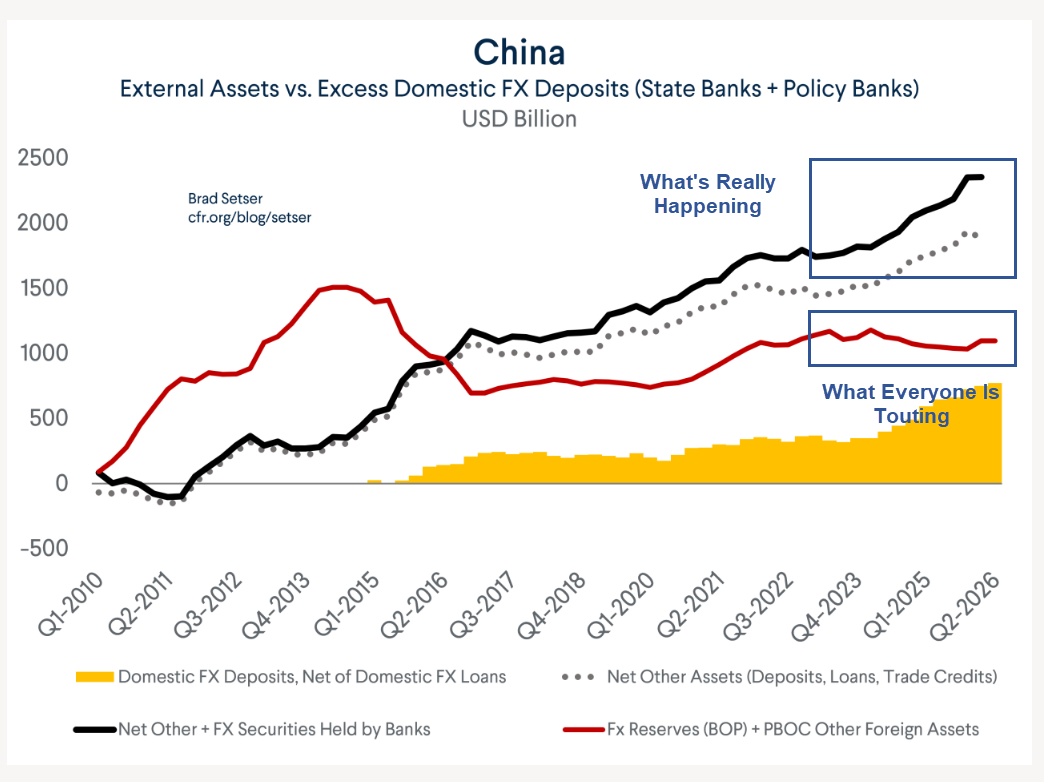
China’s state banks (per the Bank of International Settlements) have almost as many foreign assets as the central bank (PBOC).
Japan’s Government Pension Investment Fund (GPIF) has almost as many foreign assets ($986 billion) as the government has FX reserves ($1.1 trillion at the end of August). Japan’s FX reserves are on the books of the Ministry of Finance and the GPIF is overseen by the Ministry of Health, Welfare and Labor—so these are almost all assets of the Government of Japan or the broader public sector, not its central bank.
Korea’s National Pension Service has more foreign assets than the Bank of Korea has FX reserves.
Consider China.
No serious analyst now disputes that China’s state banks—including the policy banks (the China Development Bank, China Exim)—hold several trillion in foreign assets.
China reports $3.3 trillion in gross foreign assets to the BIS (the net position, counting foreign bank claims on the entire Chinese economy not just the banks, is $2.5 trillion). That maps to the BOP data, which shows almost $4 trillion in gross outflows through the banking system (technically, the sum of gross outflows in “other” plus the $500 billion in foreign currency bonds held by the state commercial banks)
China External Assets

The broad contours of this story are confirmed by the balance sheet data reported by state commercial banks in their 2025 annual reports, which showed that the top five banks held a combined $2.5 trillion in foreign currency assets (mostly held abroad).
The Chinese haven’t disclosed the foreign assets of the two policy banks (with at this stage the complicity of the IMF, which has neither analyzed the role of SAFE policy bank financing, nor highlighted the glaring gap in China’s own reporting). But the work of AidData points to nearly $1 trillion in foreign assets, with a hefty dollar share.
The available data sources all suggest that the bulk of the foreign assets of the state banks are in dollars.
Put simply, SAFE’s static dollar holdings aren’t the important story.
The real story is the rapid growth of the state banks dollar holdings.
Japan holds a high (though undisclosed) dollar share in its FX reserves, and those reserves are primarily invested in Treasuries—so Japan’s MoF is now clearly the largest contributor to the U.S. data on foreign official holdings of Treasuries. (SAFE has shifted its funds out of U.S. custodians, and thus increasingly appears in the data as a “private” holder in a European custodial center)
The broad story is thus pretty clear: the growth in the world’s sovereign and quasi-sovereign assets is not coming through an increase in FX reserve holdings managed by the world’s central banks.
So don’t obsess about the dollar’s chare in formal FX reserves. Do recognize that the dollar’s “reserve currency role” isn’t the source of any significant new inflows into the dollar.
The dollar’s dominant role in the international monetary system depends on much more than the size and composition of central bank FX reserves. It is as much, perhaps more so (given that FX reserve managers are themselves ultimately liability matchers) a function of the portfolio choice of a set of private/semi-private/quasi-sovereign investors that are much more difficult to observe. Reserve currency status is not only about FX reserves in a strict sense.
That’s been true for some time. Most of the current flow into U.S. from the “official” sector is coming from investors who are not classic reserve managers.
Those flows remain heavily tilted toward the dollar, at least for now.***
And any real de-dollarization would likely occur first among these investors.
Put differently, the dollar’s global role is increasingly as a source of returns, not a source of safety. The foreign bid, private and public, is for risk, not for Treasuries. That doesn’t help Scott Bessent much right now, but it has helped keep valuations in the stock market extended. And the global debate on the dollar’s role lags the evolution in the dollar’s role, and the risks associated with that new role.
It is currently fashionable in some circles to point to the diminution of the “convenience yield” on Treasuries even while the U.S. dollar continues to enjoy such a privilege. But the shift in the global investor base, and their apparent portfolio preference for U.S. risk assets in lieu of Treasuries, may help explain the divergence between the convenience yield on UST and the convenience yield on USD.
And of course, if the negative convenience yield implies that Treasuries are trading at a historical discount, the persistence of the latter—and its concentration in risk assets—suggests that the “profit dollar” itself is likely trading at a historical premium. That apparent premium on U.S. risk assets deserves as much (or more) scrutiny as the currency composition of central bank FX reserves.
There is much more in the report including charts on Japan, South Korea, Taiwan, and Saudi Arabia.
So no, China is not dumping dollars. Nor is any other country.
“I Am the House”
Play that video. It’s amusing.
Bessent is working with Japan to stop it from selling treasuries. But that is not dumping treasuries in the normal meaning of the word.
Rather, Japan is selling treasuries to buy yen because the yen is collapsing.
The concern to Bessent is selling treasuries would drive up treasury yields. Well guess what.
Hoot of the Month
Bessent foolishly declared himself to be the House.
“I have asymmetric information. I am the house now. You can bet against me if you want.”
The bond market did.
We have steeply rising yields despite the fact that no country is selling treasuries or abandoning the dollar in any meaningful way, if at all.
The only way for the Fed to halt the bond market revolt other than massive QE at the long end of the curve is hike interest rates.
At 10:00 PM September 28, the 30-year long bond yield is 5.57 percent. And the 10-year note yield is 5.26 percent.
Yes, that is a problem for Bessent and the Fed.
Related Posts
September 25, 2026: Texas Cattle Assn. Complains of ICE, Iowa Farmers Union Endorses Democrats
“ICE operations are having a massive chilling effect.”
September 26, 2026: Trump Rejects Iran Ceasefire Proposal, Says More Bombing After Election
There’s a lot going on with this headline. Let’s discuss.
September 28, 2026: Treasury Secretary Is Bragging About Real Wage Growth. Is He Right?
How Does Trump Compare to Biden in wage growth?






























Pension assets are not the same as CB FX reserves. They are invested to meet specific liabilities, and their asset allocation changes depending on liquidity needs and market conditions. So for example if growth suddenly picked up in Europe while it slowed in the US you will very likely see a shift from the latter to the former, it wouldn’t mean though they trust the EUR more than the USD.
IMO, the US dollar will become like the English language. Countries will use it where it suits them. But not otherwise. The days of dollar hegemony are coming to an end.
My assessment is that, long term, the value of the USD will drop to zero. The nation is technically bankrupt and in 5 years the situation will be worse. The flight to gold and silver began several years ago. 2007-08 happened because the banks were “too big to fail” meaning we could not afford not to save them (at any cost). In the coming crash, the banks will be too big to save. All the jiggery-pokery-crookery will prove to be so enormous and exploitative that no one will be willing to destroy their national economy to save it, for both moral and technical reasons.
When disaster comes, own tools.
I started calling him Scotty Basement the day he became the Secretary of the Treasury. Worst cabinet in American history.
mish and frosty……and rest of you. is now a good time to short LAND and FPI. shorting TLT has been a no brainer. and a few reits.
“Gradually, then suddenly.”(Ernest Hemingway)
Any story at all can be told with numbers. Look at what is changing (a complete, global scale gold for currency exchange mechanism being stood up in Hong Kong) and ask yourself what that means for US power through dollar dominance. It doesn’t matter how you count dollars (Jeff Snider is excellent source on dollar), what matters is that US power to use its currency as a weapon or as a tool of ignorance (unlimited irresponsible borrowing) is coming to a rather significant turning point.
This whole concept can best be discribed by that old saying: The bigger they are, the harder they fall.
What I see is that you spend 100 dollars at the grocery and have very little meat. Prices are up on a lot of items. I put spare dollars into gold and silver to preserve my money and as an investment. I’m fixing my rentals now vs later because labor and materials have gone up whether doing myself or hiring out. Insurance of everything is up! Paying off debts faster unless I get a promotional 0% from like Home Depot that I stretch out for needed repairs. I upfront now items (food) and tools (try to buy on sale same as food) to have that item before prices go up.
I don’t give a damn hoot what some economist tells me that dollars are doing great or whatever. I think it’s best to convert your dollars to gold, silver, pay extra towards bills (car loan, etc), and invest in commodities or real estate. I do keep some dollars around, but we’re broke and the currency is going to be like what this Ukrainian told me when the Soviet Union fell apart. He told me at that time you can only wipe your butt with their currency. It was worthless.
Coming to America.
Where is the US Treasury? Well it’s head is under the OO desk
bessent is pleasuring the potus
Farm interest rates are rising faster than other mortgage rates because of the increasing risk of default. My local bank manager reported to me that the farm rate is now at 8% because so many farmers are reporting losses this year. The USDA expects another 44 basis point increase for farm loans in 2026. This will take indebted farmers into 8.5% loan territory to finance next years seed, diesel, fertilizer and associated labor and machinery.
It looks like more farmland will be headed into bankruptcy near me and I should start the cherry picking research.
Not one MAGA hat at the church social on Sunday. A first in probably 10 years…
Who does Trump work for?
More farmland for the billionaires to buy up cheaply and exploit as food becomes more expensive.
The two biggest owners of American farmland are Bill Gates and Jeff Bezos.
Correct and farmland ownership is getting more and more consolidated. A person can either sit and complain or get off their ass and get to work while applying a disciplined approach to capital management. Being a successful farmer is not an accident!
Taking on debt debt as a farmer so you can have all the latest equipment and a fancy pickup truck is not the recipe for success.
It should also be noted that large consolidated landholdings have been going on for centuries as models of efficiency. In 1929 JR Simplot started his agricultural empire and grew it to private family owned/corporate landholdings of 450,000 acres.
Simplot also was an early investor of Micron Technologies and owned 20% of the company.
Success does not always create problems as Simplot employs about 13,000 people around the world.
Creative genius’s are all over the place but they are outnumbered by lazy, shallow do-nothings 100-1.
I like this post, but the surprising thing to me is the level of financial ignorance in the US is shockingly high.
I’m nearing sixty, and the number of people who have nothing saved for retirement, or worse, are deeply in debt, is depressing.
He works for Israel, Zionists, and his crony friends and family.
He’s a liar, cheat, carnival barker, dirtbag and murdered of thousands. I hope the SOB rots in hell.
not to mention a molester and thief.
We can’t know for sure because the whole establishment converged to cover up the Epstein material.
He wants farmers bankrupt – that’s good land that could be sold to foreign conglomerates or used for data centers.
Brendan Greeley in The Almighty Dollar makes the case that the dollar has evolved and survived across several sovereigns and currency regimes. I guess that would be more the model of “currency” as what people are actually using currently, alongside, or perhaps in tension with, “currency” as an extension of an issuer’s current regime and fiats.
Will the Treasury declare the US as a state which manipulates the currency?
Joke o’day: Trump in the past criticized the dollar’s use for political manipulation. But “Trump in the past” is the most ethereal, depreciating thing there is.
Now now, you know it’s a *rules-based* international order. And the rule is, the rules don’t apply to US.
🤣🤣🤣🤣🤣
Twitter hasn’t existed in over 3 years. I’m sure you heard that Elon bought it and rebranded it…..lazy writing.
We all apologize for triggering the MAGA in you
He’s partly right – it is but a shadow of its former self. Admittedly it was in a bad way when Elon found it. Yet he made it worse, not better.
In 1929, at the height of an economic boom in America, Joseph Kennedy Sr. (father of JFK) was working as a stockbroker on Wall Street. As the story goes, Joseph was walking around when he decided to sit down for a shoeshine. While polishing his shoes, the young worker gave Joseph some of his favorite stock picks. When Joseph heard the shoeshine boy giving out stock tips, he figured the party was about to end, and it was time to get out of the market. Joseph proceeded to exit his positions in the market and bought short positions that bet on the market going down.
https://www.pitzlfinancial.com/blog/ode-shoeshine-boy
De-Dollarization will happen, if ever, when your neighbors tell you they loaded up on something else (crypto, gold, euros, yen, yuan, tulips, etc). It happens when countries around the world say they are switching from dollars to x for settlements. It won’t all happen at once, it will be a trickle then when the dam breaks a flood. But for now there is no alternative.
When the shoeshine kid gives you non-dollar denominated tips then you know the dollar party is over.
My neighbors load up on the local currency. Some have dollars too, as much as euros, for their vacations.
Collectable trading cards are hitting the moon right now in prices paid. You know the end is near when the worthless becomes exceedingly valuable.
There have been such fads on and off for years. NFTs, cryptos of various flavors and features, SPAC shares …. I think the most durable thing is the tendency to find reasons to think that something visible right now signals “the end is near.” All sorts of phenomena are popping in and out of existence each day and each season like particles in quantum physics. They are like micro-earthquakes: daily stuff. The really big shake-ups are rare and exceedingly hard to predict.
Boomers still scratching their heads about postage stamp collections.
“When the shoeshine kid gives you non-dollar denominated tips then you know the dollar party is over.”
That’s backwards. The shoeshine boy gave stock tips to buy: a contrary indicator that stocks were over.
YUP. mpo has it backwards. currency is just barter. the human primate species has never had it easier. 8 billion of us.
MISH,
I get that there is a shift, and that this is mostly a consequence of the trade deficit, but underneath the surface of that shift, is this not shifting the holdings into areas that are more volatile? Central bank reserves are about as steady as you can get, where as the other one are not so much, correct? Would this make the USD more volatile over time?
I am thinking along the lines of the US market pull back (name your reason – AI, higher yields, doesn’t matter) could get accentuated if other money flows out at the same time. Thinking cracks of instability.
How does this process ever end? So, maybe US debt becomes 250% and 30 yr Treasuries pay 10% – so what? The Fed buys the debt and issues the currency and how does this ever end? Gold crashed 4% yesterday!
I agree! Ultimately, (A) there are no guarantees with any currency and (B) none of us live long enough to need to take 100+ time horizon into consideration.
I just don’t see any currency replacing the Dollar’s global reserve status because of the liquidity it has.
I agree: the network effect, the network externality is the biggest source of the dollar’s durability. The English language and US power are sticky like that too: there is no other bridge or connector so far to displace t heir centrality. Watch Xi this week flying in on a jet with big English words on its side.
That’s what the French thought under Napoleon, the English and Spanish before that, and the Romans, Greeks, Egyptians, Persians, Assyrians, Mongolians, and many others before that. None of them thought their civilization would decline for the same reasons.
bingo. of course most men only think about their own little short pathetic lives. like their personal family lore is history. 3rd base life also makes for morons. we all grew up in usa past 80 years on 3rd base. only question was did you have to march 10 feet on hard wood floors or shag carpeting, to change the channel on your teevee in your childhood. of course the kids don’t know what life without a remote is. we had it tough back in the 60s. /sarc
Please take a course in economics.
Please offer an intelligent answer to what was asked rather than a pointless glib reply. For better or worse, the US is unique in ways that textbooks so far haven’t predicted.
There is not an intelligent reply to your mess of a post, I think that is an accurate translation from His English to Your English. Let’s see what he says.
And still no focused, clear reply. More glibness.
Just take one class, in Auditing. Study how Ponzi schemes work.
Then look around and see how many on-going examples you can find in the first hour. They exist everywhere.
Can you name a country that has generated or even maintained a prosperous economy by trashing its currency?
Yes, the USA so far. They have gotten away with it and someone needs to explain how this will stop.
Glad you added “so far”, my opinion is the fat lady has arrived and about ready to start a serenade.
I wish you well in that. Unfortunately, I am deeply upset by the prevalence of False Prophecy. Too much, ‘this war will be over in a month’, or “I’m the house’ and so on. I DO see that Treasury rates such as above 6% might crash stocks but I contrast that with Congress actually doing something about the deficit – which can ONLY happen if they give up regime change fantasies and cut defense by like 2/3.
currency is just a form of barter. the world is 8 billion strong human primates producing housing and food…….much easier than ever before. the lifestyle of all of us human primates has never been better. and easier.
That’s not why gold sold off a modest 4% yesterday
oops dupe reply
Here is an intelligent response for you, sorry I am too busy to type the whole thing out: chrome-extension://efaidnbmnnnibpcajpcglclefindmkaj/https://www.nber.org/system/files/working_papers/w20339/w20339.pdf
I am very happy that the bond vigilantes are slowly trying to rein in the US Congress and it’s spend thrift ways.
I just wish they had done this 5 years back…well as they say better late than never…
5 years ago? Needed to be done in about 2007 or earlier.
Pete Peterson was a Nixon commerce appointee, and then in the 1970s started a huge promotion about deficits and debt. I guess he got frustrated and left that to become a very wealthy hedge fund guy. But in the 80s the Reagan years sent weird conflicting messages: it seemed like we won the world, but of course we later saw that wasn’t so, and meanwhile the fiscal deficits ballooned and just continued. Then Dick Cheney said Reagan had proved deficits don’t matter, and it was fully normalized in Republican as well as Democrat practices. So there was nobody left to say no by the time, as you say,of 2007. Then came the smirkingly self-titled king of debt as Republican US president.
These aren’t even real bond vigilantes yet – rates are barely in the normal range pre-QE. I believe we will see real bond vigilantes with the way things are going, though.