

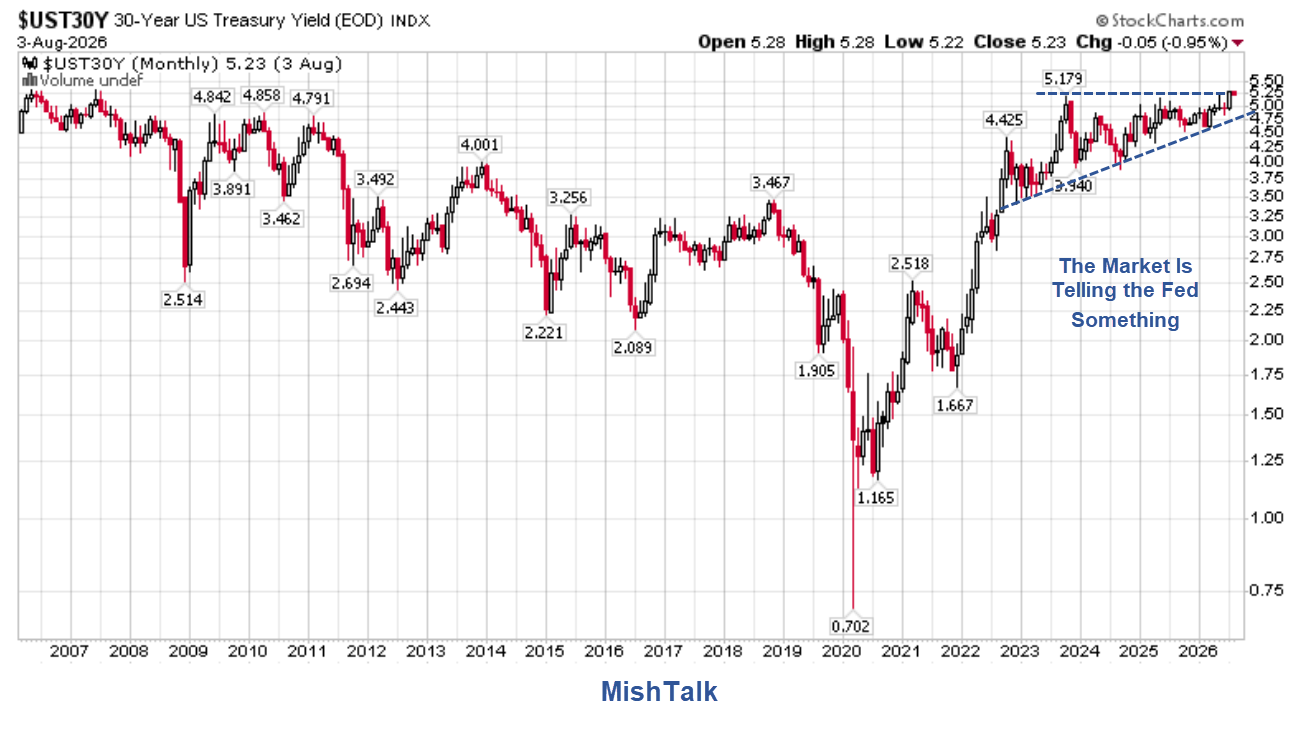
Threatened action is always in the future, too little and too late.
The Fed Will Act
Reuters reports Fed’s Williams expects inflation to ease, says Fed will act if it doesn’t.
Federal Reserve Bank of New York President John Williams said he remained optimistic that inflation pressures are on track to ease gradually, but if they don’t the U.S. central bank will not hesitate to respond with rate hikes to ensure price pressures return to target.
If energy prices and trade tariffs have peaked and the economy remains on a solid footing, “I think that some of the big drivers that pushed up inflation” over the last year and half or so “will not be at play as much, and then some of the disinflationary forces that we’ve been seeing” should reassert themselves, Williams said in an interview with Reuters on Friday.
Williams said “I am quite honestly focused quite a bit on, what are we seeing in the core inflation data over the next several months, and is that consistent with a kind of a run rate of inflation moving towards 2% and really on a disinflationary path consistent with us achieving our 2% inflation goal on a sustained basis by 2028.” He added, “my forecast personally is for inflation to come down in the second half of this year and come down further next year.”
Williams reiterated the current stance of interest rate policy is “well positioned” to bring inflation back to target.
But Williams noted that “if the economy is not on a trajectory that will bring inflation back down to 2% … it would absolutely be appropriate to act to get us on a trajectory that does bring inflation back to 2%.”
Market Forces
“I don’t anticipate, at least based on what’s happening so far in my base case, that we’re going to see … continued inflationary push in the second half of the year or the next year from the from the conflict in the Middle East, but that’s something that obviously could change depending on circumstances,” Williams said.
Asked if the Fed would feel bound to set monetary policy based on market levels, he responded “absolutely not,” although the central bank closely watches financial markets.
“We always have to come do our own analysis, do our hard work, assess all of the … factors influencing the economy, the outlook,” Williams said.
Absolutely Not
It’s important to understand what “absolutely not” implies.
Here it is in two words: Quantitative Easing (QE).
If market forces are pushing rates higher, the Fed must do whatever it takes to defend its interest rate policy.
The primary tool is QE (asset purchases, buying treasuries to force the market to the Fed’s will).
Bear in mind that Kevin Warsh wants to (says he wants to) shrink the Fed’s balance sheet.
Williams’ Forecast
Total Credit Market Debt Owed vs GDP

On July 27, 2026 I asked How Much Credit Growth Does It Take to Expand Real GDP?
TCMDO vs GDP 2026 Q1
- TCMDO: 115.556 Trillion
- Nominal GDP: 31.866 Trillion
- Real GDP: 24.180 Trillion
On August 15, 1971 president Nixon temporarily suspended redeemability of gold for dollars.
It turned out to be permanent. Since then, there has been no constraints on the expansion of money, national debt, or trade deficits.
Credit expansion is running 6 percent year-over-year. Much of that is spilling over into stock market bubbles the Fed does not even see.
The Fed does not count home prices, property taxes, or even homeowners’ insurance in its incredibly poor definition of inflation.
The Fed Is Watching!
Fed Chairman Tries to Explain Why an Interest Rate Pause Isn’t a Pause
Please note Fed Chairman Tries to Explain Why an Interest Rate Pause Isn’t a Pause
Reporter Q&A
Message from the MarketsQ: Steve Liesman, CNBC: What message are you getting from the market as to where policy out to be right now?
A: The message from markets is the message from markets. What we are tying to de is get an unfiltered message from markets.Q:Edward Lawrence, Fox News: What specifically in your mind would be the argument for a pause today?
A: I wouldn’t characterize what we did today as anything like a pause. I would characterize what we did as a rigorous review of the economic situation.
Fed Will React When?
But the Fed will react. Yeah right. And it will ignore market signals including the bond market all the way.
As I type the 30-year long bond yield is 5.20 percent down about 7-8 basis points from the intraday high.
Oil is down from $88.07 on July 22 to $75.61 today on news of another deal.
The long bond yield is up from 5.147 percent to 5.200 percent in the same timeframe.
The bond market believes in strong disinflation as much as I do. That’s not at all.
And Williams says the Fed will “absolutely not” be bound by market forces.
Hello Mr. Williams, good luck with that.






























pan to fire?
Taco’s track record is one of the few that are worse than that of the fed.
The US is now in a modern day debt trap. The Treasury has indicated that it will not be increasing the sale of long-term notes and bonds for the next several quarters, aiming to artificially keep long-term yields from breaking further upward. This is also because although a 5.2% 30-year interest rate is not historically high, given the current Debt-GDP ratio of 120%, issuing even more debt at this rate would be a catastrophe for the Federal government. So Treasury is issuing more and more short term debt. T-bill rates are strongly tied to the Fed funds rate. This of course puts the Treasury at the mercy of the Fed. Is the Fed going to destroy the Treasury by substantially raising short term interest rates? I don’t think so.
There are only a few mechanisms for a country to escape a debt trap: default (not going to happen for the US), austerity (politicians aren’t going to support that), growth (if growth is going to be driven by AI without job creation, then this won’t solve the problem), and inflation/financial repression. To me, it looks like we are in for another long era of financial repression in which real interest rates are held very low or negative. And Fed members like Williams will continue to come out and pretend they are going to act against inflation. Watch what they do, not what they say.
And if we are in for a long period of financial repression, where would you put your money? Not cash or fixed income. Things that are going to rise with inflation, like stocks or homes. Hmmm, seems like that is what we are seeing. Perhaps the markets aren’t dumb.
i suspect by 2029 after potus elections a few states will issue their own currency. now it’s so easy to do with crypto………no need to cut trees or use ink.
i will add, this is just like it was in the 1800s
“Article I, Section 10, Clause 1 of the Constitution prohibits the States from coining money”
https://www.law.cornell.edu/constitution-conan/article-1/section-8/clause-5/coinage-power
In the 19th century, states (and private banks) regularly printed money, but they did not mint coins.
Great comment. They are more constrained than ever due to the debt/gdp at 120%. It is my belief that they ultimately only care about that ratio
Another interesting aspect of this is that Bessent, clearly was behind getting Warsh in the chair, just read the op ed he wrote last year. Warsh is doing exactly what they described. He and Warsh are trying to end the post GFC era of college professors printing $ and managing the economy, which i agree with. Let markets set prices.
But the big question is whether going back to pre GFC methods are viable at post printing 120% and no globalization (deflation) backdrop
Using numbers in the TCMDO vrs GDP chart, for $34 trillion increased debt, we bought $10.1 trillion in GDP growth over the 6 years. At some point even the educated fools in congress and the fed will understand, or they understand but lining their own pockets is more import than survival of our country. The best thing the Fed can do is get out of the way and let the free-market work to repair the damage done by deficit spending and it facilitation by fixed interest rates and money printing. It will be painful, but it is necessary
I blame our so-called free press and especially the business press, for failure to report this news to the citizens of America. We cannot keep our country when we have an uneducated citizenry; for that we can blame our public education system. It is long past time we elect patriots to office.
Monetary policy objectives should be formulated in terms of desired rates-of-change, RoC’s, in monetary flows, M*Vt [volume X’s velocity], relative to RoC’s in R-gDp.
There is evidence to prove that rates-of-change [roc’s] in nominal-gDp can serve as a proxy figure for [roc’s] in all transactions (in American Yale Professor Irving Fisher’s truistic “equation of exchange”). I.e., income velocity is a contrived figure. See forecasts for 1978.
The earliest form of the velocity of money was formulated to show a relationship between the quantity of money and the value of all transactions. This is very different from the current formulation, which draws a relationship between the quantity of money and GDP, which is the income of a country.
Zombie Concepts: Velocity of Money – Joseph Wang (fedguy.com)
But rates-of-change in real-gDp have to be used as the policy standard (which is different from Dr. Scott Sumner’s level targeting N-gDp.
See: “Profit or Loss From Time Deposit Banking”, Banking and Monetary Studies, Comptroller of the Currency, United States Treasury Department, Irwin, 1963, pp. 369-386
See: “Should Commercial banks accept savings deposits?” Conference on Savings and Residential Financing 1961 Proceedings, United States Savings and loan league, Chicago, 1961, 42, 43.
Data compiled by Joseph Aschheim for member banks, by size of bank, and by ratio of time to total deposits, revealed that: as the ratio of time deposits to total deposits rises:
(1) the ratio of total expenses to total earnings is higher;
(2) the ratio of net profits to capital accounts is lower;
(3) the ratio of net profits to total assets is lower;
(4) the ratio of dividends to capital accounts is lower; and
(5) the ratio of capital accounts to total assets is lower.
All these relationships ad up to one conclusion: “the higher the ratio of time to total deposits, the less profitable are banks of a given size group”.
creature from jekyll island is a must read for all finance pros.
If they manage to end the forward guidance scam, it would be an improvement. This comes out of the derriere of such academic stalwarts as Bernanke and Yellen.
i miss ole greenspan. ayn rand called her good pal, alan, the undertaker. his bully pulpit was the best. it was mesmerizing coming from the maestro. i still LOL everytime i walk past the NYFED. just cracks me up what a great scam it is. our 3rd central bank in the empire.
And the Fed is buying long-dated JGB’s with the Yen they are accumulating via currency intervention. The Fed’s balance sheet consists of more and more garbage every day.
Gold is up $185+ today. Co-incidence?
As the late Dr. Daniel L. Thornton, May 12, 2022 said:
“However, on March 26, 2020, the Board of Governors reduced the reserve requirement on checkable deposits to zero. This action ended the Fed’s ability to control M1.”
Canada, the UK, New Zealand, Australia, Sweden, Hong Kong, and now the US have no reserve requirements.
Powell destroyed deposit classifications. He eliminated the 6 withdrawal restrictions on savings accounts. This has led to a huge shift in savings/investment type accounts into means-of-payment money. M2 has grown but all of its growth is reflected in demand deposits increasing. This has prevented a recession from developing. The ratio of DDs to TDs has tripled.
As I said in response to Powell removing legal reserves: “The FED will obviously, sometime in the future, lose control of the money stock.” May 8, 2020. 10:38 AMLink
John Williams assessment is right if the distributed lag effect of money still holds.
Monetarism has never been tried.
He spins a good word salad, lol.
Lying carnival barkers with the authority to print new, less-valuable money to “buy” assets in the same way we would be incarcerated for theft, fraud or counterfeit money use. When you are a country living high off the hog on the altar of printed fiat and lies you need your monks and religious leaders to speak to the people so as to not introduce panic in a degree that would cause the masses to demand to see what’s behind the curtain and to take back what was once theirs. They are a rot. But everyone of those asking questions has a 401k/IRA, complicit and interested now in its growth, so if they speak the holy words and merely promise to act to protect them, that gets reprinted. It’s our version of “when it gets serious you have to lie” or whatever he said about a bazooka in his pocket and to trust him that it’s enough.
As you read the blog post you can change a few words with words like “intentional” and as you scan the first paragraph you hear him redefining the infamous word “transitory”. Ain’t nothing about what has happened since late 2021 as transitory. As transitory as the recapitalization of banks since the GFC of 2009, paying interest on reserves. As transitory as the PMI Services about to show 110 months of rising prices. They’ll do the hard work and tell us that…and that they are watching.
These posts should always come with links to the Fed Uncertainty Principle post, one of Mish’s finest.
Reserves are down 241,410b from July last year. The longer the FED holds it ground, the further inflation will fall.
That’s how the FED killed the rally in bitcoin and metals.
correct.
In interviews, Bessent explicitly stated that the U.S. is intervening to help Japan because they are a trusted ally. 😂😂😂
Why is the US suddenly helping rescue the Japanese Yen?
It’s not just about being a good ally Stupid, it’s about protecting the US economy from a massive bond market crisis.
The Yen Problem: The Japanese Yen has been sliding toward historic lows. To save its currency, Japan needs to buy Yen using US Dollars.
The US Debt Connection: Japan is the #1 foreign holder of US Federal Debt, sitting on over $1.1 Trillion in US Treasuries (roughly 12-13% of all foreign holdings).
The Ultimatum: If the US doesn’t help stabilize the Yen, Japan would be forced to start dumping its massive stockpile of US Treasury bonds onto the open market to raise those dollars.
The Ripple Effect on you: Mass selling of US bonds would cause Treasury yields to skyrocket. Because US consumer interest rates are tied to these yields, a Japanese sell-off would directly drive up your mortgage, car loan, and credit card rates overnight.
The Solution: To prevent a bond market meltdown, the US Treasury and the Federal Reserve are stepping in with strategic workarounds, like currency interventions and special liquidity loans, so Japan doesn’t have to touch its US bonds.
This is another thing, from Trump & Co, that works until it doesn’t.
But when it stops working, it will hurt even more than if it had never been started.
With Scott involved, more like a “strategic reach-around”
The fisc can be weakened until a final rug-pull on the American people becomes “regrettably necessary.”
“I don’t want to abolish government. I simply want to reduce it to the size where I can drag it into the bathroom and drown it in the bathtub.”
— Grover Norquist
Or maybe a slow leak can be stage-managed.
IOW, currency and bond market manipulations.
Month’s -> Months
Insane spending by Congress and Trump is the main cause of inflation. Most of the unjustifiable spending goes to the defense contractors who produce overpriced worthless crap. $1.5 Trillion for “defense”?
war department. at least it’s more accurate. one point for the grifters in power this year.
Agreed, but remember that the Fed under Bernanke and Yellen and also Powell kept interest rates far too low for far too long. So Congress was able to spend humongous amounts of money and accumulate massive amounts of US debt for 15 years with no consequences. So while Congress was the “junkie”, the Fed was the “Dealer”. Now comes the detox process, and it is going to be painful indeed.
I am buying different inflation hedges, easier to do than ever before (aside from real estate now, but I got lucky on entry points twice). There are fascinating ETFs, but as a recession baby I always cling to cash too. Many ETFs haven’t been stress-tested through a crisis.
The can they (we) are kicking is getting bigger. But we came back from the 1970’s. (Iran was around then, too, and we had our misadventures.) We blundered through it. Is the sky falling this time? Someone is always baying (with some basis) that it is. I thought it was, back then, and I was largely (gratefully) wrong, for a very long time, through many straits and narrows, ever since. A Fed “Suez moment” never came, but it always might. Life has been existential since the first organism climbed out of the ooze.
Scott Bessent said the weirdest thing yesterday on Steve Bannon’s Warroom.
Comment was along the lines of: “Well next year I’ll be 65 so I’ll be able to start collecting social security…”
Weird for these reasons:
Full retirement age is not 65, it’s 67 for those born after 1960 — granted, Treasury isn’t in charge of SSA, but this is basic stuffYou can start collecting as early as 62 (discounted of course)…or wait until 70 and get even more worthless fiatBut why would a fucking BILLIONAIRE even have this thought anywhere in their mind?Just weird, man….like bizarre
Why doesn’t the bullet formatting work on this garbage site….I want to speak to a Manager!
I think Bessent was trying to sound like a normal person – which he isn’t. He probably has no idea when “full retirement” is for Social Security. He probably thinks it’s 65.
He is probably counting on these funds to use as a tip for his pilot.
Collecting Social Security has so little relevance to Bessent’s personal finances that I doubt he has given it any consideration at all. His pension will be a miniscule rounding error to him. Most people throw out the number 65 because they get confused with Medicare eligibility, which still is 65 for everyone. One would hope for better from a US Treasury secretary though.
Well…i liked his Star Wars theme song.
I remember not to long ago, when a can of Progresso soup was about $1.69
Was in the store today and price was $4.49 !!!!
JFC
That 2% inflation rate adds up over time (sarc)
I went to buy a manual can opener yesterday and the first one I saw was $19.95. They had a flimsy one for $7. I left the store and went to Target where I got a decent store brand one for $3. They also had a name brand one for $15. Some consumers are tolerating (and encouraging) high prices.
19 bucks. Id be using a screw driver. Till i realized i have swiss army knife somewhere.
Funny you mention that…I need a replacement for one that I broke during a recent power outage…my kitchen “junk drawer” is suddenly filled with valuable treasures
It’s on sale at Shaws for 1.99
Going to get a few cans.