

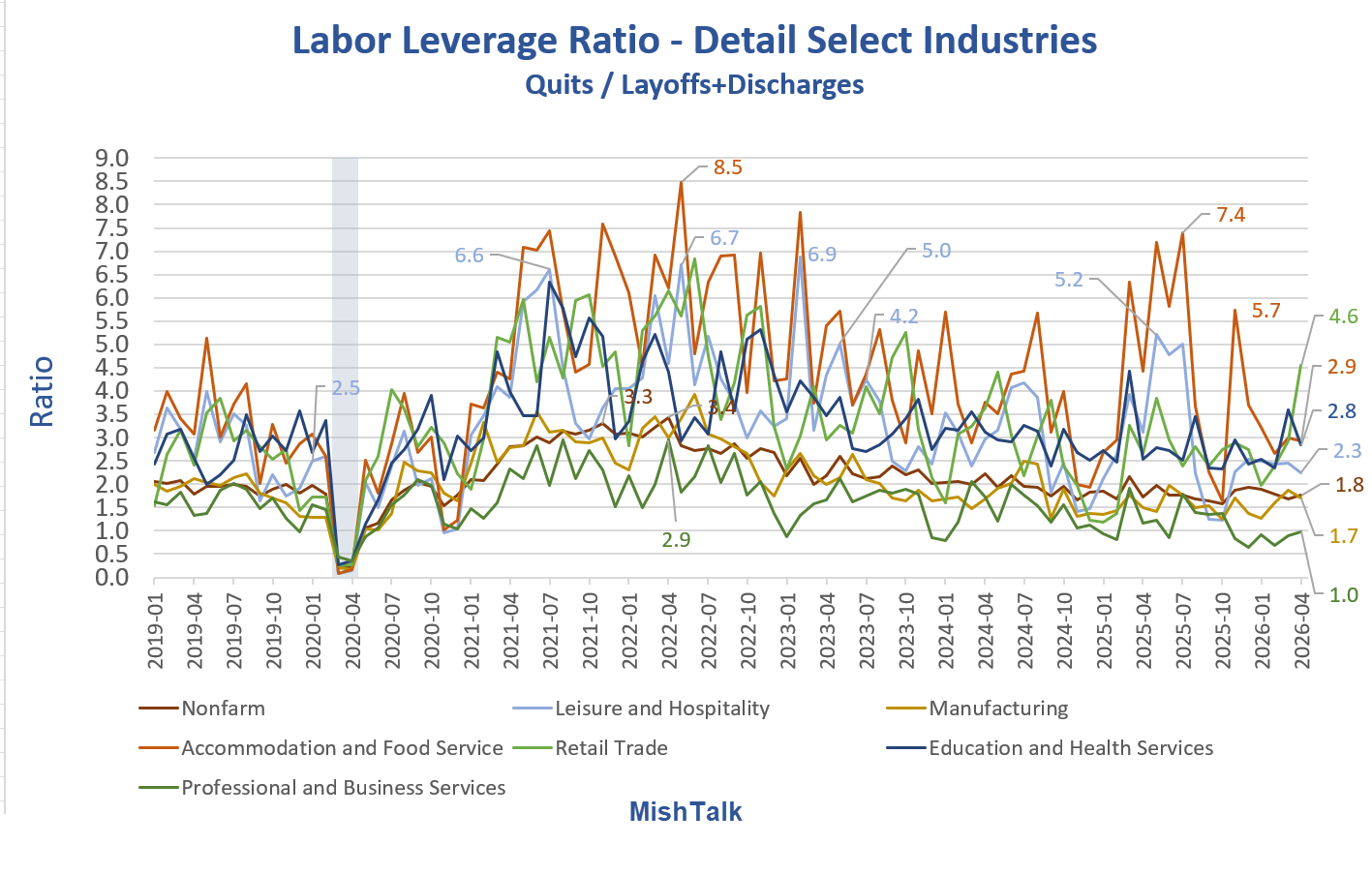
AI is impacting some sectors while wage pressures exist where consumers are most hit.
Labor Leverage Ratio
The Labor Leverage Ratio (LLR) is the number of quits divided by the number of discharges, firings, and layoffs initiated by employers.
The series comes from the BLS Job Openings and Labor Turnover Summary. Unlike openings, quits and layoffs are relatively hard data.
The BLS comments “the quits rate can serve as a measure of workers’ willingness or ability to leave jobs.”
The Labor Leverage Ratio is a refinement to the quits rate.
Labor Leverage Ratios by BLS Category
- Nonfarm: 1.76
- Private: 1.72
- Leisure and Hospitality: 2.25
- Construction: 1.57
- Durable Goods: 1.71
- Manufacturing: 1.69
- Accommodation and Food Service: 2.93
- Retail Trade: 4.55
- Education and Health Services: 2.85
- Professional and Business Services: 0.98
No sector is harder hit than Professional and Business Services. This is the sector AI is hitting the hardest.
The higher the number, the easier it is for workers to quit and find another job, and the harder it is for employers to retain employees.
According to the U.S. Bureau of Labor Statistics (BLS), Leisure and Hospitality is a broad “supersector”. Accommodation and Food Services is a narrower sector that lives inside it.
Rising Wage Pressures
- Leisure and Hospitality
- Accommodation and Food Services
- Retail Trade
- Education and Health Services
Those industries will either raise prices, lose profit margins, lose employees, or some combination of those.
Losing employees is not a great option, so, most businesses will raise prices or suffer from shrinking profit margins.
Raising prices has it own set of issues, mainly falling consumer demand.
Labor Leverage Ratios Select Services and Months

Labor Leverage Ratios generally peaked in May of 2022.
Labor Leverage Ratio – Detail Four Industries

The above chart puts a key spotlight on the jobs AI is killing.
If you lose your job in this sector, your next one may be Leisure and Hospitality.
Meanwhile, there is upward pressure on the price of food, especially eating out, as restaurants need to raise prices to keep up with higher staffing costs.
The same applies to hotels. And airlines are raising prices to accommodate rising jet fuel prices.
All of this is tempered by falling demand and cutting corners by consumers who are cash strapped.
AI Decimates Careers that Were Once a Sure Path to Middle Class
On May 27, 2026, I noted AI Decimates Careers that Were Once a Sure Path to Middle Class
Say goodbye to most customer service jobs.
The labor turnover data confirms the story. Click for more details.
Related Posts
May 26, 2026: Consumer Credit Stress Is Comparable to the Great Recession
Auto delinquencies are at a new record and credit cards are near record high.
May 28, 2026: Inflation Expectations Surge in Two Distinct Consumer Confidence Surveys
57% of consumers say high prices are eroding their personal finances.
May 28, 2026: PCE Inflation Spikes Again, Year-Over-Year Highest Since May 2023
Year-over-year PCE inflation jumped to 3.8 percent. The Fed wants 2.0 percent.






























Where does Semiconductors and Hardware fall ?
fast food is taking a big hit in CA. Can’t serve crap food, raise prices 50% in 4 years and expect people to keep showing up.
I got a freshly made egg and cheese mcmuffin and small coffee for $3 at my local McDonalds this morning. My local one actually drops the price if you don’t want sausage or bacon. Most don’t know that you can ask for a fresh egg mcmuffin and they will actually make one for you from scratch. There’s a bunch of cheat codes for most fast food places they don’t want you to know about.
The hospitality / food sector has had high turnover historically. When a business slows, it cuts hours first. Enough employees respond by looking elsewhere that no layoffs have to take place. The exception is when taxes and stock market sell offs force restaurants to close suddenly.
KUDLOW: How bad is the inflation right?
HASSETT: Right now it’s on a deep, downward dive. And the inflation is really out of control in the blue states. So if you take out New York and California, then the story is radically different. And so there’s really good news even on inflation right now.
Which state is #1 in inflation?
AI Overview
Florida currently holds the number one spot for the highest state-level inflation in the country, tracking an inflation rate of roughly 4%.
USA Today
Because the Bureau of Labor Statistics (BLS) primarily measures inflation at the regional and metropolitan levels, exact state rankings can fluctuate depending on the economic analysis:
USA Today
Florida: Leads many state-specific analyses due to continuous population surges and the subsequent strain on the housing and insurance markets.
USA Today
+1
Virginia: Follows closely behind (hovering around 3.8%), driven by a booming tech hub and increased demand for workers.
USA Today
Inflation is going to be highest in the states with the best economies. I’d expect it to be the biggest states with various tech and financial firms. Those are mostly blue, but Texas and Florida fit in too. The lowest inflation states are going to be the poorest and very red: Alabama, Mississippi, Arkansas, …
Florida has the largest number of social security socialist geezers. They get free money handouts and spend it on the open market while contributing nothing.
Florida has also been the state with the harshest anti-immigrant policies so I guess immigrants weren’t driving up inflation after all.
BB says differently…
The number of open jobs in the U.S. economy jumped to 7.6 million in April while layoffs declined, evidence of how demand for workers has intensified.
At the end of April, there were just over 7.6 million open positions, up from about 6.9 million at the end of March, according to the Labor Department’s monthly report on job openings and labor turnover. This is the largest number of job vacancies in two years.
The manufacturing sector saw openings rise to 474,000, up 24,000 from the previous month and 98,000 higher than a year ago. The monthly increase was entirely in durable goods businesses, as nondurable goods openings remained flat.
Openings in the economically sensitive professional and business services sector rose from 1.047 million to 1.715 million. Openings were down in retail trade and the hospitality and leisure sectors.
The federal government saw job vacancies climb from 78,000 to 95,000. State and local government vacancies rose from 652,000 to 682,000. Openings in healthcare and social assistance climbed from 1.378 million to 1.467.
The quits rate ticked down from 2.2 percent to 2.1 percent, indicating fewer workers voluntarily left their positions in May. A rising quits rate is associated with worker confidence. The rate was flat or declined slightly for most sectors in April.
Enhance or Eliminate? How AI Will Likely Change These Jobs
https://www.library.hbs.edu/working-knowledge/enhance-or-eliminate-how-ai-will-likely-change-these-jobs
Good article. The interactive charts are very interesting. I’m glad I am retired. I do worry about the job market for younger people going forward. The job market is changing rapidly.
Looks like “Dancers” will be relatively unaffected.
Well, they have been using CHATBOTS for Customer Service forever and those encounters make me scream into my Phone: “AGENT PLEASE!” It no longer works.
The least they could do is have the AL sound like Scarlett Johansson.
Try yelling “Fryyyyiiing Tonight!!!!”
Well that’s what anti-immigrant policies will do for you. Throw 10,000 boomers retiring and going on state welfare for money and health and it’s going to be an epic disaster.
And AI may be great for eliminating white collar jobs, it will drive up electric, water, natural gas, and land use for everyone else.
That assumes they get built though: https://www.youtube.com/watch?v=9WcAKWbs_jw
Do worry, Trump & Walrus will find a way to make things even worse.™
There already aren’t enough kids to support social security… and hospitality jobs ain’t gonna bring in enough even if there were more kids.
This is not just a problem for the young.
Yeah it’s a problem for everyone. Does “got exit strategy?” make sense yet or do you need to see more demographic death spiral, dysfunction and collapse before you take heed?
You still haven’t named this magical place that won’t be affected by any of this… and from what I can tell, you still haven’t gone there.
good response. where is this magical place MPO discusses. mish is popular but i don’t see a million folks rushing the gates to this nirvana. remember the scene in “oh brother where art thou” with the nymphs in the stream……….
worked in demographic research in 1980s. most of the predictions are bunk. people change. migrate. build walls, build bridges. pro immigration, anti immigration. fornicate less or more. so many factors. spain had a target region to import spanish speaking young people to help…………there are always plenty of places on globe that are doing just fine. includes parts of usa, too. there is no magic bullet place or time. i also have an exit strategy and have moved all over the continent for fun the past 40 years. i have a few great passports and escape plan if i want to move again. i’m in region in usa now which is very peaceful, with plenty of water and short train ride to the best city in continental usa.
While correct, we must address the situation still. For starters, why is there not a stop date to S/S? 401K type plans work just fine. We need to place an end date on it. Why is there not limits to date? Say ex.Financial limits on who can draw from it. Say ex. Age limits on when you can start drawing from it? It had its time and place, but that’s obviously gone.
Taking money from people who will have made less than you, to prop you up in retirement is ludicrous to begin with…
SS was and is insurance. for living too long and hopefully relieves the need to eat cat food. nothing more. the fact that folks think of it as a retirement plan doesn’t change that fact.
I can’t agree with you on some of this…
– SS was and is insurance. for living too long.
> Let’s consider that “Life Insurance” has been around for centuries. someone reaps the rewards.
– the fact that folks think of it as a retirement plan doesn’t change that fact.
> It does when it literally is the life line for the existence of many. What you made and put into it, was not the point. What cost would be, when and if, you would be needing it, was.
>> I personally know several people on S/S and it’s their only source of income. They were lucky enough to own some assets and smaller things that became valuable over time, but that was thrown into the same survival pot. Mostly those I know are also fortunate to have Family the can and is willing to help them all out. Those without family or none that can help, struggle mightily.
That could possibly turn into nearly ALL without it, or an option and path to saving money or value for when you age. As I pointed out, 401K plans with a small matching % by the Company or whomever pays you as an example that works.
How ignorant to characterize SSI and Medicare as welfare. People have no choice but to pay into the system if they want to work, in my case over 50 years. These are earned benefits with dedicated funding streams, not welfare.
If you wish to conflate entitlements with general revenues than you have to consider the the US taxation system is grossly regressive, as earnings are taxed from the first dollar of wages for SSI and not paid on income over $180,000, nor on capital gains or dividends.
Welfare indeed.