

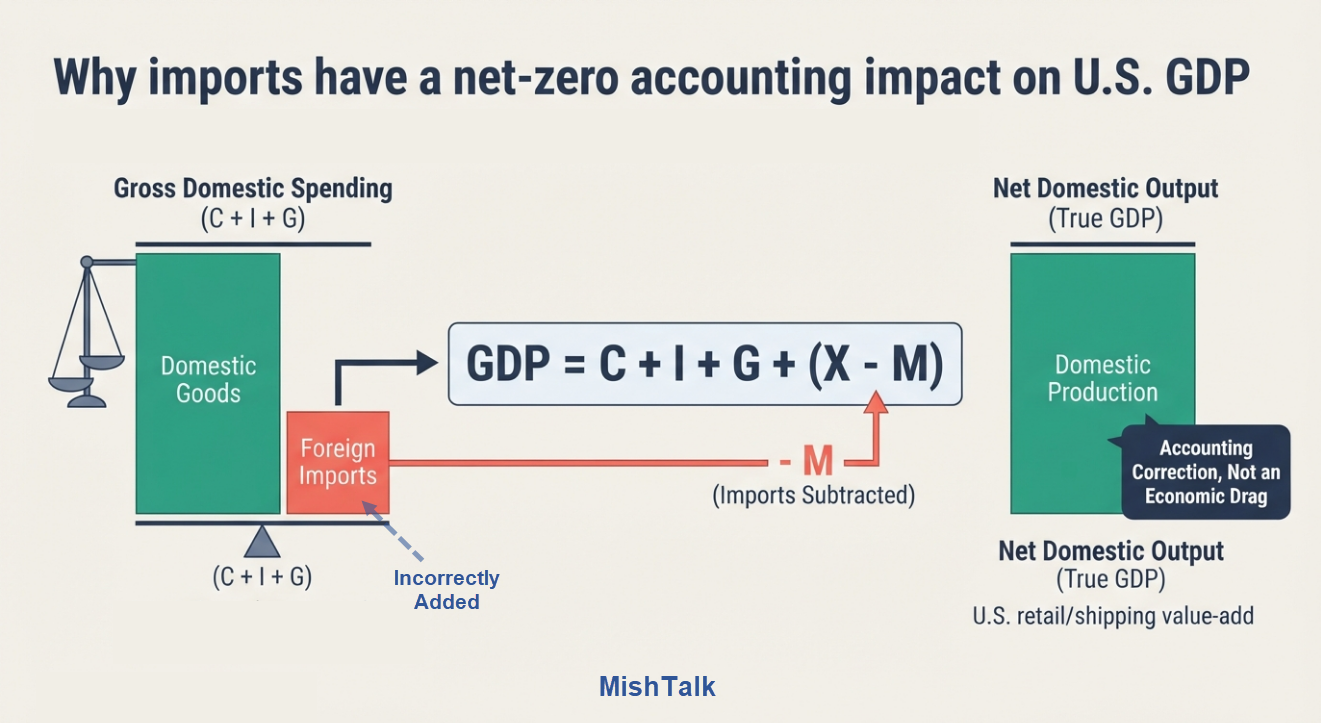
The BEA seems to subtract imports from GDP. It’s an accounting mirage. 
Here’s a paragraph I insert in my GDP posts every quarter.
Imports don’t subtract to GDP. The have no impact on GDP at all. The D in GDP explains why.
The BEA subtracts imports because its initial assumption is that all sales are domestic.
Otherwise the BEA would be trying to figure out things like “What percentage of this hammer from Home Depot is domestic?”
But It’s in the Formula!
Last week a reader told me I was wrong about imports. I explained it was an accounting mirage, and that by definition imports don’t matter to GDP and cannot logically matter by definition.
GDP stands for Gross Domestic Product and imports are not domestic.
Yet, here’s the formula the BEA uses: GDP = C + I + G + X – M
- C: Personal Consumption
- I: Business Investment
- G: Government Spending
- X: Exports
- I: Imports
I have no idea why the formula generally puts paraeneses around X – M, typically (X – M), because that algebraically does nothing and is not needed.
Regardless, imports are seemingly a subtraction. But it’s a bookkeeping adjustment.
For example. If a consumer buys a $30,000 car assembled in the U.S. using $15,000 of imported parts, C rises by $30,000 and M rises by $15,000. The net +15,000 reflects only the domestic production value.
The goal is to count Domestic Product. On a piece-by-piece basis it would be madness (and impossible) to subtract out things like the percentage of a car, chainsaw or bicycle that is an import.
Instead, the BEA subtracts the total estimated value of imports every quarter.
Indirect Impacts
While imports do not subtract from GDP, they influence domestic output through secondary channels:
- Substitution away from domestic goods. If consumers or businesses shift existing dollars from a U.S.-made product to a foreign-made substitute, C stays flat while M rises, lowering domestic production and GDP.
- Intermediate inputs and productivity. Imported raw materials, machinery, and components can lower production costs and expand output for domestic manufacturers and exporters.
- Pro-cyclical demand. Empirically, imports and GDP are positively correlated—imports surge when domestic consumers and businesses are spending aggressively, and fall during recessions.
As neutral as possible, I asked Google’s Gemini AI this simple question.
Mish to Gemini: Do imports have any impact on GDP?
Gemini: Directly, no—imports have a net-zero accounting impact on GDP.
Mish: Totally agree. They cannot by definition, because they are not domestic. The BEA subtracts imports because it erroneously added them in sales data.
Gemini: Exactly right—by definition, GDP measures domestic production, so foreign output cannot belong in the total. Calling it a cleanup of “erroneously added” spending in the source data hits the nail on the head. The BEA doesn’t collect C, I, and G by inspecting whether every item sold at a register or installed in a factory was made in America. It pulls aggregate retail sales, capital expenditure surveys, and government outlays, which lump foreign and domestic goods together. Subtracting M at the end is simply the back-end correction to strip out what shouldn’t have been in the equation in the first place.
If you still believe imports subtract from GDP you are wrong.
Related Posts
November 25, 2026: Real GDP Growth Revised Up to 4.3 Percent in the Third Quarter
Private domestic sales suggest economic overheating.
November 27, 2026: The Goods Balance of Trade Is Negative 149.5 Billion, Approaching Largest Ever
The Econoday consensus expected an improvement. The result was $14 billion worse.
November 26, 2026: How Much Did AI Spending Contribute to Third-Quarter 2026 GDP?
The charts below show the AI impact for every quarter starting 2025 Q1.






























Is there a wave of these in the near future?
https://www.fdic.gov/news/press-releases/2026/first-citizens-bank-trust-company-raleigh-north-carolina-assumes
no
Starts as a trickle then a flood. The loan leverage is over 10x of the GFC in 2008 so it could be 10x worse. And just like 2008, no one will go to jail and people will walk away with billions. Suckers and losers will pay pick up the tab.
https://www.fdic.gov/resources/resolutions/bank-failures/in-brief/index.html
It’s dejavu all over again.
Take a deep breath. You are too emotional. I invest in brokerage CD’s and I am concerned about situations like this all the time. The commercial real estate problem steming from COVID is still alive and well.
First, the $1.8 billion in losses will be assumed by FDIC insurance thru fees charged to member banks.
While Pedcor Management Corporation (which controlled the bank) seems to be a slumlord masked as a bank it probably started with good intentions to provide affordable housing to low income people. Without knowing the details resulting from COVID where renters did not have to pay rent for over a year it is hard to tell what lead up to the current situation. Did tenants ever make up the deferred rent? How did the loss of cash flow impact maintenance, etc.
Whether it’s bank investments in rental properties, office buildings or retail stores, there will be more problems. There are dozens of banks with investments that equal up to 400 percent of their assets. Hopefully the future problems will be controlled as well as this case.
So, following Mish’s example, if one imported $50,000 of car parts, pre-assembled, and sold them for $50,000 as a “car”, then GDP goes up by $50,000? How incredible is that… If one wishes to measure “goods and services produced within US borders”, how can one not include net exports..i.e. (X-M)? When relying on Gemini, or any other “AI”, for one’s “intelligence”, how one poses the question is important. I asked Gemini a simple question – “why does the the BEA include net exports in GDP?” Gemini responded, confirming the obvious:
The Bureau of Economic Analysis (BEA) includes net exports in Gross Domestic Product (GDP) so that GDP measures only goods and services produced within U.S. borders, rather than total domestic spending. [1, 2, 3]
In the expenditure approach to GDP (GDP = C + I + G + (X – M)), net exports (X – M) act as an accounting adjustment: [1, 2]
For example, if a household buys a $30,000 imported car, it adds $30,000 to consumption (C) and subtracts $30,000 in imports (M), resulting in a net $0 impact on GDP because the car was built abroad. [1, 2]
Seems pretty “logical”.
If one imports a $50,000 car GDP goes up by $0
Net exports (X-M) has a direct impact on GDP, and M has a massive impact on the term. just as X does. This is why (X-M) is put in brackets. I would also posit that global GDP growth influences X and national GDP growth influences M. How exactly would depend on their relative elasticities.