

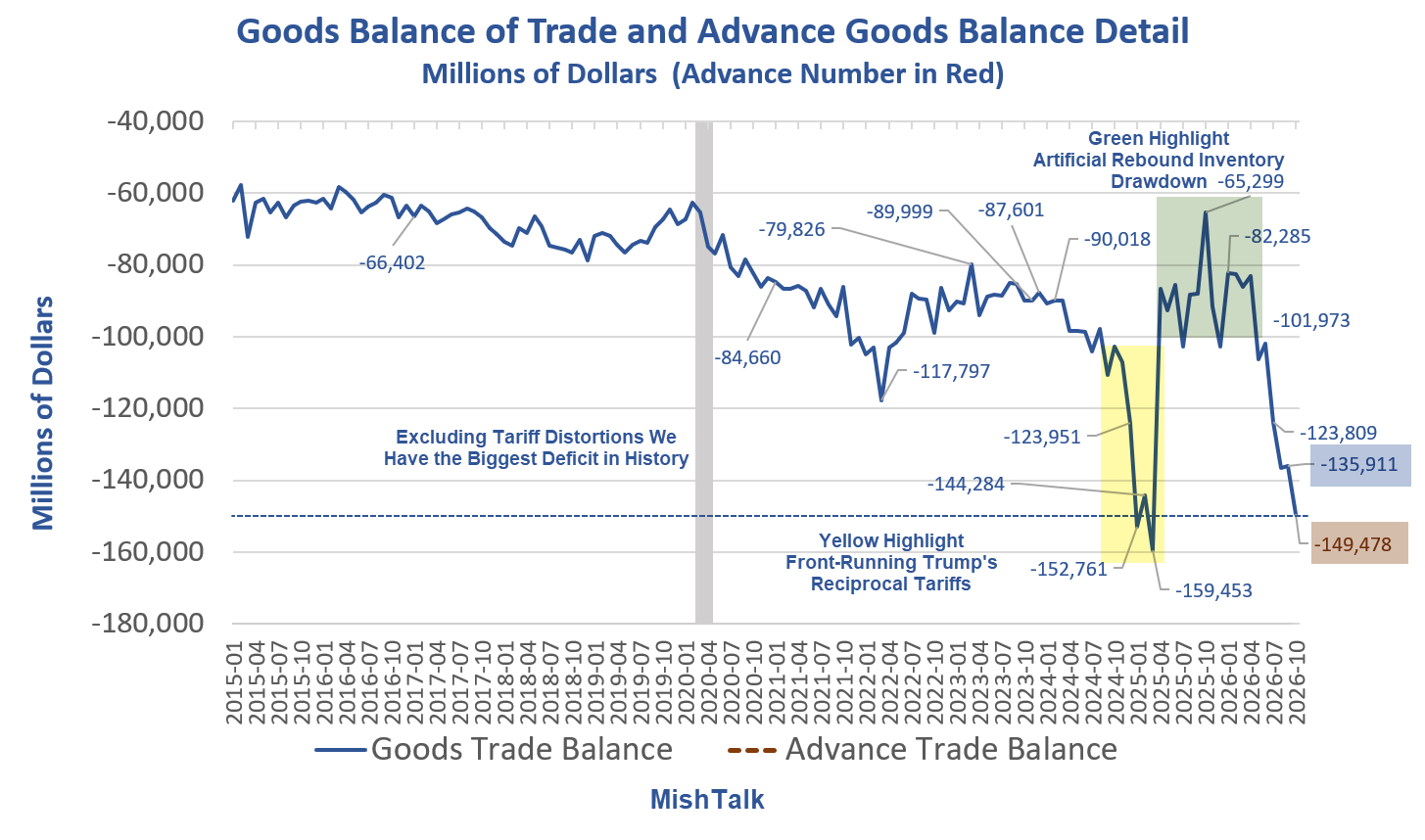
The Econoday consensus expected an improvement. The result was $14 billion worse.
The Census Bureau Advance Indicators for October show the deficit increased by $14.4 billion.
Advance Goods Data
- The international trade deficit was $149.5 billion in October, up $14.4 billion from $135.1 billion in September.
- Exports of goods for October were $215.8 billion, $6.7 billion more than September exports.
- Imports of goods for October were $365.3 billion, $21.1 billion more than September imports.
I see no reason to compare advance trade data to previous advance numbers now known to be wrong.
So, my chart shows goods from the latest full release (September) plus the advance trade data for October.
Goods Exports and Imports October 2026

October Advance vs September Actuals
- Exports: 210,968 to 215,819 Up $4.85 billion
- Imports: 346,879 to 365,297 Up $18.42 billion
- Net: $4.85 exports minus 18.42 imports = -13.57 billion
If the advance trade numbers are accurate, the next full release will show the goods deficit increasing by ~13.57 billion.
This is a better way of estimating things vs comparing advance numbers to previous advance numbers now revised away with final results.
Biggest Trade Deficit In History
Excluding the enormous trade distortions caused by Trump’s tariffs, we have the largest trade deficit in history.
First, there was a surge of front-running imports and a peak deficit of 159 billion (yellow highlight). Then we had an artificial improvement (green highlight) accompanied by inventory drawdowns.
Now things are back to where they would be without the distortions.
Q: Where is that?
A: Record deficits despite the now obviously ridiculous idea that tariffs would change anything.
Trump also drove Canada closer to China, losing the best trade partner in the process. Meanwhile, businesses suffer from higher prices and the trade deficit is still going up.
Meanwhile, please note that Trump is doubling down with Section 301 tariffs.
No exact effective date has been set yet, and nothing will take effect before late January 2027.
Question of the Day
Q: How distorted is the advance trade data today?
A: Excellent question. We may already be seeing more tariff front running in advance of the new Section 301 tariffs. Discussion below.
Section 301 Procedural Timeline
- Public comment deadline. Written comments on the proposed rates and product exemptions are due January 5, 2027.
- U.S.-China trade truce expiration. The current bilateral trade truce (the Busan Agreement) is set to expire on January 10, 2027, which directly affects whether China faces the proposed 20% baseline rate or the 40% fallback rate.
- Public hearings. USTR will hold public hearings starting January 25, 2027.
- Final determination and implementation. Any final tariff rates, product carve-outs, and effective dates will be issued only after USTR reviews the January comments and hearing testimony.
Section 301 Key Context
- Targeted economies. The 14 covered economies are Bangladesh, Cambodia, China, the European Union, India, Indonesia, Japan, Korea, Malaysia, Singapore, Switzerland, Taiwan, Thailand, and Vietnam. (Determinations for Mexico and Norway remain pending.)
- How they interact with July 2026 duties. For economies other than China, the proposed rates are designed to apply net of the 10% to 12.5% Section 301 forced-labor tariffs imposed in July 2026—meaning importers would generally pay the higher of the two rates rather than stacking both.
- For China, the new rates would stack on top of the 2018 Section 301 tariffs.
So we may be in store for another huge wave of tariff front-running, perhaps already underway.
For discussion of the new Section 301 tariffs, please see Trump Doubles Down on Tariff Stupidity, Leans Nothing from Election
My base case was Trump would act foolishly after the election, already proven.
For import discussion related to AI spending, please see How Much Did AI Spending Contribute to Third-Quarter 2026 GDP?
The charts below show the AI impact for every quarter starting 2025 Q1.
It’s possible, in theory, for the surge in the trade deficit to related to investment gold which the BEA would subtract out as irrelevant. We do not have gold imports and exports breakouts in the advance report.
However, there is little evidence this is gold related. The main import driver was capital goods imports, which rose ~8.5% to about $171.4 billion. That increase accounted for roughly two-thirds of the total import rise and is widely linked to AI infrastructure spending. Capital goods imports are also up ~80% year-over-year.
We do not know how much of that surge was tariff front running.
Related Posts
February 24, 2026: Fact Check on Trump’s Claim “Canada Ripped Us Off”. What’s the Real Story?
In a rambling Speech, Trump signals out Canada.
October 27, 2026: The US Badly Needs Cheap Canadian Aluminum but Trump Says No
Due to Trump’s 50% Tariff on Canadian aluminum, the US pays the highest global price.
November 21, 2026: My Base Case Right Now Is Democrats Will Win 60 Senate Seats in 2028
It’s a “savagely brutal map” for Republicans in 2028. Meanwhile, Trump is Trump.
My Six-Point Base Case
- Trump will continue his economically illiterate tarffs.
- Trump will continue his racist and economically illiterate deportations.
- Stephen Miller will continue to run policy.
- Inflation will not be under control.
- The Fed will hike rates and cause a recession.
- Trump will get the blame.
In short, I expect Trump will be Trump.
Also, we will be dealing with an AI bubble that is now bursting coupled with sustained inflation due to spending out of control (or a nasty recession that kills demand and the stock market).
Addendum
I revised this post to include, but mostly rule out, the possibility of a large impact due to gold imports and exports.






























Trump saying he’d fix other nations “ripping us off on trade” and the results of his efforts reminds me of when he bragged how easily he would halve liquid fuel prices, then doubled them instead.;
Those tariffs certainly seem to be working.
True, Inflation is picking up.
Was Trump the founder of the Queens KKK chapter?
The problem in US is senile presidents.
However they are brilliant in younger age the sharpness is decreasing with decades.
80 something should be in old age home but not in Commander-In-Chief position.
They are obsessed with their obsolete ideas and nobody can change.
More “good news” as a result of taconomics.
What did say about borrowing, refinancing and winos?